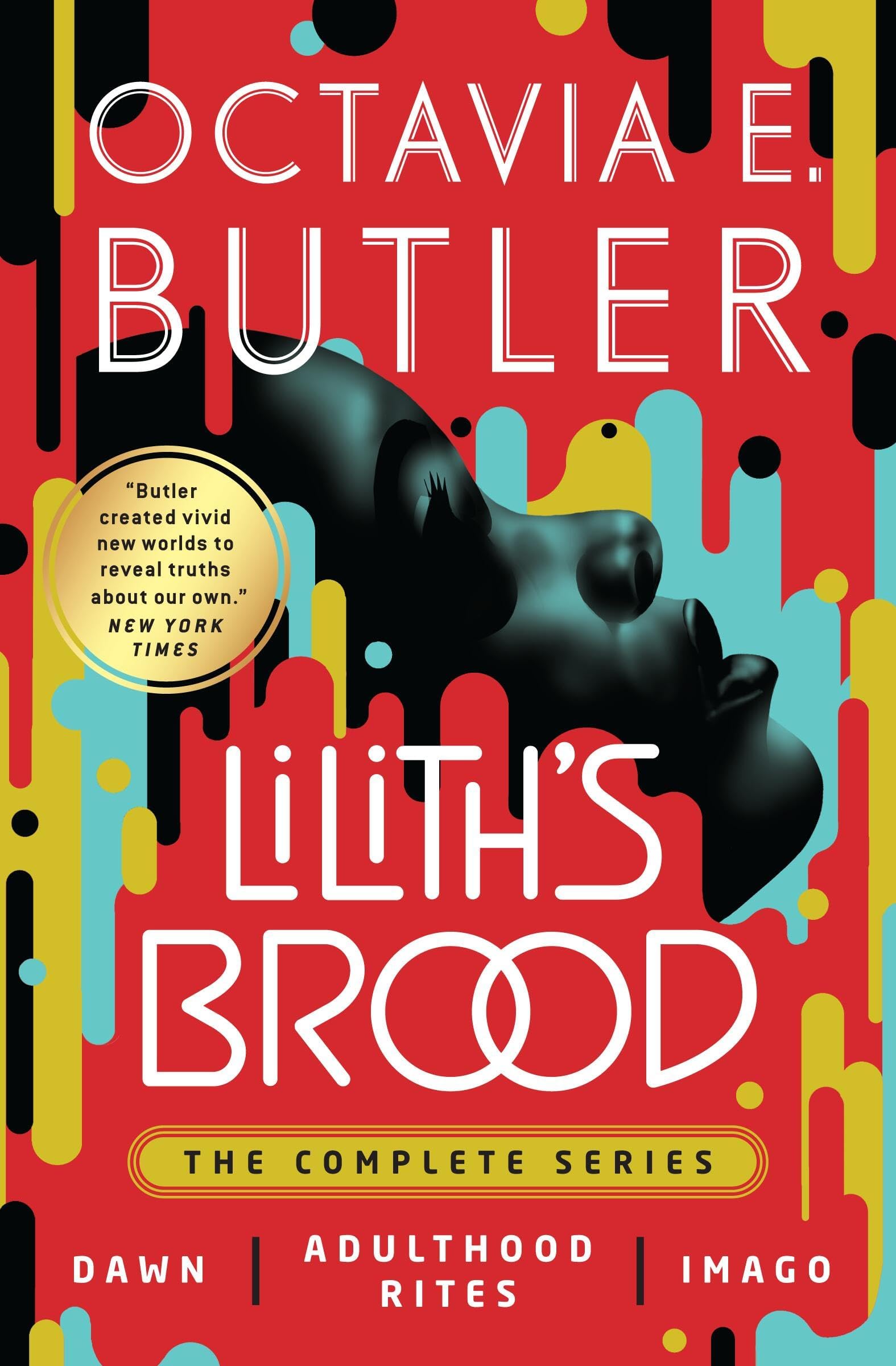
Lilith's Brood
Product ID: 11041131
Desertcart purchases this item on your behalf and handles shipping, customs, and support to Thailand.
From the Hugo and Nebula award-winning author of Parable of the Sower , an epic, sensual, and disturbing afrofuturistic trilogy of human transformation—presented for the first time in a single volume. Lilith Iyapo is in the Andes, mourning the death of her family, when war destroys Earth. Centuries later, she is resurrected by miraculously powerful unearthly beings called the Oankali. Driven by an irresistible need to heal others, the Oankali are rescuing our dying planet by merging genetically with mankind. But Lilith and all humanity must now share the world with uncanny, unimaginably alien creatures: their own children. This is their story ... Includes an introduction by Joan Slonczewski, Ph.D. Review: Outstanding - This amazing, original, deeply thoughtful trilogy is one of the best science fiction stories I've ever read, and I've read hundreds (thousands, if you count short stories, collections and anthologies, of which I own or have read hundreds). I enjoy a wide variety of book genres (with the exception of romances, no offence, romance fans), and within sci-fi I like a wide spectrum, from hard science sci-fi to soft, military to social commentary, robotic, cross-genre and operatic sci-fi. Lilith's Brood follows the legacy of a female human who survives an apocalypse, and finds her existence is no longer in her control. Her life depends on, and is saved by, an alien species who manipulate human survivors so that, in some future day, they can repopulate and use the earth again. To be honest, at one point in the first book, I got bogged down and set it aside for awhile. When I picked it up again, I had to reread and skim in order to refresh my mind, but once I re-engaged I found myself completely captivated, and quickly enjoyed the rest of the trilogy. Ms. Butler writes so beautifully. I was impressed by how she created an alien race that was so strange and original but so thoroughly realized, full of depth and character while still remaining "alien". Over the three books, there is plenty of action and adventure even as a paleontology of the new human/alien race is established. I fell in love with many of the main characters, and cared about what happened to them. For me, this is a sign of an exceptional book. For sci-fi fans who haven't tried Octavia Butler, I recommend Lilith's Brood as one of her best works. (I haven't read quite everything by her, so that might change). As a black woman writing at a time and in a genre dominated by white male writers, she shines as a unique and talented author. She doesn't ignore issues of race in her work, but it never dominates or overpowers the tapestry of her science fiction. Review: Fantastic trilogy in beautiful omnibus - Butler's Xenogenesis trilogy has been collected and released in this new omnibus edition as "Lilith's Brood" (named after the matriarch of the new race). The three books, "Dawn," "Adulthood Rites," and "Imago," are so intertwined they read like one book anyway, and the larger size is better for more comfortable reading. Because, you'll be unable to put the book down once you start! Butler writes compelling science fiction rooted in social values and examination of modern society. Though she features women of color as her protagonists, you never feel as though this is written just for people of color. The diversity is welcome, and realistic. Her writing is complex, fully fleshed out and engrossing. I cared about the characters, was sometimes disturbed by the story, and completely sucked into her world. I have enjoyed many of her books, but these are still my favorite. Mankind brought itself to the edge of extinction with nuclear holocaust. It is at this moment that the Oankali, an alien race, decide to make contact to "help" us. When Lilith Iyapo is "awakened," she finds that she has been chosen to revive her fellow humans in small groups & train them to survive in the wilderness that earth has become. But the aliens cannot help humanity without altering it forever. Our salvation may also be our utter destruction as a species. What does it truly mean to be human? Though this is science fiction, it reaches a much broader audience. My mother, who does not read scifi at all, enjoyed the trilogy (in fact, all of Butler's work) as much as I did. I cannot recommend this series, and this author, enough.


| Best Sellers Rank | #36,098 in Books ( See Top 100 in Books ) #31 in Black & African American Science Fiction (Books) #614 in Dystopian Fiction (Books) #751 in Post-Apocalyptic Science Fiction (Books) |
| Customer Reviews | 4.7 out of 5 stars 4,588 Reviews |
N**N
Outstanding
This amazing, original, deeply thoughtful trilogy is one of the best science fiction stories I've ever read, and I've read hundreds (thousands, if you count short stories, collections and anthologies, of which I own or have read hundreds). I enjoy a wide variety of book genres (with the exception of romances, no offence, romance fans), and within sci-fi I like a wide spectrum, from hard science sci-fi to soft, military to social commentary, robotic, cross-genre and operatic sci-fi. Lilith's Brood follows the legacy of a female human who survives an apocalypse, and finds her existence is no longer in her control. Her life depends on, and is saved by, an alien species who manipulate human survivors so that, in some future day, they can repopulate and use the earth again. To be honest, at one point in the first book, I got bogged down and set it aside for awhile. When I picked it up again, I had to reread and skim in order to refresh my mind, but once I re-engaged I found myself completely captivated, and quickly enjoyed the rest of the trilogy. Ms. Butler writes so beautifully. I was impressed by how she created an alien race that was so strange and original but so thoroughly realized, full of depth and character while still remaining "alien". Over the three books, there is plenty of action and adventure even as a paleontology of the new human/alien race is established. I fell in love with many of the main characters, and cared about what happened to them. For me, this is a sign of an exceptional book. For sci-fi fans who haven't tried Octavia Butler, I recommend Lilith's Brood as one of her best works. (I haven't read quite everything by her, so that might change). As a black woman writing at a time and in a genre dominated by white male writers, she shines as a unique and talented author. She doesn't ignore issues of race in her work, but it never dominates or overpowers the tapestry of her science fiction.
J**D
Fantastic trilogy in beautiful omnibus
Butler's Xenogenesis trilogy has been collected and released in this new omnibus edition as "Lilith's Brood" (named after the matriarch of the new race). The three books, "Dawn," "Adulthood Rites," and "Imago," are so intertwined they read like one book anyway, and the larger size is better for more comfortable reading. Because, you'll be unable to put the book down once you start! Butler writes compelling science fiction rooted in social values and examination of modern society. Though she features women of color as her protagonists, you never feel as though this is written just for people of color. The diversity is welcome, and realistic. Her writing is complex, fully fleshed out and engrossing. I cared about the characters, was sometimes disturbed by the story, and completely sucked into her world. I have enjoyed many of her books, but these are still my favorite. Mankind brought itself to the edge of extinction with nuclear holocaust. It is at this moment that the Oankali, an alien race, decide to make contact to "help" us. When Lilith Iyapo is "awakened," she finds that she has been chosen to revive her fellow humans in small groups & train them to survive in the wilderness that earth has become. But the aliens cannot help humanity without altering it forever. Our salvation may also be our utter destruction as a species. What does it truly mean to be human? Though this is science fiction, it reaches a much broader audience. My mother, who does not read scifi at all, enjoyed the trilogy (in fact, all of Butler's work) as much as I did. I cannot recommend this series, and this author, enough.
J**0
A Good Read
I've wanted to write a review of this book for quite some time now and am finally glad that I have an opportunity to do so. Written by the acclaimed Science Fiction author - and my very favorite one - Lilith's Brood was a treat! Octavia Butler has a beautiful writing style. Her prose is so brilliant and subtle that you don't realize that she's giving very important details to both the characters and the scenery as you go along. The book, Lilith's Brood, is actually a trilogy of novels: "Dawn," "Adulthood Rites," and "Imago." The story begins with Lilith, a new Eve in a way, the mother of "new" humankind. The twist is that aliens have saved the world from total destruction and from extinction since war has all but killed our species. Too, the destruction has left all man infertile. The only way that he can procreate is by mating with fertile aliens who produce half-human, half-alien super humans. Themes were important but very slight. In other words, Octavia didn't push her own views on people too much, although there were very clear ideals supported, like bisexuality, loyalty, and self-sacrifice. Often as I read the series, I asked myself if I would be willing to give up some measure of my own humanity to live longer, have healthier children, or a stronger, more durable physique. Some of her ideals were quite repulsive, however. I have read several of Butler's novels and have found that a common theme is incest. For example, in the last novel of Lilith's Brood, "Imago," there were people who were special (not too much of a spoiler here :)), and they were all related but having sex with their brother, their mother, their father, in order to have children. This theme is quite sickening and almost made me stop reading the book altogether when I first read of it. I recall too that the author tried to make her reader less repulsed by the idea by stating that in Biblical times families practiced incest. In every novel that I've read of Octavia's, and even in every short story anthology, she always mentions incest in an `acceptable' way or at least in a way that she tries to paint as acceptable. That is beginning to be more and more of a turnoff for me when it comes to reading her books. Other than that, it was an amazing read and I am now on the second group of novels by Octavia Butler called Seed to Harvest. When I complete this one, I'll be writing a review about it too. Good reading everyone!!!
J**N
Octavia Butler is the GOAT of Afrofuturism
I’ve read these stories before, I bought this collection because I’d previously either listened by audiobook or borrowed from the library. This collection includes all three books in the series. Nothing particularly exceptional about this edition itself but it is very convenient for those who like to binge read. As for the story itself, it’s hard to capture it in a short review. The Lillith’s Brood series tells the story of Lillith Iyapo who wakes up in a random, spartan, and seemingly clinical room after an apocalyptic war on Earth. Lillith soon discovers that her rescuers/kidnappers/imprisoners are actually aliens and she must learn how to live with them in order to preserve herself and the human species. She has been selected as one of the first humans to return to the rehabilitated Earth and rejuvenate the species from its near death experience, but of course there’s a catch — the Earth is quite different from what it was when last she lived there, and the Oankali — her alien captors — don’t intend to let humans mess things up again. This series brings up all kinds of philosophical questions about the meaning of life and what makes us human, our relationship to the planet we live in, to each other, to the creatures both on our planet and off of it, and what makes life worth living. You’ve never read anything like it — I honestly can’t believe there’s never been a film. If you like an intellectually provocative and incredibly creative sci-if story, don’t wait. Treat yo’ self.
R**I
Great SCIFI, original and extremely well written
I read a review of this writer--unknown to me--in a magazine and decided to go for it. I enjoyed Philip K Dick, Herbert, Asimov, Heinlein as well as Jules Verne in my younger days, but this trilogy is very very good: not space opera, but thoughtful postapocalyptic fiction, written with great sensibility and style--I would describe this as literature, really. This original fiction --human-curious aliens anxious to correct humans' errant ways, I won't say more, spoiler alert--foregrounds a human narrator who questions her necessary collaboration with the aliens. And not all humans--the survivors--agree with her choices. A GREAT read, and I plan to order a few more of Octavia Butler's books in the coming months. A great discovery as far as I am concerned!!!
D**N
An intriguing and interesting tale of life after the end of the world.
I am into the third of the three books, and I absolutely love this series. The characters are explored deeply, especially their interactions with one another. Typically when I read, it is at night when I am unwinding for bed, and if I am late, I skip it. I cannot skip a night with this book. Even if it is after midnight, I have to read at least one chapter. The concepts presented are very interesting, and I find myself wanting to read a prequel to find out more history of the Oonkali, but I don't know how that would be presented without a human perspective. The way the story starts draws you in, and the method that the Oonkali use to guide humans is very creative. Humans are allowed to choose, but at the same time with their guidance, the aliens are pretty confident in what those choices will be. If you enjoy science fiction about an interaction of groups, this is a book for you. If you like rocketeers blasting each other's space ships into oblivion, then maybe you should look elsewhere.
M**P
A book I will never forget
I bought this in June of 2016, devoured it, immediately re-read it, and have read it a couple more times since then. When I read it, I have the experience of living in its universe. Each time I get something new out of it, or make another connection between this book and our world. Parts of this story mirror the slave experience, and part of it mirrors the experience of Native Americans. It always feels profound, because Octavia Butler never draws these connections herself; she leaves it to the reader to find meaning. Her writing is clean and precise, and she never, ever lectures. As many other reviewers have said, this book asks some difficult questions and leaves it to the reader to provide the answers. How is consent affected by a being who really CAN read a human's physical signals like they're reading a book? Why is appearance so important to humans that we will react with terror to something that is "other," or be willing to mutilate healthy children to make appearance more conventional? At what point do we cease being human at all? The science fiction (at the time the book was written) largely involves genetic manipulation. When the first baby with three biological parents was born this year, my first thought was "Wow! Just like the Oankali (without the awesome ooloi sex). Octavia Butler, as always, seems so prescient. This book gets my highest recommendation.
T**2
Good interesting read
I thought the trilogy was well written and very imaginative. With each book, the main character changed so it was not hard but kind of irritating to have to start a book within a trilogy and try to find out who the main character is and how they relate to the main character of the previous book, The second and third book both ended with me having questions and wanting to know more. The third book did not answer the questions I was left with from the second book. The third book left me with the most questions because things that happened in the third book happened much quicker than they occurred in the 1st book. It took much longer for humans to trust any alien form but in the 3rd book it was accomplished in hours. All in all it was an interesting read but I felt in the third book everything was rush and things that should have been explained didn't get explained.
R**N
Wonderful!
I can’t imagine how I missed this when it was first published, but I’m almost glad I did, because I get to read it now when I’m older and more able to grasp the powerful themes In her story. Mind-bending extrapolation of what it would be like for humans to meet a truly alien race. Wonderful read.
K**A
Uma jornada
A leitura dessa série de livros nos leva por uma jornada através de Lilith e seus descendentes em contato com uma espécie alienígena que salvou a raça humana da extinção completa. Porém o custo dessa salvação pode ser mais alto do que muitos estão dispostos a pagar.
D**A
Amazing!!
This collection is fabolous....i reallly love the version all in one! The price is very very good, iI suggest it to all
S**Z
Enjoy
What it makes one to another different? There's really no way to understand each other? There is always hope, discover your own questions on these books.
S**.
Still wonderful, after all this time
I have not read these since I was a teenager, back when they were released ("Lilith's Brood, formerly-known as the Xenogenesis trilogy, refers to a collection of three novels"). I cannot say how wonderful these were to me then, and I am surprised that now that I have re-read them in middle age (all 3 novels in 4 days! yes, they are still un-put-downable) how much these stories had become a part of me, a part of my imagination and how I parsed the world and fiction. There are a few things that I noticed now as an adult that I had not noticed when young (no longer being a "subadult" myself, I get things more as a fully fledged grown up would, things that didn't overly interest me when young -- which is good. The novels are deep and textured). And there are a couple of historical tidbits in the first novel that momentarily make you realise what century this was written in (i.e., a Russia vs USA, cold war reference) but they are not integral to the storylines and they slip by very quickly. These novels are as easily read now, as a reflection on the human condition, as they were back then. They have not aged in that way and don't read like 'historical and good for you literature' but like great contemporary, engaging literature that you can't put down until you finish and when you finish you want more. I am so happy I read them when I was young. I am thrilled that I read them again now. And I cannot wait until my own children are old enough to read them.
Trustpilot
1 month ago
2 weeks ago