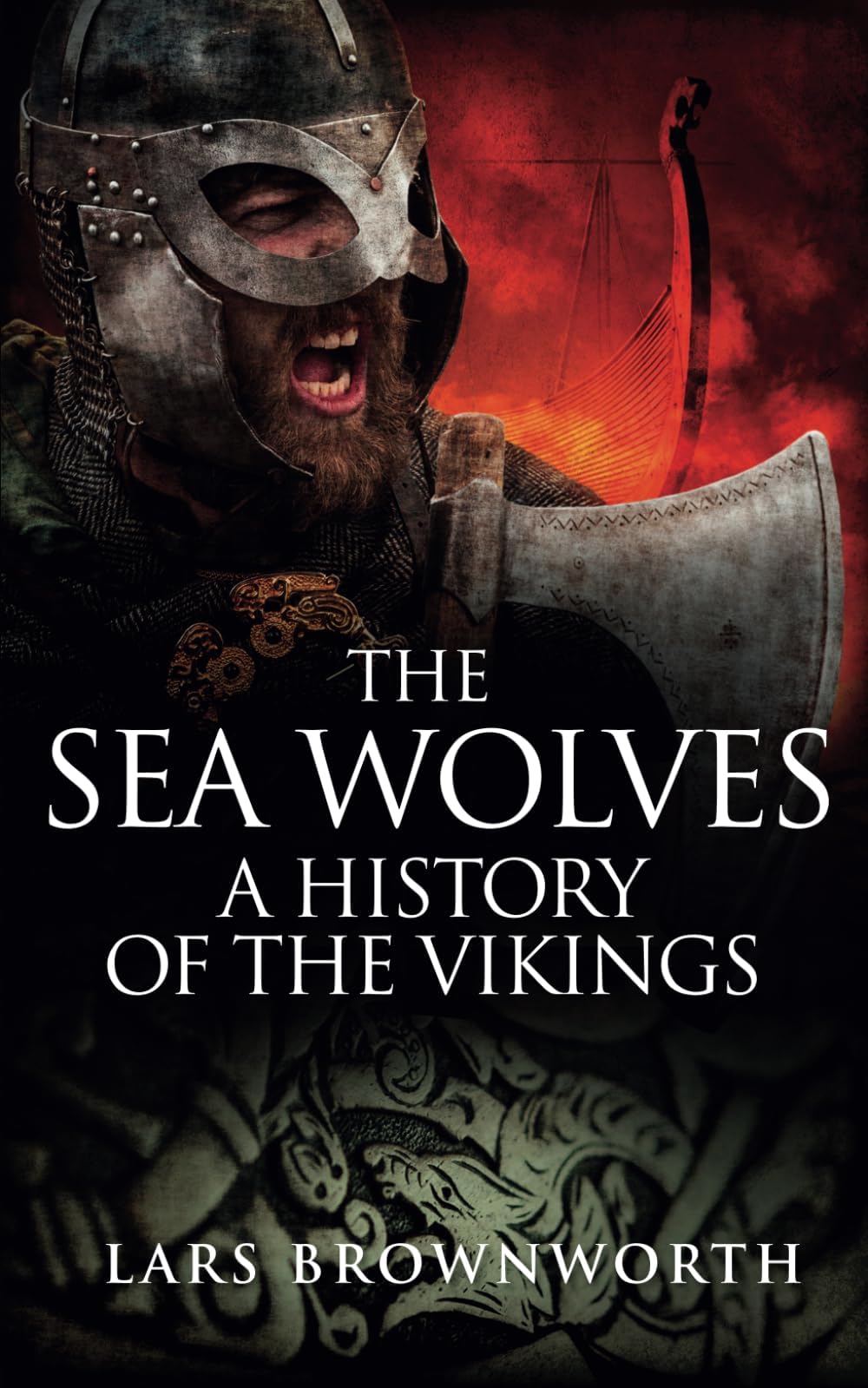
The Sea Wolves: A History of the Vikings
Product ID: 11348513
Buy anything from 5,000+ international stores. One checkout price. No surprise fees. Join 2M+ shoppers on Desertcart.
Desertcart purchases this item on your behalf and handles shipping, customs, and support to Thailand.
In AD 793 Norse warriors struck the English isle of Lindisfarne and laid waste to it. Wave after wave of Norse ‘sea-wolves’ followed in search of plunder, land, or a glorious death in battle. Much of the British Isles fell before their swords, and the continental capitals of Paris and Aachen were sacked in turn. Turning east, they swept down the uncharted rivers of central Europe, captured Kiev and clashed with mighty Constantinople, the capital of the Byzantine Empire. But there is more to the Viking story than brute force. They were makers of law - the term itself comes from an Old Norse word - and they introduced a novel form of trial by jury to England. They were also sophisticated merchants and explorers who settled Iceland, founded Dublin, and established a trading network that stretched from Baghdad to the coast of North America. In The Sea Wolves , Lars Brownworth brings to life this extraordinary Norse world of epic poets, heroes, and travellers through the stories of the great Viking figures. Among others, Leif the Lucky who discovered a new world, Ragnar Lodbrok the scourge of France, Eric Bloodaxe who ruled in York, and the crafty Harald Hardrada illuminate the saga of the Viking age - a time which “has passed away, and grown dark under the cover of night”. Review: An excellent survey of the rise of the Viking warrior age. Read this. - Well outlined, well written, fast moving account of one of the most amazing few centuries of Northern Europe that came upon the Middle Ages suddenly and without warning. This people group changed the world as we know it. Lars includes sufficient anecdotal evidence to show how these warriors were the barbaric version of the Navy Seals of their day in terms of technology, adaptability, small and large group war fighting tactics, and physical size and prowess. No Geneva Convention within these pages. Brace yourself. He traces them from raiders to conquerors to explorers to traders over time and around the Arctic Circle. Most history gives just a little mention of these Arctic pillagers, perhaps due to their illiteracy. For example, Philip Schaff's 8 volume epic History of the Christian Church gives these Scandinavians a scant 20 or so pages, but does allude to the uncountable number of martyrs that gave their lives to convert these unfettered warriors. Some of the individual stories of their 'conversions' in Sea Wolves are memorable and tinged with ironic twists humor. Well written. Review: Rules of Grammar & Punctuation not Optional - An extremely informative, very readable, and wide-ranging work. While the author does provide a short bibliography, it is unfortunate that he chose not to include an index for a cast of, seemingly, hundreds. The enjoyment in reading this work, however, is sometimes interrupted by mistakes in grammar and semantics, which could have been easily detected by careful proofreading: “…the sobriquet by which his [he’s] most well known….” “The Anglican king Aella of Northumbria, who’s [whose] lands had been a favorite target….” “Captured enemies were routinely blinded, maimed, tortured, or hung [sic].” The author should know that unlike pictures that are hung, persons are hanged—a mistake he makes repeatedly. Comprehension would have been aided by the use of hyphens, e.g. five year reign, coin based, gold encrusted. Errors in apostrophes are bothersome, e.g. “The Saxon’s… now moved in….” “The Viking’s mobility had been the key to their success….” “The closest the Byzantine’s got to explaining it was….” Grammar mistakes are numerous: “If neither of those two options were [sic] available….” “…weapons which he forbid [sic] any Norseman to sell….” “… six women who [sic] the men refused to kill….” “… a nephew who [sic] he had expelled for treason.” The author is inconsistent in his use of who and whom, on at least one occasion (though not here) correctly choosing whom. The above are examples of carelessness or ignorance (hung vs. hanged). A more serious mistake is that of the dangling participle, which here makes one wonder just who was doing what to whom: “On the return trip to Kiev, while attempting to negotiate one of the dangerous rapids along the Dnieper, a group of barbarians ambushed Sviatoslav.” The barbarians must have had their hands full, negotiating rapids and ambushing Sviatoslav at the same time. Or is this indeed what the author meant to convey? Context says “no”, while form indicates “yes”. The author’s mistakes momentarily distract one’s attention, and they do detract somewhat from the overall impression of this otherwise scholarly work. Consequently and regrettably it deserves a rating of no higher than a 4.
| Best Sellers Rank | #51,367 in Books ( See Top 100 in Books ) #5 in Scandinavian History #40 in Expeditions & Discoveries World History (Books) |
| Customer Reviews | 4.4 out of 5 stars 3,441 Reviews |
S**E
An excellent survey of the rise of the Viking warrior age. Read this.
Well outlined, well written, fast moving account of one of the most amazing few centuries of Northern Europe that came upon the Middle Ages suddenly and without warning. This people group changed the world as we know it. Lars includes sufficient anecdotal evidence to show how these warriors were the barbaric version of the Navy Seals of their day in terms of technology, adaptability, small and large group war fighting tactics, and physical size and prowess. No Geneva Convention within these pages. Brace yourself. He traces them from raiders to conquerors to explorers to traders over time and around the Arctic Circle. Most history gives just a little mention of these Arctic pillagers, perhaps due to their illiteracy. For example, Philip Schaff's 8 volume epic History of the Christian Church gives these Scandinavians a scant 20 or so pages, but does allude to the uncountable number of martyrs that gave their lives to convert these unfettered warriors. Some of the individual stories of their 'conversions' in Sea Wolves are memorable and tinged with ironic twists humor. Well written.
A**H
Rules of Grammar & Punctuation not Optional
An extremely informative, very readable, and wide-ranging work. While the author does provide a short bibliography, it is unfortunate that he chose not to include an index for a cast of, seemingly, hundreds. The enjoyment in reading this work, however, is sometimes interrupted by mistakes in grammar and semantics, which could have been easily detected by careful proofreading: “…the sobriquet by which his [he’s] most well known….” “The Anglican king Aella of Northumbria, who’s [whose] lands had been a favorite target….” “Captured enemies were routinely blinded, maimed, tortured, or hung [sic].” The author should know that unlike pictures that are hung, persons are hanged—a mistake he makes repeatedly. Comprehension would have been aided by the use of hyphens, e.g. five year reign, coin based, gold encrusted. Errors in apostrophes are bothersome, e.g. “The Saxon’s… now moved in….” “The Viking’s mobility had been the key to their success….” “The closest the Byzantine’s got to explaining it was….” Grammar mistakes are numerous: “If neither of those two options were [sic] available….” “…weapons which he forbid [sic] any Norseman to sell….” “… six women who [sic] the men refused to kill….” “… a nephew who [sic] he had expelled for treason.” The author is inconsistent in his use of who and whom, on at least one occasion (though not here) correctly choosing whom. The above are examples of carelessness or ignorance (hung vs. hanged). A more serious mistake is that of the dangling participle, which here makes one wonder just who was doing what to whom: “On the return trip to Kiev, while attempting to negotiate one of the dangerous rapids along the Dnieper, a group of barbarians ambushed Sviatoslav.” The barbarians must have had their hands full, negotiating rapids and ambushing Sviatoslav at the same time. Or is this indeed what the author meant to convey? Context says “no”, while form indicates “yes”. The author’s mistakes momentarily distract one’s attention, and they do detract somewhat from the overall impression of this otherwise scholarly work. Consequently and regrettably it deserves a rating of no higher than a 4.
B**O
If you want to read about the Vikings, look no further.
Great book! I read a lot of history, and Lars Brownworth is one of my favorite authors. This book is a good overview of Viking history. It goes just in-depth enough to satisfy without bogging in details. Mr. Brownworth is especially adept dealing with Western invasions (British Isles)- this was clearly his interest. Also had excellent overview on the Varangian Guard, the Viking shock troops of Byzantine emperors, no doubt piggyback knowledge from his excellent treatise on the Byzantine Empire. Brownworth is technical enough to give solid, reliable history, but leisurely enough that is engaging and accessible. He strikes a near perfect balance. It also has excellent maps and a glossary of people and places. I have read many books on Vikings for both research and leisure, and this is the best I've come across. It's weaknesses- very poor editing. It is riddled with typos, for which I blame the publisher. It also sorely needs a timeline to go along with the maps and glossaries. If a republish is ever made, Crux Publishing needs to strongly push for this. The cover art is kitsch, but oh well. Brownworth also glosses over the Swedish Vikings, and doesn't mention the Estonian groups. Normans are also absent, though he did write an entire book on that sub-group. Excellent book, a must read.
B**M
Fascinating subjects
This remarkably well researched book chronicles the exploits of the Vikings through two and a half centuries of rampage and rule in mideval Europe. Thirsting for loot, they initially attacked the wealthy monasteries of what are now Great Britain and France, their prowess increased by a novel boat design (the keel) that made their warships faster and more maneuverable than any in existence in Europe. They well earned their reputations for brutality, fighting with a ferociousness that terrified their unfortunate victims, which were many. Survivors of their raids were often sold into slavery in the East. They were so feared by king and commoner alike that huge bribes were regularly offered if they would leave a specific location alone. Bribery usually backfired, only ensuring return attacks that had to be paid off with larger and larger bribes. However, more and more Viking rulers adopted Christianity, most often as a political expedient rather than a spiritual awakening, and became more interested in ruling rather than simply ruining. Viking kings eventually ruled large swaths of Europe, but they rarely gained the trust of their uneasy subjects. The author chronicles the alliances, treachery, and violence involved in their political maneuverings and their final downfall in battle that resulted in confining them to their native Scandinavia. The Vikings are the fascinating subjects of this highly readable work of non-fiction. No novelist could have dreamed up the countless adventures of these wild warriors.
R**E
Really informative.......
I've always had an interest in the Vikings......big, aggressive, innovative, with one of the all time great mythologies...Ygdrassil, the tree of life, Ragnarok, twilight of the gods, Valahalla, where warriors go to fight and feast after they died. I grew up with Swedes and Norwegians in Northern Maine, perhaps that was an influence, always liked their culture too. But I digress, the book. Brownworth gives a nice chronology, from the early raiding (Hey Ragnar, is that an Abbey on Lindisfarne?)to the kingdom makers like Cnute, how they triumphed, failed, and influenced European civilization. I watch both "the Last Kingdom" and "The Vikings" (of course), and thus book helped to tie the two together. For example, Ubba, the great Viking warrior killed by Uhtred in the former is the son of Ragnar Lothbrok in they latter! It's well written and easy to follow, I've read books where just keeping the characters straight was a chore, I mean, how many Magnuses were there? Recommended for Norsephiles, Lars has a book on the Normans l, also Viking stock, and they influenced history just a bit.....
A**N
Highly recommend it Adam Altman
Excellent book.I bought it for my 13 year old boy i have a passion for history.And I thought that this book would be really great for him to read.He basically reads the same kind of stuff.I read he loved the book.I love the book.I highly recommend it easy read a ton of information in this book that I didn't even know about you may see in my earlier reviews. I bought another book on The Vikings as well. That was an awesome read. And very well written for my 13-year-old boy, we both enjoyed both of these books. thank you very much Adam Altman
O**R
A Readable Introduction To The Vikings, With Some Flaws
Lars Brownworth's "The Sea Wolves" is a nice introduction to the Vikings. The strength of the book is that it aims at a general audience, refusing to get bogged down in scholarly disputes (some of which are noted in passing, others of which are passed over silently). It's a narrative, with thumbnail sketches of significant figures, and quite readable. The book has two main weaknesses. The first is that it was evidently rushed into print by a second-rate editor. For instance, a footnote on page 134 refers to "the following ruse" where the author clearly meant "the preceding ruse." Elsewhere, we read "suite" for "suit." On page 159, Tyrker, Leif Erikson's "foster-father," loses "her" way. Comma-usage is spotty and irregular. Errors of this kind crop up often enough that it's irritating. Perhaps, too, a more gifted editor would have curtailed some of Brownworth's stylistic excesses. He has a light-bordering-on-smarmy tone that runs away with him at times. Describing the murderous Hastein as a "nuisance" to the Franks once (on page 128) is cute. Doing it twice (again one paragraph later) is obnoxious. This also tends to misdirect the reader emotionally: there was nothing light or entertaining about the northern raiders, and while Brownworth clearly aims to play the lightly-ironic history teacher, in print he just feels strangely disconnected from his subject. Second, the subtitle promises a "HISTORY" of the Vikings. But there's history and then there's history. The scholarship in this book, while not precisely _wrong_, is a bit shallow. This is always a tricky criticism in a book that so obviously means to popularize the subject and to make it easy: Brownworth doesn't intend to write a scholarly book, just one that's responsible to the scholarship. He is after all a high school teacher, not a research professor, which means that he probably concentrates on breadth rather than depth of knowledge. That's not necessarily a weakness, but the book must be read with this in mind: if your knowledge of the Vikings is small, this won't bother you at all. If you know much about them at all, the book won't increase your knowledge, and you might find yourself suspecting that Brownworth is unintentionally misrepresenting some events by keeping them light. After all, history takes a little precision and sobriety. But for all that, it's not a bad book.
S**Y
Exactly the overview I hoped to find
This was exactly what I wanted. I became interested in the particulars largely from watching the show Vikings (and to a lesser extent, the BBC show The Last Kingdom). Since it's obvious that the show is widely inaccurate, it was nice to try to put it all in perspective. This was perfect for that purpose. It's fairly short and sweet, and I knocked out the audiobook in a couple of long drives in less than 24 hours. But since I got this Whispersynced with the Kindle, that means I also had advantage of the maps. The thing I really liked was how this book does a comprehensive survey. Not only does the author talk about the most interesting nuggets of particular acts in battle or perfidy, but he also gives a good overview of the twin expansions west (into Iceland, Greenland, and the Americas) and east (into Novgorod, Kiev, and into the Black and Caspian seas). I only realized when I sat down to write this review that the author was also responsible for Lost to the West, which was one of the first audiobooks I ever purchased when I decided I wanted to start filling the huge gaps in my knowledge left by a college experience devoted to science and engineering rather than history and philosophy.
H**H
Recommended!! Excellent well researched romp through Viking history all over the globe
I found this the best of the recent books I’ve read on the Vikings. A really great read, well written and over sadly quickly once I started, as I couldn’t put it down. Really well researched with no overly speculative conclusions drawn, with a good narrative assessing Viking history all over the globe including showing the Vikings in some rather surprising and unexpected places and roles, such as the Varangian Guards (an elite unit in the Byzantine army). Highly recommend this, it’s the best of a good bunch I’ve read recently and if you want a great overarching book as an introduction to the Vikings this is the one to pick!
L**M
I couldn't stop reading
This book is very good, the author gives us a complete history of the vikings and the world they lived in. From the first page to the last it remains factually accurate while also being interesting and hard to put down
G**H
Really enjoyed reading The Seawolves—an engaging and well-written book.
Really enjoyed reading The Seawolves—an engaging and well-written book.
T**D
The Good Read
An interesting take on the Viking world learnt some things I did not know written in an easy reading and enjoyable way this author writes a good factual book.
M**A
Enjoyed the book
First time I have read a book outlining history of the Vikings in a very comprehensive and amply readable manner. Enjoyed the book. I am keeping it in my library.
Trustpilot
2 weeks ago
2 days ago