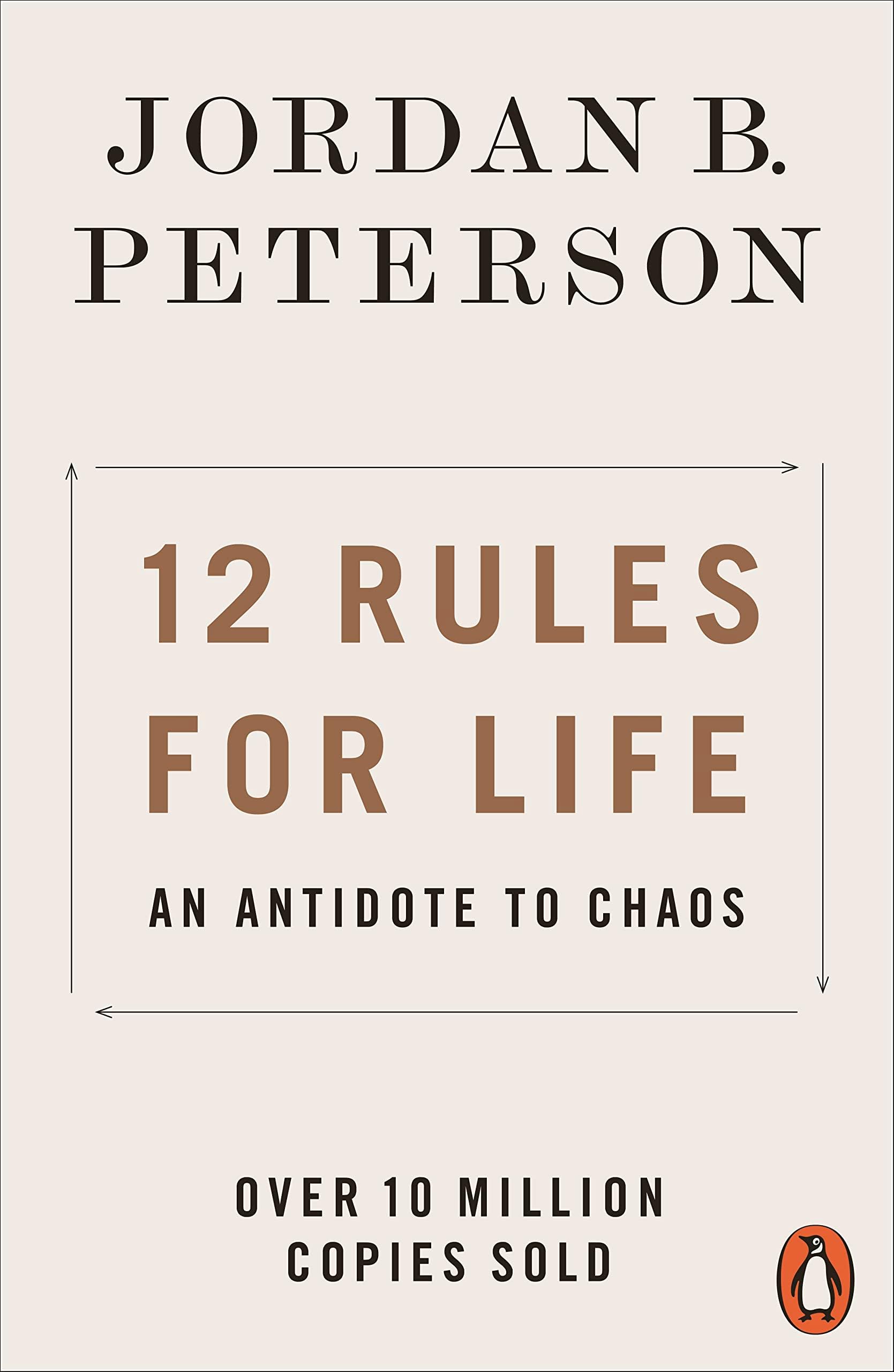
12 Rules for Life: An Antidote to Chaos
Product ID: 122676576
Buy anything from 5,000+ international stores. One checkout price. No surprise fees. Join 2M+ shoppers on Desertcart.
Desertcart purchases this item on your behalf and handles shipping, customs, and support to Thailand.
The #1 Sunday Times and International Bestseller from 'the most influential public intellectual in the Western world right now' ( New York Times ) What are the most valuable things that everyone should know? Acclaimed clinical psychologist Jordan Peterson has influenced the modern understanding of personality, and now he has become one of the world's most popular public thinkers, with his lectures on topics from the Bible to romantic relationships to mythology drawing tens of millions of viewers. In an era of unprecedented change and polarizing politics, his frank and refreshing message about the value of individual responsibility and ancient wisdom has resonated around the world. In this book, he provides twelve profound and practical principles for how to live a meaningful life, from setting your house in order before criticising others to comparing yourself to who you were yesterday, not someone else today. Happiness is a pointless goal, he shows us. Instead we must search for meaning, not for its own sake, but as a defence against the suffering that is intrinsic to our existence. Drawing on vivid examples from the author's clinical practice and personal life, cutting edge psychology and philosophy, and lessons from humanity's oldest myths and stories, 12 Rules for Life offers a deeply rewarding antidote to the chaos in our lives: eternal truths applied to our modern problems. Review: Excellent and Enjoyable Read - I saw my therapist reading this book one day and when I found it at the local library on audio, I decided to pick it up while driving. The audio version is read by Peterson himself and when I didn’t finish it on time, the book was fortunately on sale on Kindle so I picked it up then. I remember when I saw the book the first time in the therapist’s office, I looked through the table of contents and some of the rules surprised me. Taking a look, many of us would be able to say to some of them, “Well, I never did that so I’m good.” One that stood out to me was “Do not bother children when they are skateboarding.” Okay. I don’t think I have ever done that so I am good. However, each rule has a principle behind it and a long chapter where Peterson goes on about the lesson involved. When he talks about religion, though he is not a Christian at this point, he does hold a high respect for Jesus and thinks there is a lot of wisdom in the Bible. His reading of the text does provide interesting food for thought. Other rules include assume the other person might know something you don’t and compare yourself to who you were yesterday and not who someone else is today. The second is to treat yourself like someone else you are responsible for. Peterson points out that many of us sadly take better care of our pets than we do of ourselves. Also, watch your friends. Choose friends that will build you up. Many of us especially in the age of the internet make friends way too easily and choose friends that will bring us away from that which is good for us. This is not to say these people are necessarily people with evil intentions, but that their desires are not like our desires and their idea of good is not like ours. The last rule was an odd one about petting a cat. The only reason I don’t do this is I don’t know if stray cats around here have fleas and I don’t want to risk bringing something home to Shiro. So what is the meaning behind this rule? You have to read it to the end because it’s only at the very end that he explains the lesson. Much of the book focuses on psychology which shouldn’t be a shock, but there’s a lot of history as well. Peterson looks at events throughout time and finds the parallels that he needs. The man is, no doubt, highly read and very intellectual. Of course, this material is useless if you don’t apply the rules to your life. This is a process and Peterson himself has said in interviews he struggles with them, especially the one on telling the truth to people, or at least not lying. That can be hard to do in an age where we want to make sure we don’t “Hurt someone’s feelings.” I wouldn’t mind reading another one of his books after this one. Peterson I find to be a stimulating thinker and on the issue of Christianity being true, I think a meaningful dialogue could take place, especially if the rules are followed. Many of these rules are really common sense rules when studied further and ones we can all benefit from. Go out and get this book and it will be a good topic of discussion if others you know read it as well. In Christ, Nick Peters (And I affirm the virgin birth) Deeperwatersapologetics.com Review: Great advice with deep insights. - I took about a month to finish Jordan Peterson's 12 Rules for Life: An Antidote to Chaos, in part because I wanted to slow down and try some of the advice in my life. 12 Rules for Life is an interesting book. Equal parts philosophy, psychology, and self-help book, it covers a broad range of topics, with Peterson drawing from life experiences, religion, and history to build a strong case for his points and provide what seems on its surface to be very good advice for people. This is where Peterson's background as a clinical psychologist comes in handy. 12 Rules for Life is billed as an "antidote to chaos", and that is what its primary focus is. It's not great at helping you be more successful if you're disciplined and self-reliant already. As someone who always struggled with grasping the world, however, I found it very helpful. Since I started reading this book, I lost 12 pounds, went from writing five hundred words a day to three thousand words a day, started waking up earlier in the morning consistently, and have been much happier. Some of that is attributable to the fact that I was already willing to make changes, and many of the things I was doing were obviously bad ideas. But there is something to be said for the lessons Peterson teaches. They are complicated, sometimes a little indirect, and mired in allegory. This makes them more valuable, if anything. Peterson doesn't use a magic formula, he uses principles of right action. This book provides general ideas and positions that can serve as a great tool to understanding how people think and why things go wrong. Not everyone will agree with it. There is a chapter in the book where Peterson reflects on the fact that he has opportunities with clients where he could tell them one thing or another and their minds would make it to be total truth either way. Perhaps that is what Peterson has done here: perhaps most systems like this are sufficient to improve lives if brought diligently into practice. Or perhaps there is something to Peterson's words. His indictment of meaninglessness and his calls to purpose echo soundly throughout the book. There have been those who say that Peterson's calls for people to get themselves organized and his oft-mystical language is a cover for something sinister. But I don't think they've ever really listened to him. Approaching Peterson a skeptic, I was not sure that reading a book would have the power to change anything in my life. The first few chapters were met with nods, hesitancy, and the concession of points that sounded good. I wasn't hostile to him, and I found many of his points quite clever. But when Peterson delved deeper into the archetypes and depth psychology I became suspicious. I had a moderate distrust of the Jungian method; I use it to teach literature, but I did not believe in using archetypes to assess personality. Peterson's point is that we are all part of something great and interconnected. Because it is so massive, we need to be working to make sense of it. It won't happen automatically, and if we go for an easy explanation we may find ourselves walking dark, treacherous paths of misanthropy and rejection. We are complicated pieces in an even more complicated puzzle. Peterson's approach is one of self improvement. When we take steps to sort ourselves out, we also need to enter a symbiotic process of bringing order to our world. The purpose of this is not to achieve some sort of superiority. It is to achieve survival. The world will change, and we will be forced to adapt. Peterson states that "life is tragic." His point is that people need to be ready to deal with adversity. Anyone can handle good times, because that's what we are able to rest and relax during. The true test of a person comes when they lose a loved one or a job or their health. They need to make a decision: what will they do in response. Peterson uses haunting examples to illustrate what happens when this goes wrong. Using everything from Dostoevsky to the Soviet Union (and countless other insights from modern and historical figures), he creates case studies of what happens when things go wrong and people turn to dysfunction rather than improving their situation. His 12 Rules serve as a guide on how to go from that point of failure to a point of redemption, offering a series of suggestions and guidelines to take a life that is becoming corrupted by hatred of the world and everything in it and turn it into a vessel for growth and self-improvement. Is it a perfect guide to living life? No. Is it helpful? Does it give insight to great truths? Yes.


| Best Sellers Rank | #14,648 in Books ( See Top 100 in Books ) #1 in Social Philosophy #101 in Success Self-Help #236 in Happiness Self-Help |
| Customer Reviews | 4.7 out of 5 stars 85,345 Reviews |
K**R
Excellent and Enjoyable Read
I saw my therapist reading this book one day and when I found it at the local library on audio, I decided to pick it up while driving. The audio version is read by Peterson himself and when I didn’t finish it on time, the book was fortunately on sale on Kindle so I picked it up then. I remember when I saw the book the first time in the therapist’s office, I looked through the table of contents and some of the rules surprised me. Taking a look, many of us would be able to say to some of them, “Well, I never did that so I’m good.” One that stood out to me was “Do not bother children when they are skateboarding.” Okay. I don’t think I have ever done that so I am good. However, each rule has a principle behind it and a long chapter where Peterson goes on about the lesson involved. When he talks about religion, though he is not a Christian at this point, he does hold a high respect for Jesus and thinks there is a lot of wisdom in the Bible. His reading of the text does provide interesting food for thought. Other rules include assume the other person might know something you don’t and compare yourself to who you were yesterday and not who someone else is today. The second is to treat yourself like someone else you are responsible for. Peterson points out that many of us sadly take better care of our pets than we do of ourselves. Also, watch your friends. Choose friends that will build you up. Many of us especially in the age of the internet make friends way too easily and choose friends that will bring us away from that which is good for us. This is not to say these people are necessarily people with evil intentions, but that their desires are not like our desires and their idea of good is not like ours. The last rule was an odd one about petting a cat. The only reason I don’t do this is I don’t know if stray cats around here have fleas and I don’t want to risk bringing something home to Shiro. So what is the meaning behind this rule? You have to read it to the end because it’s only at the very end that he explains the lesson. Much of the book focuses on psychology which shouldn’t be a shock, but there’s a lot of history as well. Peterson looks at events throughout time and finds the parallels that he needs. The man is, no doubt, highly read and very intellectual. Of course, this material is useless if you don’t apply the rules to your life. This is a process and Peterson himself has said in interviews he struggles with them, especially the one on telling the truth to people, or at least not lying. That can be hard to do in an age where we want to make sure we don’t “Hurt someone’s feelings.” I wouldn’t mind reading another one of his books after this one. Peterson I find to be a stimulating thinker and on the issue of Christianity being true, I think a meaningful dialogue could take place, especially if the rules are followed. Many of these rules are really common sense rules when studied further and ones we can all benefit from. Go out and get this book and it will be a good topic of discussion if others you know read it as well. In Christ, Nick Peters (And I affirm the virgin birth) Deeperwatersapologetics.com
K**Y
Great advice with deep insights.
I took about a month to finish Jordan Peterson's 12 Rules for Life: An Antidote to Chaos, in part because I wanted to slow down and try some of the advice in my life. 12 Rules for Life is an interesting book. Equal parts philosophy, psychology, and self-help book, it covers a broad range of topics, with Peterson drawing from life experiences, religion, and history to build a strong case for his points and provide what seems on its surface to be very good advice for people. This is where Peterson's background as a clinical psychologist comes in handy. 12 Rules for Life is billed as an "antidote to chaos", and that is what its primary focus is. It's not great at helping you be more successful if you're disciplined and self-reliant already. As someone who always struggled with grasping the world, however, I found it very helpful. Since I started reading this book, I lost 12 pounds, went from writing five hundred words a day to three thousand words a day, started waking up earlier in the morning consistently, and have been much happier. Some of that is attributable to the fact that I was already willing to make changes, and many of the things I was doing were obviously bad ideas. But there is something to be said for the lessons Peterson teaches. They are complicated, sometimes a little indirect, and mired in allegory. This makes them more valuable, if anything. Peterson doesn't use a magic formula, he uses principles of right action. This book provides general ideas and positions that can serve as a great tool to understanding how people think and why things go wrong. Not everyone will agree with it. There is a chapter in the book where Peterson reflects on the fact that he has opportunities with clients where he could tell them one thing or another and their minds would make it to be total truth either way. Perhaps that is what Peterson has done here: perhaps most systems like this are sufficient to improve lives if brought diligently into practice. Or perhaps there is something to Peterson's words. His indictment of meaninglessness and his calls to purpose echo soundly throughout the book. There have been those who say that Peterson's calls for people to get themselves organized and his oft-mystical language is a cover for something sinister. But I don't think they've ever really listened to him. Approaching Peterson a skeptic, I was not sure that reading a book would have the power to change anything in my life. The first few chapters were met with nods, hesitancy, and the concession of points that sounded good. I wasn't hostile to him, and I found many of his points quite clever. But when Peterson delved deeper into the archetypes and depth psychology I became suspicious. I had a moderate distrust of the Jungian method; I use it to teach literature, but I did not believe in using archetypes to assess personality. Peterson's point is that we are all part of something great and interconnected. Because it is so massive, we need to be working to make sense of it. It won't happen automatically, and if we go for an easy explanation we may find ourselves walking dark, treacherous paths of misanthropy and rejection. We are complicated pieces in an even more complicated puzzle. Peterson's approach is one of self improvement. When we take steps to sort ourselves out, we also need to enter a symbiotic process of bringing order to our world. The purpose of this is not to achieve some sort of superiority. It is to achieve survival. The world will change, and we will be forced to adapt. Peterson states that "life is tragic." His point is that people need to be ready to deal with adversity. Anyone can handle good times, because that's what we are able to rest and relax during. The true test of a person comes when they lose a loved one or a job or their health. They need to make a decision: what will they do in response. Peterson uses haunting examples to illustrate what happens when this goes wrong. Using everything from Dostoevsky to the Soviet Union (and countless other insights from modern and historical figures), he creates case studies of what happens when things go wrong and people turn to dysfunction rather than improving their situation. His 12 Rules serve as a guide on how to go from that point of failure to a point of redemption, offering a series of suggestions and guidelines to take a life that is becoming corrupted by hatred of the world and everything in it and turn it into a vessel for growth and self-improvement. Is it a perfect guide to living life? No. Is it helpful? Does it give insight to great truths? Yes.
M**L
A book of profound and lasting importance and value
I ordered this book because I've learned so much during the past few years from Peterson's class lectures on YouTube. So i thought, "well, it would be nice to have a printed summary or synthesis of those lectures." What I got was so much more! This is not a superficial gloss by Peterson on what he's been saying in those lectures. Neither is it in the least bit superficial. Yes, it synthesizes into "rules" a lot of his suggestions about how anyone of any age (my "young" days are long past) can make their future better for themselves, for their loved ones, and for society. (And never in my life has there been a time when such advice was more desperately needed.) So if you've listened to his YouTube posts you've heard a lot of that, although not brought together in his coherent a fashion. But these are embedded in a surprisingly wide-ranging discussion, informed by his deep understanding of psychology, philosophy, and literature, that is deeply thoughtful, at times funny (who knew Peterson could be funny?), sometimes moving (his account of his daughter's serious illness in "Rule 12" is heartbreaking and inspiring all at the same time), and laced with real substance. This substrate is an outgrowth of ideas he covers in his lectures on personality, mythic narratives, and biblical story. But he has clearly worked very hard to make this material, which adds enormous depth and richness to the book, as accessible as he can. Yes, parts of the book will require slow, thoughtful reading to get the most out of it: but why is that a bad thing? Why should a book with so much to offer be a quick bedtime read? (It is nowhere near as demanding as his earlier book Maps of Meaning.) Once I realized that this was way more than a "self-help book" (its somewhat unfortunate title notwithstanding), I raced through it in a marathon reading session. Peterson's conviction, clarity, passion for his material, and deep concern for the future well being of his readers pulls you through the book like you were tethered to a freight train. A day or so afterward I set about reading the book again, slowly, a chapter at a time, writing about what I was reading as I went along. And I got way more out of it. Read slowly, one realizes how much effort he has put into every single paragraph (I later learned that he spent five years on this book). I couldn't help but wish I had had this book 40 or so years ago. But then I realized: that's stupid; I've got it now and man, am I grateful. About politics: Peterson has become much more visible in the public sphere during the last year, and because of his view of life and how to live it and because he is far from the liberal left and because he has taken on political correctness and identity politics in defense of freedom of speech (and lots of other things), he has been caricatured and misrepresented and his ideas have been attacked and grossly distorted by people who have everything to gain by keeping everyone else docile and, in his word, "pathetic." But this is not a book of political advocacy; I disagree with several of Peterson's political views, but they have nothing to do with this book or why I think it's so valuable. So I urge anyone who is remotely interested in the subject matter to dismiss whatever you're heard or read about the controversy surrounding Peterson or his politics and just read the book. Make up your own mind. And if you know young people, men or women, who are in crisis or lost or desperate or hopeless or teetering on the brink of nihilism or some terribly self-destructive behavior, get another copy and give it to them. Now. If they are unlikely to read it, get them the Audio-book. Whatever. This book could help them turn their lives around, could improve their future as well as the future of people they will come in contact with and maybe even of our very troubled society. And what greater gift could you give to a young person? It's the gift Peterson has given to all of us.
A**X
This book = 12 Rules (rock solid advice) + Peterson's Philosophic musings
Jordan Peterson is a beacon of light in this chaotic world, a psychologist whose writing combines science and common sense. One of his talents is his ability to articulate complex ideas to a wide audience. Regardless of whether you have a background in psychology or not, you will understand this book. It covers his twelve rules for life, which are intended not only as a guide for life of the individual, but as a remedy for society’s present ills. Peterson believes that the cure for society starts with curing the individual, the smallest unit of society. Peterson’s well-known advice to clean your room is a reflection of the truth that if you can’t even manage the most basic and mundane responsibilities of life, then you have no business dictating to others how to fix society. One of the main themes of this book is: Personal change is possible. There's no doubt you can be slightly better today than you were yesterday. Because of Pareto's Principle (small changes can have disproportionately large results), this movement towards the good increases massively, and this upward trajectory can take your life out of hell more rapidly than you could believe. Life is tragic and full of suffering and malevolence. But there's something you can start putting right, and we can't imagine what good things are in store for us if we just fix the things that are within our power to do so. The 12 Rules for Life: In Peterson’s own words, it’s 12 rules to stop you from being pathetic, written from the perspective of someone who himself tried to stop being pathetic and is still working on it. Peterson is open about his struggles and shortcomings, unlike many authors who only reveal a carefully curated façade. Rule 1: Stand up straight with your shoulders back. People have bad posture, and the meaning behind it can be demonstrated by animal behaviors. Peterson uses the example of the lobster. When a lobster loses a fight, and they fight all the time, it scrunches up a little. Lobsters run on serotonin and when he loses, levels go down, and when he wins, levels go up and he stretches out and is confident. Who cares? We evolutionarily diverged from lobsters 350 million years ago, but it’s still the same circuit. It’s a deep instinct to size others up when looking at them to see where they fit in the social hierarchy. If your serotonin levels fall, you get depressed and crunch forward and you’re inviting more oppression from predator personalities and can get stuck in a loop. Fixing our posture is part of the psycho-physiological loop that can help you get started back up again. Rule 2: Treat yourself like someone you are responsible for helping. People often have self-contempt whether they realize it or not. Imagine someone you love and treat well. You need to treat yourself with the same respect. Take care of yourself, your room, your things, and have respect for yourself as if you’re a person with potential and is important to the people around you. If you make a pattern of bad mistakes, your life gets worse, not just for you, but for the people around you. All your actions echo in ways that cannot be imagined. Think of Stalin’s mother and the mistakes she made in life, and how the ripple effects went on to affect the millions of people around him. Rule 3: Choose your friends carefully. It is appropriate for you to evaluate your social surroundings and eliminate those who are hurting you. You have no ethical obligation to associate with people who are making your life worse. In fact, you are obligated to disassociate with people who are trying to destroy the structure of being, your being, society’s being. It’s not cruel, it’s sending a message that some behaviors are not to be tolerated. Rule 4: Compare yourself to who you were yesterday, not to who someone else is today. You need to improve, and you may even be in real bad shape, but many unfairly compare themselves to some more seemingly successful person. Up till around age 17, random comparisons to other people can make sense, but afterwards, especially age 30+, our lives become so idiosyncratic that comparisons with others become meaningless and unhelpful. You only see a slice of their life, a public facet, and are blind to the problems they conceal. Rule 5: Don't let children do things that make you dislike them. You aren't as nice as you think, and you will unconsciously take revenge on them. You are massively more powerful than your children, and have the ability and subconscious proclivity for tyranny deeply rooted within you.If you don't think this is true, you don't know yourself well enough. His advice on disciplinary procedure: (1) limit the rules. (2) use minimum necessary force and (3) parents should come in pairs.It's difficult and exhausting to raise children, and it's easy to make mistakes. A bad day at work, fatigue, hunger, stress, etc, can make you unreasonable. Rule 6: Set your house in perfect order before you criticize the world. Life is tragic and there's malevolence. There's plenty to complain about, but if you dwell on it, you will become bitter and tread down a path that will take you to twisted places. The diaries of the Columbine killers are a chilling look into minds that dwelled on the unholy trinity of deceit, arrogance, and resentment) . So instead of cursing the tragedy that is life, transform into something meaningful. Start by stop doing something, anything, that you know to be wrong. Everyday you have choices in front of you. Stop doing and saying things that make you weak and ashamed. Do only those things that you would proudly talk about in public. Rule 7: Pursue what is meaningful (not what is expedient). Meaning is how you protect yourself against the suffering that life entails. This means that despite the fact that we’re all emotionally wounded by life, we’ve found something that makes it all worthwhile. Meaning, Peterson says, is like an instinct, or a form of vision. It lets you know when you’re in the right place, and he says that the right place is midway between chaos and order. If you stay firmly ensconced within order, things you understand, then you can’t grow. If you stay within chaos, then you’re lost. Expediency is what you do to get yourself out of trouble here and now, but it comes at the cost of sacrificing the future for the present. So instead of doing what gets you off the hook today, aim high. Look around you and see what you can make better. Make it better. As you gain knowledge, consciously remain humble and avoid arrogance that can stealthily creep on you. Peterson also says to be aware of our shortcomings, whatever they may be; our secret resentments, hatred, cowardice, and other failings. Be slow to accuse others because we too conceal malevolent impulses, and certainly before we attempt to fix the world. Rule 8: Tell the truth—or, at least, don't lie. Telling the truth can be hard in the sense that it’s often difficult to know the truth. However, we can know when we’re lying. Telling lies makes you weak. You can feel it, and others can sense it too. Meaning, according to Peterson, is associated with truth, and lying is the antithesis of meaning. Lying disassociates you with meaning, and thus reality itself. You might get away with lying for a short while, but only a short time. In Peterson’s words “It was the great and the small lies of the Nazi and Communist states that produced the deaths of millions of people.” Rule 9: Assume that the person you are listening to might know something you don't. A good conversation consists of you coming out wiser than you went into it. An example is when you get into an argument with your significant other, you want to win, especially if you get angry. If you’re more verbally fluent than the other person then you can win. One problem is that the other person might see something better than you, but they can’t quite articulate it as well. Always listen because there’s a possibility they’re going to tell you something that will prevent you from running headfirst into a brick wall. This is why Peterson says to listen to your enemies. They will lie about you, but they will also say true things about yourself that your friends won’t. Separate the wheat from the chaff and make your life better. Rule 10: Be Precise in Your Speech: There is some integral connection between communication and reality (or structures of belief as he likes to say). Language takes chaos and makes it into a ‘thing.’ As an example, imagine going through a rough patch in your life where you can’t quite put your finger on what’s wrong. This mysterious thing that’s bothering you—is it real? Yes, if it’s manifesting itself as physical discomfort. Then you talk about it and give it a name, and then this fuzzy, abstract thing turns into a specific thing. Once named, you can now do something about it. The unnameable is far more terrifying than the nameable. As an example, the movie the Blair Witch project didn’t actually name or describe the evil. Nothing happens in the movie, it’s all about the unnameable. If you can’t name something, it means it’s so terrifying to you that you can’t even think about it, and that makes you weaker. This is why Peterson is such a free speech advocate. He wants to bring things out of the realm of the unspeakable. Words have a creative power and you don’t want to create more mark and darkness by imprecise speech. Rule 11: Don’t bother children when they are skateboarding. This is mainly about masculinity. Peterson remembers seeing children doing all kinds of crazy stunts on skateboards and handrails, and believes this is an essential ingredient to develop masculinity, to try to develop competence and face danger. Jordan Peterson considers the act of sliding down a handrail to be brave and perhaps stupid as well, but overall positive. A lot of rebellious behavior in school is often called ‘toxic masculinity,’ but Peterson would say to let them be. An example would be a figure skater that makes a 9.9 on her performance, essentially perfect. Then the next skater that follows her seems to have no hope. But she pushes herself closer to chaos, beyond her competence, and when successful, inspires awe. Judges award her 10’s. She’s gone beyond perfection into the unknown and ennobled herself as well as humanity as well. Rule 12: Pet a cat when you encounter one on the street. This chapter is mainly autobiographical and he writes about tragedy and pain. When tragic things are in front of you and you’re somewhat powerless, you must keep your eyes open for little opportunities that highlight the redemptive elements of life that make it all worthwhile. The title of this chapter comes from his experience of observing a local stray cat, and watching it adapt to the rough circumstances around it. Another thing you must do when life is going to pieces is to shorten your temporal horizon. Instead of thinking in months, you maybe think in hours or minutes instead. You try to just have the best next minute or hour that you can. You shrink the time frame until you can handle it, this is how you adjust to the catastrophe. You try to stay on your feet and think. Although this chapters deals about harsh things, it’s an overall positive one. Always look for what’s meaningful and soul-sustaining even when you’re where you’d rather not be.
M**D
Nazi, Guru or Wiseman?
Pursue what is meaningful, not merely what is immediately expedient. Stand up straight and face the world with courage and confidence. Get your own life in order before you go out and try to save the world. Treat yourself like a person whom you are responsible for. Tell the truth. These incredibly obvious pieces of advice are some of the aphorisms found in one of the biggest selling books of the moment: Jordan Peterson’s 12 Rules for Life. The success of the book and the “academic rock star” status it’s author has achieved recently suggest just how far we have gone off track in teaching the young about life, when such aphorisms come as revelations to many. Still, 12 Rules for Life is a very good book, and one that many people could benefit from reading. Peterson, who has a vast network of followers on YouTube, is predominately attracting a younger male audience, and I suspect that the book will appeal mostly to them. I see his influence as being a positive development in the evolution of masculinity, as I argued in a recent blog post. Even I, as an older male, found much of value in the book. And women of any age could easily benefit from it as well. One theme that runs through the book is that we need to teach responsibility to children by setting appropriate boundaries. We also need to let them play and explore the world, to make their own mistakes. Now, given that so many of us adults had deficient parenting, we must teach ourselves such practical wisdom. Contained within many of the author’s points are fascinating anecdotes and specific, practical applications. Peterson tells stories gleaned from his own life experience, as well as from his experience as a clinical psychologist. There is a lot of history to draw from. The tales keep the text alive, much as with his online videos. Jordan Peterson’s background as a psychologist influences his teachings. He draws upon biology and evolutionary theory to help explicate many of his points. He famously compares human neurophysiology to that of the lobster, while making the point that we exist in hierarchies that are at least partly explicable as evolutionary patterns. His advice is then to “stand up straight”, following the example of the body language of dominant lobsters. But Peterson is no biological determinist, as his online videos show. He’s simply acknowledging that we humans are not merely ghosts in biological machines, whereby free will and culture determine all behavior. Jordan Peterson draws from many religious and spiritual traditions to clarify and expand his insights, but most frequently from Christianity. One aspect of the book which I found challenging to navigate is the frequent biblical narratives. Using a Jungian approach (Joseph Campbell, if you prefer), some chapters in the book ramble a little, and could be made shorter. The connectivity between some points also sometimes seems unclear. Yet that could have been because I read quickly. Having said this, the biblical allusions Peterson uses have reopened my mind to the Christian tradition. In mainstream, non-ecclesiastical circles, Christianity is often looked upon negatively. On the political left, it is typically criticized and distained, often at levels which would be termed bigoted if such scorn was directed at any other religion. Perhaps a more balanced perspective is required, lest we jettison entirely a formative wisdom tradition which has helped define us. Peterson is a Christian, just not a fundamentalist one. He has made the valid point that much of the thinking and values which underpin western thought and legal structures are Christian. Many of the stories in The Bible, including the idea of God, are thus archetypal. They are deeply imbedded within our psyches, even if we do not identity as Christian. Still, it may take some degree of self-discipline for some to wade through the religious mythology. In my opinion, a fair assessment of 12 Rules to Life and Peterson’s teachings should negate any fear of an impending Nazi apocalypse. The book is not heavily political, making only brief diversions into politics and ideology. One reason why I feel he can be relied upon to responsibly mediate the current cultural divide is that Peterson is an advocate of introspection and shadow work – looking within the psyche to honestly acknowledge what lies within, no matter how dark. His book lays this ideal down clearly. We are all capable of descending into that darkness, and we must be vigilant to avoid the fate. Such honest introspection is precisely what is often missing from progressivism today, largely because it has established an attitude of moral superiority over opposing voices. This is one reason why it has betrayed many of its founding principles, and is often intolerant and authoritarian. Western society has set far too many men adrift, chronically shaming males and defining masculinity via its pathological expression. 12 Rules for Life may help many men to find confidence and direction amidst this extreme turn. And for that we should greatly thank him. Of course, given the huge amount of publicity Peterson’s media appearances have generated, there are potential downsides to all this. Peterson has become a father figure to many, as well as spiritual mentor. This is occuring in the context of a society which has severely shamed masculinity and devalued fatherhood. Relating to Peterson’s paternal qualities is a healthy development if expressed responsibly. Yet it seems to me that some of his followers are projecting far too much responsibility onto Peterson for their lives. I call this “giving away your power.” It is a common issue in spiritual circles. Indeed, I would say that it is almost a universal phase of personal and spiritual development. I am no exception, and gave my own power away to one or two spiritual and psychological guides as a younger man. Still, it is to be hoped that those who do this will quickly pass through the phase and assume greater responsibility for their lives. After all, taking responsibility is a central theme in Peterson’s teachings. In 12 Rules for Life, Peterson implores us to focus our intent, to find meaningful work and self-work in order to help make the world a better place. For that is the best way that we can move forward and develop lives of power and purpose. He does not promise utopia. He merely suggests that personal responsibility, meaning and purpose should form a central part of the life journey, regardless of the outcome. And who can argue with that? 12 Rules for Life is imperfect, but I highly recommend it. It contains much wisdom and thought-provoking philosophy from one of the most courageous and influential thinkers of our time. Marcus T Anthony, PhD, author of Discover Your Soul Template
P**L
Responsibility and Duty for Today
"Clean your room," has become a mantra for a generation of lost kids who finally found a male figure in the culture to look up to. Jordan B. Peterson has become something of a Millennial Messiah in the most unusual way. He's telling people to take on responsibility and to blame only themselves if their life isn't the way they want it. This book is a condensed version of his tome "Maps of Meaning", a much longer philosophical tract on how the myths and stories humanity passed down over the centuries influence our values. It's obvious that the last generation's drive to give out participation trophies and to tell everyone that the evil system is to blame for all your ills (think of the hippies going against "the man") no longer resonates. Millennials and younger people today are under a lot of pressure. They're deep in student loan debt, they're having trouble finding jobs that pay well, they're getting married and owning homes at lower rates because they're not secure enough financially to settle down. This could make you feel deeply powerless if you were trying to blame the system. Just look on TV at every late night host talking about how hopeless and stupid our country is right now. Jordan Peterson comes with a different message- start by cleaning your own personal room. Stop blaming other people, and get your own life in order. You can't expect to see change in the world, unless you first change yourself. Rule 1 is a great example. The basic gist is to stand up straight and face the world with your head held high- literally, not just metaphorically. Famously, Peterson looks at lobsters. Lobsters have a dominance hierarchy where they constantly fight. When a lobster loses a fight, it skulks around and lowers itself to become smaller and less threatening. If you give the lobster a drug to fix its serotonin levels- the same rewards system present in most every animal brain- the lobsters picks itself back up and goes right back to fighting. Human evolution diverged from the lobster millions of years ago, and yet we can see that even they have dominance hierarchies and societal struggle and depression. It is therefore ludicrous to think that human suffering is only a "social construct" as today's academics would have you believe. These feelings are naturally built-in to our nervous system. If we want to feel better we need to pick ourselves up and "get some pep in our step" as a previous generation might have said. The whole book is like that. A blend of science, folksy wisdom, and tales from Peterson's own life and career. From working as a dish washer to a lumber mill worker to a clinical psychologist, Peterson has seen all of humanity. His conclusions are profound, yet immediately relatable. He covers the topics at all levels of analysis- from philosophy, to statistics, to evolution, to straight up humor. Peterson's critics are having a hilariously hard time trying to downplay this book. In a famous interview, a BBC host asked Peterson if he was suggesting that we should structure our society like that of the lobster. If you're that philosophically inept or that malicious trying to slam this guy, then enjoy your life, there's little I can do to try and hold a conversation with you. In case anyone's confused- nobody's saying we should structure our society like the lobster. There's an ancient philosophical debate about "is" versus "ought". Peterson wrote this book about how the world is. The human nervous system is made in such a way that depressive factors snowball until it's hard to dig yourself out, so feelings like resentment only make things worse. This says nothing about ought- nobody's saying that we're happy the human nervous system ought to be this way nor is anyone saying that societal progress ought to revert to some crude pre-historic state. The "is" and "ought" are two different topics. If you want to lead a better life in the world that is, read this book. If you'd rather fret about what ought to be, have fun with that. If you can manage to keep those concepts straight, this book's for you. Especially if you are- or are close to- a young male in the millennial group who's struggling to face the society we find ourselves in today, this book is for you. The book reads well for any person, but the millennial male group are most powerfully affected by Peterson's work for obvious reasons. Young men have biological drives toward duty and responsibility that currently aren't fulfilled in their school, home, or professional lives. Anyone can benefit from this book- so the fact that one group needs it most should tell you something. This book is powerful, timely, and profound. Give it a read.
R**K
An antidote to the cultural divide that’s destroying the West...
This book provides an antidote to the cultural divide that’s destroying the West. It’s kryptonite to shoddy social justice warrior “thinking,” and the bane of Postmodern Neo-Marxist rot in academia. But more than anything, it is clear, straightforward advice for living a meaningful life. Don’t let the trendy title fool you. If this is self-help, then it’s self-help with a hammer. Here’s the core message of 12 Rules for Life: life is suffering, but you can get through it if you get your shit together, tell the truth, fix the things you’re able to fix, and make yourself strong. Think that sounds trivial? Try doing it for a week. I love Peterson’s focus on the individual. I’ve always been suspicious of group-level solutions, or the idea that you can only be happy or fulfilled if society changes. Focusing on the individual is a lot more satisfying, and the results are better too. After all, if you can’t sort yourself out, what makes you think you can fix the world, or remake Western culture? It’s an incredibly arrogant assumption. Maybe, just maybe, the root of all your problems isn’t global capitalism, or the evil patriarchy, or beliefs about invented genders. Perhaps it’s actually a lot closer to home. You can spend your time badgering, nagging or forcing someone else to do something — the Indirect approach — or you can look for actions you can take right now to improve your life. The direct approach puts YOU firmly in control of your own destiny, but it also requires you to assume responsibility for yourself. And that’s another key concept in 12 Rules. Peterson urges his readers to take on as much responsibility as they can handle, rather than whine about “rights” and entitlements. So how should you begin? Start by sorting yourself out. Look at the problems in your own life or in your own immediate environment. Choose one that you can fix, and fix it. Then chose another. It can be something as simple as cleaning your room. In doing this, you’re bringing order to the chaos around you. It’s amazing how those small actions ripple outward to improve the lives of everyone around you. Peterson’s message is also refreshing because it’s the opposite of the currently accepted paradigm that equates male virtue with being weak and harmless. If being strong, productively aggressive, and able to fight for what’s right is somehow regarded as “toxic masculinity,” then it’s probably a good time to question the core agenda of those who are pushing such a simplistic and emasculating concept. Dr. Peterson rose to prominence in Canada during a bizarre political debate on made up gender pronouns and compelled speech, not because he was an alt-right voice of hate, but because he stood up and spoke his truth in clear, logical terms. What happened since then — the massive youtube following, the sold-out lectures, repeat appearances on international podcasts and television — is testament to the power of the Logos, the Word. I first encountered his work a year or two before that controversy, through the brilliant Maps of Meaning lectures he posted on Youtube. I went on to watch his University of Toronto Personality course too, and everything he’s produced since, because it is so relevant to my life. There is no wishful thinking here, or New Age snivelling, or back-patting. 12 Rules for Life is funny and engaging, but dense with ideas based on hard science, research-derived psychological data, and the continuous centuries-long narrative that humans have transmitted through story and culture as a way to survive and thrive in a frightening world. Dr. Peterson’s most recent effort was a public lecture series exploring the psychological significance of the Biblical stories. As an atheist who spent far too much time stewing in Sunday boredom as a child, trapped in church while my dad watched John Wayne movies at home, I was extremely skeptical of this. As a writer, an anthropology graduate, and a reader of Jung, Nietzsche and the Western Canon, I soon found myself mesmerized. His explanations of the ancient Biblical stories made sense. And even better, it made them useful whether or not I subscribe to a deity. All of this is a roundabout way of saying why you should read 12 Rules for Life, and why I will be reading it again and again. This is not a lightweight book. It’s valuable. It’s meaningful. And it will cause you to look at the world and your life a little differently than you did before.
J**E
The most influential book I have read this year! From a liberal.
I will admit this right off the bat. I knew nothing of Jordan Peterson, or any of his ideology before reading this book. I must have existed in a vacuum, as I merely picked this book up as it was given as an "Amazon Recommends." Curious about the title, I purchased on impulse. I am very glad I did. I am not Jordan Peterson's "supposed" target audience. (I used supposed because I don't think he actually claims to have one). I am a liberal, Asian, left leaning moderate with a background in philosophy, theology and film studies. I support the women's right movement, equal pay, and I find the Republican party of today rather distasteful for the anti-science movement they espouse. That being said, this book spoke to me. It is not an easy read. I had to re-read chapters slowly to fully condense my thoughts. I agree with the critical review that stated you have to be intellectually equipped to really get the most out of this. I had to utilize my background in philosophy and religion to go beyond the surface of what the author was trying to say. This is not a book you can listen to at 2x speed on Audible and hope to retain anything, imo. You need to digest this. That being said... Peterson's deft weaving of theology, mythology, and just overall cogent arguments and viewpoints made me really respect and open up my mind to things I never fully thought about. I find it laughable that a Harvard professor/psychologist has been embraced by the "alt-right" when even a moderately close reading of this text repudiates all that they stand for. Peterson is direct. He has opinions. I don't always agree with them. But he is genuinely expressing himself, and the belief that we should all try to be better. We should all try to be more compassionate, and most of all, we all should try to understand our humanity a little more each and every there. There's no division in this book; there's just deep anguish at the current state of humanity and its capacity for evil. There's some exasperation at the way things are currently constructed in society that is in many ways lost. And most of all, there's compassion and a belief that if we all got together in a room and truly talked, the world would be a better place. I would shy away from the noise around Peterson in the headlines, on Youtube, and in how the idealogues use him (or even his own personal media narrative) to justify their twisted beliefs. Don't let the fact that the "Alt-Right" has co-opted this man to make him a mascot. Just read the book independently and make your own judgments. You'll be glad you did.
C**E
Nie dla mnie
Bzdurna książka dla znoszonych chyba realnością.
V**E
A LIFE TRANSFORMING BOOK!
This is the best book I have read in my life. When the essence of the 12 rules for life are understood, they will have a profound and life changing impact on the reader. This is a book for those who are lost and feel worthless. It helps people base themselves, navigate and adapt to the vagaries of life. The reader understands where and why he or she is doing wrong and becomes motivated and determined to transform themselves into confident and optimistic individuals. This happens naturally because this book is able to make a connection with them on a fundamental level and provides practical guidance. It addresses deep rooted issues and helps the reader rid themselves of their mental blocks which prevent them from reaching their potential. Because this book explains our life from a psychological and spiritual point of view, it has a powerful and practical effect on its reader. I will definitely recommend this book to everyone I know because it has transformed my life for the better. This book is a gem from Jordan B. Peterson!
M**R
A needed voice
Jordan B. Peterson has been much in the news. His courageous stand against the totalitarianism inherent in Bill C-16 (google it if you don't know what I'm talking about) suddenly made him a public figure and then with that interview everyone was talking about him. Peterson did that interview while in the UK publicising his book, 12 Rules for Life: An antidote to chaos. It has been a long time since I've read a book that has caused me so many out-loud oohs, ahs, ahas, sighs, and laughs. Here is a chapter by chapter summary. Rule 1: Stand up straight with your shoulders back This is the chapter about lobsters. Cathy Newman and other commentators have been choking on the crustaceans Peterson offers as evidence for his first rule, but I wonder if they have actually read the chapter. It's all pretty self-explanatory and obvious: dominance hierarchy is "an essentially permanent feature of the environment to which all complex life has adapted." That's true for lobsters, and it's true for humans: "It's permanent. It's real. The dominance hierarchy is not capitalism…It's not the patriarchy." If you're at the bottom of the dominance hierarchy - as either lobster or human - life is harder on you. Low status lobsters and humans produce less serotonin. "Low serotonin means decreased confidence. Low serotonin means more response to stress and costlier physical preparedness for emergency…higher serotonin levels…are characterized by less illness, misery and death." So what to do? Put your shoulders back! "Walk tall and gaze forthrightly ahead. Dare to be dangerous. Encourage the serotonin to flow plentifully through the neural pathways desperate for its calming influence." Rule 2: Treat yourself like someone you are responsible for helping This is the chapter that explains why people will buy prescription medicine for their dog, and carefully administer it, but fail to do the same for themselves. It boils down to this: "Why should anyone take care of anything as naked, ugly, ashamed, frightened, worthless, cowardly, resentful, defensive and accusatory as a descendant of Adam? Even if that thing, that being, is himself? And I do not mean at all to exclude women with this phrasing." That humans are like this provides Peterson with what I think might be the most important insight into the problem of evil since Augustine identified original sin with pride. This is how JP describes it: "We know exactly how and where we can be hurt, and why. That is as good a definition as any of self-consciousness. We are aware of our own defencelessness, finitude and mortality. We can feel pain, and self-disgust, and shame, and horror, and we know it. We know what makes us suffer. We know how dread and pain can be inflicted on us - and that means we know exactly how to inflict it on others. We know we are naked, and how that nakedness can be exploited - and that means we know how others are naked, and how they can be exploited." The solution? "You could help direct the world, on its careening trajectory, a bit more toward Heaven and a bit more away from Hell. Once having understood Hell, researched it, so to speak - particularly your own individual Hell - you could decide against going there or creating that. You could aim elsewhere. You could, in fact, devote your life to this. That would give you a Meaning, with a capital M. That would justify your miserable existence. That would atone for your sinful nature, and replace your shame and self-consciousness with the natural pride and forthright confidence of someone who has learned once again to walk with God in the Garden." Rule 3: Make friends with people who want the best for you This is the chapter about not casting your pearls before swine. Sometimes helping is beyond us. "But Christ himself, you might object, befriended tax-collectors and prostitutes. How dare I cast aspersions on the motives of those who are trying to help? But Christ was the archetypal perfect man. And you're you. How do you know that your attempts to pull someone up won't instead bring them - or you further down?" Ouch. So, how to help? "Before you help someone, you should find out why that person in in trouble." The thing is, that often takes more effort than just helping - it's easier to throw money at a problem than really understand why the problem is there. But that is to cast our pearls before swine - and it was Jesus, not just Peterson, who warned us against that. And help yourself, by making friends with people who are going to genuinely help you - with people who are prepared to put the work in, because they want the best for you. Rule 4: Compare yourself to who you were yesterday, not to who someone else is today This is the chapter about silencing your internal critic. Is this the very heart of Petersonism? Perhaps so. Certainly, it's something I've heard him talk about in pretty much every clip and lecture of his I've listened to. It's this: "Aim small. You don't want to shoulder too much to begin with, given your limited talents, tendency to deceive, burden of resentment, and ability to shirk responsibility. Thus, you set the following goal: by the end of the day, I want things in my life to be a tiny bit better than they were this morning. Then you ask yourself, 'What could I do, that I would do, that would accomplish that, and what small thing would I like as a reward?' Then you do what you have decided to do, even if you do it badly. Then you give yourself that damn coffee, in triumph. Maybe you feel a bit stupid about it, but you do it anyway. And you do the same thing tomorrow, and the next day, and the next. And, with each day, your baseline of comparison gets a little higher, and that's magic. That's compound interest. Do that for three years, and your life will be entirely different. Now you're aiming for something higher. Now you're wishing on a star. Now the beam is disappearing from your eye, and you're learning to see. And what you aim at determines what you see. That's worth repeating. What you aim at determines what you see." Peterson is brutally honest about the human condition: "What do you know about yourself? You are, on the one hand, the most complex thing in the entire universe, and on the other, someone who can't even set the clock on your microwave. Don't over-estimate your self-knowledge." So, you - amazing, ignorant you - aim at something, and "compare yourself to who you were yesterday, not to who someone else is today." Rule 5: Do not let your children do anything that makes you dislike them This is the chapter every parent needs to read. If you are a parent you must read it. And if you are not a parent but know someone who is, you need to persuade them to read it. Peterson sees, "today's parents as terrified by their children." We are heirs of the revolutions of the 1960s and have forgotten what children need and what parents are meant to provide. What children need is parents who will give them the right kind of attention, and that means parents remembering that they are parents. "A child will have many friends, but only two parents - if that - and parents are more, not less, than friends. Friends have very limited authority to correct. Every parent therefore needs to learn to tolerate the momentary anger or even hatred directed towards them by their children, after necessary corrective action has been taken." Parents must learn to correct their children, and socialise them. After all, "Two-year-olds, statistically speaking, are the most violent of people." If parents don't take this responsibility seriously, their children will be disciplined by the much harsher realities of the world. "If a child has not been taught to behave properly by the age of four, it will forever be difficult for him or her to make friends. The research literature on this is quite clear." So what should parents teach their kids? Peterson suggests the following: "Do not bite, kick or hit, except in self-defence. Do not torture or bully other children, so you don't end up in jail. Eat in a civilised and thankful manner, so that people are happy to have you at their house, and pleased to feed you. Learn to share, so other kids will play with you. Pay attention when spoken to by adults, so they don't hate you and might therefore deign to teach you something. Go to sleep properly, and peaceably, so that your parents can have a private life and not resent your existence. Take care of your belongings, because you need to learn how and because you're lucky to have them. Be good company when something fun is happening, so that you're invited for the fun. Act so that other people are happy you're around, so that people will want you around. A child who knows these rules will be welcome everywhere." And that is why so many children are unwelcome, pretty much everywhere. If you are a parent, don't let this be your child. Rule 6: Set your house in perfect order before you criticize the world This is the chapter that tells you to take responsibility for yourself. "Don't blame capitalism, the radical left, or the iniquity of your enemies. Don't reorganise the state until you have ordered your own experience. Have some humility. If you cannot bring peace to your own household, how dare you try to rule a city?" Rule 7: Pursue what is meaningful (not what is expedient) This is the longest and densest chapter. "Life is suffering. That's clear. There is no more basic, irrefutable truth. It's basically what God tells Adam and Eve, immediately before he kicks them out of Paradise." The way to deal with this is by learning delayed gratification - that is, to work and to sacrifice. Be Abel, not Cain. "Cain turns to Evil to obtain what Good denied him, and he does it voluntarily, self-consciously and with malice aforethought." Don't do that. Aim higher. It is here that Peterson gives the clearest definition of his ethic, his "fundamental moral conclusions": "Aim up. Pay attention. Fix what you can fix. Don't be arrogant in your knowledge. Strive for humility, because totalitarian pride manifests itself in intolerance, oppression, torture and death. Become aware of your own insufficiency - your cowardice, malevolence, resentment and hatred. Consider the murderousness of your own spirit before you dare accuse others, and before you attempt to repair the fabric of the world. Maybe it's not the world that's at fault. Maybe it's you. You've failed to make the mark. You've missed the target. You've fallen short of the glory of God. You've sinned. And all of that is your contribution to the insufficiency and evil of the world. And, above all, don't lie. Don't lie about anything, ever. Lying leads to Hell. It was the great and the small lies of the Nazi and Communist states that produced the deaths of millions of people." And that leads us to the next chapter… Rule 8: Tell the truth - or, at least, don't lie This is the chapter to put courage into your moral spine. We lie in order to make others like us more than they otherwise would, to make ourselves look better, to avoid difficult tasks or conversations - because we think lying makes life easier. But lying makes things worse: "If you say no to your boss, or your spouse, or your mother, when it needs to be said, then you transform yourself into someone who can say no when it needs to be said. If you say yes when no needs to be said, however, you transform yourself into someone who can only say yes, even when it is very clearly time to say no. If you ever wonder how perfectly ordinary, decent people could find themselves doing the terrible things the gulag camp guards did, you now have your answer. By the time no seriously needed to be said, there was no one left capable of saying it." Rule 9: Assume that the person you are listening to might know something you don't This is the chapter Cathy Newman should have read. Peterson is not only an academic, he is a clinical psychologist, and he knows how to listen. He has some things to teach those of us who aspire to hear people. Peterson recounts the case of 'Miss S' who came to see him, saying, "I think I was raped. Five times." Peterson explains how he could have convinced her of the truth, which could have been either, "You are an innocent victim" or "You have made yourself a victim." To have done so would have been to give her advice; but Peterson didn't give advice, he listened. Peterson gives advice (ha!) about how to listen well. And it is this that Cathy Newman should have read and applied before tangling with the clinical psychologist: "When someone opposes you, it is very tempting to oversimplify, parody, or distort his or her position. This is a counterproductive game, designed both to harm the dissenter and unjustly raise your personal status. By contrast, if you are called upon to summarize someone's position, so that the speaking person agrees with that summary, you may have to state the argument even more clearly and succinctly than the speaker has yet managed. If you first give the devil his due, looking at his arguments from his perspective, you can (1) find the value in them, and learn something in the process, or (2) hone your positions against them (if you still believe they are wrong) and strengthen your arguments further against challenge. This will make you much stronger. Then you will no longer have to misrepresent your opponent's position (and may well have bridged at least part of the gap between the two of you). You will also be much better at withstanding your own doubts." Rule 10: Be precise in your speech This is the chapter that might save your marriage. The world is only simple when it is working. That is so obvious we miss it all the time. Peterson illustrates with the story of a woman who believes herself to be in a happy, stable, marriage, only to discover her husband is having an affair. Suddenly chaos roars, the dragon is unleashed. This is what happens when we don't communicate, precisely. "One day it bursts forth, in a form that no one can ignore. It lifts the very household from its foundations. Then it's an affair, or a decades-long custody dispute of ruinous economic and psychological proportions. Then it's the concentrated version of the acrimony that could have been spread out, tolerably, issue by issue, over the years of the pseudo-paradise of the marriage. Every one of the three hundred thousand unrevealed issues, which have been lied about, avoided, rationalized away, hidden like an army of skeletons in some great horrific closet, bursts forth like Noah's flood, drowning everything. There's no ark, because no one built one, even though everyone felt the storm gathering." So, how about this suggestion? "Maybe a forthright conversation about sexual dissatisfaction might have been the proverbial stitch in time - not that it would be easy. Perhaps madame desired the death of intimacy, clandestinely, because she was deeply and secretly ambivalent about sex. God knows there's reason to be. Perhaps monsieur was a terrible, selfish lover. Maybe they both were. Sorting that out is worth a fight, isn't it? That's a big part of life, isn't it? Perhaps addressing that and (you never know) solving the problem would be worth two months of pure misery just telling each other the truth (not with intent to destroy, or attain victory, because that's not the truth: that's just all-out war)." Like I say, this chapter could save your marriage. Rule 11: Do not bother children when they are skateboarding This is the chapter that refutes the "postmodern/neo-Marxist claim that Western culture, in particular, is an oppressive structure, created by white men to dominate and exclude women." Boys and girls are different. Sexual difference is biological in basis. Sexual difference is not a cultural construct. The current cultural narrative that denies these things is bad for boys - and for girls. Boys don't know how to compete when they are forced to compete in the girls' hierarchy. "Girls can win by winning in their own hierarchy - by being good at what girls value, as girls. They can add to this victory by winning in the boys' hierarchy. Boys, however, can only win by winning in the male hierarchy. They will lose status, among girls and boys, by being good at what girls value. It costs them in reputation among the boys, and in attractiveness among the girls." If we insist on going down this path, soon there will be no men left that any self-respecting woman would want to form a relationship with. It was alarming to hear the president of the Marxist Society at the university where my eldest daughter is a student, defend and promote communism on national radio recently. Marxist ideology always ends in starvation and murder. That has been demonstrated, irrefutably, at the cost of millions of lives. Yet it is this very philosophy that underpins so many current cultural developments. It is Marxism filtered through the French intellectuals and now dominant in our universities and media that says things like, "There are 'women' only because men gain by excluding them. There are 'males and females' only because members of that heterogeneous group benefit by excluding the tiny minority of people whose biological sexuality is amorphous." Peterson retorts, "It is almost impossible to over-estimate the nihilistic and destructive nature of this philosophy. It puts the act of categorization itself in doubt. It negates the idea that distinctions might be drawn between things for any reasons other than that of raw power." And then he deals with the "equal pay for equal work" argument. You should read that. This is a powerful chapter, that deserves careful reading, not angry, knee-jerk, liberal reaction. The practical consequences are profound: "If you think tough men are dangerous, wait until you see what weak men are capable of." Rule 12: Pet a cat when you encounter one on the street This is the chapter that will make you cry. The inevitability of suffering is a recurring theme for Peterson. Here he deals with it through the suffering of his daughter, who endured the misery of severe polyarticular juvenile idiopathic arthritis. How are we supposed to make sense of suffering? How are we meant to cope with it? Peterson says that part of the answer is this: "Being of any reasonable sort appears to require limitation." It is our human limitations that make us human, and that makes suffering something we have to face. He offers wise counsel for those caught in the maelstrom of suffering - counsel about how to talk, and to listen. And he says to stop and stroke a cat: "And maybe when you are going for a walk and your head is spinning a cat will show up and if you pay attention to it then you will get a reminder for just fifteen seconds that the wonder of Being might make up for the ineradicable suffering that accompanies it." Coda This is the chapter in which Peterson tells us what he hopes for - he hopes for the best. So… So what to make of all this? There are incredible depths of wisdom here. There is much to glean, much to feed on. Peterson is courageous, and clear. He loves people, and hates tyranny. He is engaging and funny. Thoughtful and emotional. More of us need to share something of his courage and clarity. He is kicking down doors we should be unafraid to walk through. In fact, my most serious complaint about 12 Rules is that the fascinating endnotes are endnotes, rather than easier to access footnotes; and that there is an incredibly irritating misnumbering of these from note 33. I don't know how that slipped through the net, but as Peterson often states, things fall apart, and chaos is always waiting to overwhelm us. What we need is order. 12 Rules will help you understand that.
E**T
Jordan Peterson and Emotional Intelligence
Following Jordan Peterson’s triumphant speaking tour of Australia I promised in my April 2018 newsletter that I would read and review his book “12 Rules for Life: An Antidote to Chaos”. I have now read the book but what I did not realise is that our paths had already crossed. On 6 May 2016, Peterson wrote a reply on Quora denying that EQ exists. Then on 2 March 2017 I wrote a comment to his blog saying that I, even as an EQ practitioner, agreed with most of Peterson’s reply. My comment was a repetition on my mantra that temperament is the key to lifting you EQ and that the most practical model of temperament is the 7MTF/Humm. I would commend the whole Quora conversation to you as it provides a very good insight into Peterson’s character. The book is worth reading. This quote from New Statesman sums up the book beautifully. “It is that rare thing: self-help that might actually be helpful.” It is also worth watching the interview between Peterson and Cathy Newman. The cartoon attached with this blog says it all. Newman continuously tries to put words into Peterson’s mouth yet he demonstrates unbelievable self-control and constantly and logically rebuts her. Accordingly, I would regard his Regulator/Normal temperament component as high. Peterson is very stubborn as demonstrated by his defence of free speech in refusing to use gender-neutral pronouns despite the Canadian Government passing compelling legislation and publicly defending James Damore, the sacked Google employee who suggested there were innate gender differences. The book itself is a exceptionally creative piece of writing. Peterson leaps from the Bible to Dostoevsky to Nietzsche yet writes with clarity as he explains the logic behind his 12 rules. There is perhaps a little too much Jung and Freud for me but Peterson has spent 20 years as a psychotherapist so such an emphasis is understandable. So, one has to conclude his Artist component is also at the high end of the spectrum. He particularly defends the personal liberty of the individual against the proponents of radical identity politics. Finally I read that he suffered from clinical depression. This might be hearsay but Peterson also has a lot of the Doublechecker component in his temperament. In the last chapter Peterson describes the personal struggles he and his family went through when they discovered his daughter, Mikhaila, had a rare bone disease. It is an incredibly compassionate piece of writing. He believes that searching for happiness is a fruitless aim. Instead he says that what we have to do is learn to walk the line between masculine order and feminine chaos. Normally you do not find ADs becoming the centre of attention. However the high intelligence and strong self-control of Peterson are great strengths. Also his use of social media (his YouTube channel contains 40 hours of lectures) and his political positioning has brought him deserved fame. Last month the New Yorker published a review of his book: Jordan Peterson’s Gospel of Masculinity. Great title but the author, Kelefa Sanneh, does not seem to me to really understand what makes Peterson tick.
A**S
Impact of culture on success
This book is a great work of art. It guides you to accept human fate; the fact that we are natural born into chaos and we find meaning in life by struggling to maintain order.
Trustpilot
1 month ago
1 week ago