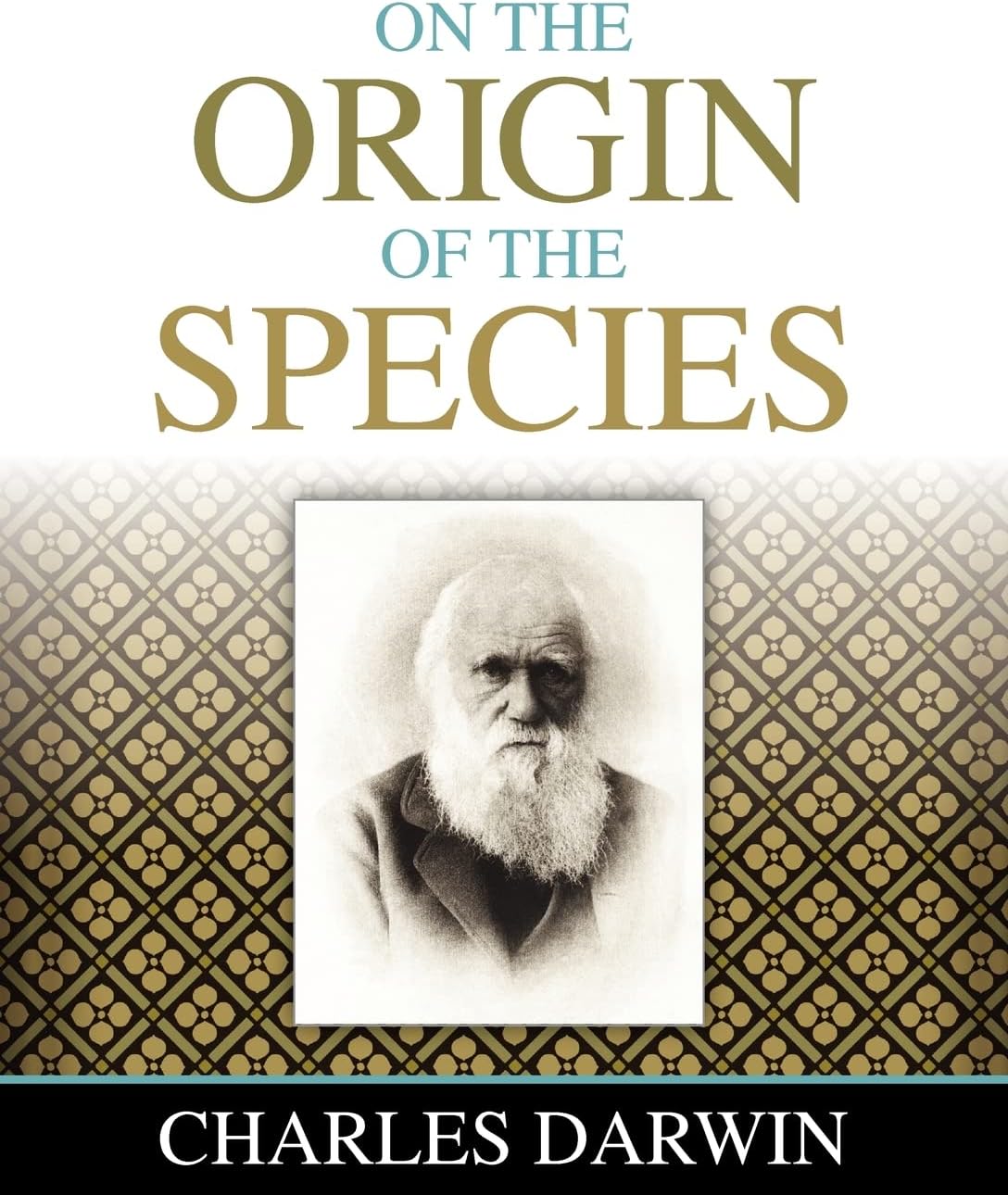
On the Origin of the Species
Product ID: 123913810
Buy anything from 5,000+ international stores. One checkout price. No surprise fees. Join 2M+ shoppers on Desertcart.
Desertcart purchases this item on your behalf and handles shipping, customs, and support to Thailand.
In 1831, naturalist and geologist Charles Darwin joined the Beagle expedition to Tierra del Fuego. What he observed when he got to the new world would eventually lead him to formulate his theory of natural selection. Published in 1859, “On the Origin of the Species” is the controversial classic that revolutionized natural science and altered our understanding of the world.
| Best Sellers Rank | 6,165 in Biology (Books) |
| Dimensions | 20.32 x 1.85 x 25.4 cm |
| Isbn 10 | 1619491303 |
| Isbn 13 | 978-1619491304 |
| Item Weight | 640 g |
| Language | English |
| Print Length | 320 pages |
| Publication Date | 17 Dec. 2011 |
| Publisher | Empire Books |
User
Of surpassing interest and value
This is, as noted, the first edition of probably the single best known science text and undoubtedly one of the most important books ever written. And it's free. Are we done here?Seriously, this book was the genesis of the modern-day wedge between science and religion, it is one of the most important books ever written even if your faith precludes your actually accepting a single word it says (and I know plenty of sincere Christians who have no problem with the idea of evolution by natural selection). It's also a fascinating study in the style and manner of 19th Century scientific writing; it was the ultimate pop science book of its day and as a study in the history of popular scientific discourse is as indispensable as Micrographia.And you can have it free on your Kindle.If you're still reading then I guess you're just waiting for the download, right?
User
I love Darwin
As Evolution is one of the most corroborated theories in Science why would I not recommend the Origin of Species. When reading it now Darwin's approach to science is a bit too subjective and outdated when compared with research today. However, his motivation to understand and the practical manner in which he carried out his observations were ahead of his time. From reading this book you can very clearly see that he was a lot more than a Philosopher sitting in an armchair. Furthermore, this book is free and quite refreshing to read when comparing it with some illegible recent publications. I would recommend this to anyone who would like to understand a bit more about Evolution and Darwin whether you plan to read the whole book or just a chapter.
User
Hard read but fascinating
If you're expecting a rollicking good read with great writing, skip a century and get Dawkin's books instead. As a fan of evolution and science history, this is a must. You really feel Darwin building his argument from basics for a hostile audience, sloooowly sneaking more and more hints of evolution into the book. You also see how much hard work went into checking out his ideas - he became an expert pigeon breeder, and spent years learning all sorts of selective breeding history from agriculture experts.Don't forget Alfred Russell Wallace was figuring it out at same time too but history relatively forgets him.
User
Origin of the species
5 star is all I could really give this book. It really opens your mind to the true connections of every living creature that's ever lived on our planet. I always had a fair average knowledge on evolution but this book showed me how geographical distribution and other such things also play a massive part in the variations of organic life. I recommend this book to people that want to learn the truth of the living world and what to get away from the false claims of the theory of a creator and how Charles Darwin's ideas that are backed up with great theories and evidence, put things in a manner that makes most sense.
User
brilliant
Charles Darwin is a genius. well, he was a genius. this book is a book i had been after for a long time. it is all about how we on this earth evolved. if you are in the least bit interested about where we came from, then this is the book for you. it really goes against the belief of our being here because of one entity. careful not to offend. Darwin caused great offence with his writings but they are true and we now know so many things because of him. great read don't miss it.
User
Nice to read the original
I read Dawkins like I need to pass exams but it is nice to read the book that started it all. I have read in reviews that this version is incomplete - perhaps this is true, it is hard to tell without checking elsewhere, although it is definitely missing diagrams as would be expected from a community-sourced book.It has that going-over-the-same-thing-more-than-once style (inherited by Dawkins) that occasionally annoys and occasionally helps.I am still reading it but I have learned a thing or two and clarified other things. It definitely re-inforces the view - so obvious now - of the method by which life came to be as it is now.He selects difficult cases, says often that he cannot understand how such an animal came to be but always says that, just because he doesn't know doesn't mean that Natural Selection isn't the cause - just that he cannot work out how it occurred and that someday, someone will.Given the recent news that yet another strange adaptation which perplexed people (and was presumably used as a anti-evolution argument - an oxymoron of the highest order), that of the reason that some insects like the hover fly don't look much much more like wasps, which they impersonate to avoid being eaten. It transpires that, since they are a small meal, worth little effort, that they only need to be passingly like a dangerous insect to keep predators well away. Any extra 'effort' made to be more wasp-like is largely wasted and better spent on more productive (ie reproductive) efforts.Anyway, read it if you are into science reading in general, evolution in particular or if you are studying in this area of course.
User
Well worth a download.
A fantastic, detailed book discussing scientific theories in a very easy to read, civilian way. Diagrams would have been helpful but are not essential. Lots of interesting facts and ideas. Glad I downloaded it - it's one of those books that you make reference to without ever reading. The Kindle Top 100 Free list is very good for reading those sorts of books!
User
Probably the biggest scientific idea since Galileo. I bought ...
Probably the biggest scientific idea since Galileo. I bought two copies 30 years ago and gave one to someone I met in the US who was unhappy with the whole idea of evolution. Sadly, I don't know if it was ever read. I think everyone should at least see a copy and wonder at how the ideas (pre-genetics) were formulated to bring us a theory of how species come into being in particular environments.
User
Interesting read!
Pretty good read!
User
Tudo o que um clássico merece
Essa edição em capa dura é incrível. Essa capa exibida no anúncio é, na verdade, uma caixa de ótima qualidade que envolve o livro. Este tem um visual clássico, com uma capa dura em estilo antigo e uma ótima diagramação. O livro acadêmico mais importante de todos os tempos não podia ter uma edição mais caprichada.
User
Un classico
Un classico. Conosciuto universalmente, ho potuto acquisirlo a costo zero. Consiglio questo testo a tutti coloro che desiderano leggere l'opera originale di Darwin
User
Impressive, Beautiful, Luxurious edition, with many illustrations
What a surprise when I received this book. This edition is very impressive. Luxurious and beautiful, the paper is high quality, the printing is perfect and it comes with an elegant slip-case for protection. It's been many years that I hadn't seen a book in such high quality. This is the way that all books should be made.This Hardcover edition makes this work of Charles Darwin a good cumpliment.Well worth the money: it's actually cheap when compared with other similarly priced editions.The font size is a bit on the small side, but the reading is very pleasing. It could come with a built-in bookmark.
User
A work of dazzling originality
After reading the first edition of the great man's work, I can state with confidence Darwin was a great theorist and a daring and innovative thinker. Which is admittedly a bit like saying that Einstein was quite intelligent or that Galileo had a few good ideas in his day. Still, with Darwin's originality and his very character often under attack, it's good to actually read the man himself and realize that in this case conventional wisdom is conventional because it's true.The idea of evolution itself was not original, and many obtuse critics of Darwin naively point to the existence of pre-Darwinian evolutionary ideas in order to claim that he was merely a plagiarist. But Darwin's original conception was that evolution was a *population-level* process occurring among varying individuals and that this population-level process occurred by the statistical overrepresentation of some variants due to early death or failure to beget offspring. The centrality of this to understanding evolutionary theory today cannot be overemphasized. Darwin's statistical insights in biology were no less revolutionary in their implications and discombobulating to his contemporaries than Ludwig Boltzmann's insights were in the field of thermodynamics. Prior to and even for some time after Darwin, evolution was seen as a process driven by some kind of inner striving or by some motive force pushing individuals to ever 'higher' or more 'complex' forms. Darwin's conception did away with not only any need for the design argument and special creation, but also with any need for these mystical forces and strivings that supposedly made evolution possible.People often say you can read the first half of the book, or even just the first four chapters (up to "Natural Selection") and understand Darwin's thought. Perhaps you can understand natural selection, but for my money the most dazzling originality comes in the latter half, where Darwin lays out the case for evolution in the most convincing manner. This was the section that wowed his contemporaries and led to evolution -- but not necessarily natural selection -- being accepted nearly overnight. If I were on the fence about evolution vs. special creation, Darwin on biogeography ("Geographic Distribution") alone would have been sufficient to convince me. It would have thrilled Darwin to see that his insights have been picked up on and expanded by the development of plate tectonics, which solves his most problematic cases. At one point Darwin writes, "The affinity, which, though feeble, I am assured by Dr. Hooker is real, between the flora of the south-western corner of Australia and of the Cape of Good Hope, is a far more remarkable case, and is at present inexplicable: but this affinity is confined to the plants, and will, I do not doubt, be some day explained." This affinity was very well explained by the discovery that South America, Africa, Antarctica, the Indian subcontinent, and Australia were all joined in a single land mass called Gondwana. Southwestern Australia and the Cape Peninsula of South Africa were once near neighbors.Darwin is equally convincing in the discussion of biostratigraphy ("On The Geological Succession of Organic Beings"). Why should we see a consistent pattern of fewer and fewer modern species, then fewer and fewer modern genera, fewer and fewer modern families, and so on, as we go down deeper into the fossil record? Why do these fossil forms show affinities to each other and to the creatures now living on top of them? Creationists try to explain biostratigraphy by means of two hypotheses from "flood geology": "higher" organisms outran the "lower" ones from the increasing floodwaters, and hydrodynamic sorting explains the rest. But neither of these fit the facts. If marine fossils on mountains are supposed to be evidence for Noah's flood, why don't we find human fossils and artifacts in these same mountainous layers? Did the flower-bearing plants (angiosperms) outrun the cone-bearing plants (conifers)? Did both outrun the ferns and mosses? And if hydrodynamic sorting explains the fossil record, why does it show the pattern of fewer and fewer modern species, genera, etc. as one goes further down? Have we all been getting smaller and lighter over history -- including the blue whale? Why don't we see whale fossils mixed in with benthic (bottom-dwelling) trilobites? Why do we see microfossils (pollen, diatoms, foraminifera, etc.) exhibit the same patterns as the larger fossils when they're all roughly the same size and should have all floated to the top?The number of issues evolution resolves but no other view can is simply astonishing when one begins to contemplate them. That was Darwin's argument and his key concern. He saw with tremendous clarity both what his own theory implied for the existing real-world observations of naturalists and what they might accomplish for the natural sciences in the future. Here too he was ahead of his time because 150 years later we're still doing work, often in fields Darwin couldn't even conceive of, by using evolutionary principles. It's Darwin's world and we're just living in it.
Trustpilot
1 day ago
2 months ago