

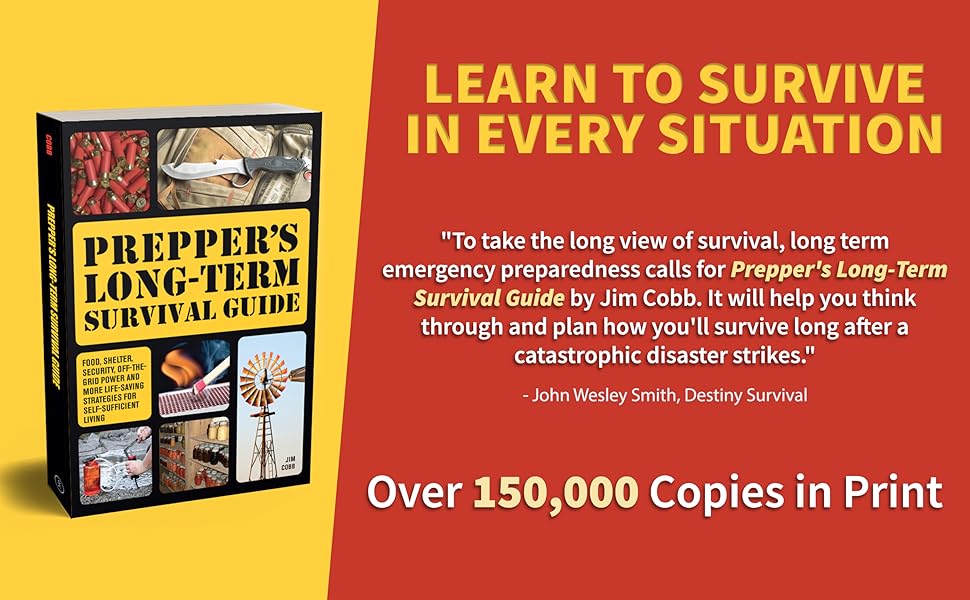
Prepper's Long-Term Survival Guide: Food, Shelter, Security, Off-the-Grid Power and More Life-Saving Strategies for Self-Sufficient Living (Books for Preppers)
Product ID: 1273710
Buy anything from 5,000+ international stores. One checkout price. No surprise fees. Join 2M+ shoppers on Desertcart.
Desertcart purchases this item on your behalf and handles shipping, customs, and support to Thailand.
Prepare your home and family for any life-threatening catastrophe with this step-by-step survivalist guide filled with techniques, strategies, and DIY projects from a lifelong prepping expert. The preparation you make for a hurricane, earthquake or other short-term disaster will not keep you alive in the event of widespread social collapse caused by pandemic, failure of the grid or other long-term crises. Government pamphlets and other prepping books tell you how to hold out through an emergency until services are restored. This book teaches you how to survive when nothing returns to normal for weeks, months or even years, including: Practical water collection for drinking and hygieneStoring, growing, hunting and foraging for foodFirst aid and medical treatments when there’s no doctorTechniques and tactics for fortifying and defending your homeCommunity-building strategies for creating a new society Review: Great book for anyone who wants to be prepared for self-reliance!!! - So, where do I start? I am not a prepper. Actually, I did not even know what a prepper was until I read this book. So, you are probably wondering why I even bought it. Well, I'm getting to that point in life where I am thinking of retirement in the next ten years. I would like to find some property out of the city...away from everything. Just tired of traffic, tired of barking dogs, tired of hit and runs, tired of loud music - you get it. With living on a large plot of land, I have been keeping in mind that I need to have some things to be prepared. I'm looking at moving to Montana, and, with the thought of being snowed in a for a while, I wanted to make sure that I was prepared. I thought this book was fantastic. I hope we never need to prep for a major catastrophe, but this book provided some very good and useful knowledge. The author started off with discussing some major historical events that - if they happened in today's age or in populated areas - we could be in trouble and being prepared may mean survival. The author provided enough detail for each chapter on things to think about and some steps to take to prepare. We all need water and food to survive, having the right tools and security, and thinking about medicine and hygiene challenges. What I particularly liked is that there is a comprehensive, seven page checklist of items to have. The book covered the items that I had thought of (such as having plywood handy for windows in case you need to cover them - again, I'm thinking Montana having a window out and needing to get it covered so a bear doesn't wander in), and then touched on lots of things I hadn't thought of. The author goes into how to create potable water and the best types of seeds for growing vegetables. The checklist is very handy as something for me to start with and modify as I start to prepare for my retirement in the country (aka wilderness). Even though it may be classified as a book for prepppers, I think this book also has a lot of great information for someone who may need to think about issues, challenges, and possible problems that may be encountered if you do not have the modern conveniences that society currently offers and ways to deal with those. It is an easy read and well written. I spent one Sunday and read the entire book from cover to cover. I will definitely be reading through this again and use it as a reference too. Review: Superb introcution to the topic of long-term survival - I found this book to be a superb introduction to the subject of long-term survival. Cobb moves through the relevant issues, starting with the most important (e.g., water and food), and then proceeding to matters of lesser importance (e.g., barter and trade). While not a comprehensive or "definitive guide" (and I doubt there is any such thing), Cobb provides plenty of good information to get you thinking, and get you started. I have been through 2 significant earthquakes (Loma Prieta and Northridge), an ice storm, a wind storm (2 weeks without power for both the ice storm and the wind storm), a volcano (Mount St. Helen's), and a forest fire, not to mention many snow storms and a flood situation. I am now well prepared for up-to a month without power or services. But lasting 6 months or more? That's a whole different matter. And I think Cobb does a good job of getting you thinking about what you have, and what you might need, to last for 6 months or more. There are a ton of resources out there, but the problem is in knowing where to start, depending on your particular situation. And I think this is where Cobb really shines. He pretty much directs his book to surviving in a suburban setting, and to be frank, those are the folks who are mostly likely curious about survival, who are not currently prepared, and need some guidance on where to start. In the event of a world-changing event, urban dwellers will probably be toast (relying on whatever crumbs they can get from FEMA and the like), and rural dwellers are already pretty much prepared (or should be). So consider this "the suburban's guide to getting started in thinking about long-term survival". The "Checklists" at pages 171-177 are also very helpful in getting you thinking about supplies you might need. I am relatively new to this whole subject, and obviously have a lot to learn. Cobb's book got me started in what I believe is the right direction. As a final comment, unfortunately the top-rated desertcart review of this book (a one-star review) takes the author (Cobb) to task for perhaps being off-point on some particulars. My response to that review is as follows: the reviewer seems to be missing the entire point of Cobb's book, which is not to provide readers with a comprehensive "survival guide", but rather to get readers thinking about their own particular situation, and then for the readers to perform further research which might help them to survive in their own particular situation. Cobb's book is merely an introduction (and a good one at that) for those of us who are starting to seriously think about the topic of long-term survival.


| Best Sellers Rank | #70,888 in Books ( See Top 100 in Books ) #47 in Survival & Emergency Preparedness #93 in Sustainable Living #93 in Hiking & Camping Instructional Guides |
| Customer Reviews | 4.5 out of 5 stars 8,316 Reviews |
C**E
Great book for anyone who wants to be prepared for self-reliance!!!
So, where do I start? I am not a prepper. Actually, I did not even know what a prepper was until I read this book. So, you are probably wondering why I even bought it. Well, I'm getting to that point in life where I am thinking of retirement in the next ten years. I would like to find some property out of the city...away from everything. Just tired of traffic, tired of barking dogs, tired of hit and runs, tired of loud music - you get it. With living on a large plot of land, I have been keeping in mind that I need to have some things to be prepared. I'm looking at moving to Montana, and, with the thought of being snowed in a for a while, I wanted to make sure that I was prepared. I thought this book was fantastic. I hope we never need to prep for a major catastrophe, but this book provided some very good and useful knowledge. The author started off with discussing some major historical events that - if they happened in today's age or in populated areas - we could be in trouble and being prepared may mean survival. The author provided enough detail for each chapter on things to think about and some steps to take to prepare. We all need water and food to survive, having the right tools and security, and thinking about medicine and hygiene challenges. What I particularly liked is that there is a comprehensive, seven page checklist of items to have. The book covered the items that I had thought of (such as having plywood handy for windows in case you need to cover them - again, I'm thinking Montana having a window out and needing to get it covered so a bear doesn't wander in), and then touched on lots of things I hadn't thought of. The author goes into how to create potable water and the best types of seeds for growing vegetables. The checklist is very handy as something for me to start with and modify as I start to prepare for my retirement in the country (aka wilderness). Even though it may be classified as a book for prepppers, I think this book also has a lot of great information for someone who may need to think about issues, challenges, and possible problems that may be encountered if you do not have the modern conveniences that society currently offers and ways to deal with those. It is an easy read and well written. I spent one Sunday and read the entire book from cover to cover. I will definitely be reading through this again and use it as a reference too.
J**D
Superb introcution to the topic of long-term survival
I found this book to be a superb introduction to the subject of long-term survival. Cobb moves through the relevant issues, starting with the most important (e.g., water and food), and then proceeding to matters of lesser importance (e.g., barter and trade). While not a comprehensive or "definitive guide" (and I doubt there is any such thing), Cobb provides plenty of good information to get you thinking, and get you started. I have been through 2 significant earthquakes (Loma Prieta and Northridge), an ice storm, a wind storm (2 weeks without power for both the ice storm and the wind storm), a volcano (Mount St. Helen's), and a forest fire, not to mention many snow storms and a flood situation. I am now well prepared for up-to a month without power or services. But lasting 6 months or more? That's a whole different matter. And I think Cobb does a good job of getting you thinking about what you have, and what you might need, to last for 6 months or more. There are a ton of resources out there, but the problem is in knowing where to start, depending on your particular situation. And I think this is where Cobb really shines. He pretty much directs his book to surviving in a suburban setting, and to be frank, those are the folks who are mostly likely curious about survival, who are not currently prepared, and need some guidance on where to start. In the event of a world-changing event, urban dwellers will probably be toast (relying on whatever crumbs they can get from FEMA and the like), and rural dwellers are already pretty much prepared (or should be). So consider this "the suburban's guide to getting started in thinking about long-term survival". The "Checklists" at pages 171-177 are also very helpful in getting you thinking about supplies you might need. I am relatively new to this whole subject, and obviously have a lot to learn. Cobb's book got me started in what I believe is the right direction. As a final comment, unfortunately the top-rated Amazon review of this book (a one-star review) takes the author (Cobb) to task for perhaps being off-point on some particulars. My response to that review is as follows: the reviewer seems to be missing the entire point of Cobb's book, which is not to provide readers with a comprehensive "survival guide", but rather to get readers thinking about their own particular situation, and then for the readers to perform further research which might help them to survive in their own particular situation. Cobb's book is merely an introduction (and a good one at that) for those of us who are starting to seriously think about the topic of long-term survival.
H**S
Great book for people wanting somewhere to start
I'm not sure what the prepping experts with the bad reviews thought a 180 page book was going to tell them that they didn't already know! This book seems to be a great starting point for people like my family who are just beginning to move from small disaster preparedness to a more long term mind set preparation. I love how the author gives book recommendations within the different subjects so that, for example, my husband who is more in charge of firearms and defense can research more, and I who like food and medicine can get books with that specific knowledge. He touts being diversified, and not just prepared for one type of scenario. If an EMP disables all electronics, your vehicle is not going to be available for bugging out will it, but? If a super volcano eruption creates a year or two of mini ice age and acid rain, you're not going to be able to grow gardens or have as many animals to hunt or food to forage. He talks about pros and cons of many kinds of ways to live after a worldwide collapse. As he says in the book, it's going to be practically impossible for one or just a couple people to learn and master all the skills necessary for every type of long term disaster possible. It's a great book to get you thinking. Thinking about what kinds of scenarios you believe are most likely, what talents and skills you can bring to the table, and how to start. Prepping can be an overwhelming idea with the materials and expenses, and more people would perhaps try to learn about it if they could start with a quick read like this to set up a plan. My criticism of this book would be that he is a little too kid glove with the threats, especially those faced by women, but you can tell from the section on firearms he knows he may be speaking to the kind of people who don't even own a gun yet. The book is meant to encourage people into this, not scare them away because they don't already "know" what they need to do.
S**I
This book could save your life in time of a national emergancy
As many people have written on reviews, this is pretty much a basic book with not a lot of new ideas, but does have some helpful advice. Before you think you will not buy it, think again. If we have a EMP go off and there is no electric, water, or anything else, what would you do? Would you be able to rationalize and organize your self to help and save your family? Very doubt full as everyone will be scared and no one will know where to start. But, if you keep this book with your emergency supplies, you will be ahead of the game. Everyone in your family will be able to refer to this book to get things done the right way and that's what's so important. Yes, right now as you sit in your easy chair, you know how to start a fire, hunt, and bandage people. Could you do this when we have no electric, inability to travel, and you need to protect your family? Do you expect them to sit calmly and relax while you take care of things? Hardly! Get this book, read it, and put it with your emergency supplies. This book could save you and your families life at a time of extreme emergency. Do you know what to do to keep proper hygiene? What about water, and food. What do you need? Are you ready to defend your property against intruders who want your supplies? Do you have what you need to barter to get what you need? What good is money with no economy? I sincerely pity the people who don't have this book. Its a small price to pay for saving you and your families life if the day ever comes when you need it. This is more like an insurance policy than a book. We live in a dangerous world with unstable countries that have nuclear capacity that could change our life forever! Be prepared and keep this book where everyone will be able to get to it!
A**E
Great overview of preparing for a disaster
I bought this book looking for some reasonable tips on preparing for unexpected disasters. As a financial planner who advises clients on preparing for the future, I wanted a good book to think through some of the issues that might come up in a disaster scenario. I view it like insurance in that you can buy as much insurance as someone will sell you to try to protect your family against the risks of death, disability or sickness. But there is usually a sweet spot where you "get the most bang for your buck" considering the overall risks. For me, it is preparing for an event that will disrupt your life as you know it for 6 months or less. Sure there is a possibility that disasters will be much worse and could last years or decades. But that kind of preparation can get expensive and is less likely to happen than a shorter term disruption in my view. And if you prepare for a 6 month disruption, at least you will have some time to go to plan B. With that in mind, I thought this book was great because it got me thinking about what my family would need to prepare for a shorter term dislocation. And I think the biggest value is working with my kids on some self-sufficiency skills that will benefit them even if I'm fortunate enough to avoid a life altering disaster. My 11-year old son and I have already bonded a lot over planting a garden; getting comfortable with various firearms and learning how things work without electricity. As the book title suggests, Cobb helps you think through making a list of what you need to survive and he gives a lot of specific recommendations. Well worth the investment of money in my view.
J**N
This book also is very useful if you own a home or are able to ...
If you plan on living in the city after a grid-down no-power survival experience, this book is made for you. I, however, will not be waiting around in my apartment in this ghetto neighborhood for somebody to kick my door in while I'm sleeping and I don't have the ability to stand watch 24 hours a day. This book also is very useful if you own a home or are able to beat the vast amount of bums into one after the chaos ensues. It is entirely based upon living around all of the other desperate human beings an everything that comes along with that human nature survival instinct type of situation. Fitting in, trading, cooking, protecting, and all sorts of other very practical methods for making it by. Jim is very, very knowledgeable about surviving in the wake of a catastrophic event. Even if you're like me and plan on being a woodsman, this is a must-read. No matter how you roll the dice, it is a must-read and must-keep. In addition, he provides several referrals to must-read books and resources. Like going on a guided tour and learning how to make use of the wild right outside your front door. I will be doing just that! The main point I think he wants everybody to know is: Do what you can, while you can, before you can't. Again, read this book and take or leave what you will! Jim: do you have a book about surviving in the woods? I understand your recommendation to avoid gong it alone, but simply cannot stomach the idea of crapping in a bucket in a boarded up house, surrounded by humans in survival mode who are just waiting for the opportunity to kill me and my daughter and take everything we have.... The diseases that people have, ugh just all of it. We are woods people! Always will be. Far far away from others, far far away from help too... Sigh.
J**.
Do you think you're prepared?
Being a child of Ronald Reagan's 1980's M.A.D. world, I grew up with an interest in post apocalyptic fiction. It was hard not to, back then. As a kid I was pretty sure the evil Soviets were just around the corner, ready to wipe us off the face of the earth. Turned out I didn't need those fall out shelter plans I ordered, back then, but those many post-apocalyptic books (Guardians, Deathlands, Traveller, The Stand... my library is filled with these) led me down a path of having an interest in prepping. Many of the prepping books I've run across over the years are geared towards surviving for a few days or months after an event like a hurricane or terrorist attack. They are books with the basic premise that life will, one day, return to normal. Jim's book, Prepper's Long-Term Survival Guide, isn't that book. It's not a book about how to construct a B.O.B. (Bug Out Bag), nor is it a book filled with checklists of what your family will need to survive a few days without power, though it does have great, comprehensive checklists. Just think longer term. Jim's book goes well beyond that, and is a overall guide to what you need to get your mind wrapped around if things never went back to normal. Imagine losing electricity, plumbing, and police forever. Prepper's Long-Term Survival Guide isn't just a reference manual, it's a change in the way you think about prepping. It envisions a bigger picture where the modern trappings of our world, electronics, instant communications, and even toilet paper are gone. The book covers topics ranging from Food Storage, Medicine, Security, and even Entertainment. The book starts you on the path of realizing what you're missing from your preps, and is a great guide to putting you on the road to fixing those issues in your longer term planning. Each chapter starts with a fictional snippet, relating to the chapter topic, from a world where the power has gone off and won't come back on. I love these. I'd love to see a fictional book from Jim based off his vast wealth of knowledge in the emergency preparedness arena. The writing is clean and crisp. Jim does a great job of breaking down complicated topics into an easily read and understood fashion. You don't have to be an expert on the covered topics in order to understand what Jim is laying out. Prepper's Long-Term Survival Guide is a great addition to any prepper Library. Just make sure you read and understand it before you need it.
J**E
Needs more pictures!
His books are OK. They need more photos, people like photos.
L**A
Very practical and down to earth
Jim Cobb's practical and non-preachy overview of disaster preparedness is an excellent read. While some of his recommendations are not useful for someone living in an apartment (see his upcoming book on urban prepping for that), he covers a lot of ground in simple language. You will understand what you need to do, and why. Granted, the section on weapons may be less appealing to Canadians, but his reasoning is grounded in practicality, not political ideology. Nor does he recommend buying gear just to have all the toys. This is a book grounded in real life potential scenarios (seeming almost prescient at times) that also recognizes real world constraints such as budgetary limitations. I highly recommend this book, especially to a novice.
L**0
Brilliant
So much useful information
S**E
Bring on the apocalypse
Great starter guide...
S**E
Nul
Pas d’information concrète dans ce livre et c’est pourtant mon premier livre sur le sujet. Je pensais quand même apprendre quelques astuces pour stocker de la nourriture ou de l’eau etc. ici que des trucs de base qu’un esprit sain a déjà bien compris. Des trucs qui ont l’air carrément faux comme les conserves qui se gardent « un an » lol.
C**L
Interesante
Interesante y completo
Trustpilot
1 month ago
1 month ago