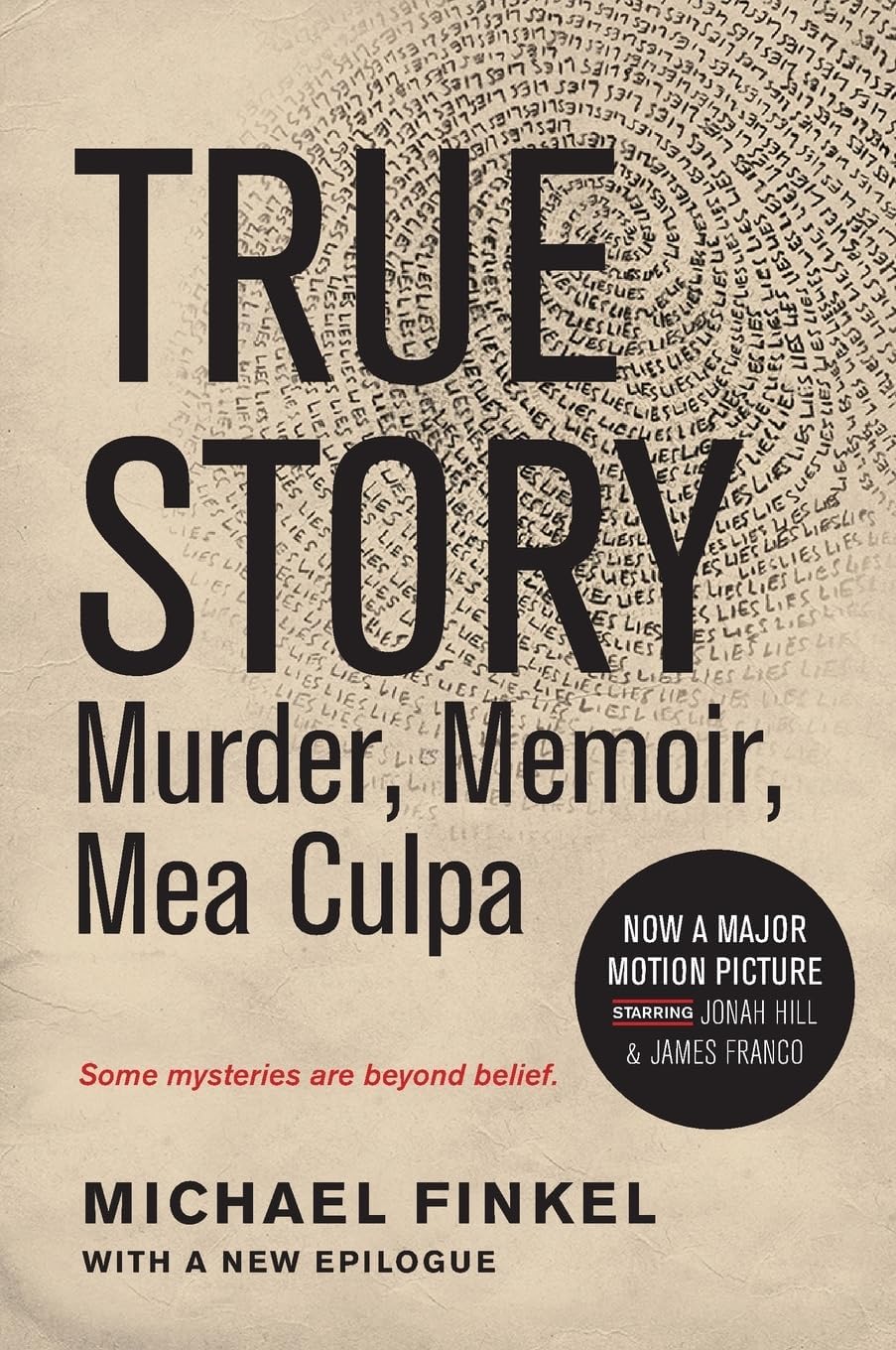
True Story tie-in edition: Murder, Memoir, Mea Culpa
Product ID: 13960073
Buy anything from 5,000+ international stores. One checkout price. No surprise fees. Join 2M+ shoppers on Desertcart.
Desertcart purchases this item on your behalf and handles shipping, customs, and support to Thailand.
The improbable but true story of a man accused of murdering his entire family and the journalist he impersonated while on the run In 2001, Mike Finkel was on top of the world: young, talented, and recently promoted to a plum job at the New York Times Magazine. Then he made an irremediable slip: Under extraordinary pressure to keep producing blockbuster stories, he fabricated parts of an article. Caught and excommunicated from the Times, he retreated to his home in Montana, swearing off any contact with the media. When the phone rang, though, he couldn’t resist. At the other end was a reporter from the San Francisco Chronicle, whom Finkel congratulated on being the first in what was sure to be a long and bloodthirsty line of media watchdogs. The reporter was puzzled. In Waldport, Oregon, Christian Longo had killed his young wife and three children and dumped their bodies into the bay. With a stolen credit card, he fled south, making his way to Cancun, where he lived for several weeks under an assumed identity: Michael Finkel, journalist for the New York Times. True Story is the tale of a bizarre and convoluted collision between fact and fiction, and a meditation on the slippery nature of truth. When Finkel contacts Longo in jail, the two men begin a close and complex relationship. Over the course of a year, they exchange long letters and weekly phone calls, playing out a cat-and-mouse game in which it’s never quite clear if the pursuer is Finkel or Longo―or both. Finkel’s dogged pursuit of the true story pays off only at the end, in the gripping trial scenes in which Longo, after a lifetime of deception, finally tells the whole truth. Or so he says. Review: The Journalist and the Killer: Lives Strangely Linked - This is a compelling and disturbing book. Author Michael Finkel tells both his own story and that of Christian Longo, who was convicted of killing his wife and three children in Newport, Oregon in December 2001. Their lives became intertwined when Longo fled to Mexico following the killings. There, he adopted the identity of a journalist whose work he had read and admired: Michael Finkel. Then came a twist of fate no screenwriter could get away with. As Longo was being escorted back to the U.S. for trial following his arrest, the New York Times Magazine announced it was dropping the real Finkel as a regular contributor because he had created a composite character for one of his stories. (Disclaimer: I have a strong personal interest in the Longo case. I covered the killings, his arrest and trial as a radio news reporter; my apartment is a two-minute walk from the condominium where the killings took place. As the trial unfolded, we in the press were aware that Longo was in regular contact with Finkel, though he had turned down all other requests for interviews.) Finkel wrote a letter to Longo in jail, explaining that he wanted to know why he had assumed his identity. This led to weekly hour-long telephone conversations between the two men and a regular correspondence that stretched to more than a thousand pages on Longo's part. Although both men pledged complete honesty to each other, neither kept that vow. Finkel came to realize that each was using the other. Seeing some of his own worst qualities magnified in Longo, Finkel was looking for a form of personal and professional redemption. Longo, meanwhile, was using Finkel as a sounding board for the persona and story he would present to the jury. In the beginning, Finkel went out of his way to give Longo the benefit of the doubt, despite strong evidence linking him to the killings. In the end, when Longo stood exposed for the despicable liar that he was, Finkel found himself unable to make sense of a supremely senseless act. If there's any frustration for the reader--at least this reader--it's the discovery that there are no answers in these pages to help make any better sense of this tragedy. Longo may be beyond redemption, but Finkel is not. He's an obviously talented writer who has brought to life a tragic event in all its awful detail.-William C. Hall Review: Fascinating true crime story - First off, I have say that I feel that Finkel used this book to talk about getting fired from the New York Times. Every other chapter, for at least the first half, is an explanation for why he did what he did and how sorry he is. Yes, this ties into the Longo story slightly. But I like the way they handled this in the movie. It was acknowledged in the beginning, and then they moved on. As for the rest of it, I really liked it. I enjoyed both the book and the movie. I find the Longo murders to be very interesting, and Finkel's relationship with Longo himself is fascinating. It's like you're right there with Finkel, along for the ride: is Longo a good guy who made some bad choices? Or is he playing everyone? This is a great read. Highly recommended for true crime buffs.
| Best Sellers Rank | #233,401 in Books ( See Top 100 in Books ) #36 in Journalism Writing Reference (Books) #210 in Serial Killers True Accounts #362 in Crime & Criminal Biographies |
| Customer Reviews | 4.3 out of 5 stars 1,654 Reviews |
C**L
The Journalist and the Killer: Lives Strangely Linked
This is a compelling and disturbing book. Author Michael Finkel tells both his own story and that of Christian Longo, who was convicted of killing his wife and three children in Newport, Oregon in December 2001. Their lives became intertwined when Longo fled to Mexico following the killings. There, he adopted the identity of a journalist whose work he had read and admired: Michael Finkel. Then came a twist of fate no screenwriter could get away with. As Longo was being escorted back to the U.S. for trial following his arrest, the New York Times Magazine announced it was dropping the real Finkel as a regular contributor because he had created a composite character for one of his stories. (Disclaimer: I have a strong personal interest in the Longo case. I covered the killings, his arrest and trial as a radio news reporter; my apartment is a two-minute walk from the condominium where the killings took place. As the trial unfolded, we in the press were aware that Longo was in regular contact with Finkel, though he had turned down all other requests for interviews.) Finkel wrote a letter to Longo in jail, explaining that he wanted to know why he had assumed his identity. This led to weekly hour-long telephone conversations between the two men and a regular correspondence that stretched to more than a thousand pages on Longo's part. Although both men pledged complete honesty to each other, neither kept that vow. Finkel came to realize that each was using the other. Seeing some of his own worst qualities magnified in Longo, Finkel was looking for a form of personal and professional redemption. Longo, meanwhile, was using Finkel as a sounding board for the persona and story he would present to the jury. In the beginning, Finkel went out of his way to give Longo the benefit of the doubt, despite strong evidence linking him to the killings. In the end, when Longo stood exposed for the despicable liar that he was, Finkel found himself unable to make sense of a supremely senseless act. If there's any frustration for the reader--at least this reader--it's the discovery that there are no answers in these pages to help make any better sense of this tragedy. Longo may be beyond redemption, but Finkel is not. He's an obviously talented writer who has brought to life a tragic event in all its awful detail.-William C. Hall
M**S
Fascinating true crime story
First off, I have say that I feel that Finkel used this book to talk about getting fired from the New York Times. Every other chapter, for at least the first half, is an explanation for why he did what he did and how sorry he is. Yes, this ties into the Longo story slightly. But I like the way they handled this in the movie. It was acknowledged in the beginning, and then they moved on. As for the rest of it, I really liked it. I enjoyed both the book and the movie. I find the Longo murders to be very interesting, and Finkel's relationship with Longo himself is fascinating. It's like you're right there with Finkel, along for the ride: is Longo a good guy who made some bad choices? Or is he playing everyone? This is a great read. Highly recommended for true crime buffs.
A**R
EXCELLENT
This is an excellent book on two fronts: one, the author's mea culpa...... and two, a true crime story. I had already read most of the details of the Christian Longo murders in Carlton Smith's book, but it was no problem reading them again because the crimes were so dastardly and this book so well written. I also was curious about the author's so called crime of inventing parts of a piece he wrote for the New York Times. So, after reading the author's account of his "crime" (which alternates in this book with Long's horrific crimes), plus the account of the NY Times and others, I do not see evidence of a crime of any sort. For all those writers (journalists) who think they are being totally truthful and tell the truth and nothing but the truth, have they forgotten that "there is nothing new under the sun" (Ecclesiastes 1:19) and that therefore all writing is in some way pilfered from other sources. For Finkel, who is a fine writer, to have been fired for what he did is as ridiculous as historian Doris Kearns Goodwin's name being smeared in a hateful manner for doing something similar. How on earth can a story be told, any story, without using something that is not entirely new? There are only so many ways the scant letters of our alphabet can be arranged. That being said, this is a very readable book and I wish the best to the author and hope to read more of his works soon. Hopefully, the shunning of Finkel, Goodwin and others will soon halt in the face of common sense.
K**R
5 Stars for writing, 1 Star for an attempted double-whammy con job.
Finkel is a good writer. I believe he accurately reported the content of the letters and phone calls he shared with Longo. However, I am very sceptical of his and Longo's revelations of their innermost thoughts and feelings. They're both con artists in their own way. I've read that approx. 4% of people have sociopathic tendencies. Most are on the lower end of the scale: liars, cheaters, people who create havoc in the lives of their friends and families over and over and don't really seem to care. Then, of course, there is the far end of the spectrum where you find the Ted Bundys and John Wayne Gacys. (For the record, I am not a mental health professional and am only relating what I have read). I believe Longo is on the extreme end. Finkel', for all his assertions of remorse, new self_awareness, etc. attempted to con readers throughout the book. At the end of the trial he writes the single word, B***S****, on his notepad, expecting us to believe that only at that moment did he have an epiphany. He was conning Longo the whole time, fully intending to drop him like a hot potato as soon as he had his story. Of course, Longo was conning him, too. And I was stunned that no one seemed to comprehend why Longo killed his family! For the same reason that so many other convicted sociopaths have done it: they get trapped in a web of lies, cheating, crime, and when they finally find themselves going under from the pressure or on the verge of being revealed as scumbags, the only way they feel they can save themselves is to quickly rid themselves of the wives (and sometimes the children) who are millstones around their necks. Fortunately they are never as smart as they think they are and their hubris leads them to believe they can con people about murder as easily as they have conned everyone about financial p problems, infidelity, etc.
R**M
Disturbing, Weird, Creepy - and Unputdownable
Michael Finkel is a failed journalist who’s been fired from the prestigious NY Times for filing a false story. Chris Longo is a mass murderer - of his wife and three children. They are both, at least to some degree, narcissists who are able to justify their bad acts and move on without too much of a look back. The story of how they came to know each other is weird and creepy, and the weirdness and creepiness escalate as they establish a written and later telephonic and personal relationship. Eventually, Longo is tried for the murders and, eventually, both Longo and Finkel move on - sort of. If this sounds like an absurd and just too weird book, it is. But it is fascinating and, apparently, true. I almost literally couldn’t put it down, even though both characters are repugnant to some degree. So much better than Finkel’s current best-seller, The Art Thief.
P**D
Fascinating and Bizarre
Now here's a strange situation. The author was well on his way to becoming a first class journalist, with pieces published in the best press. Then he went and messed himself up royally by phonying up a story about folks in Africa. Got caught. Got fired. Went into deep depression. Then he finds out that this dude who killed his whole family has escaped to Mexico and taken on his persona.. WHAT? Yes, and the two of them embarked on a long-term correspondence which is the story in this book. Very well written and just as bizarre as you might imagine. And a great insight into the true nature of a psychopath.
E**I
An unusual story well told
I knew parts of the Michael Finkel story. I also knew parts of the Chris Longo story. I definitely remember reading about him spending time in Mexico on a beach with a German woman. But like so many stories that get filtered through a media lens, the stories were somewhat distorted. I didn’t think very highly of a reporter who was fired for falsifying a story. And my initial thoughts about that same reporter writing a book about a supposed connection with an accused murderer seemed too convenient. I was wrong on both accounts. I found both stories fascinating. I knew parts of the Michael Finkel story. I also knew parts of the Chris Longo story. I definitely remember reading about him spending time in Mexico on a beach with a German woman. But like so many stories that get filtered through a media lens, the stories were somewhat distorted. I didn’t think very highly of a reporter who was fired for falsifying a story. And my initial thoughts about that same reporter writing a book about a supposed connection with an accused murderer seemed too convenient. I was wrong on both accounts. I found both stories fascinating. Not long after his ignominious departure from the Times, Finkel learned that an accused murderer was using his identity while on the run in Mexico. Thus began a relationship between Finkel and the man who stole his identity, Chris Longo. While Longo awaits trial for the murders of his wife and three small children, Finkel visits Longo in prison and the two begin exchanging letters. Slowly a portrait of a psychopath emerges. Longo has only a high school education and no skills, but he has a family to support. He can’t stand the thought of failure. So, he invents success through lies and deceit. He writes bad checks because he needs money for his family and his failing business. He steals an SUV because his wife always wanted one and he wants to be seen as a good provider. Finkel tells Longo’s story while at the same time reflecting on his own indiscretions and the mistake that cost him his job. Here’s how Finkel sums up Longo’s story. “My year with Longo made me see how a person’s life could spiral out of control; how one could get lost in a haze of dishonesty, and how these things could have dire consequences.” Throughout the book Finkel leaves Longo’s guilt or innocence in question. This part memoir, part portrait of a psychopath, is also a murder mystery. You want to know hat happened and why. As it turns out, Longo gives three different versions of what happened to his family. And since Longo is the only one who knows the truth, you’re left to decide on your own which version is correct.
L**A
Interesting book
Easy read
S**L
Read in one sitting
Watched the movie first and felt it did not do justice to the story that was behind it. Mike Finkel should have started his career as a biographer rather than as a reporter. Superb narration, full of emotions.
M**C
Very egocentric
I prefer not to use the word 'narcissistic' because it is nowadays overused, but this story is not about the main character, Longo, but about the attonement of the author himself, about the Times affair. The author learns to dislike Longo over time, because he understands he has been using him. The same way and for the same reason, I have come to dislike the author and his selfishness with writing this book about himself. Not worth the time. I've finished it out of curiosity for the resolution of the case, which I did not want to look in Google. The case itself is horrendous. A very sad and troubling true story.
U**4
Da leggere
Libro bellissimo, in lingua originale è utilissimo per ampliare i propri orizzonti circa la lingua inglese. Finkel qui geniale.
T**R
Tolles Produkt 👌
Tolles Produkt 👌
H**K
Five Stars
A good read and a fascinating insight into the mind of a killer.
Trustpilot
3 weeks ago
2 weeks ago