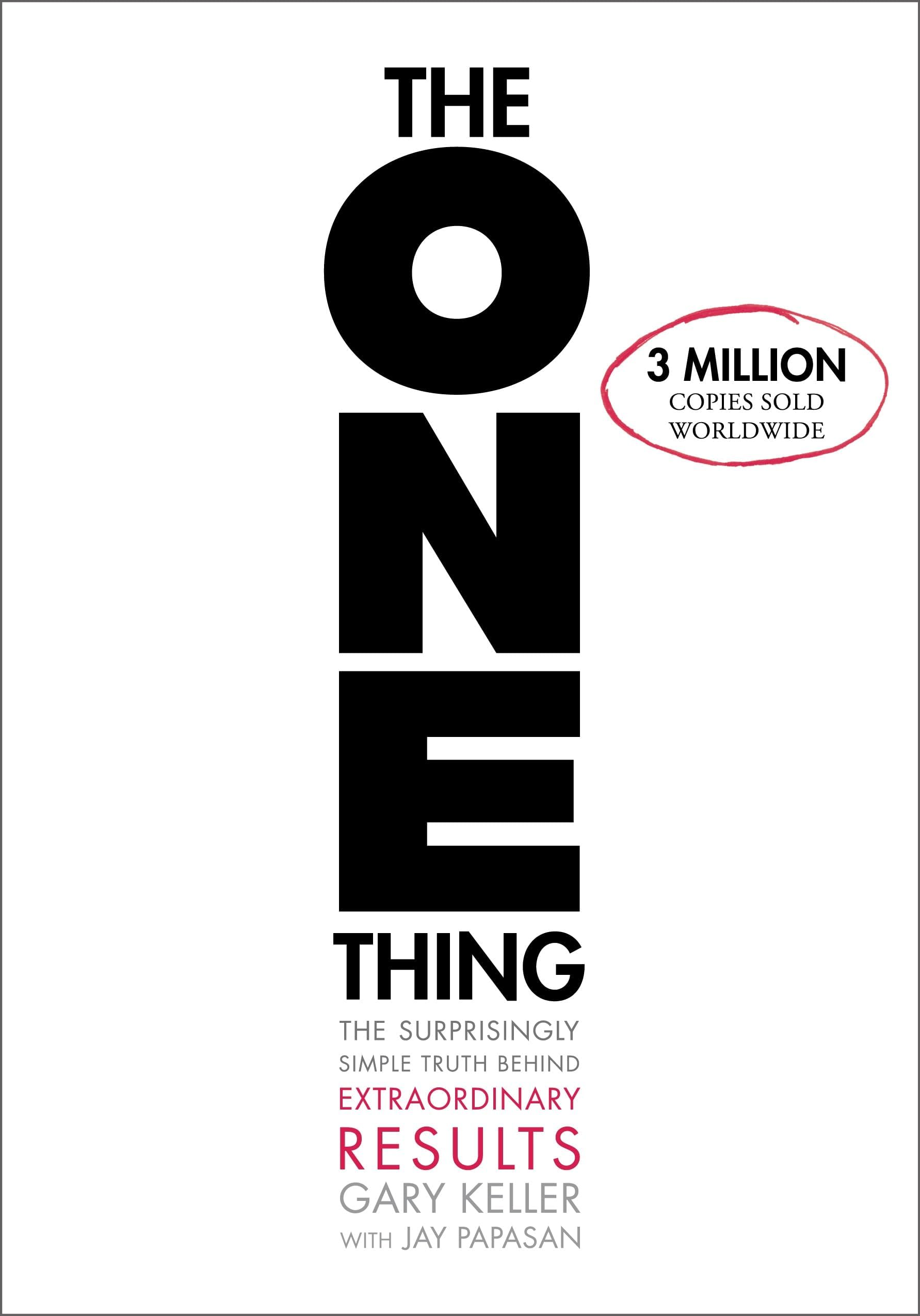
The ONE Thing: The Surprisingly Simple Truth About Extraordinary Results
Product ID: 1415428
⭐4.6/5 from 21,478 reviews
📈Top #6 in Time Management
📚Bestseller #2,141 overall
Buy anything from 5,000+ international stores. One checkout price. No surprise fees. Join 2M+ shoppers on Desertcart.
Desertcart purchases this item on your behalf and handles shipping, customs, and support to Thailand.
🎯 Focus on the ONE Thing that makes everything else easier — don’t get left behind!
The ONE Thing by Gary Keller and Jay Papasan is a bestselling guide that reveals how extraordinary results come from focusing on the most important task. With a 4.6-star rating from over 21,000 readers, it combines scientific research, practical advice, and mindset shifts to help professionals prioritize, build productive habits, and achieve breakthrough success in work and life.


| Best Sellers Rank | #4,310 in Books ( See Top 100 in Books ) #7 in Time Management (Books) #41 in Success Self-Help #144 in Personal Transformation Self-Help |
| Customer Reviews | 4.6 out of 5 stars 21,718 Reviews |
B**A
Great book
I found The ONE Thing to be an incredibly insightful and motivating read. The concepts are simple, practical, and immediately applicable to both personal and professional life. It really helped me rethink how I prioritize my time and energy. The authors do an excellent job of breaking down the importance of focusing on what truly matters instead of getting overwhelmed by endless to-do lists. The central message is powerful: identifying the one most important task can create extraordinary results over time. The writing is engaging, easy to follow, and filled with actionable advice. I walked away with a clearer mindset, better productivity habits, and a renewed sense of direction. If you're looking for a book that can genuinely improve your focus and effectiveness, this is absolutely worth reading. Highly recommended!
S**N
Structure your passion into results
Have you ever watched people whose careers and lives seem to be driven by one central passion and wondered how they do it? In The One Thing, entrepreneur Gary Keller explains how to make that happen in your life – if you’re willing to take the journey. The first step is to identify what your “one thing” is. Are you a writer? Or an organizer? Or do you start businesses? What field are you interested in? At first, the answers seem obvious, but upon further introspection, many of these answers aren’t so clear. Deciding who you are – that is, learning self-knowledge – is a key first step to your journey. Next, you need to learn time management. Especially at first, life is usually not amenable to big dreams. We have responsibilities and tasks to do that get in the way of pursuing our one thing. Keller recommends deliberately blocking off several hours each day to the one thing. He cites writer Stephen King as an inspiration. He blocks off about four hours to write each day. What’s impressive is that he started this habit while working a full-time job as a young man when his schedule was not centered around writing. As he mastered his trade and his life, more freedoms came. You don’t have to quit your “day job” to pursue your one thing; you just have to structure your time enough around engaging in the task. I also found Keller’s comments about “work-life balance” thought-provoking. He says that balance should not be the goal. Rather a “counterbalance” of pursuing both life and work ambitions should be a goal. I might describe this perspective as a work-life synergy. At times, either end of the spectrum might predominate, but we just can’t stay at one end or the other too long lest we neglect the other end. His overall goal is to master the one thing. He cites the famous 10,000-hour challenge to master complex tasks as a guide. Mastery takes time and deliberate effort. Both have to win priority – that is, first place – in one’s life. Mastery begins as a youth, but often adult life overwhelms our attempts at mastery. Blocking off time and not letting interruptions dominate are key steps to achieving mastery over a domain. I personally recommend the audiobook version of this book as an option for those inclined to learning by listening. Music is incorporated in the display, and the overall project displays good technical mastery itself. I enjoyed listening to it as I went about my weekend chores. Overall, this book offers more than inspiration: it offers a plan to make your life more deliberate and more structured around what matters most to you. The “one thing” doesn’t have to be something that inspires awe. Rather, it can be any task that you want to intensify your focus to master. Maybe more mastery is only a few steps away if you’re willing to walk along the journey…
C**L
It's good, not amazing. A lot of obvious stuff.
It's a bestseller, so of course it's not a bad read. But a lot of the points are really simple, and not too mind-blowing. It's written as if following the tips in this book will completely change your life... Mehhhh. It's a good read, but I wasn't as enthusiastic as its author, Gary Keller. It covers a lot of really basic things, and gets a little repetitive sometimes. For example: X was famous. X's story is blah blah blah. X was famous because he prioritized and focused. Y was famous. Y's story is blah blah blah. Y was famous because he prioritized and focused. Z was famous. Z's story is blah blah blah. Z was famous because he prioritized and focused. He mentions all the obvious famous people and their stories. Bill Gates. Steve Jobs. Oprah Winfrey. Sam Walton. Geez. Yes, they're famous, and yes they probably prioritized and stuff. But it goes on and on and on. He does have a lot of other points, but by the end I was getting bored. Most of his sentences were words of enthusiasm or repetition rather than new original ideas. And he does have a lot of ideas. Those ideas don't require much explaining though. He probably spends dozens of pages on "focusing" alone. I know that the whole book is about prioritizing, but... geez. A lot of droning on about this whole "ONE Thing" idea. Like I said, it's a great book, but by the end I was getting a little bored. Some other advice is just really basic, like time management, and putting your time into blocks. Thinking big instead of thinking small. They're all good points, but you could sum of the whole entire book in like, one page with bullets. And that's how I feel about the book. It's great, but could be condensed into just a page with bullets. It's like one of those books that's better for skimming rather than deep reading. Just skim the hell out of it, take those "bullet-point ideas" and finish from it.
R**A
Great book about achieving extraordinary results by focusing on what's important
Gary Keller proposes a framework for achieving extraordinary results in work and in life in general. The author’s premise is that extraordinary results are directly determined by how narrow you can make your focus, or more precisely, by focusing on the One Thing. "[Achievers] have an eye for the essential. They pause just long enough to decide what matters and then allow what matters to drive their day. Achievers do sooner what others plan to do later and defer, perhaps indefinitely, what others do sooner. The difference isn’t in intent, but in right of way. Achievers always work from a clear sense of priority." The author explains how getting things done is not a matter of discipline but of developing habits that will help you focus on the task at hand. Discipline is needed to acquire the habit, but we cannot run on discipline in the long term. Achieving extraordinary results requires making extraordinary efforts. In that sense, Keller does not believe in a balanced life as a goal to be achieved or a state of balance, but in counterbalancing your life as an every day reality, an act of balancing. "If you think of balance as the middle, then out of balance is when you’re away from it. Get too far away from the middle and you’re living at the extremes. The problem with living in the middle is that it prevents you from making extraordinary time commitments to anything. In your effort to attend to all things, everything gets shortchanged and nothing gets its due. Sometimes this can be okay and sometimes not. Knowing when to pursue the middle and when to pursue the extremes is in essence the true beginning of wisdom. Extraordinary results are achieved by this negotiation with your time." "One day you finally come to understand that work is a rubber ball. If you drop it, it will bounce back. The other four balls—family, health, friends, integrity—are made of glass. If you drop one of these, it will be irrevocably scuffed, nicked, perhaps even shattered." The book mentions the now-more-known Stanford Marshmallow Experiment by Walter Mischel, which relates the effect of delayed gratification and developing grit with outcome and success in different areas in life. Keller also cites Carol Dweck‘s research on growth-mindsets vs fixed mindsets as an example of how your perception of things strongly affect what you can achieve: "Dweck’s work with children revealed two mindsets in action—a “growth” mindset that generally thinks big and seeks growth and a “fixed” mindset that places artificial limits and avoids failure. Growth-minded students, as she calls them, employ better learning strategies, experience less helplessness, exhibit more positive effort, and achieve more in the classroom than their fixed-minded peers. They are less likely to place limits on their lives and more likely to reach for their potential" Keller’s framework is constructed on applying what he calls the Focusing Question to the different areas of your life: What’s the ONE Thing I can do such that by doing it everything else will be easier or unnecessary? "Productivity isn’t about being a workhorse, keeping busy or burning the midnight oil…. It’s more about priorities, planning, and fiercely protecting your time." "To stay on track for the best possible day, month, year, or career, you must keep asking the Focusing Question. Ask it again and again, and it forces you to line up tasks in their levered order of importance. (…) you can drive yourself nuts analyzing every little aspect of everything you might do. I don’t do that, and you shouldn’t either. Start with the big stuff and see where it takes you. Over time, you’ll develop your own sense of when to use the big-picture question and when to use the small-focus question." Answers to the Focusing Question come in three categories: doable (something that is already within your reach), stretch (at the farthest end of your range), and possibility (an answer that exists beyond what is already known and being done). “Highly successful people”, explains Keller, “choose to live at the outer limits of achievement. They not only dream of but deeply crave what is beyond their natural grasp.” The Focusing Question, however, is not enough. Adopting the mindset of someone seeking mastery is needed (the commitment to becoming your best, and embrace the effort it represents). "More than anything else, expertise tracks with hours invested. Michelangelo once said, 'If the people knew how hard I had to work to gain my mastery, it wouldn’t seem wonderful at all.'" You will also need to deal with the natural ceiling of achievement with a purposeful mindset (not accepting the limitations of our natural approach as the last word), and learn to be accountable for the outcome of your lives (in contrast with being a victim of the situation). This is essential —according to Keller— to achieve extraordinary results. "If you have to beg, then beg. If you have to barter, then barter. If you have to be creative, then be creative. Just don’t be a victim of your circumstances." Almost finishing the book, Keller warns the reader against the four thieves that can stand in our way to extraordinary results. The inhability to say “No” , the fear of chaos —”pursuing your One Thing moves other things to the back burner (…) chaos is unavoidable. Make peace with it. Learn to deal with it”— , poor health habits, and an environment that doesn’t support your goals. I enjoyed reading the book and strongly agree with most of what the author proposes. You can use the framework “as-is” or adapt it to suit your needs
G**F
Read This
This is the Third best professional guidance book in my library. I own it in hardback and Audible. I highly recommend reading this book. I would say to read Essentialism, The Responsibility Ethic, and then this book. Well worth it and you will revisit it multiple times.
J**N
10 Tweetable Quotations
Never done this before! Right there—on page 117—was a stunner-of-a-statement that went immediately from the book to my brain, to my laptop, to my printer, and now it’s big and bold on my office door: "Until my ONE Thing is done—everything everything else is a distraction." I’ve just read a powerful book, The ONE Thing: The Surprisingly Simple Truth Behind Extraordinary Results, by Gary Keller with Jay Papasan. This bestseller will certainly be on my Top-10 book list for 2016, and is already a contender for my 2016 book-of-the-year. But first—an apology. The ONE Thing waited patiently on my overflowing “books-to-read” shelves for three years. Then recently, it popped back onto The Wall Street Journal business bestsellers list. (OK. OK. I’ll read it!) But I apologize because you (and I) could have been much more productive over these last three years. So sorry—but better late than never. Gary Keller, chairman of the board and cofounder of Keller Williams Realty, Inc., the largest real estate company in the U.S., has seen his share of failures and successes—and that’s how he discovered The ONE Thing. He writes, “Where I’d had huge success, I had narrowed my concentration to one thing, and where my success varied, my focus had too.” Here’s Keller’s big idea: "What's the ONE Thing you can do this week such that by doing it everything else would be easier or unnecessary?" Read his chapter titles and you’re hooked. The first section highlights six lies that mislead and derail us: • Lie #1: Everything Matters Equally • Lie #2: Multitasking • Lie #3: A Disciplined Life • Lie #4: Willpower Is Always on Will-Call • Lie #5: A Balanced Life • Lie #6: Big Is Bad The second section addresses the focusing question, the success habit (66 days), and the path to great answers. The final section motivates with unusual clarity on the four thieves of productivity: • Thief #1: Inability to Say “No” • Thief #2: Fear of Chaos • Thief #3: Poor Health Habits • Thief #4: Environment Doesn’t Support Your Goals Well…I promised you 10 tweetable quotations. (I know—somewhat ironic that I have over 20 quotations in a book review about The ONE Thing.) On a short plane ride, I winnowed hundreds of PowerPoint-worthy insights down to just 35—just before I landed. I’ve given you three already—and here are 20 more (but who’s counting?). Tweet your 10 favorite! On rabbits, to-do lists, and irrelevancy: • "If you chase two rabbits, you will not catch either one." (Russian proverb) • "Instead of a to-do list, you need a success list—a list that is purposefully created around extraordinary results." • "...it turns out that high multitaskers are suckers for irrelevancy." On a “balanced life” and productivity: • "A 'balanced life' is a myth—a misleading concept most accept as a worthy and attainable goal without ever stopping to truly consider it." • "'Don't put all your eggs in one basket is all wrong.' I tell you ‘put all your eggs in one basket, and then watch that basket.'" (Dale Carnegie) • "Productivity isn’t about being a workhorse, keeping busy or burning the midnight oil. ... It's more about priorities, planning, and fiercely protecting your time." (Margarita Tartakovsky) On goal-setting, accountability, and coaching: • "Accountable people receive results only others dream of." • "When Arthur Guinness set up his first brewery, he signed a 9,000-year lease." • "Earlier I discussed Dr. Gail Matthew's research that individuals with written goals were 39.5 percent more likely to succeed. But there's more to the story. Individuals who wrote their goals and sent progress reports to friends were 76.7 percent more likely to achieve them." • “Ericsson’s research on expert performance confirms the same relationship between elite performance and coaching. He observed that ‘the single most important difference between these amateurs and the three groups of elite performers is that the future elite performers seek out teachers and coaches and engage in supervised training, whereas the amateurs rarely engage in similar types of practice.’” On saying no: • “Someone once told me that one ‘yes’ must be defended over time by 1,000 no’s.” • In the two years after Steve Jobs returned to Apple in 1997, “he took the company from 350 products to ten. That’s 340 no’s, not counting anything else proposed during that period.” On time-blocking and buckets to focus on The ONE Thing: • "Build a bunker. Turn off your phone, shut down your email, and exit your Internet browser. Your most important work deserves 100 percent of your attention." • "My recommendation is to block four hours a day. This isn't a typo. I repeat: four hours a day. Honestly, that’s the minimum. If you can do more, then do it." • "If your time-blocking were on trial, would your calendar contain enough evidence to convict you?" • "The people who achieve extraordinary results don't achieve them by working more hours. They achieve them by getting more done in the hours they work." • "Paul Graham's 2009 essay, 'Maker's Schedule, Manager's Schedule,' underscores the need for large time blocks." • "Graham divides all work into two buckets: maker (do or create) and manager (oversee or direct)." •"To experience extraordinary results, be a maker in the morning and a manager in the afternoon. Your goal is 'ONE and done.’ But if you don't block each day to do your ONE Thing, your ONE Thing won't become a done thing." On books: "One of the reasons I've amassed a large library of books over the years is because books are a great go-to resource. Short of having a conversation with someone who has accomplished what you hope to achieve, in my experience books and published works offer the most in terms of documented research and role models for success." Warning! Keller: “After my wife, Mary, read this book, I asked her to do something. She turned to me and you know what she said? ‘Gary, that’s not my ONE Thing right now!’ We laughed, high-fived, and I got to do it myself!” Ready, set, TWEET!
Y**C
Incredible book. A must read.
I am not a huge book reader but this book is incredible. One of the few books that I actually read from beginning to end and still come back to it at times to review the notes. If you struggle with too many ideas/tasks in your life and wonder how to succeed focussing on the right things, this is the book for you.
C**N
A must-read for "Idea Factories"
I am an "idea factory," and this book has been a total game-changer for me. It offers a realistic framework and tools to get projects all the way across the finish line efficiently and effectively I first listened to it right before the pandemic, and it was the key to staying productive and hitting my goals while sheltering in place. I’m currently revisiting it for a refresh to tighten up my habits and get back to peak focus. It is just as relevant the second time around!
V**M
5 star
I didnt read this yet, but I have to give 5 star for physical quality, packaging and no damage.
M**N
Un principio fundamental que se nos escapa todos los días
El libro contiene un mensaje muy claro: Enfócate en hacer UNA Cosa, que al cumplirla, hará lo demás mucho más fácil o te quitará más cosas que hacer. Dice que apliques esto en tu vida personal, espiritual, laboral, en cada ámbito de tu vida. Muy sencillo de leer y además al final de cada capítulo tiene un resumen con los puntos más importantes. Realmente, un libro excelente
M**T
Un must!
Recomiendo este libro a quien quiera comprometerse con sus metas, sueños y objetivos sin perder el rumbo. Lo volvería a leer mil veces!!
A**L
Great book, super practical!
The idea of the book is good and shifts your mindset about how you need to work and organize your goals. The book gives you what you bought it for and then overdelivers. Big recommendation!
S**R
LIVRO PRÁTICO E CLARO
A tese do livro vai contra a opinião comum, de que as pessoas que executam multitarefas são mais produtivas, e defende com pesquisas e ideias que devemos ter um foco principal na vida, e nos concentrarmos neste valor principal, e sim, essas são as pessoas mais bem resolvidas. Considerei excelente, simples e harmonioso.
Trustpilot
2 weeks ago
1 week ago