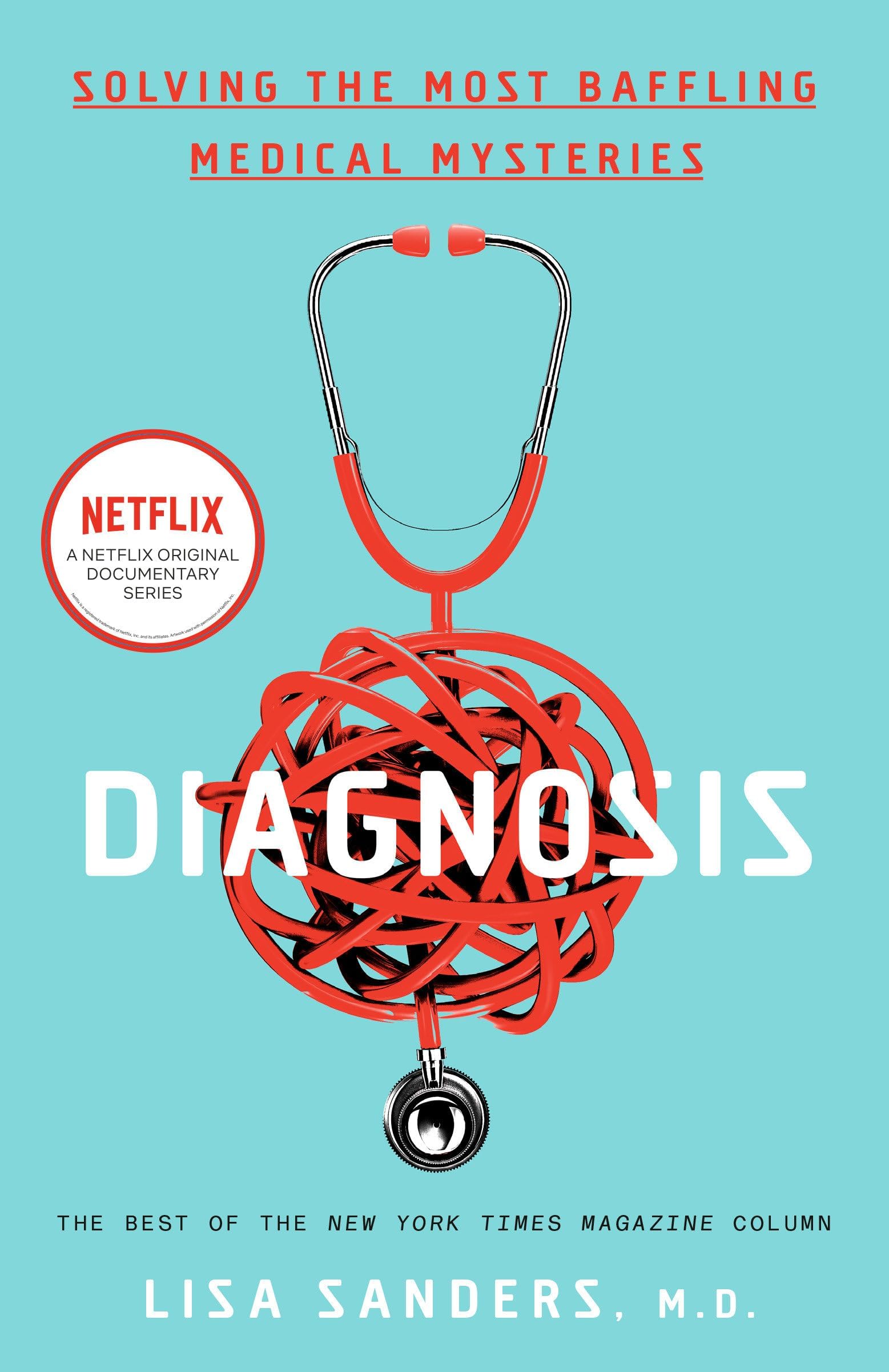
Diagnosis: Solving the Most Baffling Medical Mysteries
Product ID: 153160696
Buy anything from 5,000+ international stores. One checkout price. No surprise fees. Join 2M+ shoppers on Desertcart.
Desertcart purchases this item on your behalf and handles shipping, customs, and support to Thailand.
A collection of more than fifty hard-to-crack medical quandaries, featuring the best of The New York Times Magazine's popular Diagnosis column—now a Netflix original series “Lisa Sanders is a paragon of the modern medical detective storyteller.”—Atul Gawande, author of Being Mortal As a Yale School of Medicine physician, the New York Times bestselling author of Every Patient Tells a Story, and an inspiration and adviser for the hit Fox TV drama House, M.D., Lisa Sanders has seen it all. And yet she is often confounded by the cases she describes in her column: unexpected collections of symptoms that she and other physicians struggle to diagnose. A twenty-eight-year-old man, vacationing in the Bahamas for his birthday, tries some barracuda for dinner. Hours later, he collapses on the dance floor with crippling stomach pains. A middle-aged woman returns to her doctor, after visiting two days earlier with a mild rash on the back of her hands. Now the rash has turned purple and has spread across her entire body in whiplike streaks. A young elephant trainer in a traveling circus, once head-butted by a rogue zebra, is suddenly beset with splitting headaches, as if someone were “slamming a door inside his head.” In each of these cases, the path to diagnosis—and treatment—is winding, sometimes frustratingly unclear. Dr. Sanders shows how making the right diagnosis requires expertise, painstaking procedure, and sometimes a little luck. Intricate, gripping, and full of twists and turns, Diagnosis puts readers in the doctor’s place. It lets them see what doctors see, feel the uncertainty they feel—and experience the thrill when the puzzle is finally solved. Review: Very interesting book! - This book is SO interesting. It is very well written and easy to understand. Review: Fun Read for the Layperson - Written by a practicing physician, this book is filled with short chapters (4-5 pages, generally) that originally appeared as columns in The New York Times Magazine. These cover the roughly 5% of diagnoses that are difficult for doctors to make, simply because they are rare or have unusual presentations. For a person with no understanding of medical terminology, this book would be quite interesting because the author defines terms clearly. If the reader does have some knowledge of medical terminology, the explanations become redundant. Would not recommend for people in the medical field. The book would be enjoyed by people who enjoy medical shows on TV.

| Best Sellers Rank | #87,651 in Books ( See Top 100 in Books ) #19 in Science Essays & Commentary (Books) #47 in Medical Diagnosis (Books) #98 in Medical Diseases (Books) |
| Customer Reviews | 4.5 out of 5 stars 1,273 Reviews |
J**7
Very interesting book!
This book is SO interesting. It is very well written and easy to understand.
C**R
Fun Read for the Layperson
Written by a practicing physician, this book is filled with short chapters (4-5 pages, generally) that originally appeared as columns in The New York Times Magazine. These cover the roughly 5% of diagnoses that are difficult for doctors to make, simply because they are rare or have unusual presentations. For a person with no understanding of medical terminology, this book would be quite interesting because the author defines terms clearly. If the reader does have some knowledge of medical terminology, the explanations become redundant. Would not recommend for people in the medical field. The book would be enjoyed by people who enjoy medical shows on TV.
T**Y
Thinking outside the box
The author, herself a physician, presents cases with unusually diagnoses, in language lay person like myself can understand. She discusses the patients' symptoms and the effects they have, detrimentally, on the patients. The reader of her book is absorbed with the patients as people and and with their medical and lifestyle problems. There is the story of a patient with symptoms doctors can't explain. Many diseases are ruled out, even Lyme's disease. But it turns out patient does indeed have a tick-borne disease, one that is not susceptible to the medication that treats Lyme's disease, which medication she had been put on. In fact, the patient had Rocky Mountain Spotted Fever, from a different species of tick. Another patient with a myriad of symptoms that baffled doctors for a while turned out to have Schnitzler syndrome, wherein macrophages go wild and tell the body to act like it's infected. An expensive drug was available to treat it, but the patient's insurance company wouldn't pay for it. The doctor appealed to the drug manufacturer, which thereupon provided the drug to the patient for free. The patient then became symptom free. Another patient wound up having Lemierre's syndrome. It's a rare infection that was very fatal before antibiotics. Even now, with antibiotics, it's 18 percent fatal. It's caused by a strep throat going awry. It took month, but this patient recovered completely. There's a message from this case : take strep throat seriously. There can be serious side effects from prescribed medications. One patient was on allopurinol for gout. She developed an allergic reaction that affected the kidneys. She was on dialysis for weeks. The gout medication was stopped. The patient then rapidly improved. Another patient turned out to have a disease from flying squirrels. It was endemic typhus, a rare bacterial disease. Once diagnosed and treated, the patient recovered. A patient with mystifying symptoms was determined to have hereditary angioedema, a genetic anomaly . She was treated with steroids to prevent the swelling caused by the disease. Another patient developed symptoms that included tingling, numbness and an irregular heart beat. Turns out the patient had cinguatera poisoning from a barracuda fish he ate. The toxin therefrom came from organisms that grow on reef algae in some tropical waters. Cooking doesn't destroy the toxin. The symptoms can persist for months, even years. I only eat fish from cold water, fish such as cod,haddock, flounder, sole. In another case, s young woman with a medical problem that defied diagnosis, died. Her organs were donated. The recipient of her liver died within days of receiving the liver transplant. Turns out the dead donor had a rare genetic defect and was missing an enzyme that breaks down proteins and thereby allows ammonia to build up with fatal conclusions. A patient presented with pain,fever, and inflammation. She had familial Mediterranean fever, which caused malformed proteins. White blood cells overreacted. The patient was put on the medication colchicine,which prevents most attacks. The patient takes this medication regularly. I assume for life. Another baffling set of symptoms in another patient turned out to be Whipple's disease, caused by a bacterium. The patient was on antibiotics for more than a year. The patient was able to stop using a wheelchair, then able to put aside a walker, and even be able to walk without a cane -- but not far. And so it goes, one medical mystery after another in this compendium of interesting and challenging medical cases. I was enthrall despite my lack of a medical background. I love good detective stories, including medical ones. I recommend this book.
A**R
Even Zebras Need Their Day
I’ve been a fan of Dr Sanders’ Diagnosis columns in the New York Times where she tackles medical mysteries and seeks out the wisdom of the crowd (AKA crowd-sourcing). There is a similar column in the Washington Post called “Medical Mysteries” which similarly discusses those cases that doctors call zebras (from the dictum that if you hear hoof beats behind you think a horse and not the more unusual zebra) and on occasion, also does a crowd-source. But back to Dr Sanders book. Besides the writing, what I most enjoyed about the book that each patient’s story was short and to the point, not a lot of meaningless fluff. And the book also made a nice companion to the (late 2019) series on Netflix series “Diagnosis.” I enjoyed this book just as much as I enjoyed her previous book (not reviewed since it was a hardcover and I read it long ago — probably worth a re-read), Every Patient Tells a Story: Medical Mysteries and the Art of Diagnosis. She was a medical consultant for the late great TV show House and, as I recall, when I read that book, I was rather reminded of House as I was reading the book. The bottom line is, if you love medical mysteries as I do, especially zebras and other exotic disease presentations, then this is definitely the book for you. I gave it five enthusiastic stars and really can’t wait to re-read it.
I**A
Excellent collection
During the time I was reading this book, I was hospitalized and had an opportunity to talk to others about the book and various chapters. It was very interesting and I also enjoyed the Netflix series.
P**E
The mysteries of medicine
This book is a collection of the Diagnosis columns that have appeared in the New York Times for many years, and the book was issued to go along with the new TV series of the same name, based on the true stories of patients who perplexed their doctors. It's organized by symptom: fever, stomach ache, sore throat, headache...things that everyone experiences sooner or later. But in these columns, the diagnosis is never quite what you expect. Something that looks, sounds, and feels like flu turns out to be something else entirely. It's fascinating to read about the pathways doctors and patients take to define the cause of the illness. My favorite is when a diagnosis was achieved after a patient's son made an off-hand joke. If you are interested in medical case histories and the odd ailments that afflict people, you will enjoy this very much.
E**W
Great read
Great read. Highly recommend. Read it through audible
A**T
Disappointing
I had read 'Every Patient Tells a Story' and loved it so much that I distributed some copies to my friends. Having watched House, M.D., where the diagnosis is made when the patient is almost dying, I found these case histories are not much different. All are rare ailments which are not outright thought by the doctors. True, but in almost all cases, the patient s have been seen by a handful of different specialists, subjected to too many harmful investigations, before the diagnosis is made. Doesn't reflect competency of our physicians history taking and clinical skills. I was especially upset when a 94 year old lady with a history of vomitting, having one kidney removed, who was obviously dehydrated but her sodium was low was subjected to a highly dangerous procedure of contrast dye CT abdomen. She also had history of hypertension. Age, a single kidney, hypertension were all great risk factors for throwing her into contrast dye nephropathy. Why do so when serum sodium was already found low. The book could have been more interesting if Lisa Sanders also included patients coming in with common diseases with uncommon presentation. I am getting a gut feeling that the author was pushed by the publisher to write another book as fast as she could.
G**O
Excelente
Livro excelente!
C**R
A page-turner
If you like medical mysteries this is for you. The style of the writing carries you along and I had cut short one afternoon so that I could get back to carry on reading. I only wish it was much, much longer. I read it on Kindle so I can't estimate how many pages it had. All the medical mysteries were explained as the medics got to grips with the various tests, without being overly complicated for the lay person. I will have to seek out any other titles from this author.
B**E
👍
👍
C**.
Buena lectura para médicos clinicos
Me gustó
K**R
Fascinating stories
The content of the book was fascinating and explored a wide array of uncommon diagnoses. The book was well written and researched. The cases were quite short with some detail which is great for the average reader however I would have liked a little more detail on the mechanism of each illness. All in all this was a fantastic read.
Trustpilot
2 weeks ago
1 month ago