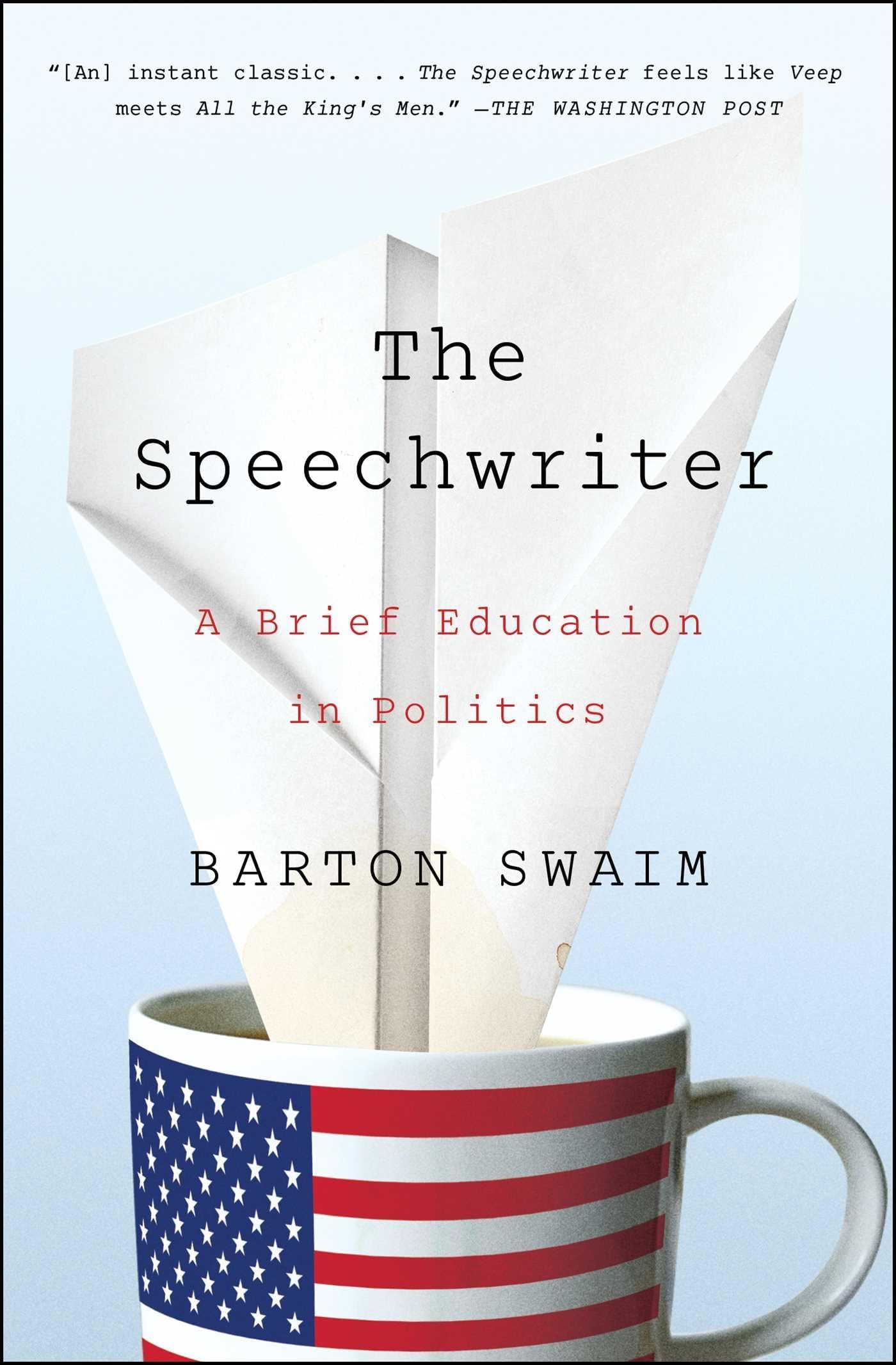
The Speechwriter: A Brief Education in Politics
Product ID: 163149449
Buy anything from 5,000+ international stores. One checkout price. No surprise fees. Join 2M+ shoppers on Desertcart.
Desertcart purchases this item on your behalf and handles shipping, customs, and support to Thailand.
The Speechwriter brings you inside the spin room of the modern politician in “a wry and eloquent memoir” ( The Wall Street Journal ) that is “the best book about politics I’ve read in years” ( GQ ) and “will become a classic” ( The Washington Post ). Everyone knows this kind of politician: a charismatic maverick who goes up against the system and its ways, but thinks he doesn’t have to live by the rules. Through his own experience as a speechwriter for a controversial governor, Barton Swaim tells the story of a band of believers who attach themselves to this sort of ambitious narcissist—and what happens when it all comes crashing down. As The Washington Post put it, “ The Speechwriter feels like Veep meets All the King’s Men —an entertaining and engrossing book not just about the absurdities of working in the press shop of a Southern governor but also about the meaning of words in public life.” Swaim paints a portrait of a boss so principled he’d rather sweat than use state money to pay for air conditioning, so oblivious he’d wear the same stained shirt for two weeks, so egotistical he’d belittle his staffers to make himself feel better, and so self-absorbed he never once apologized to his staff for making his administration the laughingstock of the country. On the surface, this is the story of one politician’s rise and fall. But in the end, it’s a story about us—the very real people who want to believe in our leaders and must learn to survive with broken hearts. The Speechwriter is “a wryly funny, beautifully written…dissection of what it is like to perform a thankless job for an unreasonable person in a dysfunctional office…A marvelously entertaining book. It’s clear [Swaim] spent a long time on it, because he’s made it look so effortless” ( The New York Times ).
| Dimensions | 5.5 x 0.56 x 8.38 inches |
| Edition | Reprint |
| Isbn 10 | 147676994X |
| Isbn 13 | 978-1476769943 |
| Item Weight | 7.2 ounces |
| Language | English |
| Print Length | 224 pages |
| Publication Date | July 5, 2016 |
| Publisher | Simon & Schuster |
User
not good literature but certainly an interesting book
This book was our book group selection for April 10, 2016. We all found the book interesting though not great literature. In general what we found interesting included the author revising his understanding of what it meant to be a good writer when faced with the need to adopt the voice of his boss and that that voice needed to speak to a particular conception of the audience the boss had that essentially required poor writing instead. This of course brings up the question regarding what good writing is when it obviously is context dependent. This book also shows what it is like working for a boss in one particular circumstance where the office is like a “fiefdom” as one of our group mentioned who had worked in similar circumstances. As Swaim points out it is a shame the character of the politician is not the same in both the face he presents to the public and to the staff. But here again there is the issue of context dependence. We are also given the clear indication this is a potentially successful politician that in the end was only hindered by a personal blunder that concerned his private life. We note as well that he remained governor of South Carolina and further serves in elected office as of our reading which means he is still successful and so probably treating staff as he had while presenting a different face to the voting public. So in this sense we also gain insights into this bipolar nature of at least one successful politician and wonder if it is a pattern repeated by others. Still another interesting aspect of the book concerns the voice of the governor as analyzed by Swaim and his fellow writers. Of note is the collection of words and phrases that were frequently used – so that a letter containing sentences of these in combinations “sounded” like the governor wrote it. It could even be difficult to know if one of the writers was responsible for a piece or if the governor had written it himself. In this regard I brought up the Postmodern Generator and the interesting question regarding Alan Sokal’s automatically generated works using the so called Dada Engine. Are we just using a data base which we run through an algorithm to produce a text? All in all, not good literature but certainly an interesting book which sparked an interesting discussion.
User
Down the rabbit hole in South Carolina
Pity the librarian's assistant. A miserable job some will endure much to escape. So it is with Barton Swaim, one-time speechwriter to Mark Sanford, former governor of South Carolina. All sorts of boorish behavior are just another day at the office, a bizarre workplace described with great humor and insight. Part memoir, part reflection upon politics and democracy, The Speechwriter is work on many levels. The insights fell fresh, the conclusions remarkably unbitter. At times it struck me as a bit self-serving but what memoir isn’t?Early days depict the thankless task of not improving speeches but learning to master catch vacuous or fatuous phrases. The Gov has an arsenal that when coupled with turgid prose make for positively goofy constituent letters, op ed pieces and talking points. I appreciated the insight that politicians are expected to comment upon a ridiculous number of topics and the best tactic is to avoid specifics and temporize.It’s not til two thirds in that we get to the salty tale of Sanford’s affair and public disgrace. The author doesn’t linger on the lurid but tells the story from the POV of Sanford’s staff-- how he damaged much more then himself with his arrogance and selfishness. The lesson learned is a practical one: never trust a politician. “…in his ruin he could not find more then the paltriest shred of genuine self-criticism.” It is a stunning and entirely believable observation.A very enjoyable read.
User
A well-written cheap shot is still a cheap shot
Mr. Swaim worked for three very, very unhappy years for Mark Sanford, and here is his account of why those years were so unhappy. Mr. Swaim tells the reader--repeatedly--about his doctorate in English and his writing skills, and spends even more time telling the reader about what an awful writer Mr. Sanford is. If you're a good writing nerd, and I kind of am, there's some good fun to be had in the mixed metaphors and dangling participles in Mr. Sanford's work.And Mr. Sanford seems to have been more than a bit of a jerk as a boss. He constantly interrupts Mr. Swaim as he is pitching ideas for speeches, and is regularly curt and dismissive. And the incident with the birthday cake is just astounding.It seems the crux of the problem is that Mr. Sanford wants his speeches written in a certain manner, and Mr. Swaim considers that manner bad writing and simply doesn't want write that way. Mr. Sanford and Mr. Swain go round and round until word gets back to Mr. Swain that he may be replaced, and then he gets with the program.The author assures the reader in the very beginning that this book is not written as payback or to settle scores. And then the author spends a great deal of time getting payback and settling scores. Certainly Mr. Sanford, if all in the book is true, is not a nice man to his staff. Everybody is under pressure of some sort, and it seems that most of us behave in a much better way towards others than Mr. Sanford does.At the same time, once I finished this and put it down I couldn't help but feel a bit of sympathy for Mr. Sanford. The author's outrage and disgust at Mr. Sanford's affair seems a bit much. Mr. Swaim is constantly telling the reader about his education and knowledge of history, and then he is shocked, shocked that his boss is having an affair. Really? Mr. Sanford does not handle the press conference about the affair in the right manner, but when is such a thing ever done in a good way?Mr. Swaim goes on and on about the mistakes Mr. Sanford made, about how he is a buffon, how he has a minor speech impediment--really, in 2015 we are still making fun of people with speech impediments?--and all sorts of other things. And yet--and the author kind of admits this--Mr. Sanford is out there in the ring and is trying and he is taking on some matters very principled stands and is taking lots of heat for doing so. Mr. Sanford is trying to lead, and Mr. Swaim is sitting there like a Monday morning quarterback, pointing out that Mr. Sanford should have said this or done that.It's a well-written book and it's a quick read. The best parts are in the reviews in the newspapers, but even so there's some good stuff in there. Mr. Swaim set out to paint Mr. Sanford as a monster--and he's not terribly kind to his co-workers either--but I actually came away with a bit of sympathy for the man.
User
A good look at a public life in turmoil...
Barton Swaim's memoir, "The Speechwriter: A Brief Education in Politics", is excellent reading for a political junkie. Swaim, who writes about his three years as a speechwriter for a certain South Carolinian governor - never mentioned by name - is as honest as possible about the ups-and-downs, the give-and-takes that a political staffer must make in his own moral life as he puts in 16 hour days working for a politician.People become elected officials for a variety of reasons, but most begin with the idea that they're going into politics to "help others". I think that as the years go by, the positives of the life go down and the negatives go up as the realities of the compromises of political life hit home. Governor Mark Sanford - a two term Republican governor of South Carolina - was a difficult individual to work for and with...and I assume to be married to. Never popular with members of the South Carolinian House and Senate, Sanford had what appears to be a displeasing personality. He had certain ideas and would not compromise them even for the purported good of the state. For instance, he opposed taking government stimulus money in 2009, even though it was for education. Who could be against education? Mark Sanford, evidently...But in the mid-2000's - while a sitting governor on a government trip to South America - Sanford met an Argentine journalist and he fell in love. Like a thunderbolt, he was hit by Maria Belen Chapur's beauty and charm, and began an extra-marital affair. A long, long distance extra-marital affair. His wife found out about it and in 2009, he took a trip to Argentina to see Chapur. As one who lost his good sense to lust and love, Sanford went missing for several days. His hapless office - where Barton Swaim was employed as a speechwriter - claimed Sanford was "hiking the Appalachian Trail". Sanford was discovered returning to Atlanta from Buenos Aires and the jig was up. Sanford gave a press conference, claiming he had met his true "soulmate", and embarrassing everyone who watched.Barton Swaim and his colleagues were put into difficult situations as Sanford finished up his term as the lamest of "lame duck" politicians. Never easy to work for, Sanford became even more quarrelsome and contentious to work for. Swaim writes a wonderful look at politics from a staffer's view. I was amazed at the perceptive way Swaim looked at "the governor" and at his own work. Very good book.
User
How not to be a boss 101
I was intrigued by The Speechwriter when it was first published but it sat on my to read list until the Republican National Convention. As I listened to the various speeches and then the controversy surrounding Melania Trump's speech, I was inspired to push Swaim's book to the top of the list.That decision proved to be worthwhile although not for the reasons I had expected. I am not completely sure what I had expected from the story other than a closer look at the life of a speechwriter and how decisions are made as to what goes into a speech. Swaim delivered that in a candid and entertaining manner. He is a skilled writer and as becomes clear early in the narrative, way too good of a writer for the person that employed him. As the story unfolds, it is also clear that the book is less about speech writing and more about life working for a tyrant of a boss. As I read I could not help but think his governor boss was the epitome of how not to be a boss and I wondered why Swaim continued to work for him.Speech writing is far from glamorous. Yet it also has a huge influence on how we - John and Jane Q. Public - view and interact with our politicians. Swaim's book is a great starting place to better understand that dynamic.
User
The Quality of Mercy Inside a House of Cards
This book seemed mostly to be about the power and beauty of language, and ultimately that's why I liked it so much. It was clearly a labor of love - a love for language. The writing carries with it a dual sense of what it's like to be shackled to the approval of politicians and constituencies and what's it's like to now sprint unfettered into the arms of a far more literate electorate - we the readers. So while the book elicits genuine, head shaking laughter, I also got to secretly applaud myself for reading it and getting to stand above the American political machine, while staring down into its extraordinarily dark heart.Brief and efficient, the book portrays everyone in the most human terms, from the Governor, to the insiders, to the voters. And leaving out or changing everyone's names (even though we all know - wink, wink) allowed these people to not just be from a particular state at a particular time, but from any state at any time. This is Machiavelli's "The Prince" for the 24 hour news cycle era. And as the language here portrays, politics can lift our eyes to what we want to believe, and still be rooted in worst kind of corruption and skulduggery. And most of us already know about both ends of our political animals, and openly admire their ambition, even as we indulge in our own self-satisfaction at their failings. This book allows you to do all of this but with flourish and style instead of bitterness and contempt.
User
Lurid, illuminating stories, fascinating insights
Absolutely fascinated with this book. It is by turns maddening, brilliant, inadvertently self-revealing. While the author is impossible to like (his politics are horrifying), it is impossible not to sympathize with him and his fellow employees. And he tells some of the most hilarious stories I've ever heard/read, often with great wit. I was alternately howling with laughter and howling from despair.
User
Are All Politicians Scoundrels?
"Speechwriter" is both informative and puzzling. Swaim is a young, idealistic English PhD with a new family who takes a job as a staffer to Gov. Sanford (who is never actually named in the book) of South Carolina. The Governor is portrayed as vain, ignorant, and verbally abusive. The stress makes Swaim physically ill and harms his family and the reader wonders why he stays. Even more puzzling is the odd loyalty he develops toward the humiliated Sanford after his public fiasco with his Argentine mistress. The book's treatment of Sanford's conceptual and semantic posturing is entertaining for a while but it is not resolved. The book doesn't deal with Sanford's rebirth in the House of Representatives. Did he change as a consequence of his experience? For me, the most interesting part of the book is a discussion the the final pages of the author's view, based on his experiences as a Sanford staffer, that in a democracy all politicians ultimately have to be untrustworthy to succeed. It would be really interesting to develop this concept based on something beyond Swaim's sample of one.
User
The Speechwriter: surprisingly compelling
Not a fan of politics, but love good writing. What a pleasure to read this book and benefit from Swaim's understanding of the system, expressed without affectation or guile. I learned a lot and laughed even more.
User
Writing on the AppalachianTrail
This is an entertaining insight into the practices of communication in politics. The book gives readers interested in the process of politics insights into the working lives of the drudges who write the letters, speeches and opinion pieces for elected officials, struggling to be vacuous in the "voice" of their boss. The book is also of value to readers interested in the practice of strategic communication, describing how the comms team dealt with the governor disappearing to Buenos Aires to hike the Appalachian trail. This episode gives the book its focus and is well used to highlight how post-crisis certain words became unusable, including "honesty", "integrity" and "Argentina", and the conflict between disenchantment with the governor and a reflexive defence of the governor from attacks by his enemies. Swaim writes beautifully, with a near perfect balance between capturing his subjective reactions and a description of the objective circumstances.
User
insightful
To all who've worked in the communications engine room, helping leaders present themselves to the public, Barton Swaim gives a voice. And while his Governor's antics may be extreme, the tantrums, inanity and ego all strike a chord. Should be compulsory reading for all trainee political aides and PR people.
User
Five Stars
authentic
User
Ok but nothing amazing
A decent look at life with a US politician - in fact, slice of life is exactly what it is - but there's little hard-earned insight or realisation with it. OK for less than a fiver and as an alternative to the more heavyweight books out there.
Trustpilot
2 weeks ago
2 months ago