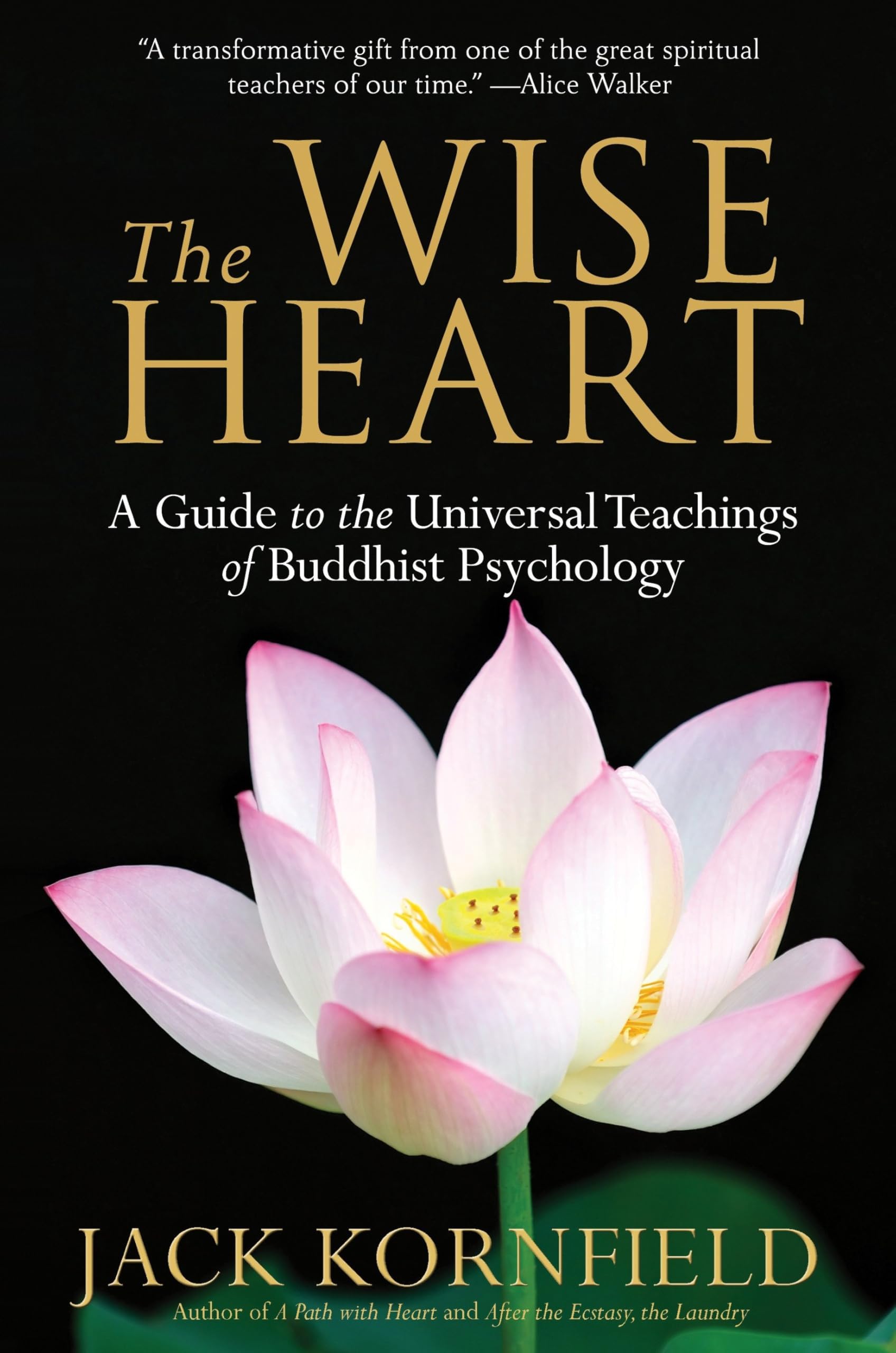
The Wise Heart: A Guide to the Universal Teachings of Buddhist Psychology
Product ID: 1692867
Buy anything from 5,000+ international stores. One checkout price. No surprise fees. Join 2M+ shoppers on Desertcart.
Desertcart purchases this item on your behalf and handles shipping, customs, and support to Thailand.
A guide to the transformative power of Buddhist psychology—for meditators and mental health professionals, Buddhists and non-Buddhists alike. You have within you unlimited capacities for extraordinary love, for joy, for communion with life, and for unshakable freedom—and here is how to awaken them. In The Wise Heart, celebrated author and psychologist Jack Kornfield offers the most accessible, comprehensive, and illuminating guide to Buddhist psychology ever published in the West. Here is a vision of radiant human dignity, a journey to the highest expression of human possibility—and a practical path for realizing it in our own lives. Review: Wise Heart Review - Divided into 5 parts, Jack Kornfield's book, 'The Wise Heart: A Guide to the Universal Teachings of Buddhist Psychology,' is an insightful introduction to Buddhist psychology for beginning students. A must read, 'The Wise Heart' is interspersed with fresh insights into psychology both east and west. In parts I and II Mr. Kornfield commences with a discussion of the Buddhist idea of self and consciousness. Then he continues with an examination of practices of mindfulness. In part III he begins to look at suffering and its transformation through mindfulness practices. Part IV offers guidance on finding freedom in the midst of suffering. Part V introduces the path of the Boddhisattva and the application of Buddhist teachings into the world around us. Each part is subdivided into specific chapters in which Mr. Korfield introduces an element of Buddhist psychology. Then he includes personal anecdotes and real life stories which illustrate the principle introduced. He ends each chapter with a meditation for readers to practice. I found Mr. Kornfield's thoughts on interdependence, emptiness, and the nature of consciousness especially intriguing. He shows how the concepts of interdependence and emptiness illustrate that there is no separation between the things that make up the universe; instead, things have no intrinsic qualities unto themselves. The perception of separation is merely an illusion. However, everyday experiential consciousness perceives separation. This is our thinking, planning mind. It is the part of our consciousness that reviews the past, and simulates the future. Our feelings of anger, guilt, denial, jealousy, depression, fear, desire, and momentary pleasures stem from this experiential consciousness. It is the segment of our selves attached to our experiences. Nonetheless, there is more to consciousness than this experiential side. There is also an aspect of consciousness that is pure awareness, a witnessing aspect, that is untainted pure potential. It is this witnessing aspect which could be considered pantheistic. Unlike contemporary western philosophy, in Buddhism consciousness is the foundation of existence, and the witnessing aspect of consciousness permeates throughout reality. The trick for a practitioner is to access this witnessing aspect of consciousness for themselves. Buddhism elaborates on a methodology for awakening to the witnessing within us and in the outer reality around us. Right living, right thinking, and mindfulness practices assist in this awakening. This mindfulness methodology also assists us in navigating the suffering states that we endure through our experiential everyday consciousness. One thing that readers must be aware of is 'like the finger pointing to the moon,' concepts can point the way to 'witnessing' consciousness. However, concepts fall short, and we should not mistake the finger that points for the moon itself. This is part of the reason for the emphasis on practice in Buddhism, because it is the practice and not the concepts that transform. Buddhism like other branches of mysticism also employs metaphors to describe what cannot be adequately named. Two metaphors that Mr. Kornfield discussed were the sky and the mirror. The sky represents pure awareness, whereas clouds within the sky serve as experience and the mental states resulting from this experience. Reflections within the mirror also embodies experience whereas the clear mirror again represents a pure witnessing awareness that is unclouded by experience. I like what Mr. Kornfield said about the brain's malleability. Utilizing scientific evidence to back up Buddhist philosophy, he illustrates that we can change our patterns of thinking and behavior. Through proper practice at any age we can actually change our brain's wiring. The beauty of 'A Wise Heart,' is that it imparts a message of inspiration, hope, and a path to freedom. This short synopsis cannot do justice to all of the contents within this book. Therefore, I urge other readers to pick up this book, read it, and contemplate its message for themselves. I assure you that you will be richly rewarded for your efforts. Review: wonderful, transformative book - This is a wonderful, transformative book. Jack Kornfield is a former Buddhist monk and holds a PhD in Clinical Psychology. Incorporating Buddhist teaching, real-life stories, and scientific research, he explains Buddhism to the Western mind better than any other book I’ve ever read. And he teaches us how to cultivate mindfulness and to live with a peaceful and loving heart.

| Best Sellers Rank | #39,093 in Books ( See Top 100 in Books ) #35 in Buddhist Rituals & Practice (Books) #72 in Spiritualism #1,054 in Personal Transformation Self-Help |
| Customer Reviews | 4.8 out of 5 stars 1,531 Reviews |
T**L
Wise Heart Review
Divided into 5 parts, Jack Kornfield's book, 'The Wise Heart: A Guide to the Universal Teachings of Buddhist Psychology,' is an insightful introduction to Buddhist psychology for beginning students. A must read, 'The Wise Heart' is interspersed with fresh insights into psychology both east and west. In parts I and II Mr. Kornfield commences with a discussion of the Buddhist idea of self and consciousness. Then he continues with an examination of practices of mindfulness. In part III he begins to look at suffering and its transformation through mindfulness practices. Part IV offers guidance on finding freedom in the midst of suffering. Part V introduces the path of the Boddhisattva and the application of Buddhist teachings into the world around us. Each part is subdivided into specific chapters in which Mr. Korfield introduces an element of Buddhist psychology. Then he includes personal anecdotes and real life stories which illustrate the principle introduced. He ends each chapter with a meditation for readers to practice. I found Mr. Kornfield's thoughts on interdependence, emptiness, and the nature of consciousness especially intriguing. He shows how the concepts of interdependence and emptiness illustrate that there is no separation between the things that make up the universe; instead, things have no intrinsic qualities unto themselves. The perception of separation is merely an illusion. However, everyday experiential consciousness perceives separation. This is our thinking, planning mind. It is the part of our consciousness that reviews the past, and simulates the future. Our feelings of anger, guilt, denial, jealousy, depression, fear, desire, and momentary pleasures stem from this experiential consciousness. It is the segment of our selves attached to our experiences. Nonetheless, there is more to consciousness than this experiential side. There is also an aspect of consciousness that is pure awareness, a witnessing aspect, that is untainted pure potential. It is this witnessing aspect which could be considered pantheistic. Unlike contemporary western philosophy, in Buddhism consciousness is the foundation of existence, and the witnessing aspect of consciousness permeates throughout reality. The trick for a practitioner is to access this witnessing aspect of consciousness for themselves. Buddhism elaborates on a methodology for awakening to the witnessing within us and in the outer reality around us. Right living, right thinking, and mindfulness practices assist in this awakening. This mindfulness methodology also assists us in navigating the suffering states that we endure through our experiential everyday consciousness. One thing that readers must be aware of is 'like the finger pointing to the moon,' concepts can point the way to 'witnessing' consciousness. However, concepts fall short, and we should not mistake the finger that points for the moon itself. This is part of the reason for the emphasis on practice in Buddhism, because it is the practice and not the concepts that transform. Buddhism like other branches of mysticism also employs metaphors to describe what cannot be adequately named. Two metaphors that Mr. Kornfield discussed were the sky and the mirror. The sky represents pure awareness, whereas clouds within the sky serve as experience and the mental states resulting from this experience. Reflections within the mirror also embodies experience whereas the clear mirror again represents a pure witnessing awareness that is unclouded by experience. I like what Mr. Kornfield said about the brain's malleability. Utilizing scientific evidence to back up Buddhist philosophy, he illustrates that we can change our patterns of thinking and behavior. Through proper practice at any age we can actually change our brain's wiring. The beauty of 'A Wise Heart,' is that it imparts a message of inspiration, hope, and a path to freedom. This short synopsis cannot do justice to all of the contents within this book. Therefore, I urge other readers to pick up this book, read it, and contemplate its message for themselves. I assure you that you will be richly rewarded for your efforts.
M**M
wonderful, transformative book
This is a wonderful, transformative book. Jack Kornfield is a former Buddhist monk and holds a PhD in Clinical Psychology. Incorporating Buddhist teaching, real-life stories, and scientific research, he explains Buddhism to the Western mind better than any other book I’ve ever read. And he teaches us how to cultivate mindfulness and to live with a peaceful and loving heart.
M**O
Compassion for oneself and others is front and center.
After wearing out my first, this is the second new copy I've purchased. Invaluable to the Cognitive Behavioral or DBT therapist, the book is also a deeply convincing and compassionate read for anyone who finds the evolution of recent American culture repellent, or for anyone who concludes that to be reasonably satisfied with life, one must swim against the current. In fact, swimming against the current is the last thing Kornfield would recommend. Instead he teaches us with painstaking clarity and fluid prose, how to identify and relax into our own currents. Anyone who is even vaguely familiar with the noble truths of Buddhist philosophy will find great energy and solace here. The book is a must, and the Audible recording equally valuable, to anyone who wants to live a sound, compassionate life with equanimity and poise.
C**R
The go-to book for re-reading and digesting basic and life-changing advice
This is such a sweet basic book on Buddhist fundamentals. I got it at the library and knew that I had to have my own copy. I read it but I tend to read in an "overall" kind of way ---- get the drift and pick up the main pieces and move on. Then I go back and read parts in detail. That's why I wanted to own the book because I knew that I wanted to go back and read certain sections in detail. Did it make me a better person? Not sure. But what it DID do was make me think - as in after I was judgmental about someone or started to dwell on the future - maybe it was after the fact but if you do this often enough - think afterwards that perhaps this was not a good way to think about something or someone - you stop doing it. So that's how it has helped me and may, in fact, make me a better person in the long run. Anyway, this is a very readable book and full of useful information. I would recommend it to anyone who takes an interest in the Buddhist philosophy.
J**A
The value of this this book lies in how westerners can relate to and apply Buddhist teachings in their lives
This book is a comprehensive guide into applied Buddhist psychology. The mental and emotional processes we all face are analysed and described from a Buddhist perspective. This ranges from how we perceive the world, how we react to anger, frustration, vanity, across addiction patterns of seeking pleasure and avoiding suffering; through to how do we see ourselves and our relationship to others. Jack Kornfield divides the book into chapters, where each delivers a single principle of Buddhist psychology, complimented with stories from his students ('sort of like patients') and advise on how to incorporate these principles into meditation practice and our lives. The wisdom imparted in this book echoes other books on the transforming power of meditation. But the value of this this book lies in how westerners can relate to and apply Buddhist teachings in their lives. It is the personal stories offered in this book (deemed trite in another review) that act as a bridge between eastern wisdom and the vicissitudes of modern life. What I like most about this author, is that he doesn't expect us to abandon our way of living and become monks, but to rethink our life as it is, and engage with it in a more wholesome way. I will re-read chapters of this book several times to remind myself of its lessons.
P**G
Great
Great delivery and exactly as described.
K**N
A wonderful experience!
I did not at first realize that Jack Kornfield was going to take me on a precious adventure through the teachings of the Buddhist way of becoming awake. In following him through his path of study and experience of the Buddhist way, I find my sense of richness, peacefulness, compassion, and joy very much more clear and deep. Often given pause to consider where he had invited me in the two weeks it took me to read, study, and experience this gem, Inever stumbled. I would recommend this work to all those who would consider taking the peaceful path through the tumultuous fields of violence that have been a necessary part of our evolution over the last five millennia of warfare. With the help of Kornfield and others as devoted to our metamorphosis into "spiritual beings immersed in the human condition" (Teilhard de Chardin), I am confident that we shall find our way through the dark forest of suffering arising from the misapplications of knowledge which underlie all harm. As we come to benefit each other through loving-kindness, we shall see the light that shows us how come the evolving Universe evolved into this Earth and our remarkable species.
S**4
There is wisdom in our hearts..
Jack Kornfield is a very generous and insightful author. I say generous because he tries to share as much as he can from his profound knowledge and wisdom with his readers. Considering, that this book was written at a time when mindfulness and meditation wasn't as popular as in these days -It must have been difficult to condense traditional Buddhist practices from Jack's personal experiences in the east, in a way that it was acceptable to the audience here. And, he does a wonderful job here by maintaining a balance between traditional teachings, and his experiences with people he has met through his practice as a psychologist. Yes, some parts of the book are redundant, but this worked for me as the principles and the rationale behind a regular practice was drilled unto my mind. Given, that meditation practice is easy to start and hard to stick to, this book is an excellent guide to come back to again and again. Also, the book does blend in relevant Buddhist teachings, but it's secular and non-religious in its content.
A**R
Not for beginners
This book is not for beginners. However, the style of writing is very down-to-earth. Topics covered are quite deep and touch the core of the Enlightened One's teachings. The stories and anecdotes are heart-touching and helps to drive the point quite clearly. Highly recommended.
J**O
A nice book
I liked it very much
N**E
One of my favourite books !
I originally read this book about a year ago and recently reread it. It's clear, warm and insightful. Explains the theories and teachings of the Buddha and the links to western psychology. Good for "self help" or as a more "intellectual" read whether you have a longstanding interest in Buddhism or not. I know I'm sure to reread it many times as I find it inspiring and comforting.
T**O
Mein Lieblingssachbuch
Super tolles Buch über Psychologie aus der Sicht des Buddhismus. Bis heute mein Lieblingssachbuch. Gelesen 2019.
M**L
Buddhism lections for everyday life
I found the book very pleasant to read. I enjoy the way Jack Cornfield tries to find similarities between Eastern and Western traditions, also citing classic authors. But what I like the most about this book is its willingness to give you a mindset to deal with the good and bad of life.
Trustpilot
4 days ago
1 month ago