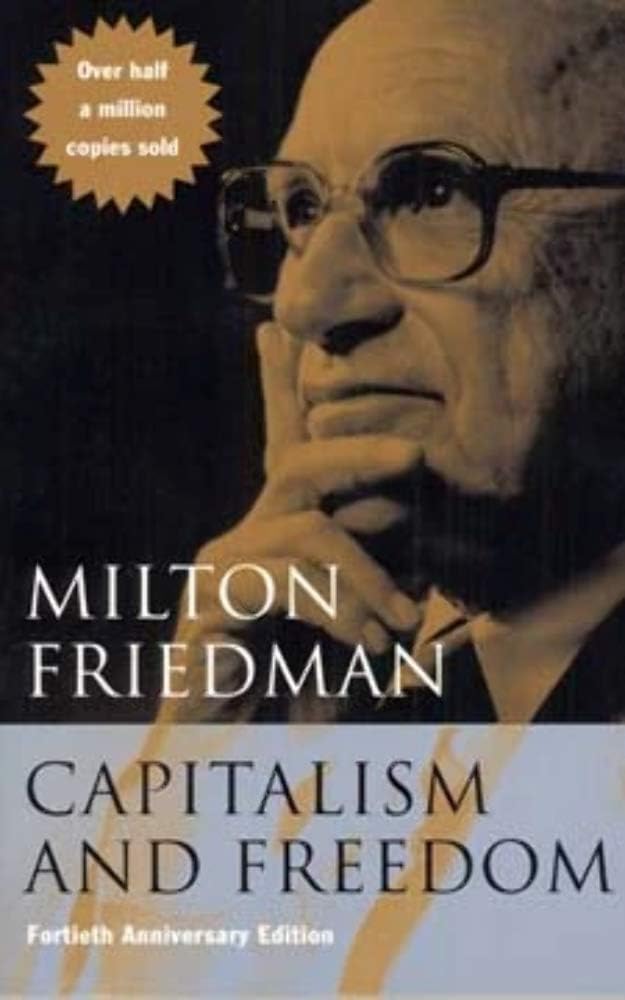
Capitalism and Freedom: Fortieth Anniversary Edition
Product ID: 1699167
Buy anything from 5,000+ international stores. One checkout price. No surprise fees. Join 2M+ shoppers on Desertcart.
Desertcart purchases this item on your behalf and handles shipping, customs, and support to Thailand.
Selected by the Times Literary Supplement as one of the "hundred most influential books since the war" How can we benefit from the promise of government while avoiding the threat it poses to individual freedom? In this classic book, Milton Friedman provides the definitive statement of his immensely influential economic philosophy—one in which competitive capitalism serves as both a device for achieving economic freedom and a necessary condition for political freedom. The result is an accessible text that has sold well over half a million copies in English, has been translated into eighteen languages, and shows every sign of becoming more and more influential as time goes on. Review: Insight for those who wish to be free - Nobel laureate Milton Friedman is quite possibly the most brilliant economist in the world today and a man on the cutting edge of libertarian (classical liberal) thought. And in "Capitalism and Freedom" he lays out a basic political philosophy in the classical liberal tradition in the first two chapters of the book and alternately defends and expands upon that premise for the remainder of the work. In much the same way that F. A. Hayek - an ideological predecessor - spelled out his basic thesis in one concise book and then fleshed it out in another, Friedman provides the basics here and fleshes them out in the larger (and somewhat better written) "Free to Choose". In addition, while not wishing to rehash some of the detailed support for his assertions, he does - through footnotes - provide the reader with opportunity to delve deeper. Given the nature of the subject matter and the expertise of the author, the writing can be dry and may appear difficult to approach, particularly in the initial chapters, but the reader who sticks with it will be well rewarded. Subsequent chapters, largely adapted from lectures by the author, are easier reads. And Friedman avoids, for the most part, the economic jargon that can make works such as this hopelessly confusing to the layman. Friedman is often tagged with the "monetarist" or "supply-side" labels (if you don't believe me, read some of the other reviews), largely because he believes that these methods of economic manipulation are infinitely preferable to the fiscal manipulation that has been the norm in this country. Those who actually READ this book will find that he advocates intervention by neither means, preferring instead stable monetary growth removed from the hands of either fiscal or monetary interventionists. He provides one of the most succinct explanations of the monetary actions (of the Fed) that created and worsened the Great Depression that I have ever come across, though mentioning only briefly the fiscal policies that subsequently lengthened it considerably: the New Deal and, to a much lesser extent, Smoot-Hawley. This alone makes the work valuable. He goes on to examine a number of things that are now taken for granted in this country (the Welfare State, Social Security, public education, licensing requirements) and asks the question, "Have these government actions made things better or worse?" The record is less than stellar (especially in the subsequent 40 years since this was written). And he proposes some alternatives such as the negative income tax and other alternative roles for government that are, arguably, less intrusive on the liberty of the citizenry. And he uses examples that are easy to follow and understand including one about men stranded on desert isles that is NOT as presented in another review. As an economist, I would say that this work has aged remarkably well. The analysis has clearly not become dated as have those of Galbraith and, to a certain extent Keynes. [Keynes WAS a genius, providing the mathematical and econometric bases for much of current economic thought, but, contrary to the assertion by another reviewer, much of what he proposed should be done by the state has been discredited.] Friedman, for example, was one of the first to advocate a school voucher system, which is only now receiving serious attention. It is noteworthy that a number of economists from the left have criticized Friedman in general and this work in particular. But those attacks (by Krugman, Herman and Diesing, among others) have proven to be, for the most part, without merit. If you accept the basic premise that freedom is vitally important and that the actions of the state should be viewed from that point of view, you will find this work to be invaluable. If not, you will certainly not be pleased. And if you believe the utter nonsense that capitalism is in any way "oppressive", well, if you can't see reality... Review: The Best Book for New Libertarians - I loaned this book to someone so, of course, I had to buy it again. It's a fantastic book! I recommend this book to anyone interested in economics and/or Libertarian thought. Milton Friedman is a great teacher because he has a very natural way of laying things out. It doesn't read like a dry textbook at all.
| Best Sellers Rank | #397,784 in Books ( See Top 100 in Books ) #2 in Free Enterprise & Capitalism #6 in Theory of Economics #21 in Democracy (Books) |
| Customer Reviews | 4.6 out of 5 stars 2,948 Reviews |
W**N
Insight for those who wish to be free
Nobel laureate Milton Friedman is quite possibly the most brilliant economist in the world today and a man on the cutting edge of libertarian (classical liberal) thought. And in "Capitalism and Freedom" he lays out a basic political philosophy in the classical liberal tradition in the first two chapters of the book and alternately defends and expands upon that premise for the remainder of the work. In much the same way that F. A. Hayek - an ideological predecessor - spelled out his basic thesis in one concise book and then fleshed it out in another, Friedman provides the basics here and fleshes them out in the larger (and somewhat better written) "Free to Choose". In addition, while not wishing to rehash some of the detailed support for his assertions, he does - through footnotes - provide the reader with opportunity to delve deeper. Given the nature of the subject matter and the expertise of the author, the writing can be dry and may appear difficult to approach, particularly in the initial chapters, but the reader who sticks with it will be well rewarded. Subsequent chapters, largely adapted from lectures by the author, are easier reads. And Friedman avoids, for the most part, the economic jargon that can make works such as this hopelessly confusing to the layman. Friedman is often tagged with the "monetarist" or "supply-side" labels (if you don't believe me, read some of the other reviews), largely because he believes that these methods of economic manipulation are infinitely preferable to the fiscal manipulation that has been the norm in this country. Those who actually READ this book will find that he advocates intervention by neither means, preferring instead stable monetary growth removed from the hands of either fiscal or monetary interventionists. He provides one of the most succinct explanations of the monetary actions (of the Fed) that created and worsened the Great Depression that I have ever come across, though mentioning only briefly the fiscal policies that subsequently lengthened it considerably: the New Deal and, to a much lesser extent, Smoot-Hawley. This alone makes the work valuable. He goes on to examine a number of things that are now taken for granted in this country (the Welfare State, Social Security, public education, licensing requirements) and asks the question, "Have these government actions made things better or worse?" The record is less than stellar (especially in the subsequent 40 years since this was written). And he proposes some alternatives such as the negative income tax and other alternative roles for government that are, arguably, less intrusive on the liberty of the citizenry. And he uses examples that are easy to follow and understand including one about men stranded on desert isles that is NOT as presented in another review. As an economist, I would say that this work has aged remarkably well. The analysis has clearly not become dated as have those of Galbraith and, to a certain extent Keynes. [Keynes WAS a genius, providing the mathematical and econometric bases for much of current economic thought, but, contrary to the assertion by another reviewer, much of what he proposed should be done by the state has been discredited.] Friedman, for example, was one of the first to advocate a school voucher system, which is only now receiving serious attention. It is noteworthy that a number of economists from the left have criticized Friedman in general and this work in particular. But those attacks (by Krugman, Herman and Diesing, among others) have proven to be, for the most part, without merit. If you accept the basic premise that freedom is vitally important and that the actions of the state should be viewed from that point of view, you will find this work to be invaluable. If not, you will certainly not be pleased. And if you believe the utter nonsense that capitalism is in any way "oppressive", well, if you can't see reality...
C**W
The Best Book for New Libertarians
I loaned this book to someone so, of course, I had to buy it again. It's a fantastic book! I recommend this book to anyone interested in economics and/or Libertarian thought. Milton Friedman is a great teacher because he has a very natural way of laying things out. It doesn't read like a dry textbook at all.
Ø**E
Fifty years old and still truly refreshing
Five decades on, Friedmans thoughts of the functioning of the economic and political life, are still mind-blowing. Written in a clear and powerful language, the points are well made after logical discussions of some important issues facing all societies. The main theme in the book is the close link between democracy and capitalism, or political freedom and economic freedom. Without the latter the former is very difficult. The Hollywood blacklist threatened the freedom of many film workers. However, the movie companies desires to make money gave them incentives to hire the blacklisted writers, producers and actors, and the workers got to work because of capitalism. Conversely, Winston Churchill never got to speak against Hitler on the government owned BBC between 1933 and the outbreak of WWII. Throughout the book, Friedmans belief in the individual and his abilities to take care of himself stands as a lighthouse. However, because man is imperfect, and cares mostly of himself and the closest ones, often disregarding others, power should be dispersed as much as possible. Those two propositions are the bedrock of the conservative ideology (Friedman calls it liberal, furious that the left has stolen the term), and of this book and its attacks on ICC (a regulating body turning into a lobby organization), Social Security (why is the government monopolizing saving), counter-cyclical economic policy (impossible), corporate social responsibility (not a corporate issue), the Medical Association (modern guild restricting the education of doctors) and a range of other organizations and institutions. In general, I think Friedman is giving to little weight on neighborhood effects, or public goods as it is called now. Nor is the fact that most human beings are irrational shortsighted, and therefore better off forced to save for later, touched upon. At last, information problems make several markets, among them education, far from perfect. Still, its one of my best reads of the year.
C**.
A polemic on philosophers of both economics and political philosophy that fail to accept the "real world"
This is a fairly dense book. In the sense that if you don't know some of the basic key economic concepts and philosophers that Friedman references, then you will be totally lost and have to re-read full chapters to get the ideas. It took me a month to work through this book, basically having to re-read whole chapters because some of the explanations that Friedman uses get confusing as be jumps around. That said, to me in reading this and thinking about it; the book is probably misunderstood by most of the general public that attempts to read this. It appears that Freidman presents a libertarian ideals of how the economy could run and that a capitalistic economic theory. At the same time he shows how the Keynesian, Engles/Marx philosophy can't work in some of their ideas because the empirical data from both history that they can't work. Then also explains how some of the ideas that are popular in both the Keynesian and Marx economic philosophy can't work when applied to the logical end since they would violate other portions of those related to basic economic philosophy and just the general idea of other economic principles such as basic ideas of Monetary Policy or Fiscal Policy. When viewed thru this idea, then this book is an interesting philosophy book about both political concepts, economic theories and showing that if we even apply some basic logic of philosophy concepts from Plato or Kant or similar. To me once I took this idea on that what Friedman is doing, at least in my mind, he is presenting is not only a polemic on Keynesian and Marx economic theory; but also on most all economic theories and philosophies as a whole. Since, as he states numerous times in most of the chapters, that these theories are idealized and perfect worlds. Rather than the history has shown constantly and as he reviewed the data with his students, that theory was nice until it hit harsh reality. In that sense this book should be idealized as an economic or political treatise as some put it. Rather it should be viewed as a harsh attack on the philosophers who are unwilling to view reality as it actually happens and properly interpret the human condition on their philosophies. As well as those that try and hand wave away those questions from folks with the "What about ... when ... happens?" sort of concerns. When I re-read some of the chapters later after viewing what I have interpreted Friedman's theme, then some of his explanations and concepts became a little clearer and even he showed that they weren't perfect, but it would be an interesting thought experiment if they were tried.
O**H
Liberalism Defined!
This classic, written by one of the founding fathers of modern economy discusses "competitive capitalism". As Milton explains it is: "The organization of the bulk of economic activity through private enterprise operating in a free market - as a system of economic freedom and a necessary condition for political freedom." In doing so, he addresses the role that the government should and needs to play in such an economic system - a minor role (in comparison to today's role) - that relies on the free market to organize economic activity. In this context, Milton goes on to discuss the following: The Relation between Economic Freedom and Political Freedom, The Role of Government In a Free Society, The Control of Money, International Financial and Trade Arrangements, Fiscal Policy, The Role of Government In Education, Capitalism and Discrimination, Monopoly and the Social Responsibility of Business and Labor, Occupational Licensure, The Distribution of Income, Social Welfare Measures and Alleviation of Poverty. What distinguishes this books in the mix of theory and abstract concepts, with the real-life applications and implications. The arguments presented are objective and rational, and defy a lot of the conventional and political wisdom. This is despite the fact that a number of these topics are "hot" political/social debate items such as social security. Milton discusses in depth how such items can be addressed within the competitive capitalism framework, the bigger role the private sector can play, and a retraction in the role of government. A truly timeless classic, and a must read for anyone interested in the field of economics, the interlude between politics and economics, and liberalism. Highly recommended![...]
A**R
basically now viewing how pretty much everything the government touches outside of its Constitutional ...
Just finished Milton Friedman's Capitalism and Freedom! Reading his in-depth analysis of every single aspect of U.S. economic and public reality highlights how blind we have been to government control, and how we as a people have learned to cope with intrusion, even if it may appear to be based on a supposedly logical scale (Social Security, Education, Income Inequality, Medical Practice, Public Housing, etc.). Milton Friedman utilizes an arsenal of capitalist reasoning to highlight the fallacious reasoning entailed in any involvement of government outside of the role of being the enforcer of the rules in controlling aspects of the market that could have been used to spur economic growth and more opportunity by the invisible hand of the free market system. Reading this helped me to analyze government from a completely new perspective; basically now viewing how pretty much everything the government touches outside of its Constitutional purposes causes disaster. It is incredible how much of our liberty we have been willing to sacrifice; all in the name of supposed security. It appears that Benjamin Franklin was right when he said that those who are willing to sacrifice liberty for security deserve neither. And across the political spectrum, we have been bamboozled by the government using brilliant manipulative strategies to continue to seize control of the market away from the invisible hand to our detriment as an economic powerhouse. This was indeed an enlightening read, I would recommend this book to anyone who is looking to understand why Capitalism, although not ideal, does the best in maintaining the freedoms of citizens to have the opportunity to invest freely in the market an idea or ideas that could be manufactured into a source for economic competition and growth.
R**N
One of Friedman's best works, a tremendous read
I love reading Friedman's works. He's one of the real 'heavyweights' when it comes to economics. As far as I'm concerned, there are no living economists that are even somewhat close to his caliber. He also has a PBS series 'free to choose' - you can watch it on youtube for free - if you want to know if you'll like this book, watch some of his one hour films! They're wonderfully 80s, but the ideas are just as applicable today. His predictions and ideas nearly 3 decades ago are still just as applicable today. Although at first blush many of his ideas sound somewhat hard to digest / believe, but after getting his explanation of the topic at hand, along with real world examples, his points come across loud and clear - and easy to understand. It seems to me as though Friedman is probably about the last of the great economists. His ideas are rooted firmly in evidence and common sense (very much in opposition to the economists of the current years). His case for political and economic freedom - and the accompanying reasons for a small and non-intrusive government come across clear as a bell. Really a very enlightening read.
F**D
I wish I could give this book both five stars and one star.
Since that is not an option, I took the average. You should read it, but with an open mind. The book was published in 1962 and much of it was written in the 1950s. It makes a number of predictions, some of which have come true and some of which have not. In short Friedman, brilliant though he is, is right about some things and wrong about others, something he has in common with every other human being. First, something he was correct about. He said that Americans should be allowed to own gold and that the price of gold should be determined by the market. That has come to pass, to the benefit of many. On the other hand, he predicted that "big government" would lead to a loss of our basic freedoms, just like in communist countries. That did not happen. Instead, our freedoms have grown to an extent that was hard to imagine in 1962. He often quotes Hayek's The Road to Serfdom: Fiftieth Anniversary Edition , but does not mention that Hayek himself repudiated his conclusions because of later experience, as described in the book Keynes Hayek: The Clash that Defined Modern Economics . The worst thing in Capitalism and Freedom is the defense of segregation. Friedman is not personally prejudiced against Black people, but he compares the US government forcing a White man to hire a Black man to Nazi Germany. Clearly, in this he was on the wrong side of history, and while he did not use his arguments out of prejudice against Blacks, some of his followers did. He defends "states rights" but in practice "states rights" have been used most often by states to defend discrimination. On the plus side, he rightly says that there are too many regulations, too many laws generally, and that the laws, particularly the tax laws, are much too complicated. Sadly, some people have used argument of "too many regulations" to cut back on the regulations Friedman agrees are necessary, such as regulations against pollution. On the minus side, he is against such popular and successful programs as the National Park Service, the Interstate highways, and the requirement that doctors have a medical license. He mentions two reasons for a strong federal government: to accomplish what states and individuals cannot (defense for example), and to compensate for neighborhood effects (control of pollution for example). There are at least two others I can think of, which he does not mention. A strong federal government may be necessary to save future generations from current greed. In a hard winter, people must be prevented from eating the seed corn necessary for survival in the coming year. This, I think, justifies the National Parks. Yes, a quick profit might be made by cutting down all the redwoods to make paper, but that would deprive all future generations. Secondly, people may vote, in times of tranquility, to limit their own freedom in times of stress. Thus, almost everyone wants doctors to be licensed, even though if they are dying, they may be tempted to spend their life savings on a quack. Friedman frequently quotes Adam Smith's The Wealth of Nations (Bantam Classics) , but does not mention that Adam Smith, unlike Friedman, favored a graduated income tax. The only reason for a graduated income tax that Friedman mentions is redistribution of wealth. That was not the reason Adam Smith gave. He said the rich should pay higher taxes because they have the lion's share of the money. What has been the outcome of the drastic cuts in taxes since Freidman wrote the book? Huge deficits, cuts to education, and a decaying infrastructure. If the rich have all the money, they have to pay for the necessities, or nobody will.
N**N
Liberty, Equality, Fraternity - Incompatible Ideals?
I became vaguely aware of Milton Friedman in the 1980s, when he was often referred to as the favourite economic guru of Thatcher and Reagan, the founder of "monetarism" as a new school of economics. He was disliked by the left, and there were dark mutterings about his involvement with some of the less pleasant South American regimes of the period. More recently I was referred to some excellent video clips of Milton Friedman on YouTube, and became interested in how his views fitted into economic thinking as a whole. I also became aware of economic libertarianism, expounded by such organisations as The Cato Institute (publishers of some of the sceptical volumes on man-made global warming theory, but with a much wider range of interests than that) and The Von Mises Institute, that seems to have quite an extreme view as to how limited the role of the state should be. Private justice, anyone? Capital and Freedom was Friedman's seminal popular work, published in 1962 and based on a series of lectures that Friedman had delivered in the mid to late 1950s. Other popular works include Free to Choose, written jointly with his wife and published in 1980. He doubtless wrote scores of more technical papers in between. Friedman's economic hypothesis is that free market capitalism is the most effective mechanism for organising economic activity and growth, and that it thrives best when the government intervenes in it as little as possible. This economic hypothesis is allied to a strong personal conviction for individual liberty, that men should as far as possible be left to do as they choose so long as their actions to not have injurious effects on others - a philosophy stated emphatically by the founding fathers of the United States. Milton Friedman argues his case clearly and effectively, and most of it is as apposite today as it was in 1955. Often it is only when he refers to numbers of dollars that one remembers that this book is nearly 50 years old - there always seems to be one or two noughts missing from the end of average salaries. There is quite a lot of historical detail - he devotes a chapter to the Great Depression, and his hypothesis that it was caused not by a failure of the market but by incompetent government intervention. Friedman believed that the market would have suffered less badly, and recovered more quickly, if the government had left well alone. As the Federal Reserve and the Bank of England intervene to deal with the current "credit crunch" banking crisis we have to hope that they will get it right - Friedman seemed to believe that by concentrating the power - and the responsibility - for managing the market even into highly intelligent and well-intentioned hands, you created the conditions for a major upset that the market, left to its own devices, would have avoided by the separate actions of thousands of individual participants acting in their own interests. We shall see! The problem with Friedman's brand of economic liberalism (and he deliberately stuck to the word "liberal" in an attempt to win it back from left of centre state-interventionists - later he gave up and accepted the description "libertarian") - and with the Thatcherism and Reaganomics that it spawned - was that it can seem harsh and uncaring. Friedman argues passionately against the public provisions of housing, minimum wages, agricultural support, state provided old age pensions and much compulsory attempts to redistribute wealth. He does so on the basis that they interfere with individuals' freedom, concentrate power in government (which often operates inefficiently, and that most such schemes are ultimately counterproductive. He does also argue against the abuse of power by big corporations, through cartels and government lobbying, and expresses concern that the tax laws that allow corporations' retained profit to suffer a lower rate of taxation than income a disadvantages small companies against big ones, and that this, even in the early 1960s, had artificially supported the development of massive corporations. Friedman was, it seems, a small company man, a believer in enterprise on a human scale. Friedman believed above all in Liberty. His belief in equality - egalitarianism - was more qualified. He believed in equality of rights under the law and of opportunity, but not that the state should attempt to achieve "equality of outcome" - i.e. equality of material wealth. That should be left to individuals to resolve through interaction with others and in accordance with their talents and inclinations. Equality of opportunity, of course, is easily said, and not an issue that Friedman resolves. For example, in arguing for a limited role for government in education, (though a much greater one that some present day libertarians might argue) opportunity for a high quality education would at the least be much easier for those born of rich parents than poor - one point at which I find myself unconvinced by him. In short, though, Friedman thought that men should be free to be unequal. Whether or not you subscribe to Friedman's ideas, this book represented a major reassertion of the principles of classic, free market economics in the face of progressively more state-directed economies not just in the Eastern-bloc but in the US and Western Europe too. That school of thought had been dominated by John Maynard Keynes, and the latter's "General Theory" shall be my next project. This is an excellent, thought provoking and easily absorbed book.
S**.
Capitalism, the framework to economic flourishing
Before reading this, I would describe myself as a free market capitalist. Though I could never properly articulate why. I love that Milton shows the historical and present-day tremendous economic growth under capitalism. He helped me understand this is not really created, but it is more akin to an evolutionary framework. Freedom of the individual is at the basis of this framework. Laissez-faire
D**E
Una pietra miliare
Un libro obbligatorio per capire il mondo.
A**R
Excelente livro para se entender liberdade
Milton Friedman foi um dos grandes defensores da liberdade individual. Mostrando a forma liberal de ser ver o mundo com diversos exemplos da vida real, Friedman consegue ilustrar que poder, por que se tenham boas intenções, acabam gerando consequências não intencionais de privilégios que acabam por reduzir a liberdade individual em prol do coletivismo.
E**R
Excellent book, little outdated
For its times it was excellent. Nowadays free market economics in both the Austrian and Chicago School have evolved and improved past what is exposed in the this book. Never the less it was one of best books I read early in my search for understanding economics and a springboard into other books on radical capitalism
Trustpilot
4 days ago
2 months ago