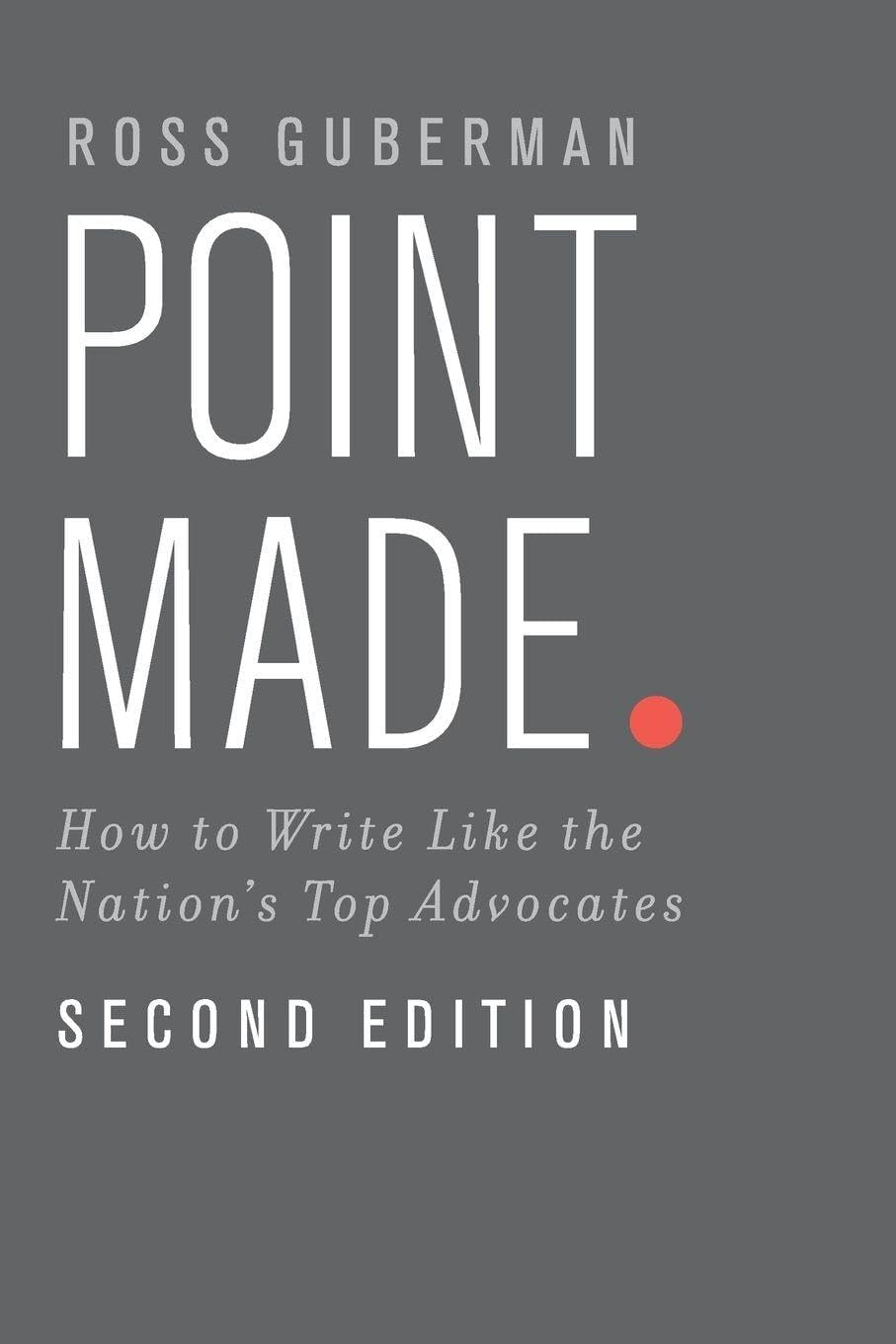
Point Made: How to Write Like the Nation's Top Advocates
Product ID: 1701203
Buy anything from 5,000+ international stores. One checkout price. No surprise fees. Join 2M+ shoppers on Desertcart.
Desertcart purchases this item on your behalf and handles shipping, customs, and support to Thailand.
With Point Made , legal writing expert, Ross Guberman, throws a life preserver to attorneys, who are under more pressure than ever to produce compelling prose. What is the strongest opening for a motion or brief? How to draft winning headings? How to tell a persuasive story when the record is dry and dense? The answers are "more science than art," says Guberman, who has analyzed stellar arguments by distinguished attorneys to develop step-by-step instructions for achieving the results you want. The author takes an empirical approach, drawing heavily on the writings of the nation's 50 most influential lawyers, including Barack Obama, John Roberts, Elena Kagan, Ted Olson, and David Boies. Their strategies, demystified and broken down into specific, learnable techniques, become a detailed writing guide full of practical models. In FCC v. Fox , for example, Kathleen Sullivan conjures the potentially dangerous, unintended consequences of finding for the other side (the "Why Should I Care?" technique). Arguing against allowing the FCC to continue fining broadcasters that let the "F-word" slip out, she highlights the chilling effect these fines have on America's radio and TV stations, "discouraging live programming altogether, with attendant loss to valuable and vibrant programming that has long been part of American culture." Each chapter of Point Made focuses on a typically tough challenge, providing a strategic roadmap and practical tips along with annotated examples of how prominent attorneys have resolved that challenge in varied trial and appellate briefs. Short examples and explanations with engaging titles--"Brass Tacks," "Talk to Yourself," "Russian Doll"--deliver weighty materials with a light tone, making the guidelines easy to remember and apply. In addition to all-new examples from the original 50 advocates, this Second Edition introduces eight new superstar lawyers from Solicitor General Don Verrilli, Deanne Maynard, Larry Robbins, and Lisa Blatt to Joshua Rosencranz, Texas Senator Ted Cruz, Judy Clarke, and Sri Srinvasan, now a D.C. Circuit Judge. Ross Guberman also provides provocative new examples from the Affordable Care Act wars, the same-sex marriage fight, and many other recent high-profile cases. Considerably more commentary on the examples is included, along with dozens of style and grammar tips interspersed throughout. Also, for those who seek to improve their advocacy skills and for those who simply need a step-by-step guide to making a good brief better, the book concludes with an all-new set of 50 writing challenges corresponding to the 50 techniques. Review: It is so good that I have paid for it three times now - This book has been one of the most influential legal writing books I have read over the course of my entire legal career. It is so good that I have paid for it three times now: (1) the first edition for Kindle; (2) the second edition paperback; and (3) the second edition for Kindle. If Mr. Guberman comes out with a third edition, count me in for that too. It's so helpful that, after reading the first edition, I started asking junior associate candidates interviewing at my last firm if they had read it--as a litmus test of sorts for how serious they were about the craft of writing. And every associate I've supervised since has had this book on their list of required reading for working with me. One big problem with most legal writing is that it reads like lawyers and judges wrote it. Perhaps an even bigger problem is that most lawyers and judges don't realize that this is a problem. I've lost count how many times I've read terrible briefs by lawyers with big resumes at big firms who think that their briefs are the stuff of legend. (I confess I'm guilty of that myself.) Point Made does a great job using examples from the elite of the elite to show us mere mortals (everyday practitioners like me whose names are not John Roberts or Seth Waxman) that we're not as good as we thought we were. But Mr. Guberman doesn't leave you in the gutter for too long: Point Made does a fabulous job providing concrete examples to improve your writing dramatically today. I give Point Made the strongest recommendation possible. And if you get a chance to attend one of Mr. Guberman's seminars, do whatever it takes to get to one. I've had the privilege of attending a couple. Mr. Guberman is as good in person as he is on paper. Review: Highly Recommended - This book is legitimately a Godsend in terms of its efficacy. I would recommend this book to other lawyers or law students for three reasons: (1) this book outlines, in step format, what is required of a solid brief to persuade the court; (2) the book does a great job of providing real-world examples from briefs submitted by everyone from C.J. John Roberts and J. RBG to Joe Jamail to help illustrate his points; and (3) the writing is really easy to read and quick to get through. Moving onto my first point, the book outlines the components of a well-structured brief from beginning to end. The front and back covers contain an "outline" not dissimilar to a table of contents, and that outline effectively gives you a checklist to go through while writing your brief or motion. If you are stuck on a particular section like the introduction or the statement of facts, you can easily hop into the table of contents and just jump to the relevant section. Onto my second point, as you are reading through each chapter in the book, the author will supply excerpts from actual briefs while bolding and emphasizing the concepts that particular section is teaching you so that you may see the lesson in action. He then expands on those points immediately following the excerpt and goes on to explain why he emphasized certain words or phrases. This makes following along very easy, even if the actual subject matter of the brief goes over your head (I admire IP lawyers more now than I did before I read this book). Furthermore, the brief excerpts are from heavy hitters who definitely know their way around Microsoft Word, so the examples you're being taught with are written by some of the best advocates in the country. The author even gives grammatical lessons or suggestions to help get a point across more clearly which is really nice because it humanizes the big shot advocates. I am happy to know that even the Chief Justice of the SCOTUS sometimes makes grammatical errors in his writing too. Lastly, the book is so well written that it's just really easy to get through. I got through a hundred pages or so within the first day, and should be finishing the book in a couple of days. All in all, I would suggest this book to anyone who wants to improve their legal writing. The first way to win in court is through your brief, and the second way is through oral arguments. If an attorney can persuade the court before they even appear in front of the judge, half the battle has already been won. Five out of five stars.
| Best Sellers Rank | #52,260 in Books ( See Top 100 in Books ) #5 in Legal Education Writing #11 in Law (Books) |
| Customer Reviews | 4.7 out of 5 stars 507 Reviews |
A**X
It is so good that I have paid for it three times now
This book has been one of the most influential legal writing books I have read over the course of my entire legal career. It is so good that I have paid for it three times now: (1) the first edition for Kindle; (2) the second edition paperback; and (3) the second edition for Kindle. If Mr. Guberman comes out with a third edition, count me in for that too. It's so helpful that, after reading the first edition, I started asking junior associate candidates interviewing at my last firm if they had read it--as a litmus test of sorts for how serious they were about the craft of writing. And every associate I've supervised since has had this book on their list of required reading for working with me. One big problem with most legal writing is that it reads like lawyers and judges wrote it. Perhaps an even bigger problem is that most lawyers and judges don't realize that this is a problem. I've lost count how many times I've read terrible briefs by lawyers with big resumes at big firms who think that their briefs are the stuff of legend. (I confess I'm guilty of that myself.) Point Made does a great job using examples from the elite of the elite to show us mere mortals (everyday practitioners like me whose names are not John Roberts or Seth Waxman) that we're not as good as we thought we were. But Mr. Guberman doesn't leave you in the gutter for too long: Point Made does a fabulous job providing concrete examples to improve your writing dramatically today. I give Point Made the strongest recommendation possible. And if you get a chance to attend one of Mr. Guberman's seminars, do whatever it takes to get to one. I've had the privilege of attending a couple. Mr. Guberman is as good in person as he is on paper.
T**Y
Highly Recommended
This book is legitimately a Godsend in terms of its efficacy. I would recommend this book to other lawyers or law students for three reasons: (1) this book outlines, in step format, what is required of a solid brief to persuade the court; (2) the book does a great job of providing real-world examples from briefs submitted by everyone from C.J. John Roberts and J. RBG to Joe Jamail to help illustrate his points; and (3) the writing is really easy to read and quick to get through. Moving onto my first point, the book outlines the components of a well-structured brief from beginning to end. The front and back covers contain an "outline" not dissimilar to a table of contents, and that outline effectively gives you a checklist to go through while writing your brief or motion. If you are stuck on a particular section like the introduction or the statement of facts, you can easily hop into the table of contents and just jump to the relevant section. Onto my second point, as you are reading through each chapter in the book, the author will supply excerpts from actual briefs while bolding and emphasizing the concepts that particular section is teaching you so that you may see the lesson in action. He then expands on those points immediately following the excerpt and goes on to explain why he emphasized certain words or phrases. This makes following along very easy, even if the actual subject matter of the brief goes over your head (I admire IP lawyers more now than I did before I read this book). Furthermore, the brief excerpts are from heavy hitters who definitely know their way around Microsoft Word, so the examples you're being taught with are written by some of the best advocates in the country. The author even gives grammatical lessons or suggestions to help get a point across more clearly which is really nice because it humanizes the big shot advocates. I am happy to know that even the Chief Justice of the SCOTUS sometimes makes grammatical errors in his writing too. Lastly, the book is so well written that it's just really easy to get through. I got through a hundred pages or so within the first day, and should be finishing the book in a couple of days. All in all, I would suggest this book to anyone who wants to improve their legal writing. The first way to win in court is through your brief, and the second way is through oral arguments. If an attorney can persuade the court before they even appear in front of the judge, half the battle has already been won. Five out of five stars.
R**S
Great reference!
My husband and I purchased the audible version and the paperback, and this book has been super helpful. I'm a paralegal and my husband is just entering the legal field and even with my experience, this book has been awesome. I write all pleadings for my attorney and I'm always trying to enhance my writing skills. This book has helped a great deal with the examples and format. Definitely a great book to have in your collection, even if you're just starting our. I found this book almost more helpful to me than the legal writing book I paid $100+ for when I was in school 10 years ago!
M**S
AND OUTSTANDING BOOK for even non-laywers, even if you never show up in a courtroom- Great book of ARGUMENT!
OUTSTANDING!!! So good that I just recommended to my son who is an attorney at WilmerHale -- A great book for ANYONE who is interested in argument -- whether it is in the court room, politics, or the pulpit. It provides some outstanding insight into how argument works, and for one like my with their Ph.D. in Rhetoric & Public Address, and has spent his life speaking -- this book is a real addition to just that. It is UNIQUE in many ways in that it provides an insightful understanding of how argument works, how people work, and totally unique helps that are so very practical -- like "techniques" -- Thanks Ron for a labor of love because this had to take a lot of time and thought to produce something so helpful!!!!!!
B**R
Good book
Useful book, better than most of the ones 1Ls' use.
L**.
Clear, consice, well-written
Great book for legal writers.
J**Q
A Must Read for Any Attorney Seeking Improvement in Legal Persuasion
I preordered this book based on the reviews of the first edition. Ross Guberman captures the intellect, wittiness, and tactical writing of some of the most successful attorneys in the profession. The pages turn effortlessly with invaluable illustrations of simple, yet profound ways to take your legal writing to the next level. Mr. Guberman also offers tutoring one-on-one according to his website. It appears he spends most of his time engaging in a very profound study of what makes a great legal advocate. His findings are a very fresh perspective to the outdated prose found in most law school curriculum. A job well done.
L**N
Interesting, Knowledgeable, and Accessible
Guberman does an excellent job of explaining the methodology and thought process behind legal writing. His simplification of such a foreign style of literature it impeccable and makes it accessible for everyone. The writing is not monotonous and maintains interest in the reader. As someone who is preparing to go to law school, I was intimidated by the form of writing that lawyers utilize. Guberman, however, gives the reader confidence. Overall, an amazing read!
M**H
Excellent
Book was in perfect condition and it arrived precisely on time.
M**.
Ok
Ok
R**N
Titled 'point made', but what's the point?
Bought to help my writing due to other reviews. Instead, had to persevere through difficult writing where the author respectfully doesn't make or prove his points. I felt like I was in a washing machine with his points and we all tumbled around — seldom to meet, or too briefly to be of value. I like the idea of the book though, so will search for more that are to my taste or helpful.
R**N
How to make your point
A very useful book that has helped me present arguments more clearly.
G**S
Very informative and valuable for all lawyers
One of the finest books ever written on the subject, no pointless jargon. If one follows it carefully legal drafting while maintaining necessary precision would become much easier.
Trustpilot
2 weeks ago
1 day ago