UNIX and Linux System Administration Handbook, 4th Edition
Product ID: 1703986
Buy anything from 5,000+ international stores. One checkout price. No surprise fees. Join 2M+ shoppers on Desertcart.
Desertcart purchases this item on your behalf and handles shipping, customs, and support to Thailand.
desertcart.com: UNIX and Linux System Administration Handbook, 4th Edition: 8580001058917: Nemeth, Evi, Snyder, Garth, Hein, Trent R., Whaley, Ben, Morreale, Terry: Books Review: Very useful to have around - This book is very thorough in its details for the current line of Unix/Linux systems, including Ubuntu, OpenSuse, Red Hat, Solaris, HP-UX and IBM AIX. It is well written, often entertaining and always informative. The amount of detail the authors go into for the various operating systems is impressive. If one looks at the definition for "absolute and relative paths" (page 142), they can get a pretty good idea of the approach this book takes; "The list of directories that must be traversed to locate a particular file plus that file's filename form a pathname. Pathnames can be either absolute (/tmp/foo) or relative (book4/filesystem). Relative pathnames are interpreted starting at the current directory. You might be accustomed to thinking of the current directory as a feature of the shell, but every process has one." Now the definition from "A Practical Guide to Fedora and Red Hat Enterprise Linux" (page 193) by Mark Sobell: "Every file has a pathname. An absolute pathname always starts with a slash(/), the name of the root directory. You can then build the absolute pathname of a file by tracing a path from the root directory through all the intermediate directories to the file. A relative pathname traces a path from the working directory to a file" Of the two I felt the explanation from Sobell's book was more straightforward, but the "The Unix and Linux System Administration Handbook" integrate the philosophy of the Unix/Linux world much more into the text than others I have read. If you are a beginner, you might not be able to rely ONLY on this book, you will almost certainly need something a little more elementary; "Linux in Easy Steps" by Mike McGrath is good for those who are visually oriented. "Administration Handbook" book is good at is covering the breadth of Unix/Linux system administration duties across multiple versions. It makes it relatively clear and easy. It sticks to principles rather than a "cookbook" approach. The section on shell and bash scripting is a very good primer, but you will need to build out from there. There is also a good chapter on virtualization and particularity desertcart Web services. If you thought desertcart was just about books and music, well, that is the tip of the iceberg. Students and professionals alike will find this a valuable reference. If you are a previous owner, it is worth it to get the new edition. I would think this book will cover at least 90% of what you are likely to run into as you administer systems. Beginning Linux books only go so far. Books that focus on one area such as writing shell scripts won't be general enough. This book covers a lot and covers it well. It is the one I kept in my backpack to lug to class. Review: Best Linux/UNIX Book I've Read. Ever. - There's a reason this book receives glowing reviews, and it doesn't have much to do with what's in it. It has to do with what's not in it. I am so accustomed to really miserable, overly verbose tech writing by people who are clearly not good writers that finding this book blew me away. In an era of disposable and free blog writing, I forgot how good tech writing can be. We need more writing like this. I bought the paperback and the Kindle edition. First time, ever, that I bought a book twice. When they come out with a new edition, I'll buy that one, too. Another first. Tech book publishers, take note of why this book works: - There aren't equally-weighted discussions about every single option available. - There's not a lot of BS filler. - There's historical context which aids in memorization. Stories teach. - There's a lot of "do this, here's why" aka "best practices". - There aren't pages and pages of useless code that nobody cares about. - There are no gimmicks (free CD/DVDs and the like) attached to the book. - The writing style assumes you are busy and treats your time as valuable. In this book is practical wisdom and tested/tried techniques to get you started on most things you will do as an admin. The authors know you have Google, and they don't kill you wasting your time. They give you a description of the technology, the most appropriate way(s) to handle it (with syntax), how to think about it, and how it differs (if it differs) between versions of Linux/UNIX.
| Best Sellers Rank | #513,708 in Books ( See Top 100 in Books ) #3 in Unix Administration #91 in Linux & UNIX Administration (Books) #117 in Linux Networking & System Administration |
| Customer Reviews | 4.6 4.6 out of 5 stars (282) |
| Dimensions | 7.25 x 1.75 x 9.25 inches |
| Edition | 4th |
| ISBN-10 | 0131480057 |
| ISBN-13 | 978-0131480056 |
| Item Weight | 3.8 pounds |
| Language | English |
| Print length | 1279 pages |
| Publication date | July 15, 2010 |
| Publisher | Prentice Hall |
W**S
Very useful to have around
This book is very thorough in its details for the current line of Unix/Linux systems, including Ubuntu, OpenSuse, Red Hat, Solaris, HP-UX and IBM AIX. It is well written, often entertaining and always informative. The amount of detail the authors go into for the various operating systems is impressive. If one looks at the definition for "absolute and relative paths" (page 142), they can get a pretty good idea of the approach this book takes; "The list of directories that must be traversed to locate a particular file plus that file's filename form a pathname. Pathnames can be either absolute (/tmp/foo) or relative (book4/filesystem). Relative pathnames are interpreted starting at the current directory. You might be accustomed to thinking of the current directory as a feature of the shell, but every process has one." Now the definition from "A Practical Guide to Fedora and Red Hat Enterprise Linux" (page 193) by Mark Sobell: "Every file has a pathname. An absolute pathname always starts with a slash(/), the name of the root directory. You can then build the absolute pathname of a file by tracing a path from the root directory through all the intermediate directories to the file. A relative pathname traces a path from the working directory to a file" Of the two I felt the explanation from Sobell's book was more straightforward, but the "The Unix and Linux System Administration Handbook" integrate the philosophy of the Unix/Linux world much more into the text than others I have read. If you are a beginner, you might not be able to rely ONLY on this book, you will almost certainly need something a little more elementary; "Linux in Easy Steps" by Mike McGrath is good for those who are visually oriented. "Administration Handbook" book is good at is covering the breadth of Unix/Linux system administration duties across multiple versions. It makes it relatively clear and easy. It sticks to principles rather than a "cookbook" approach. The section on shell and bash scripting is a very good primer, but you will need to build out from there. There is also a good chapter on virtualization and particularity Amazon Web services. If you thought Amazon was just about books and music, well, that is the tip of the iceberg. Students and professionals alike will find this a valuable reference. If you are a previous owner, it is worth it to get the new edition. I would think this book will cover at least 90% of what you are likely to run into as you administer systems. Beginning Linux books only go so far. Books that focus on one area such as writing shell scripts won't be general enough. This book covers a lot and covers it well. It is the one I kept in my backpack to lug to class.
O**E
Best Linux/UNIX Book I've Read. Ever.
There's a reason this book receives glowing reviews, and it doesn't have much to do with what's in it. It has to do with what's not in it. I am so accustomed to really miserable, overly verbose tech writing by people who are clearly not good writers that finding this book blew me away. In an era of disposable and free blog writing, I forgot how good tech writing can be. We need more writing like this. I bought the paperback and the Kindle edition. First time, ever, that I bought a book twice. When they come out with a new edition, I'll buy that one, too. Another first. Tech book publishers, take note of why this book works: - There aren't equally-weighted discussions about every single option available. - There's not a lot of BS filler. - There's historical context which aids in memorization. Stories teach. - There's a lot of "do this, here's why" aka "best practices". - There aren't pages and pages of useless code that nobody cares about. - There are no gimmicks (free CD/DVDs and the like) attached to the book. - The writing style assumes you are busy and treats your time as valuable. In this book is practical wisdom and tested/tried techniques to get you started on most things you will do as an admin. The authors know you have Google, and they don't kill you wasting your time. They give you a description of the technology, the most appropriate way(s) to handle it (with syntax), how to think about it, and how it differs (if it differs) between versions of Linux/UNIX.
J**E
Very Thorough
This book is amazing. I maintain a server that sees a lot of traffic, and can only afford to have a VPS. This book has shown me how to deploy a server on Linux, in a CPU friendly, and secure manner. This is not a book to simply teach you the ins and outs of being a sysadmin, but is an amazing reference for those of us who have enough experience to understand what we need to get done just aren't sure of the best way to do it. You might end up going from cover to cover (which wouldn't be a bad thing as this book contains a wealth of knowledge) but instead you will use it as the need arises. I keep it next to my desk just to be safe.
S**E
IMHO - This is THE admin book to own
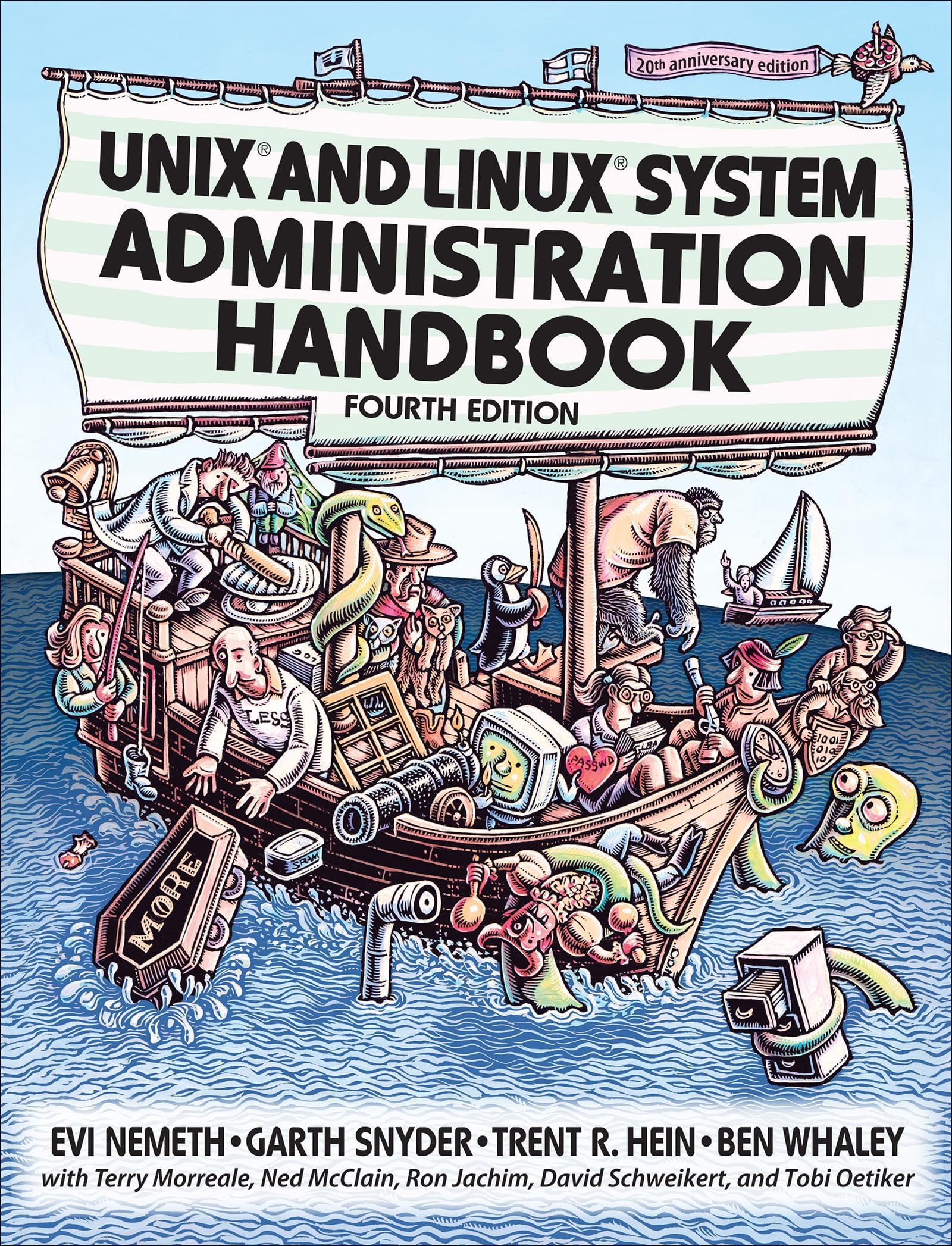
I've been a big fan of the authors since the 2nd edition was released. I was kind of dissapointed when they split it into separate Unix-Linux books, especially because of the cost. Glad to see it's back into one large book for the 4th edition. In my opinion, this is THE admin book to have for those who do this for a living. No unix/linux admin book will ever cover everything, especially since you have to decide if you want to be aimed at beginners or experienced admins, or try to include both. This series has always been for the experienced admins, and covers a TON of real-world issues in the world of unix-administration. They cover the main topics, the differences in major releases, and show you exactly where to go for more detailed information, if needed. Easy. And a great sense of humour throughout, like the LESS guy dumping the MORE coffin into the sea on the cover of the book. The free on-line version is a great bonus, even if it is slightly flawed. Unfortunately, a page-by-page on-line version of an admin manual still isn't the best option. There needs to be a more interactive way to go back/forth to different topics, be able to view different pages at once, etc. For now, the paper format is still the best, as far as I'm concerned. 5 stars, period. If you have the 2nd edition, you MUST get the 4th. If you bought both the Unix and Linux versions of the 3rd, it could hurt a bit to spend another $XX for this edition, but it is worth it. If you're a "professional" unix admin, I highly recommend looking at getting this book.
E**A
Very useful guide to become a SysAdmin. I can recommend it to all students interested in System Administration and Unix/Linux lovers.
T**E
Pra quem procura um livro para auxiliar na automação do sistema, estará fazendo o investimento certeiro de tangibilidade garantida como exemplo inicial ou prático já avançado! Apesar do livro oferecer tudo que é necessário, o preço que pagamos ainda é um pouco alto, no que se refere, sem a versão digital!
D**T
In a nutshell: If you're administrating Linux/Unix on a daily basis then this book is indispensable. It describes all core concepts, skills and commands a Sysadmin will need for his/her daily duties, and it will also be a great complete reference for the emerging DevOps people. Trust me, if you're new to sysadmin work then please buy this book (along with my other recommendations below) - I can almost guarantee that it will be worn out and dog-eared by the end of your first year in your new chosen profession! I buy a lot of computing books, and with complex topics like Operating Systems and programming languages I typically find there are three primary categories of books - the quick reference (pocket guide, essentials etc), the introductory or focused guide (think 'In Action' or 'Cookbook'), and the 'weighty tome' reference ('complete guide to', 'bible of' etc). This book lands firmly in the latter category for Linux administration. It's not a book you'll read over a weekend, but the sheer quantity and range of material contained within it means that you will keep coming back to this book time and time again. This book doesn't 'hand-hold' too much, and although this may be disconcerting for a complete sysadmin novice, I believe it's pitched perfectly at the average IT professional/geek (like myself) with a few years experience under their belt. If you do want a gentler introduction to Linux Adminstration then I would recommend the Pro Linux System Administration (Expert's Voice in Open Source) My recommendation on how to initially use this book is to skim the first few sections of each chapter over the first weeks of ownership (e.g. shell-scripting, access-control, file system, network etc). This will give you a great grounding in sysadmin duties and skills, and more importantly when you're out in the real world and find yourself up against a tricky problem, even if you don't know how to solve it, you'll know where to look. It's often fun to deep-dive into a chapter if you're up against a specific problem, and soon you'll realise that over the past few months you've actually digested a large percentage of the book. I would also recommend Linux Pocket Guide , which fits firmly into the quick reference category mentioned above (and I find myself using this book on a daily basis), and Pro Linux System Administration (Expert's Voice in Open Source) , which although arguably not as detailed as the book being reviewed, is an easier read for someone new to the world of Linux sysadmin work.
A**I
Wer sich für die Details des Linux / Unix Systems interessiert, findet in diesem Buch ein Kompendium über alle wichtigen Aspekte der Linux / Unix Administration.
A**R
これか現在版よりもない この版はsystemdの前とのこと。 systemdを関係なかったらこれで絶対に大丈夫。 There is no better than this or the current edition. This edition is before systemd. If you do not care about systemd this is definitely perfect.
Trustpilot
1 week ago
1 month ago