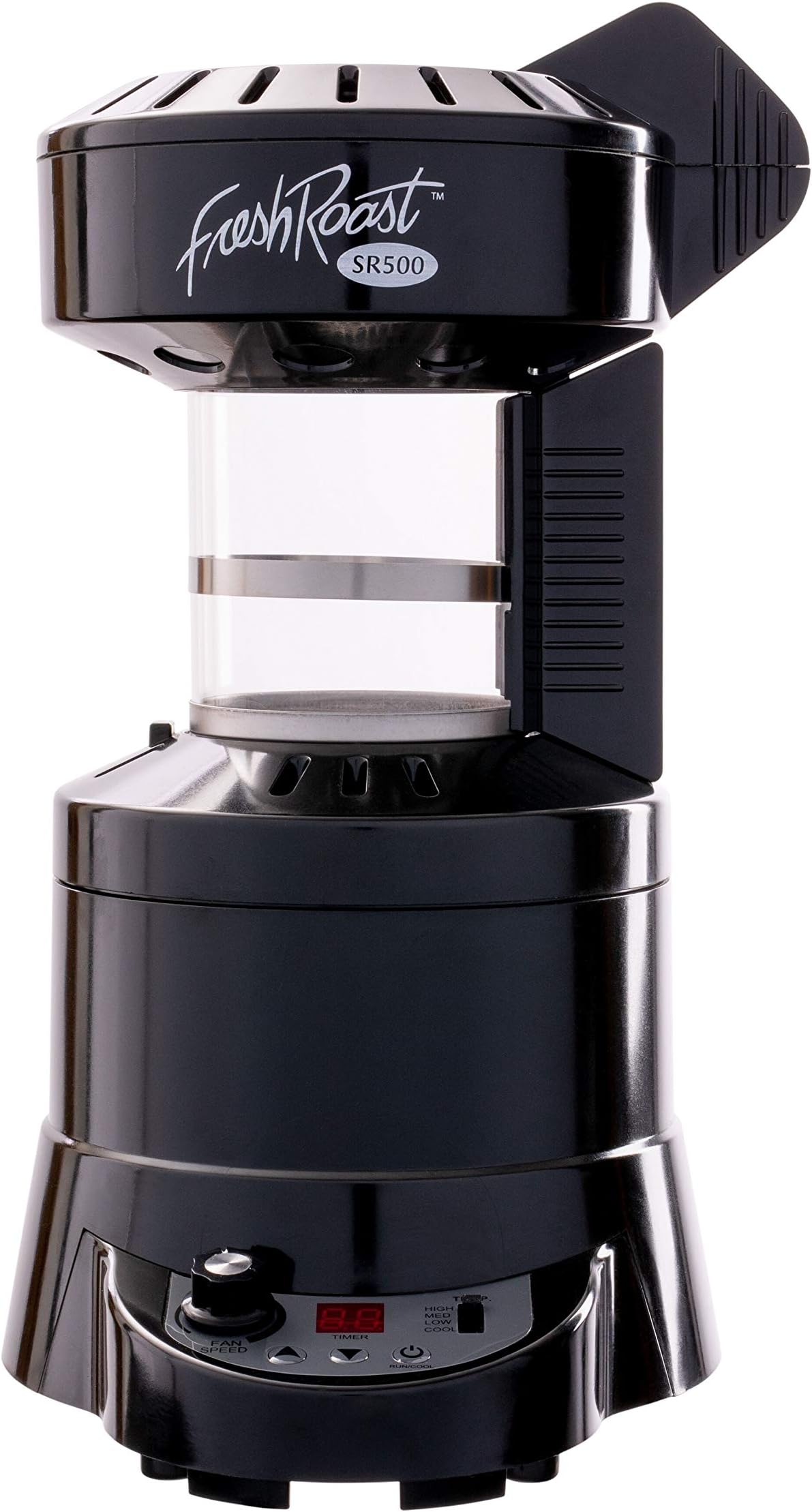


FreshRoast SR500 Automatic Coffee Bean Roaster
Product ID: 1730667
Details
- BrandFresh Roast
- ColorBlack
- MaterialStainless
- Special FeatureAdjustable and
- Specific Uses For ProductEspresso
☕Fluid Bed Roasting
⚡1500 Watts Power
📱Touchscreen Control
☕ Brew Your Best: Elevate Your Coffee Game!
The FreshRoast SR500 Automatic Coffee Bean Roaster is a state-of-the-art fluid bed roaster designed for coffee enthusiasts. With a 4 1/4 ounce capacity, it features a fully automatic operation mode, a user-friendly touchscreen interface, and adjustable fan speed control, all powered by 1500 watts. This compact and efficient roaster allows you to customize your roasting cycles, ensuring a perfect brew every time.
| ASIN | B0034D9ONO |
| Brand | Fresh Roast |
| Brand Name | Fresh Roast |
| Color | Black |
| Customer Reviews | 4.3 out of 5 stars 432 Reviews |
| Filter Type | Reusable |
| Human Interface Input | Touchscreen |
| Included Components | Filter |
| Item Weight | 2 Pounds |
| Manufacturer | Fresh Beans, Inc. |
| Material | Stainless Steel |
| Model Number | SR500 |
| Number of Items | 1 |
| Operation Mode | Fully Automatic |
| Other Special Features of the Product | Adjustable Temperature and Fan Speed Control, Portable (within home/business setting) |
| Part Number | B0034D9ONO |
| Recommended Uses For Product | Coffee Preparation |
| Special Feature | Adjustable Temperature and Fan Speed Control, Portable (within home/business setting) |
| Specific Uses For Product | Espresso |
| UPC | 793842098631 656129101021 139643760122 791769521287 |
| Unit Count | 1.0 Count |
| Warranty Description | One year manufacturer's warranty on the roaster. Six month warranty on the glass roasting chamber. |
| Wattage | 1500 watts |
S**T
Absolutely fantastic home coffee roaster!
I started home roasting with an air popcorn popper like most home roasters do. I was hooked on it enough that I was willing to save up a bunch of Christmas money and buy this FreshRoast SR500. I'm very glad that I did. I read dozens upon dozens of reviews on Amazon, reviews on other websites, YouTube videos, etc., and felt confident this wouldn't be a waste of money. It's very well packaged. Hang on the to the instructions and the small plastic 1oz scoop. Do a quick wash of the glass roasting chamber, and you're ready to go! Two concerns that I had with this roaster were that several people state it's very tipsy, and the chaff collector and roasting chamber have a high danger of falling off and breaking if you tip the unit. Neither the chaff collector not the roasting chamber lock into place and can fall off if you tip it, but if you're leaving it on your counter (or garage work bench in my case) there's little to no reason to monkey with it's position once you turn it on. Treat it carefully and you'll never have a problem. The second concern I saw in several reviews was that with the fan speed on high, there wasn't enough force to get the beans to move in the extreme early stages of roasting when the beans are still green. I've tried numerous roasts so far and haven't had any issues as long as I don't exceed 4oz. Turn the heat on high, crank the fan to 100%, and the beans move adequately, and increase their speed quickly as they begin to dry and moisture evaporates from them. There is absolutely no reason to remove the chaff collector and stir the beans as some people claim is required in reviews. If you're at that point, you've probably added too many beans. If you absolutely MUST, gently tip the unit to the side while making sure the top doesn't fall off for a couple of seconds. It'll get the beans to move right away, but even that isn't truly necessary. I found that the best roasts for me occur when I closely monitor the fan speed. I leave the heat on high and don't change it until I turn it off to cool. I turn the fan to 100% at the beginning, and somewhere around the 3.5-4 minute mark turn it down to the point that the beans still move, but aren't bouncing around excessively in the chamber. I want constant movement in the beans, but not excessive movement. I continue to monitor the fan speed and adjust downward through the roast process as the beans approach 1C (1st crack), usually at around 5:00 to 5:30, and then again as they proceed toward 2C (2nd crack). At that point I usually turn the fan down close to 25% or even less based on the bean movement. I typically turn the heat off and start the automatic 3 minute cooling cycle at around 9:50. This results in a beautiful medium/dark roast, which I love. The chaff collector does a fantastic job of collecting a solid 95+% of it, with only the finest of particles passing through. The amount that makes it out really is extremely minimal, but as I roast in my garage, it's not a problem in any way. Emptying the chaff collector is simple and can be done right after the roasting, after the collector cools a little bit. As soon as my roast is done, I dump the beans into a colander and swirl them around for a minute or two to make sure any excess chaff blows away. The beans are usually adequately cool by the time the 3 minute cooling cycle is done, but I have seen some chaff still in the roast, and I always want to make sure to get rid of the rest. As for roasting indoors vs. outdoors, you really will want to do this in your garage or outside if at all possible. I'm not gutsy enough to try it on my stove top with the exhaust fan going, because if you've used a popcorn popper to roast coffee before, you'll recognize there really are several different odors that come from the beans in various stages of the roasting process. They're not offensive in any way to me, but considering you're roasting beans for a solid 9-10 minutes, the smells really can permeate the room you're in. The initial grassy smells aren't bad, but probably won't ever be used as an air freshener scent any time this century. They proceed into more of a toast odor, which as with the grassy smell isn't offensive, but will permeate whatever you're around. Fortunately this starts moving toward a nice roast smell which IS incredible, but as with the others is NOT subtle and WILL permeate your home if working indoors. I roast in my garage during the winter with the garage door open. The odors usually dissipate within a day or two. That roast scent that lingers nice and strong for that first day though...delicious... Sometimes I'll walk into the garage a couple of hours after I roast just to smell. Serious. :-) I've tried a couple of different beans from Lavanta's Amazon store now and am very pleased. With the money saved on buying green coffee beans compared to buying in the store or from my preferred specialty roasters (Black Rifle Coffee, primarily), this machine will pay for itself. I'll then be rewarded with a machine that's paid for itself within the first 12-16 months, the freedom to roast to whatever depth I please, and in whatever quantities I need. Word of advice: create a journal of your roasts so that you can make notes of the finished product and the adjusted fan and/or heat at different times you took to achieve that roast. This way, you can duplicate what you love, or make changes to ones you're not as pleased with. Thanks to Google Sheets (Google's answer to MS Excel), I have a spreadsheet I created on my Kindle that I make instant notes in during the roast cycle. It's kind of nerdy, but I like that. Best $180 I've spent in a long time.
S**P
Updated review- Not perfect, but fun- and does a good job
Updated review. I've had my SR500 since Christmas and I think we've reached approximately the break-even point financially vs. buying Stumptown Hair Bender blend, which we brewed most of the time before. Less than six months. Not bad. Buying green beans from Sweet Maria's, paying for shipping, weeding out the no-good beans after roasting, and the weight lost during roasting leaves me with roasted coffee that costs almost exactly half of Hair Bender's $20/lb price, so I make up $10 per pound that I roast. Once you become practiced at roasting, you will make better coffee than you can buy. It doesn't take long. A few batches. I still think the SR 500 is the best small roaster out there for the price. I cooks beans quickly and the roasting process is easy and fun to watch and control. There are two issues, however, that badly need to be resolved. One, the thing is far too top-heavy and will topple if given the slightest provocation. That big plastic top, which by the way does a great job of catching chaff, just sits on top of the roasting cup, which in turn is just sitting in its hole- not attached in any way- on the base. Keep your roaster away from kids or anywhere where there's activity! And if it falls over while roasting, you have 400-degree beans and parts scattering everywhere. That is HOT. I cook my beans in the garage and have knocked it over once while roasting. It doesn't take much. The other issue is the fan. Watch YouTube demonstrations of this roaster and you'll see people picking up all or part of the roaster while it's working and shaking the entire thing during the first part of the roast. Wow. THAT's not a disaster waiting to happen. The reason they do that is the fan is not powerful enough to adequately circulate coffee beans until they dry out a bit, about 90-120 seconds into the process. If you don't do something to help it out you get unevenly roasted beans. What I do probably isn't much better: I start the roast with the top off and stir the beans with a long wooden chopstick every few seconds for that first minute and a half, causing a chaff snowstorm in my garage. The fresh Roast people say to turn the heat off and on a few times until the beans start circulating. Honestly I haven't tried that. Probably the smartest thing to do but I worry about affecting the quality of the roast. Having gotten the gripes off of my chest I still enjoy using this roaster. I feel very involved in the process while cooking beans, more so than I think I would with, say, a Behmore (sp?). A couple of quirks- If you roast two batches in a row, the second batch takes longer. I don't know why. I do recommend running two cooling cycles between batches because the lid gets really, really hot if you don't. Also, six months in, the lid and the roasting cup are hotter now after a cooling cycle than they used to be, and I don't know why that is either. Either the fan has gotten weaker or I am using higher temperatures when I roast. Either one is possible- I just find myself using two 3-minute cooling cycles sometimes. Overall, this machine is far from perfect, but if you think you'll enjoy hands-on roasting and can tell yourself that you're getting the best roaster out there for the price- issues and all- I recommend this machine. I've roasted a lot of really good coffee with it. By the way, a lot of users talk about having to mash the "add time" button many times to extend the roast. Not necessary. Moving the heat selector switch to "cool", then back up to whatever temp you want resets the clock to 5.9 minutes. I wait until it counts down to 0.9 and then reset it, so I know to add 5 minutes to whatever time the timer has counted off. I typically let the machine run at high fan and low heat for 6 minutes, then turn the heat to medium and start slowing the fan down. First crack is usually achieved at about 7 minutes that way, and second crack 1-2 minutes later. Total of 9 minutes max plus a 3 minute cool down for beans dark enough (but not oily- yuck) to brew good espresso. I've never used high heat.
R**N
Works very well
I am new to coffee roasting so don't consider me an expert. I ordered this roaster and a sample assortment from another company and I am very pleased. I have always been frustrated by what people believe is "good" coffee, i.e. the burned, gnarly St****cks type roast. True quality coffee is far better than what you get from the usual street vendor or big coffee merchants. My first batch with this unit turned up one of the shortcomings of roasting your own coffee. SMOKE! You cannot roast in the house unless you have a darn good vent to send the smoke outside. I was doing a fairly light roast and managed to set off all the smoke detectors even with the roaster sitting right next to the vent. This is not a fault of the roaster. It did its job admirably. You put the beans in, select your temperature, the fan speed and length of time. It takes a few batches before you get the timing and temperature right. But that's one of the reasons you roast your own coffee...it's an art form. And it's fun! I would suggest setting up a spreadsheet so you can track all the variable for each coffee you try. Write down what you did each time you roast and when you get it just right, you can refer back to the instructions the next time. This unit is very sensitive to the surrounding temperature. For example, it comes with a default roast time of about 6 minutes. In the house, where it will set off the smoke detectors, this is about right. Since I roast out on the deck where it is 30 degrees, I have to up the time to 8 minutes. So be prepared to adjust time as the weather changes. Also, roasting coffee generates chaff that you have to empty out of the top of this unit. I find that when the coffee is done roasting and has gone through a cooling cycle, I have to empty the chaff and then turn on the cooling cycle one more time to get the rest out of the beans. THe screen on the chaff filter get clogged so it is a two part process. Not a big deal at all. I had done a huge amount of reading on the various roasters available and have found this to be an outstanding compromise offering quality performance and a reasonable price. 9/24/2012 I have used this unit DAILY since I bought it. Still works great. I use compressed air to blow out the guts occasionally since it inhales air through the base and expels it at the top. Nothing major has ever come out but it seems like minimal routine maintenance to keep the machine running. I use mine on the deck, outside. I note that the plastic does get less shiny due to UV exposure. I don't care about the looks as long as it continues as it has. For coffee beans, try Sweet Marias. For an outstanding grinder the Bodum burr grinder is a work of art. October 2013 THis wonderful roaster is still running just fine. Over a thousand batches roasted and showing no signs of wear other than the glass beaker is dark brown, the plastic isn't shiny anymore and I have a small chip in the filter lid that was my fault. THis works out to less than 17 cents per batch. Heck of a deal. February 2014 Still working great. I have had to up the time required for the roast by about a minute. Not a big deal. This roaster has lived on my back deck its entire life and has held up through blazing sun and freezing cold. It is protected from direct rain but has lived a humid life during the winter. At some point I will replace the unit and will buy the same thing again. August 2014 Still ticking fine... June 2015 Finally died. I have roasted about 1300 batches of coffee. That works out to 12 cents per batch. I am fully satisfied with these results. I ordered a new roadster. Same model and brand.
A**R
The beginning of a flavorful journey
My wife's and my journey towards a better cup of coffee has probably taken far more years than it should have. This latest step, however, has made the greatest impact. Home roasting is what I'm referring to, and the SR500 has been the primary tool we've used to take that step. There's really only three ways to get into roasting: stove-top roasting (whether with a pop-corn roaster or other), fluid bed roasting, or drum roasting. The first method has the cheapest startup costs, but takes a great deal more effort to maintain a consistent quality of output. The last method has the highest startup costs, but is said to give the user the most control over the quality, with the ability to do larger batches. The middle method lies right in the middle, and that's where the SR500 lies. The most important criteria for considering home roasting a success (for me) is the ability to produce a superior cup of coffee at the same cost, or lower, of our existing supply of coffee at the store. The use of the SR500 has made this unequivocally a success. We get a much better coffee at a lower cost of bean, with the SR500 paying for itself in a little under a year. At our levels of consumption it only takes about 45min to produce a week's worth of coffee. The time expenditure might not seem worth it for the average coffee drinker, but the difference between coffee made from store beans and freshly roasted beens, quite frankly, is shocking. And that's really the kicker: the leap in quality. Even while drinking the stale swill at work, I always appreciated a better cup of coffee at home and elsewhere. Even so, they were both still just degrees of coffee. After home roasting, though, it's like I never knew what real coffee tasted like. I still drink coffee at work and at restaurants, but now I know it's a completely different class of beverage. Truly fresh coffee has much more complex flavors, and has a creamier texture. The differences between the various beans is much more pronounced than what I've tasted at coffee shops. And if you want flavor, but with the same thinness of your average percolated coffee, fresh coffee takes less grounds to produce it. But, back to the SR500. This is a relatively inexpensive machine for roasting very good coffee. The instructions are overly simplified, however, and not really useful in getting the kind of coffee you might want. The variations needed for different beans might be significantly different. Nor is this the kind of roaster you can set & forget for each batch. The reality is that each batch will need multiple adjustments for best results. For instance, we enjoy a good Costa Rican Tarrazu bean roasted to full city+, a roast that's bordering on the lightest of the dark roasts, not quite Vienna. In the SR500 I would roast each batch (four level scoops of beans) as such: 00:00 - 03:00: max fan, low heat 03:00 - 05:30: 80% fan, med heat 05:30 - 08:00: 50% fan, high heat Even that, however, is simplified. The trick with fluid bed roasters is slow, but steady bean movement. Tarrazu can be very dense, so you might not get good movement until after the first drying phase. Once heat is put on medium, you'll want to occasionally lower the fan speed as they dry enough and start causing bean movement that's too fast, or air pockets that cause the whole column of beans to jump. Even the end of phase two isn't an exact time, I usually time it so it ends at the beginning of first crack (where the beans sound like pop corn as the water vapor escapes). At that point, phase three begins, fan adjustments continue as needed, and it should end at the beginning of second crack (a lighter popping sounds than the first, the result of oils vaporizing). This does mean that when I'm roasting, I'm focused on the beans, I can't really multitask except during the drying phase. The results, however, are very much worth it. One other word to the wise for other fledgling roasters: this process does produce some smoke. It's not that noticeable for a single batch, but it will build up if you're doing multiple batches. You might not want to roast in the house, a heated garage is a better option, and one with a fan on an exterior vent.
E**E
Great roaster, allows for smoke-free roasting with 1 easy modification!
I LOVE my SR500, I am getting absolutely spoiled by always having freshly roasted coffee at home! I find that SR500 works fine the way it is, but it has one big drawback - you either have to roast outside, or your smoke alarm will go off every time you roast coffee. Here's the easiest solution I found to the issue: go to hardware store and buy yourself a 6" aluminum air duct (I think 4" would work too, but I didn't test it). Then take the very top cover of SR500 off, put air duct on top and stick the other side of it out of the window. That's it! Now you can roast inside and not have any issues with smoke. Side effect of this modification is that the airflow inside SR500 increases, so you can now roast more coffee per batch (I found that 2/3 of a cup work best) without sacrificing evenness of the roast. The drawback of the method is that there will be some chaff falling from the air duct as you lift it from the roaster - put something under it to collect it. In case you are looking for some place to start roasting, here's how I view the roasting process: First phase of roasting: get some water out and lighten the beans, so that they move around better for better roasting. It usually takes about 3-4 minutes at low heat and max air flow. Second phase: get to first crack. That takes about 4 minutes with heat on medium and fan speed at about 2/5 (just a bit below half). You can stop here if you choose. Third phase: 2nd crack and further roasting. I am not a fan of the darkest roasts, so I don't do more than 2 minutes of this phase. You can do it longer, but be careful not to burn the beans. This phase is done on the high heat and about 1/4 of fan speed. Here are the 2 roasts that I start with when trying new beans, and then modifying the roasts to my taste (if you are not using a duct modification, you may need to prolong phase 1 and use higher fan speeds for phase 2). I am using about 2/3 of a cup of beans per batch. Lighter roast (1 crack) - start on low heat, full speed fan, set time to 8. As the time reaches 4.5 - adjust heat to medium and fan to 2/5 speed. Let the roasting finish. You should expect to hear the 1st crack at around 2 minutes. There will be no 2nd crack. Darker roast (2 cracks) - start on low heat, full speed fan, set time to 9.5. As the time reaches 6 - adjust heat to medium and fan to 2/5 speed. First crack should start at 3.5 minutes. At 2 minutes, set the heat to high and drop the fan down to 1/4 speed. The 2nd crack will start at about 1 min.
A**R
Great Product - A few odd choices
I previously started roasting coffee beans in a hot air popcorn popper, and decided to step it up to something more professional when I realized it was going to be more than just a periodic hobby. As the other reviews have said, this is an excellent product and it works extremely well, just a few things that I would like to see improved in the next version: 1 - Display - This has a timer built in with minutes and fractions of a minute. I've never expressed time as fraction of 10 before, so seeing time displayed as 3.7 minutes is just odd. Adding another space on the display would allow this to countdown like a normal timer, which I would prefer. This isn't a problem per se, just seems like an odd choice. 2 - Default Timer - I would like to be able to adjust the default timer to match my roasting style. Again, this isn't a huge issue, but every time I roast a batch I end up adding about 4 minutes in 1/10 of a minute increments, so clicking the "Up" button 40 times gets a little old with every roast. 3 - Fan Sensitivity - The fan speed is controlled via a dial, however I've noticed no difference between the lowest setting, and approximately 1/2 way on the dial. When you start at full speed and slowly turn the fan down, when you hit the 1/2 way point on the dial it simply doesn't slow down any further below this. Again, not a problem, but would like to see the dial to be fully sensitive so you can better control the fan speed. As I mentioned, this is an excellent product, and none of the items that I've highlighted change the ability to roast beans, the quality of the roast, or the experience, however these would be nice things for the company to consider in their next version of the product.
J**A
Should be so much better.
Yes, you can (in spite of the machine), get a good roast. However, there has got to be better out there. This is my first machine. I have had it 3 months and have used it multiple times a week. and I have gotten to the point where I can get a darn nice roast, but this is in spite of the machine being inconsistent, poorly designed, fragile and just generally a poor product. There are so many flaws in this design, I almost don't know where to start: -The digital timer is set up in tenths of a minute. It defaults to 6.0 min, but no roast takes less than 11 minutes. To add time, you have to push the up arrow button 1 time to add 6 seconds. To add 5 minutes you have to push it 50 times! -The heat control is just low-meduim-high. Thats it-deal with it -The fan control is a simple dial-no markings-just a dial -The chaff collector just sits on top of the chamber, and the glass chamber just sits on top of the heater. You have to be very careful when you move the machine because it readily falls over and crashes onto the floor or countertop and because of the cheap plastic construction of the chaff collector, it readily breaks & cracks. -The heating is very inconsistent. You cannot just come up with a method (time/coffee type/fan setting/heat setting) and duplicate it every time for a good roast. You get wildly different results every time. The only way to get good results is to stand there for 11-12 minutes and babysit it. All in all, this machine is a disappointment and while I do make good coffee with it, I would never by another one and I cannot recommend it.
R**K
Easy to use. Very consistent roast. wares out after about 3 years.
I'm new to roasting, so I'm no expert. I tried the whirly-pop method on my grill and after tossing a few batches out into my backyard, I bought the SR500. On my first try it was perfect. I tend to be a tech geek and always follow the directions in the owners manual. The manual says beans can vary in weight and four level scoops should weigh less then 120g. If this isn't so then you should dry them on low heat and high speed for a few minutes. After that I run it as usual and it does fine. I know 120 grams is not 5 ounces but its called marketing. Deal with it. The machine is much quieter then I thought it would be but I still have trouble hearing the 2nd crack. I just attribute this to my still being a newbie and a little hard of hearing. When you are all done you end up with about 100g of fresh roasted coffee beans. How many cups of coffee that is depends on you. 6/20/13 UPDATE: OK, I'm definitely becoming a coffee snob and this machine is the way to do it. I have no problems hearing the 2nd crack now and can crank out some beautiful dark roasted beans. The sight glass is a real plus as this is one of the few systems that let you watch the beans go thru their various shades of browning. The 4oz capacity is good and bad as it would be hard to keep up with more then four coffee drinkers but (big but) it makes it much easier to be creative and try different roasting profiles. Here's a tip. Keep a log when you roast and brew. There are so many different beans and so many different ways to roast them and so many different ways to brew them, that you will get it mixed up. 3/01/14 UPDATE: Okay, I've been using this machine for a while and it has become part of my afternoon and morning routines. Every few days I will roast a batch of coffee in the evening. I leave it to cool overnight, then bottle it up in the morning. After roasting, I end up with about 100 g of roasted coffee. Since I am the only drinker in the house, this will last me a few days. I must say, that I will probably never go back to my old ways of drinking coffee. I will roast from now on. For one thing, the price of green coffee beans is about half of what it would cost to purchase them roasted. So in the long run, if you want to drink really good coffee, a roaster will eventually pay for itself. Also, there is something about drinking a cup of coffee you made from scratch. Even if it doesn't really taste better, it just seems that way. It is also, a cool/cheap Christmas present for a client or associate. Just roast up a half pound, put it into a cute little bag and put a nice card with it. Just make sure they know you Hand roasted it just for them, and no one else. Be advised, though, this may be a gateway drug. I am looking into nicer/more expensive coffee roasters. This is a big point. I've been using the fresh roast SR500 for about 6 or 7 years now. The heater unit gives out after about 3 years. For about $80 I can buy a replacement lower heater unit. I will be buying the third unit, tonight. Since I cannot go back to using regular coffee beans. Other models cost 5 to 6 hundred dollars.
橋**弥
夢のコーヒー焙煎機
アメリカ仕様120Vのままですと、100Vの仕上がりは弱いブラウン程度まで。コーヒーの焙煎には至りません。しかし電圧その他を工夫すれば、プロも絶句する柔らかな苦味と深いコク、恐らくこれこそが本来のコーヒーだろう、そう叫びたい風味を生み出す事が出来ます。繰り返しますが、このまま日本の100V環境で使っても、全く焙煎には至りませんので、変圧器や特別な工夫をご自分で対応出来方に限って、ご愛用下さいますように。
B**N
Great coffee roaster
A great coffee roaster - it is easy to use, and easy to adjust to your liking
A**ー
焼きムラが有る様な気がします
全体的には良いですが 容量が少ないことと 早い段階から色の濃い豆が現れます。
オ**ラ
力不足?
説明はありませんが、120Vに昇圧する必要があります。 また、1500Wなので2〜3,000円くらいの安いアップトランスでは容量オーバーになってしまいます。 お持ちでない方はアップトランスでさらに1万円以上かかってしまいます。 使用感は、やり方が悪いのか煎りムラが出てしまいます。 容量は120gとありますが、85g程度で焙煎してみました。 チャフ受けはついてますが多少飛び散ります。 作動音がわりと大きめなので聞こえないのか、長時間ローストしても1ハゼが起きません。 豆にシルバースキンが付いたまま剥がれず、白っぽい豆も残った状態ですが、20分程経過時で諦めました。 煎りムラの軽減になるかとファンを最大にしてローストしましたが、次は最少で試してみようと思います。
Trustpilot
1 week ago
2 months ago