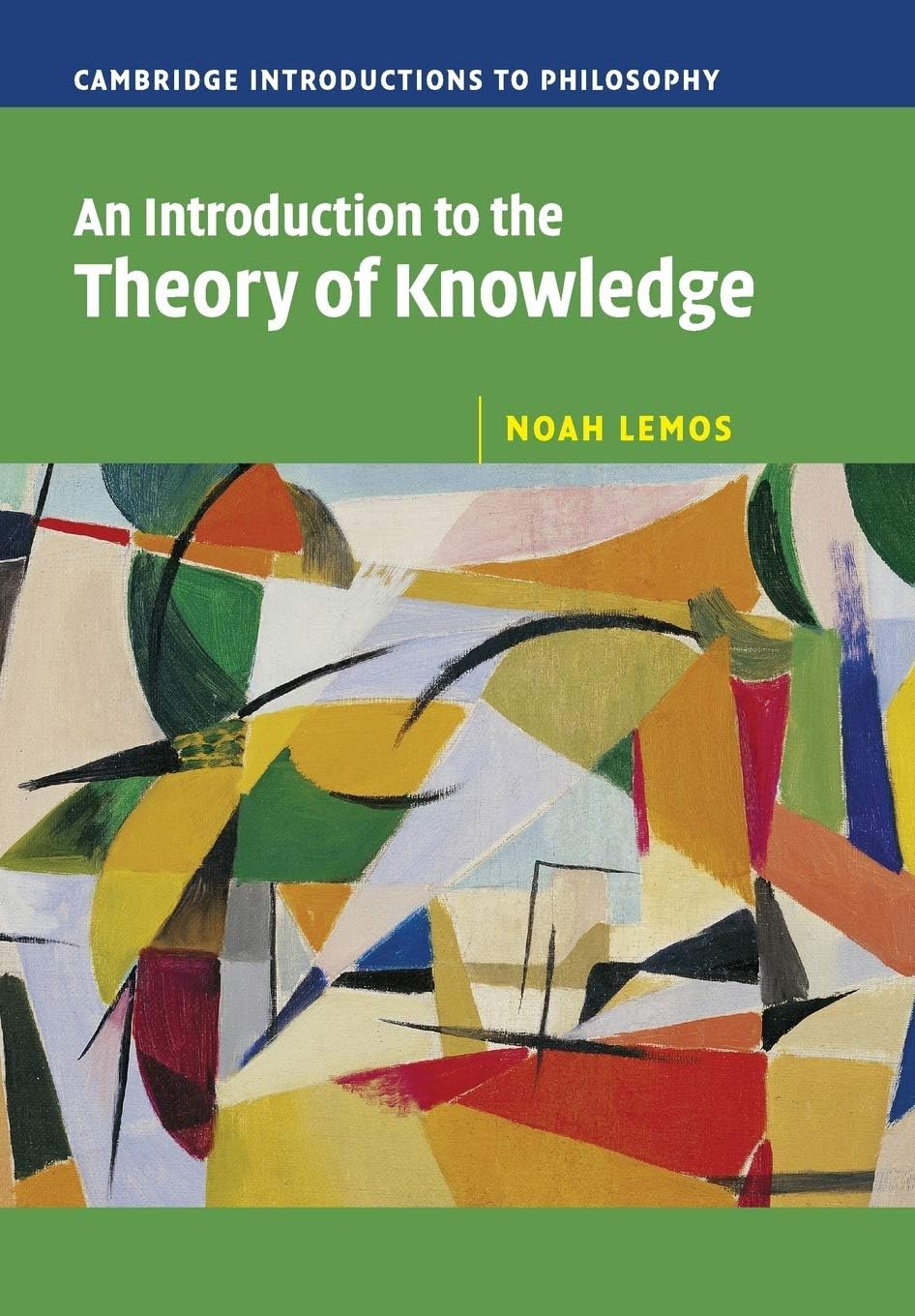
An Introduction to the Theory of Knowledge (Cambridge Introductions to Philosophy)
Product ID: 176564240
Buy anything from 5,000+ international stores. One checkout price. No surprise fees. Join 2M+ shoppers on Desertcart.
Desertcart purchases this item on your behalf and handles shipping, customs, and support to Thailand.
Epistemology or the theory of knowledge is one of the cornerstones of analytic philosophy, and this book provides a clear and accessible introduction to the subject. It discusses some of the main theories of justification, including foundationalism, coherentism, reliabilism, and virtue epistemology. Other topics include the Gettier problem, internalism and externalism, skepticism, the problem of epistemic circularity, the problem of the criterion, a priori knowledge, and naturalized epistemology. Intended primarily for students taking a first class in epistemology, this lucid and well-written text would also provide an excellent introduction for anyone interested in knowing more about this important area of philosophy. Review: Highly recommended - Conversational yet technical to undergraduate level. Delightful Review: Easy read. - Easy to read. Informative introduction to the topic, with clear explanations of the key areas. Good place to start studying.
| Best Sellers Rank | #1,245,709 in Books ( See Top 100 in Books ) #180 in Epistemology (Books) #2,667 in History & Surveys #109,474 in History (Books) |
| Customer Reviews | 4.7 out of 5 stars 40 Reviews |
B**S
Highly recommended
Conversational yet technical to undergraduate level. Delightful
J**S
Easy read.
Easy to read. Informative introduction to the topic, with clear explanations of the key areas. Good place to start studying.
P**S
A Very Useful Introduction
Noah Lemos' An Introduction to Theory of Knowledge is a very useful introduction of the philosophy branch of Epistemology. What makes Lemos' introduction useful is he focuses on the general and important philosophical positions in epistemology and evaluates those arguments in "pros" and "cons", or in other words evaluating the strengths and weaknesses of those positions by providing counter arguments. While Lemos concedes through out the book that he could not go over the subtleties and convulsions of the more difficult arguments, he does try to reiterate the more general, basic, and comprehensible arguments for many of the important positions in epistemology such as classical foundationalism, moderate foundationalism, reliablism, intellectual virtues, coherentism, and natural epistemology. He even evaluates one of the most important contemporary arguments such as Gettier Problem which provides thought experiments that are counterexamples to the definition of knowledge according to various views of foundationalism. For every claim he quotes, Lemos carefully evaluates those claims to see whether or not they hold up to scrutiny. Because it is not entirely clear what Lemos personally believes in this makes a fine introduction since Lemos tries to objectively evaluate these positions without influencing the reader favor a specific kind. There are certain positions Lemos would explain to be untenable which could influence reader to be more careful in selecting which views he or she endorses. But in the end the purpose of the introduction is critically introducing different positions rather than merely introducing them. Unfortunately, because there are not that many introductory books on epistemology for beginners this is probably the only book for beginner interested in epistemology; it would be wise any beginner of epistemology should not pass off the opportunity to obtain this book, it might really help to read it.
S**R
Good introductory survey
Philosophy is woefully lacking in good introductory surveys in its various subdisciplines... which is why it's so great to see a book like this -- an accessible, clearly-written, comprehensive intro to epistemology. It covers all the basics (the "standard view" of knowledge as justified true belief, Gettier problems, foundationalism/coherentism/relaibilism, etc.) and has a decent balance of theoretical discussion and specific examples. Also, it highlights some of the more recent developments in the field (e.g. writings by Ernest Sosa). While not perfect -- for example, sometimes terms aren't defined as thoroughly as they could/should be -- for my money this is the best intro epistemology survey out there. (Though Richard Feldman's is also good. Feldman's is probably best if you have no background in philosophy, while this is a little more philosophically rigorous.)
D**E
Easy to use
My daughter needed this for school
Trustpilot
1 month ago
5 days ago