

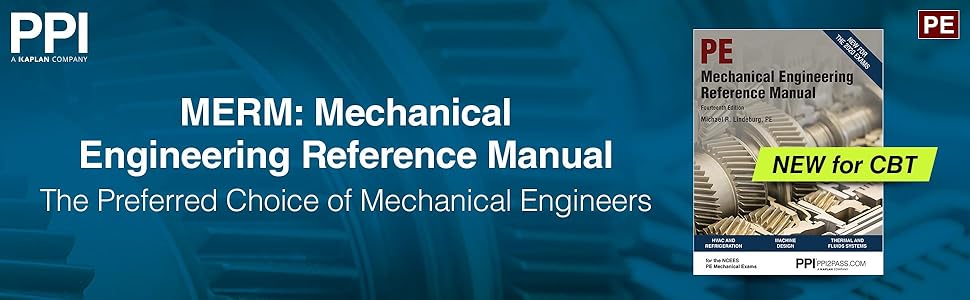
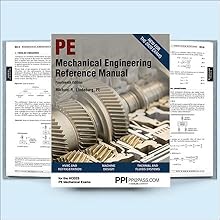
PE Mechanical Engineering Reference Manual
Product ID: 195541950
Buy anything from 5,000+ international stores. One checkout price. No surprise fees. Join 2M+ shoppers on Desertcart.
Desertcart purchases this item on your behalf and handles shipping, customs, and support to Thailand.
Comprehensive Reference Manual for the NCEES PE Mechanical Exams The Mechanical Engineering Reference Manual is the most comprehensive textbook for the three NCEES PE Mechanical exams: HVAC and Refrigeration, Machine Design and Materials, Thermal and Fluid Systems. This book&;s time-tested organization and clear explanations start with the basics to help you quickly get up to speed on common mechanical engineering concepts. Together, the 75 chapters provide an in-depth review of the PE Mechanical exam topics and the NCEES Handbook. Michael R. Lindeburg&;s Mechanical Engineering Reference Manual has undergone an intensive transformation in this 14th edition to ensure focused study for success on the 2020 NCEES computer-based tests (CBT). As of April 2020, exams are offered year-round at approved Pearson Vue testing centers. The only resource examinees can use during the test is the NCEES PE Mechanical Reference Handbook . To succeed on exam day, you need to know how to solve problems using that resource. The Mechanical Engineering Reference Manual, 14th Edition makes that connection for you by using only NCEES equations in the review and problem solving. Topics Covered Fluids Thermodynamics Power Cycles Heat Transfer HVAC Statics Materials Machine Design Dynamics and Vibrations Control Systems Plant Engineering Economics Law and Ethics Key Features Improved design to focus study on most important PE exam material Explanations and demonstration of how to use NCEES handbook equations NCEES handbook equations are highlighted in blue for quick access In chapter callouts map to the specific PE exam to streamline review process Extensive index contains thousands of entries, with multiple entries included for each topic Binding: Hardcover Publisher: PPI, A Kaplan Company Review: Not worth it - It is not a great book as it has all 3 mechanical majors so it's hard to focus on the relevant topics. Bought it and returned it back. Thanks for desertcart's excellent customer service though. Review: Here, this one, get this one. No seriously, stop shopping around and just get this one. - I took the April 2017 Mechanical Engineering Thermal and Fluid Systems exam...and passed! This is THE book to get if you are planning on taking the PE exam. After reading several reviews, I decided that the price was worth it, so I bought the reference manual itself, along with the accompanying question and answer soft cover book. I spent about seven months reading through the entirety of the book and performing about 95% of the study problems. I stayed away from most of the questions that said that they would take at least an hour to solve since I thought they would be outside the realm of what I would have to do on the exam. Granted, they are good if you have the time. All-in-all I used about 400 pages of engineering paper working problems out. I only solved the problems in English units, primarily because I felt more comfortable with SI, so I figured it wouldn't be that big of a stretch to solve an SI based problem. I also did not work out the problems from the Plant Operations and Management section, but I did read through those chapters. They did expose me to many aspects of Mechanical Engineering that I had little to no experience with, so it was definitely worth it from a learning perspective. Some reviewers have said to skip over the first 13 chapters since they are just background skills, but I did go through them and learned a thing or two along the way. I did end up taking a few extra books with me to the exam, although it was wholly unnecessary. I also printed out a few engineering codes that I was able to find online, but again I didn't need any of those. I would have been fine bringing only this book and a calculator. I thought that the morning session was actually pretty straight forward. The afternoon session was a bit more challenging, but I finished both sections with 45 minutes to an hour left on the clock. The extensive study beforehand really paid off. While the book does a great job of giving you usable equations, I would not recommend relying on just finding a "plug and chug" solution to every problem. If you understand how systems actually work, you can solve every problem relatively quickly. If you find yourself using an erf function, you're probably overthinking the solution. Bottom line, if you want to pass the exam with style, get this book.





| Best Sellers Rank | 2,463,681 in Books ( See Top 100 in Books ) 3,708 in Mechanical & Materials Engineering 5,978 in Engineering & Technology References 202,455 in Reference (Books) |
| Customer Reviews | 4.4 out of 5 stars 245 Reviews |
K**R
Not worth it
It is not a great book as it has all 3 mechanical majors so it's hard to focus on the relevant topics. Bought it and returned it back. Thanks for Amazon's excellent customer service though.
T**L
Here, this one, get this one. No seriously, stop shopping around and just get this one.
I took the April 2017 Mechanical Engineering Thermal and Fluid Systems exam...and passed! This is THE book to get if you are planning on taking the PE exam. After reading several reviews, I decided that the price was worth it, so I bought the reference manual itself, along with the accompanying question and answer soft cover book. I spent about seven months reading through the entirety of the book and performing about 95% of the study problems. I stayed away from most of the questions that said that they would take at least an hour to solve since I thought they would be outside the realm of what I would have to do on the exam. Granted, they are good if you have the time. All-in-all I used about 400 pages of engineering paper working problems out. I only solved the problems in English units, primarily because I felt more comfortable with SI, so I figured it wouldn't be that big of a stretch to solve an SI based problem. I also did not work out the problems from the Plant Operations and Management section, but I did read through those chapters. They did expose me to many aspects of Mechanical Engineering that I had little to no experience with, so it was definitely worth it from a learning perspective. Some reviewers have said to skip over the first 13 chapters since they are just background skills, but I did go through them and learned a thing or two along the way. I did end up taking a few extra books with me to the exam, although it was wholly unnecessary. I also printed out a few engineering codes that I was able to find online, but again I didn't need any of those. I would have been fine bringing only this book and a calculator. I thought that the morning session was actually pretty straight forward. The afternoon session was a bit more challenging, but I finished both sections with 45 minutes to an hour left on the clock. The extensive study beforehand really paid off. While the book does a great job of giving you usable equations, I would not recommend relying on just finding a "plug and chug" solution to every problem. If you understand how systems actually work, you can solve every problem relatively quickly. If you find yourself using an erf function, you're probably overthinking the solution. Bottom line, if you want to pass the exam with style, get this book.
A**ー
幅広い分野をカバーし内容も掘り下げ,なおかつ分かり易い本です.
1週間ほど使用している,現在の感想です. 設計職に内定が決まり,勉強のための本を探していた時に知り合いのPEの方から薦めていただいた本です. 幅広い分野に対応する参考書で,一つ一つの分野でみてもかなりの分量の資料,問題をそろえております. 熱力学の項では化学的な電気陰性度での化合について,制御器の項ではモデル化について触れるなど,内容も深く掘り下げられており,値段は高いですが,納得できる良著です. 少し気になるのは,どの項目についてもさっくりとまとめているので,内容を理解するには大学で学んだレベルの事前知識が必要と思います. とはいえ非常によくまとめられており勉強し易いと感じますので,星5にさせていただきます.
N**K
Tips to pass the Mechanical Engineering PE Exam
I passed the October 2015 Mechanical Engineering PE exam (I chose to take the Mechanical Systems and Materials in the afternoon), and I would like to share with you how I prepared for the exam. I did not enroll in a course, but I used the following four resources, all purchased on Amazon: (1) Mechanical Engineering Reference Manual for the PE Exam, 13th Ed (2) PE Exam Review for Mechanical Systems and Materials: PE Review Book for ME (3) PE Mechanical Engineering: Mechanical Systems and Materials Practice Exam (4) Six-Minute Solutions for Mechanical PE Exam Mechanical Systems and Materials Problems, 2nd Ed The first of these four resources, of which this review concerns, is by far the most essential. I repeatedly used Lindeburg's Mechanical Engineering Reference Manual during the actual test. While the other three resources were helpful, and I recommend that you purchase and use them, the Mechanical Engineering Reference Manual was by far the most helpful. Most of the chapters contain material that is "fair game" on the exam. You can compare what the exam covers versus the chapters in this book. You will notice that some chapters contain material that is no longer covered on the exam. I skipped these chapters. For the chapters that did contain material on the exam (which was a majority of the book), I read them completely, and I worked through all examples. Most example problems have solutions in both S.I. and U.S. systems, and this is helpful because the exam can use either system. I switched back and forth: if I solved one example problem using S.I., then I would solve the next using the U.S. system. Furthermore, to get extra studying time, I studied during my lunch break at work. I ate for about 15 minutes and studied for about 45 minutes. If you do this 5 days per week, then that is an extra 3.75 hours of study per week that you did not have to do at home. Plus, when you bring a really big book to work and read it, people will look and think you look really smart. I will also review the other three resources listed in this review. In my opinion, the afternoon exam is orders of magnitude harder than the morning exam, so prepare for the afternoon exam even more than the morning exam. Best of luck, I wish you well!
A**N
Get this and a practice exam and you're good to go.
I passed the PE on the first try using only this book and a practice exam (I believe I ordered the practice exam directly from NCEES). I'm an Electrical Engineer but needed to get my Mechanical license as well. I used the practice exam as a guide to help me figure out which parts of the book to focus on. I'd estimate I only studied about 1/3rd of the book, certainly no more than half. I studied it very closely, anywhere from 1 to 4 hours each night for 2 months. I brought the book and the practice exam with me, and nothing else but a calculator. Like the Electrical PE exam, I observed several people bring in carts and/or crates of books and binders. Trust me, that's not necessary or helpful. Work the practice problems. Get a good night's sleep. Good luck!!
Trustpilot
2 months ago
2 days ago