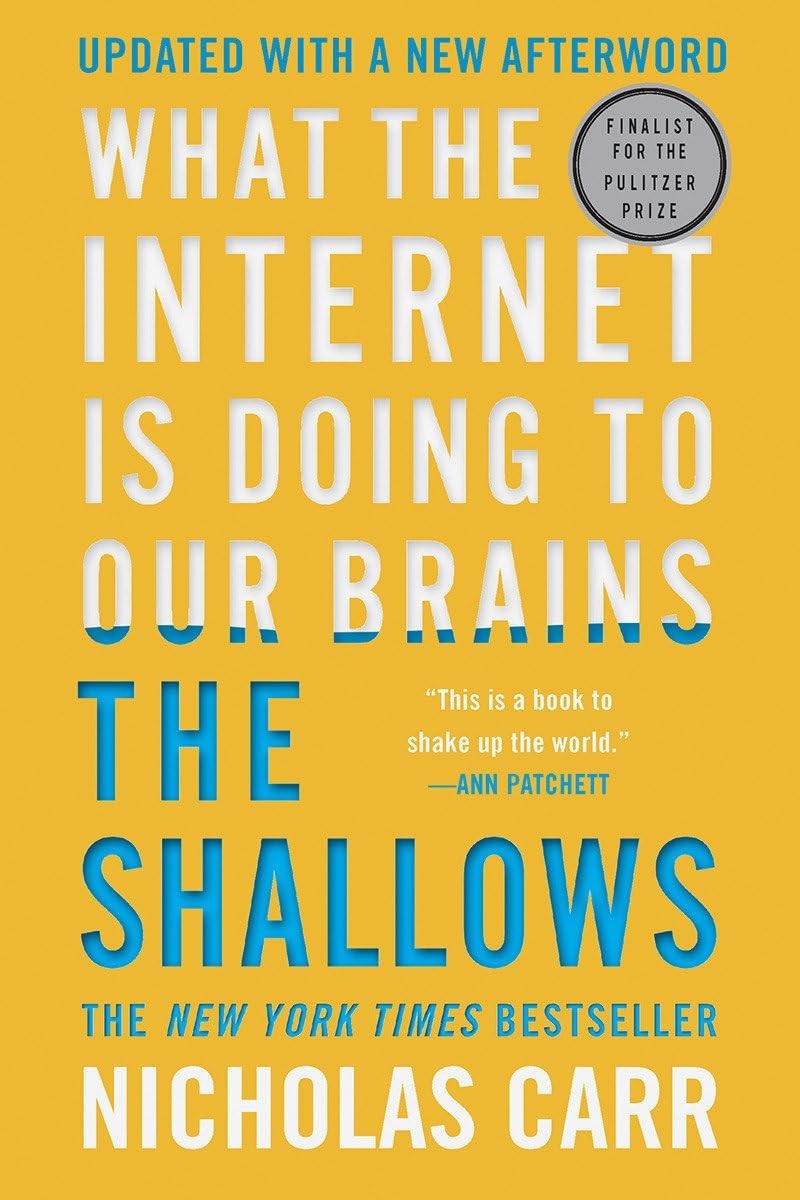
The Shallows: What the Internet Is Doing to Our Brains
Product ID: 203307559
Buy anything from 5,000+ international stores. One checkout price. No surprise fees. Join 2M+ shoppers on Desertcart.
Desertcart purchases this item on your behalf and handles shipping, customs, and support to Thailand.
New York Times bestseller • Finalist for the Pulitzer Prize "This is a book to shake up the world." ―Ann Patchett Nicholas Carr’s bestseller The Shallows has become a foundational book in one of the most important debates of our time: As we enjoy the internet’s bounties, are we sacrificing our ability to read and think deeply? This 10th-anniversary edition includes a new afterword that brings the story up to date, with a deep examination of the cognitive and behavioral effects of smartphones and social media. Review: This is a helpful and interesting read. - Nicholas Carr has written a fascinating book on the effect of the internet on lives and, in particular, our way of thinking. The author’s thesis is that modern technology, especially the internet, is rerouting our brains (p. 77), changing the way we think (p. 18) and the way we read (p. 90), is designed to divide our attention (pp. 115-116, 136-143, 194) train us to multitask (pp. 113-114), and “pay attention to crap” (pp. 142). Carr contends that net reading is, by design, distracting and superficial; it seizes our attention only to scatter it (pp. 115, 118). Thus large chunks of information is gained at the expense of concentration, contemplation (p. 5), and linear thinking (p. 10). Google, for example wants to digitize all information including books (pp. 152, 163), but has designed its system such that the reader moves from site to site quickly. The more clicks the better. “The last thing the company wants is to encourage leisurely reading or slow, concentrated thought. Google is, quite literally, in the business of distraction” (p. 157). The Shallows confirms Marshall McLuhan’s now popular observation, “The medium is the message” (p. 2). That is, the internet is not just another way of gathering information, reading, or being entertained. It has become the message and is rapidly changing everything. A most interesting part of Carr’s evidence comes from scientific research regarding the brain. Many studies have been done, often in response to medical issues caused by injury, disease, and deformities, that have revealed the plasticity of the brain (pp. 24-38). Scientists have observed the brain adjusting to defects and injuries in remarkable and beneficial ways. Observed also is the ability to train ourselves to be sick, alterations in the brain circuitry and function due to addictive drugs, and intellectual decay through mental laziness or indifference (p. 35). If the brain can actually change in these ways, then it’s obvious that it will be affected by constant exposure to the internet and other distractive technology. Basically we are being trained to be distracted, to lack concentration, to be shallow and superficial in our thinking, to lose our ability to reason deeply. Our brains are now on high alert and struggle with calmness, rest and leisure (pp. 5-10, 77, 90, 115-118, 123, 127-134, 140-143, 166-168, 194, 221). With all the complexity of the brain, how strange that the author nevertheless embraces evolution (pp. 49-51). Another valuable feature of the book is tracing technology advances throughout time (pp. 17-24). This includes the history of writing and books (pp. 52-77) memory is evolving role as technology advanced (pp. 54-57), and Gutenberg’s press resulting in the expansion of reading as well as the multiplication of words (pp. 68-75). Of interest are the pioneers of the modern computer and internet, such as Lee de Forest and his audion (pp. 78-80), Alan Turing who wrote the blueprint for the modern computer in 1936 (p. 80), the “prophecy” by futurist Edward Bellamy of “indispensables” in 1889 which is the harbinger of the modern I-Phone (p.109), the founding of the web in 1990, Apple in 1977, Google in 1996 (pp. 9, 154), and the invention of ELIZA software which served as a Rogerian therapist in 1966 (pp. 202-208). Carr documents both the value and dangers that technology and the internet have brought to the modern world. He sees no turning back and no real solution to our dilemma. Technology is addictive and virtually indispensable in our culture. The closest he gets to a remedy is to turn to Nathaniel Hawthorne’s Sleepy Hollow to recommend that in our distracted technological age we need to return often to Sleepy Hollow where we can rest our brains, think more leisurely and deeply, and contemplate more slowly (pp. 166-168, 220). I found The Shallows most insightful. Only two criticisms would I register. First, being a purely secular book, God and Scripture are absent and evolution accepted, but that is to be expected from an author who does not know the Lord. Secondly, the book was written in 2010 and in some ways is already out of date. Nevertheless, for anyone interested in how technology is changing us, and in particular changing our ways of thinking, this is a helpful and interesting read. Reviewed by Gary E. Gilley, Pastor-teacher at Southern View Chapel Review: Broad and shallow with a few deep ends - The central point in Nicholas Carr's new book, The Shallows is that our brains change based on the technology we use and the technology we use changes our brains. "Every intellectual technology embodies a intellectual ethic, a set of assumptions about how the human mind works or should work" That quote sums up the essence of the book. In the case of the internet, Carr says that the sheer volume of messages and the web's very design are changing our brains away from deep thought toward more rapid response and that in that change we are losing our ability to think deeply. Carr takes careful consideration of this idea, building a case for the internet's impact on our brain over the majority of the chapters in this book. I recommend it for people interested in understanding the impact of our tools on our brains. This is as much a `brain study' book as anything. You have to read what Carr writes, which is one reason for the recommendation. As his PR machine and popular press reactions to the book are not the same as what he says. In many ways, Carr is creating controversy to drive the kind of attention the web culture craves that drives book sales and other opportunities. He wants to be as much of a force in the `shallow' internet world as in the `deep' world that preceded it. His ideas are not that radical. He does not say that we should ban the internet, or that the FDA should regulate the internet as an addictive or harmful device. This is not a technology-bashing book that his media hype or the hype around his prior books would lead you to believe. The book is a detailed study of studies rather than original research. Carr is more of a journalist than a scientist, thinker or policy maker. That is ok as he raises good points and I found the book to have two major sources of value. First, the book raises an important issue that we are responsible for our actions and our brains, not the technology we use. By pointing out the potential impact of the Internet and its applications on how we think, act and work, Carr provides a powerful reminder associated with any technology we use to the extent that we now use the web. This first point is pretty much summed up in the first and the last chapter of the book. The argument is better made in an article and if you want to get to the essence of the argument, I would suggest reading the debate between Carr and Clay Shirkey in the Wall Street Journal "Does the Internet Make You Dumber?" published on June 6th 2010. Full disclosure, I am starting Shirkey's book after I finish this review. Unfortunately Carr raises these issues without offering recommendations on how to retain those skills while still having the internet work for you. If his next book is around `going deep' then the sincerity of this work will be compromised and the whole point would then be to sell books. Second, the book is a great resource/compendium of scientific and philosophical discussions about the development of our mental tools from books to computers, their impact on the brain and society. Carr spends a whole Chapter 8, discussing Google that provides an interesting insight into the company. Prior discussions about clocks, maps and other tools are equally interesting. Its funny but in a way this book is like an annotated and bound set of edited and researched search findings. It is an ironic aspect of the book that while Carr decries Google and how it chops up big ideas; he uses the same approach in print, which is apparently ok. Overall, recommended for people who are interested in the relationship between technology, thinking and society. If you do not want to get into the depth of the argument or all the studies supporting it, then read the WSJ article, Carr's Blog or other sources. They will provide the essence of the argument, so take the time to read it in a quite place so you can think through it. This book is a one sided as it views the web as a threat and it raises more alarms than provides alternatives. This is not a policy book, but I can see people using to try to make policy. Restricting technology has never seemed to work, particularly a technology that is as ubiquitous and impactful as the web. The Shallows reminds us that these things are tools and that we can easily and unknowingly use the tools in ways that reshape ourselves. That point alone is worthwhile to understand, regardless of how you feel about the web, your attention span or society. STRENGTHS The discussion of the brain science, while going into too much detail at times, was strength of the book. I would recommend this book as a Brain Book as much as a book about the internet and society. The characterizations of shallow behavior are accurate and things that the reader will recognize. The need to check email, validate yourself externally, etc are all symptoms of the points Carr is raising and the help the reader see the issue at a personal level. Carr tries hard to keep the argument at an intellectual level. He could and sometimes does drift into other points, but by in large this is an examination of the impact of technology on our brains and the way we think. He does recognize that the web is a tool that is here to stay and that we cannot all go off into a meadow in Massachusetts to unplug. He recognizes the point but provides little advice on what to do about it. CHALLENGES Carr raises the specter of the Internet and our brains without offering concrete advice and tools to manage it. He says that he had to unplug himself by moving to Colorado, limiting email and stopping his blog. It would have been more helpful if he could have provided advice on how to continue to keep deep cognitive skills while using the internet properly as not all of us can unplug. A note William Powers's Hamlet's Blackberry offers better advice on how to manage in this world in its last few chapters, but overall book is considerably weaker than this one. The book is `conservative' with hints of elitism in its views, basically asserting that past technologies were ok because they made intellectual life better, but this one is worse because its different. Seems that the author is ok with prior technologies shaped his way of thinking but he is a little closed to the idea that others in the future may think differently. The book's argument is carried by the weight of studies Carr reviews. He is not really advancing an argument on his own as much as raising the volume by integrating evidence provided by others. It is as if Carr knows that the subject itself would not provide enough content for an entire book. Fortunately these studies and his many digressions are themselves interesting, but they add weight to the book and they are not his central argument. The book talks about Google, the Kindle, etc. But it is surprisingly silent on the issue of online education. Sure it does talk about the fact that people thought the web would be a great educational tool, but he does not talk about online degree programs - the type of work that builds deep thinking and communications skills for professional lives. Schools like the University of Phoenix are growing like crazy and they seem like an obvious point for Carr to make but he misses it. The book is repetitive with others on the subject as they all rehash arguments by McLuhan, Seneca, Socrates, Emerson, etc. These are common citations that while powerful are reaching the point of being over used.


| Best Sellers Rank | #21,851 in Books ( See Top 100 in Books ) #7 in Human-Computer Interaction (Books) #55 in History & Philosophy of Science (Books) #76 in Cognitive Psychology (Books) |
| Customer Reviews | 4.4 out of 5 stars 3,614 Reviews |
G**Y
This is a helpful and interesting read.
Nicholas Carr has written a fascinating book on the effect of the internet on lives and, in particular, our way of thinking. The author’s thesis is that modern technology, especially the internet, is rerouting our brains (p. 77), changing the way we think (p. 18) and the way we read (p. 90), is designed to divide our attention (pp. 115-116, 136-143, 194) train us to multitask (pp. 113-114), and “pay attention to crap” (pp. 142). Carr contends that net reading is, by design, distracting and superficial; it seizes our attention only to scatter it (pp. 115, 118). Thus large chunks of information is gained at the expense of concentration, contemplation (p. 5), and linear thinking (p. 10). Google, for example wants to digitize all information including books (pp. 152, 163), but has designed its system such that the reader moves from site to site quickly. The more clicks the better. “The last thing the company wants is to encourage leisurely reading or slow, concentrated thought. Google is, quite literally, in the business of distraction” (p. 157). The Shallows confirms Marshall McLuhan’s now popular observation, “The medium is the message” (p. 2). That is, the internet is not just another way of gathering information, reading, or being entertained. It has become the message and is rapidly changing everything. A most interesting part of Carr’s evidence comes from scientific research regarding the brain. Many studies have been done, often in response to medical issues caused by injury, disease, and deformities, that have revealed the plasticity of the brain (pp. 24-38). Scientists have observed the brain adjusting to defects and injuries in remarkable and beneficial ways. Observed also is the ability to train ourselves to be sick, alterations in the brain circuitry and function due to addictive drugs, and intellectual decay through mental laziness or indifference (p. 35). If the brain can actually change in these ways, then it’s obvious that it will be affected by constant exposure to the internet and other distractive technology. Basically we are being trained to be distracted, to lack concentration, to be shallow and superficial in our thinking, to lose our ability to reason deeply. Our brains are now on high alert and struggle with calmness, rest and leisure (pp. 5-10, 77, 90, 115-118, 123, 127-134, 140-143, 166-168, 194, 221). With all the complexity of the brain, how strange that the author nevertheless embraces evolution (pp. 49-51). Another valuable feature of the book is tracing technology advances throughout time (pp. 17-24). This includes the history of writing and books (pp. 52-77) memory is evolving role as technology advanced (pp. 54-57), and Gutenberg’s press resulting in the expansion of reading as well as the multiplication of words (pp. 68-75). Of interest are the pioneers of the modern computer and internet, such as Lee de Forest and his audion (pp. 78-80), Alan Turing who wrote the blueprint for the modern computer in 1936 (p. 80), the “prophecy” by futurist Edward Bellamy of “indispensables” in 1889 which is the harbinger of the modern I-Phone (p.109), the founding of the web in 1990, Apple in 1977, Google in 1996 (pp. 9, 154), and the invention of ELIZA software which served as a Rogerian therapist in 1966 (pp. 202-208). Carr documents both the value and dangers that technology and the internet have brought to the modern world. He sees no turning back and no real solution to our dilemma. Technology is addictive and virtually indispensable in our culture. The closest he gets to a remedy is to turn to Nathaniel Hawthorne’s Sleepy Hollow to recommend that in our distracted technological age we need to return often to Sleepy Hollow where we can rest our brains, think more leisurely and deeply, and contemplate more slowly (pp. 166-168, 220). I found The Shallows most insightful. Only two criticisms would I register. First, being a purely secular book, God and Scripture are absent and evolution accepted, but that is to be expected from an author who does not know the Lord. Secondly, the book was written in 2010 and in some ways is already out of date. Nevertheless, for anyone interested in how technology is changing us, and in particular changing our ways of thinking, this is a helpful and interesting read. Reviewed by Gary E. Gilley, Pastor-teacher at Southern View Chapel
M**D
Broad and shallow with a few deep ends
The central point in Nicholas Carr's new book, The Shallows is that our brains change based on the technology we use and the technology we use changes our brains. "Every intellectual technology embodies a intellectual ethic, a set of assumptions about how the human mind works or should work" That quote sums up the essence of the book. In the case of the internet, Carr says that the sheer volume of messages and the web's very design are changing our brains away from deep thought toward more rapid response and that in that change we are losing our ability to think deeply. Carr takes careful consideration of this idea, building a case for the internet's impact on our brain over the majority of the chapters in this book. I recommend it for people interested in understanding the impact of our tools on our brains. This is as much a `brain study' book as anything. You have to read what Carr writes, which is one reason for the recommendation. As his PR machine and popular press reactions to the book are not the same as what he says. In many ways, Carr is creating controversy to drive the kind of attention the web culture craves that drives book sales and other opportunities. He wants to be as much of a force in the `shallow' internet world as in the `deep' world that preceded it. His ideas are not that radical. He does not say that we should ban the internet, or that the FDA should regulate the internet as an addictive or harmful device. This is not a technology-bashing book that his media hype or the hype around his prior books would lead you to believe. The book is a detailed study of studies rather than original research. Carr is more of a journalist than a scientist, thinker or policy maker. That is ok as he raises good points and I found the book to have two major sources of value. First, the book raises an important issue that we are responsible for our actions and our brains, not the technology we use. By pointing out the potential impact of the Internet and its applications on how we think, act and work, Carr provides a powerful reminder associated with any technology we use to the extent that we now use the web. This first point is pretty much summed up in the first and the last chapter of the book. The argument is better made in an article and if you want to get to the essence of the argument, I would suggest reading the debate between Carr and Clay Shirkey in the Wall Street Journal "Does the Internet Make You Dumber?" published on June 6th 2010. Full disclosure, I am starting Shirkey's book after I finish this review. Unfortunately Carr raises these issues without offering recommendations on how to retain those skills while still having the internet work for you. If his next book is around `going deep' then the sincerity of this work will be compromised and the whole point would then be to sell books. Second, the book is a great resource/compendium of scientific and philosophical discussions about the development of our mental tools from books to computers, their impact on the brain and society. Carr spends a whole Chapter 8, discussing Google that provides an interesting insight into the company. Prior discussions about clocks, maps and other tools are equally interesting. Its funny but in a way this book is like an annotated and bound set of edited and researched search findings. It is an ironic aspect of the book that while Carr decries Google and how it chops up big ideas; he uses the same approach in print, which is apparently ok. Overall, recommended for people who are interested in the relationship between technology, thinking and society. If you do not want to get into the depth of the argument or all the studies supporting it, then read the WSJ article, Carr's Blog or other sources. They will provide the essence of the argument, so take the time to read it in a quite place so you can think through it. This book is a one sided as it views the web as a threat and it raises more alarms than provides alternatives. This is not a policy book, but I can see people using to try to make policy. Restricting technology has never seemed to work, particularly a technology that is as ubiquitous and impactful as the web. The Shallows reminds us that these things are tools and that we can easily and unknowingly use the tools in ways that reshape ourselves. That point alone is worthwhile to understand, regardless of how you feel about the web, your attention span or society. STRENGTHS The discussion of the brain science, while going into too much detail at times, was strength of the book. I would recommend this book as a Brain Book as much as a book about the internet and society. The characterizations of shallow behavior are accurate and things that the reader will recognize. The need to check email, validate yourself externally, etc are all symptoms of the points Carr is raising and the help the reader see the issue at a personal level. Carr tries hard to keep the argument at an intellectual level. He could and sometimes does drift into other points, but by in large this is an examination of the impact of technology on our brains and the way we think. He does recognize that the web is a tool that is here to stay and that we cannot all go off into a meadow in Massachusetts to unplug. He recognizes the point but provides little advice on what to do about it. CHALLENGES Carr raises the specter of the Internet and our brains without offering concrete advice and tools to manage it. He says that he had to unplug himself by moving to Colorado, limiting email and stopping his blog. It would have been more helpful if he could have provided advice on how to continue to keep deep cognitive skills while using the internet properly as not all of us can unplug. A note William Powers's Hamlet's Blackberry offers better advice on how to manage in this world in its last few chapters, but overall book is considerably weaker than this one. The book is `conservative' with hints of elitism in its views, basically asserting that past technologies were ok because they made intellectual life better, but this one is worse because its different. Seems that the author is ok with prior technologies shaped his way of thinking but he is a little closed to the idea that others in the future may think differently. The book's argument is carried by the weight of studies Carr reviews. He is not really advancing an argument on his own as much as raising the volume by integrating evidence provided by others. It is as if Carr knows that the subject itself would not provide enough content for an entire book. Fortunately these studies and his many digressions are themselves interesting, but they add weight to the book and they are not his central argument. The book talks about Google, the Kindle, etc. But it is surprisingly silent on the issue of online education. Sure it does talk about the fact that people thought the web would be a great educational tool, but he does not talk about online degree programs - the type of work that builds deep thinking and communications skills for professional lives. Schools like the University of Phoenix are growing like crazy and they seem like an obvious point for Carr to make but he misses it. The book is repetitive with others on the subject as they all rehash arguments by McLuhan, Seneca, Socrates, Emerson, etc. These are common citations that while powerful are reaching the point of being over used.
C**R
"Turmoil is stilled in my heart, waves of joy are sent me by inner thoughts, beyond expectation arising to delight my heart''
“What was so remarkable about book reading was that the deep concentration was combined with the highly active and efficient deciphering of text and interpretation of meaning. The reading of a sequence of printed pages was valuable not just for the knowledge readers acquired from the author’s words but for the way those words set off intellectual vibrations within their own minds.’’ ‘Intellectual vibrations’? ‘’In the quiet spaces opened up by the prolonged, undistracted reading of a book, people made their own associations, drew their own inferences and analogies, fostered their own ideas. They thought deeply as they read deeply.’’ (62) This was primarily a religious, essentially Biblical devotion. How experienced? “Even the earliest silent readers recognized the striking change in their consciousness that took place as they immersed themselves in the pages of a book. The medieval bishop Isaac of Syria described how, whenever he read to himself,’’ Of course, these were almost overwhelmingly reading religious books, usually the Bible or Greek philosophers. Deep reading. . . “as in a dream, I enter a state when my sense and thoughts are concentrated. Then, when with prolonging of this silence the turmoil of memories is stilled in my heart, ceaseless waves of joy are sent me by inner thoughts, beyond expectation suddenly arising to delight my heart.” Wow! Who does this? How significant? “Reading a book was a meditative act, but it didn’t involve a clearing of the mind. It involved a filling, or replenishing, of the mind. Readers disengaged their attention from the outward flow of passing stimuli in order to engage it more deeply with an inward flow of words, ideas, and emotions. That was—and is—the essence of the unique mental process of deep reading. It was the technology of the book that made this “strange anomaly” in our psychological history possible. The brain of the book reader was more than a literate brain. It was a literary brain.” (62) Carr develops this theme throughout - the importance, even essential - process of ‘deep reading’. For example, even the physical form of the brain changes . . . “One of the most important lessons we’ve learned from the study of neuroplasticity is that the mental capacities, the very neural circuits, we develop for one purpose can be put to other uses as well. As our ancestors imbued their minds with the discipline to follow a line of argument or narrative through a succession of printed pages, they became more contemplative, reflective, and imaginative. “New thought came more readily to a brain that had already learned how to rearrange itself to read,” says Maryanne Wolf; “the increasingly sophisticated intellectual skills promoted by reading and writing added to our intellectual repertoire.” The quiet of deep reading became, as Stevens understood, “part of the mind.” (74) Carr emphasizes that this - contemplative, reflective, imaginative - brain is being replaced by the - distracted, shallow brain. “Jordan Grafman explains that the constant shifting of our attention when we’re online may make our brains more nimble when it comes to multitasking, but improving our ability to multitask actually hampers our ability to think deeply and creatively. “Does optimizing for multitasking result in better functioning—that is, creativity, inventiveness, productiveness? The answer is, in more cases than not, no,” says Grafman. “The more you multitask, the less deliberative you become; the less able to think and reason out a problem.” Well. . .won’t all this extra information help? “You become, he argues, more likely to rely on conventional ideas and solutions rather than challenging them with original lines of thought.’’ (140) No ability to challenge ideas? Where is Luther, Galileo, Faraday - when we need them? THE WATCHDOG AND THE THIEF One HAL AND ME Two THE VITAL PATHS - a digression on what the brain thinks about when it thinks about itself Three TOOLS OF THE MIND Four THE DEEPENING PAGE - a digression on lee de forest and his amazing audion Five A MEDIUM OF THE MOST GENERAL NATURE Six THE VERY IMAGE OF A BOOK Seven THE JUGGLER’S BRAIN - a digression on the buoyancy of IQ scores Eight THE CHURCH OF GOOGLE Nine SEARCH, MEMORY - a digression on the writing of this book Ten A THING LIKE ME “What the Net diminishes is Johnson’s primary kind of knowledge: the ability to know, in depth, a subject for ourselves, to construct within our own minds the rich and idiosyncratic set of connections that give rise to a singular intelligence.’’ (143) Another theme is the difference between human mental processes and computers. . . “The old botanical metaphors for memory, with their emphasis on continual, indeterminate organic growth, are, it turns out, remarkably apt. In fact, they seem to be more fitting than our new, fashionably high-tech metaphors, which equate biological memory with the precisely defined bits of digital data stored in databases and processed by computer chips. Governed by highly variable biological signals, chemical, electrical, and genetic, every aspect of human memory—the way it’s formed, maintained, connected, recalled—has almost infinite gradations. Computer memory exists as simple binary bits—ones and zeros—that are processed through fixed circuits, which can be either open or closed but nothing in between.’’ (188) Reminds me of the wise man’s illustration of spiritual growth - “So he went on to say: “In this way the Kingdom of God is just as when a man casts seeds on the ground. He sleeps at night and rises up by day, and the seeds sprout and grow tall—just how, he does not know. On its own the ground bears fruit gradually, first the stalk, then the head, finally the full grain in the head.’’ (Mark 4:26) A biological metaphor, not a mechanical one! Carr connects another idea that I had not considered. “As McLuhan acknowledged, he was far from the first to observe technology’s numbing effect. It’s an ancient idea, one that was given perhaps its most eloquent and ominous expression by the Old Testament psalmist: “Their idols are silver and gold, The work of men’s hands. They have mouths, but they speak not; Eyes have they, but they see not; They have ears, but they hear not; Noses have they, but they smell not; They have hands, but they handle not; Feet have they, but they walk not; Neither speak they through their throat. They that make them are like unto them; So is every one that trusteth in them.’’ “The price we pay to assume technology’s power is alienation. The toll can be particularly high with our intellectual technologies. The tools of the mind amplify and in turn numb the most intimate, the most human, of our natural capacities—those for reason, perception, memory, emotion.’’ Of course, the psalmist was condemning idols, not technology. Nevertheless, perhaps Carr has a point, maybe we really are ‘worshipping the work of our own hands’.
J**N
Why there are so few worth talking to
The development of that magnificent resource for the mind, the Internet, has put us at a turning point in human history. The development of all the tools of the mind has provided turning points and in making his case Nicholas Carr takes us through what happened to us when we went from clay to papyrus to paper and from tablets to scrolls to books. With every one of these changes the world shifted some. Not as much as now though. At the same time that the Internet is changing the world, bringing us closer together around masses of information, it is changing our ability to think and it is changing our brains in dangerous ways. The issue is not the content of the Internet, but its process. The human adapts to its tools and its tasks. Give a man a hammer for a lifetime’s work and his body shapes to effectively drive nails. Take away his pen and give him a typewriter with a ball and his prose turns from fluid to staccato. (That happened to Nietzsche in the late nineteenth century.) In that process of adaption the brain, since it is not a machine but an organ, changes. These changes can be seen with instruments and their results observed in human behavior. This is the world of Nicholas Carr. I will describe a tiny fraction of what the Internet is doing to our brains. 1) The brain, confronted with a glowing screen and the ability to hypertext its way from one interruption to another across the universe of knowledge from what its buddy in Australia thinks of rutabagas, to the spelling of rutabagas to the history of rutabagas to dishes that can be prepared from rutabagas leaves the brain sliding from one fact of surface interest to another fact even less useful, until it occurs to the brain to pursue the prompt on the pop-up menu and check the weather and get off of this slide onto the weather channel where a five minute video on playful seals on San Francisco Bay can be watched for free which does remind the brain that it could slide over to Facebook and find out if anyone “liked” the picture of the family cat posted an hour ago. And many do. Twenty-three “likes,” praise the Lord. Just as the carpenter’s arm grew it muscles to deal effectively with the hammer the brain changes to succeed in a slippy slidey world of itty bitty bits of knowledge intended to interest momentarily and then disappear. So what will happen when it confronts a life choice? Will this passive instrument skidding from meaningless bit to another meaningless bit see itself suddenly as an agent? A “decider?” Or will it in panic seek the next button to push, even if that button bears the label “Self Destruct?” According to Time magazine this is happening now in the Silicon Valley high schools; kids depressed and without a sense of agency pushed around by the ripples on the surface of the Internet are choosing to leave life. Rutabagas have lost their interest. Having your cat liked did not fill the hole intended for having yourself loved. And this child is not accustomed to doing things about things. This child does not do. This child is done to. With the same alacrity that he or she pursued the prompt to watch the seals he or she may “decide” it is time to end this. 2) I discovered my wife of the last forty-three years with whom I have raised two children and now five grandchildren with much happiness when while sitting on her front lawn, I seriously told her my goals in life. She thought they were so funny she actually rolled over laughing. If I had instituted a computer search what algorithm would have found her an appropriate match? Yet this brain of mine sorted through whatever book-formed channels it had and locked in immediately on her as the “one,” the antidote to the man who takes himself too seriously. The Internet would have provided me many potential companions, each more serious than the last. That is the way it works. It finds my interests and then adds to the pile. If I follow its suggestions I become narrower and narrower, a better candidate to respond to the advertisers, a defined target, and a wealth of possibilities pass me by. 3) For something to remain in long-term memory it must spend two hours in short term memory. (There is actually a tiny physical growth that must happen.) But on the trip through rutabaga land, things go in and out too quickly to be grafted on the long-term nodules. Of course it still exists in the computer’s memory. When you know you need it, it can be sought. However the advantage of the human memory is that it coughs up stored information when you need it but do not know you need it. Not only does your intellect call on your memory, but your memory initiates conversations with your intellect. You won’t have that ability any longer. And since your long-term memory is not being used the section of the brain devoted to long-term memory has already begun to shrink. Distant memories of your mother’s tears, your father’s embrace, your sisters admiration and your little brother’s needs will be crowded out of the brain, and I doubt if you will find them in Internet land either. 4) There are now residential therapy centers to assist the hooked to unhook from the Internet. The Internet lights up the same section of the brain as does cocaine. Didn’t’ know those grade school kids were getting a buzz? Makes what may be happening to my grandchildren a little less cute and a little less funny. Read The Shallows yourself. What I have written is just a corner of the future described there. See if it scares you! And if it does, see who else you can scare with it. Hope they have enough of an attention span left to read the book. (A sign of the times is that people who used to write books no longer can read them. Not enough slippy and slidey. Boring!) Can the majority of us survive without complex and nuanced thought? Without deep and poignant memories? Do we want to?
T**N
Death by a thousand distracting cuts
In this short but informative, thought-provoking book, Nicholas Carr presents an argument I've long felt to be true on a humanist level, but supports it with considerable scientific research. In fact, he speaks as a longtime computer enthusiast, one who's come to question what he once wholeheartedly embraced ... and even now, he takes care to distinguish between the beneficial & detrimental aspects of the Internet. The argument in question? - Greater access to knowledge is not the same as greater knowledge. - An ever-increasing plethora of facts & data is not the same as wisdom. - Breadth of knowledge is not the same as depth of knowledge. - Multitasking is not the same as complexity. The studies that Carr presents are troubling, to say the least. From what has been gleaned to date, it's clear that the brain retains a certain amount of plasticity throughout life -- that is, it can be reshaped, and the way that we think can be reshaped, for good or for ill. Thus, if the brain is trained to respond to & take pleasure in the faster pace of the digital world, it is reshaped to favor that approach to experiencing the world as a whole. More, it comes to crave that experience, as the body increasingly craves more of anything it's trained to respond to pleasurably & positively. The more you use a drug, the more you need to sustain even the basic rush. And where does that leave the mind shaped by deep reading? The mind that immerses itself in the universe of a book, rather than simply looking for a few key phrases & paragraphs? The mind that develops through slow, quiet contemplation, mulling over ideas in their entirety, and growing as a result? The mature mind that ponders possibilities & consequences, rather than simply going with the bright, dazzling, digital flow? Nowhere, it seems. Carr makes it clear that the digital world, like any other technology that undeniably makes parts of life so much easier, is here to stay. All the more reason, then, to approach it warily, suspiciously, and limit its use whenever possible, since it is so ubiquitous. "Yes, but," many will say, "everything is moving so fast that we've got to adapt to it, keep up with it!" Not unlike the Red Queen commenting that it takes all of one's energy & speed to simply remain in one place while running. But what sort of life is that? How much depth does it really have? Because some aspects of life -- often the most meaningful & rewarding aspects -- require time & depth. Yet the digital world constantly makes us break it into discrete, interchangeable bits that hurtle us forward so rapidly & inexorably that we simply don't have time to stop & think. And before we know it, we're unwilling & even unable to think. Not in any way that allows true self-awareness in any real context. Emerson once said (as aptly quoted by Carr), "Things are in the saddle / And ride mankind." The danger is that we'll not only willingly, even eagerly, wear those saddles, but that we'll come to desire them & buckle them on ever more tightly, until we feel naked without them. And we'll gladly pay anything to keep them there, even as we lose the capacity to wonder why we ever put them on in the first place. Most highly recommended!
K**M
or craft a Power Point that could have been done easily at home
Carr's book centers around the premise that modern technology is causing us to outsource our memory and making our thinking and absorption of information less methodical, and well - more shallow. I definitely agree with the overall premise of this book, speaking as someone who came of age when powerpoint making became a required classroom skill and 'Mavis Beacon Teaches Typing' occupied several hours of school time. I always wondered what the point was of having children come to school only to have class time used to play a computer game during the whole period, or craft a Power Point that could have been done easily at home. I craved the days when reading a book aloud in class and discussing it, or collaborating on a poster board with other students was the preferred method of teaching. When we rely on computer programs to teach our students, what are we really teaching them? Carr focuses on how the Internet has become a proxy for human memory. When I was older, in medical school, I remembered the popular refrain among fellow medical students - "you don't need to remember that, you'll just look it up online". While I agree that we can't remember all arcane details in our mind, and that venturing to do so would be burdensome and come at the expense of other skills (such as reasoning, problem solving) -- there are some things that are worth holding in our memory, and I fear that we are losing sight of what those things are. To take medicine for example - maybe memorizing the exact dosage of every antibiotic is a bit of an overkill (especially in the days of EMR and UpToDate), and can be looked up at the time it needs to be known, but knowing what the common side effects are may be worth knowing offhand. Carr's argument is that the Internet is slowly replacing our need to remember things, and that with less "fund of knowledge" we are less able to think creatively, deeply, and productively. Instead, we are grabbing bits and pieces of information 'here and there' via internet searches, but it doesn't necessarily add up to a rich or meaningful understanding. I must now admit that I read this book in rapid succession after finishing Kahneman's "Thinking, Fast and Slow" and before that Daniel Levitin's "The Organized Mind" which both covered relatively similar topics in immense detail (Kahneman, a Nobel prize winning economist, made studying decision making and its relation to economics his life's work; Levitin, a neuroscientist focused on our brain's different functions and patterns of concentration). I found them to be, from my biased perspective (as a neurology resident, married to an economist) more enlightening as they contained more detail than Carr's book - which is more of a general warning about losing our autonomy to computers. After reading the two books I mentioned above, I found Carr's book to be somewhat simplistic, though it does touch upon the history of written and oral communication, which is something that the other two books did not really delve into. Overall, I think that this didn't add a lot of new information to my understanding of the Internet and how our minds work, but set forth a persuasive argument about the perils of over reliance on machines.
B**Y
The Shallows Book Review
Internet. This one simple word is not really that simple after all. The Internet is a tool that has many aspects to it and has given people the opportunity to do some amazing things. I often question myself: What is it about the Internet that is so compelling to society today?; Why has online reading become more popular than reading a printed book?; And why are people spending the majority of their free time online? Nicholas Carr, the author of The Shallows, does a great job of answering these questions throughout his book. Going on the Internet is something that many people do on a daily basis. Whether it is checking an e-mail, looking up the weather or quickly searching something on Google. The Net is a place where one can keep in touch with friends, post homework that is due for class, or just simply gather information. The Internet has it all. The internet is very fast and efficient which is one of the reasons why people enjoy using it. You can click on hyperlinks, skim pages, and look up information quickly. Going on Google is very popular today, especially for students. If a student is having trouble finding an answer for their homework, Google has the answer. If someone types in a simple word or phrase, Google will be sure to give a load of information. On the other hand, some people, such as Nicholas Carr, think that Google is making us "stupid"; this is because there is hardly any work done in order to get an answer. Everything is right there in front of you, without having to use any brain power. Considering we no longer "use any brain power", Nicholas Carr describes how the Internet is changing the way we think. When the Internet was new to the world, Carr did not see what the big deal was until he actually started using it. There were social networks, e-mails, games and easy-to-access information that he was starting to use. It was then that he finally understood why the Internet was so addicting. He found himself yearning to be online when he was no where near a computer. That feeling of being connected was flowing throughout his mind. Carr also stated that he could not pay attention for more than a few minutes, which in turn was changing the way he thought. When reading long excerpts online, he could not do it and found himself skimming the information instead. He would multi-task by going on his e-mail or playing a game. It was also hard for him to read printed books because he did not have the patience to do so. Being immersed in the story was a challenge and skimming was not uncommon. This seems to be happening not only with Carr but a lot of others as well, including myself. Technology, it seems, revolves around everything in today's society which is why my Macbook is one of my most prized possessions. The way it is set up and the programs that are available are very high-tech. It seems that I am always on the Internet as well. From the moment I wake up, I have to run and check Facebook to see if I have received any new notifications. It is a little bit sad to think that I am so in love with such a thing, but it is extremely addictive. Carr states that the Internet has changed the way we think. I would have to completely agree with that statement. To be honest, I do not know how to read a book anymore. I get easily side-tracked; I look around for a few minutes, pull up Facebook and then finally finish reading my paragraph. I do not have the patience to sit down in a quiet room and read for hours on end. I just want to get through it. I am to used to reading excerpts off of the Internet and skimming the pages only for the information that I need. Carr also talks a lot about how the Internet has affected our lives, and I know that it has definitely affected mine. I multi-task without even realizing it, which may not be one of the best things. Reading printed books seems pretty old fashioned now that we have e-books. An e-book reader can now have their own personal library. People are able to download books online right when they order them. With e-books it is possible to make the text bigger, highlight and click on hyperlinked words. Many people are choosing this new way of reading over the old fashioned way. There are however some downfalls to online reading. With this type of reading people tend to scan the information which can lead to not understanding or thinking about the text. Some people also get eye fatigue when looking at the screen for a long period of time. These people may choose to read a printed book because you can take it wherever you want, sit on it, place a bookmark in it and do not have to worry about a battery. With a printed book, one is more likely to stay focused on the content. Online books and printed books both have pros and cons. It is up to the reader to decide which style meets their needs. Nicholas Carr "writes on the social, economic and business implications of technology." (Carr 92) It is stated that he wrote The Big Switch, which is "widely considered to be the most influential book so far on the cloud computing movement." (Christian Science Monitor 83) Carr's books have been so popular throughout the world, that "they have been translated into more than a dozen languages." (Carr 102) "Earlier in his career, he was an executive editor of the Harvard Business Review and a principal at Mercer Management Consulting." (Carr 115) Overall, Carr has had much experience and is a phenomenal writer. His books have become extremely popular and are very informative about today's technology. The Shallows is a book of many words, thoughts and facts. I would say that this book is very informative and has a lot to offer. I enjoyed reading it because I can truly relate. I was born in a time period where the Internet is all anyone knows. Carr places a lot of valid points in his book about the Internet and how it has affected our lives; for better and for worse. I would recommend this book to anyone who is interested in the deep concepts of the Internet and how it has affected them. I would say that this book was written for young adults or adults who rely on technology throughout their everyday lives. Overall, the Internet has had a great impact on the majority of people around the world. The Internet seems to be "dumbing us down" the more and more we use it. However, is it really making us dumber, rather than being used as a tool to guide us? Citation Carr, Nicholas What the Internet Is Doing To Our Brains. New York: W.W Norton & Company Inc, 2010. Print.
A**R
Life changing read
For several years I’ve been unable to read a book. Not that I lost the ability to read, but I’ve just been unable to focus. I’d try and I’d feel like I was jumping out of my skin, like I could hardly even slow my brain down enough to make sense of the jumble of words on a page. And I’m not someone who was always this way - I was a voracious reader in childhood, through high school and even into college and my late 20s. Beginning in medical school, however, I began to find reading nearly impossible. When COVID restrictions began, I started to pay more attention to my use of my iPhone and my computer. I noticed how agitated and angry I became with excessive use. Not necessarily because the content was inflammatory - even playing Tetris, I started to notice that I was holding my body in a constant state of tension and holding my breath a lot. I started to wonder if something about the devices themselves was to blame, and that led me to wonder if this was related to my inability to concentrate long enough to read. I picked up this book and a book about EMFs. Together, they’ve changed my life. This book discusses the effect that the medium through which information is delivered has on your ability to comprehend and process it. Reading a book on the amazon app on your computer is not the same as reading a physical copy of that same book. Why? Reading an online book - with all the hyperlinks and ads competing for our attention, begging for us to click them - is an experience akin to being on the lookout for predators in the savannah. As least as far as the brain is concerned. Managing multiple incoming stimuli, being asked to filter what is relevant from what isn’t - this is a stressful process that our brains have no evolutionary history of adapting to in an environment of safety. This sort of processing is not an at-rest, parasympathetic activity - not a resting activity in which higher level cortical “thinking” processes are occurring but rather a limbic system based fight or flight type of thing. What this means is that by ingesting a book online, you are by definition in a state of hyperarrousal that prevents you from using the higher level thinking processes that would allow for deep contemplation and understanding of the book’s content. At least if I understand correctly what the author is saying. As a result of this book, I got rid of my iPhone and replaced it with a “dumb” Light Phone (google it) which calls and texts only (you can get maps and podcasts, I elected not to). I am almost never on my phone anymore. I also read Nick Penault’s book about EMFs and their effects on sleep, anxiety, and more. As a result if that book, I implemented about 20 more changes in my use of technology and even electricity! For example, I switched from Wifi to ethernet in my house (if you do this, you have to turn off Wifi at the level of the router by following the link that should be on a sticker on the router - for me router login.net). I bought the recommended EMF meter, and tested the radiation levels coming from the router before and after turning off the Wifi. Beforehand - well into the danger zone close to the router and even in the next room. After - essentially no detectable RF radiation. Other things - I never keep my phone (even my dumb phone) in the same room with me when it’s not in use. The meter showed scary radiation levels there too. Oh and I stopped using Bluetooth devices and replaced them with wired devices. Back to hardwired mouse, keyboard, headphones. Turn bluetooth on and off on your computer and watch the radiation levels skyrocket then fall back to safe levels using the meter to convince yourself. Anyway, lifechanging book. Do yourself a huge favor and get it - and the Penault one, and the Cornet meter he recommends!
A**R
A Deep Read
Given the title of this book, it would be a shame if it were a shallow read itself. Instead, it is challenging, perceptive and informative. I am enjoying it very much.
C**Ã
Livro em inglês, conteúdo extremamente relevante para os tempos atuais.
Esse livro precisa ser impresso em português o quanto antes! É extremamente essencial para os tempos atuais. Eu li a versão de 2011 em português e esse é exatamente o mesmo, mas com um capítulo a mais no final. Apesar de ter sido escrito em 2007-2009, o conteúdo é atual e alarmante. Nicholas nos mostra, com base em vários estudos, como a internet alterou nossa forma de pensar e agir (assim como outras ferramentas criadas no passado, como o relógio e mapa). Hoje em dia, nosso cérebro tem mais dificuldade em se aprofundar em algo, em se concentrar e em se manter focado por muito tempo. O cérebro acostumou-se com estímulos rápidos e superficiais, graças ao que a internet nos proporciona: acesso a milhões de informações em questão de segundos, de forma muito descomplicada. O último capítulo é mais atualizado e aborda bastante sobre os smartphones e suas implicações na nossa mente. É preocupante, estamos nos tornando mais superficiais e reféns desses aparelhos. Me sinto muito privilegiado em ter absorvido esse conteúdo. Mesmo não tendo inglês fluente, consegui entender grande parte dos textos. Sugiro a leitura a todos, principalmente àqueles que estão preocupados e que notaram que suas mentes estão inquietas e que não conseguem se concentrar por muito tempo.
S**J
It's a good book and I will definitely recommend it for someone ...
It's a good book and I will definitely recommend it for someone who is willing to contemplate the impact of modern day technology on our lives.
D**T
Great book
Fabulous book. A great examination of what digital life is doing to our minds. Slow down, focus, and read the real book.
C**2
Interesante
Un libro que va al grano. Muy buena lectura y me llego en perfectas condiciones.
Trustpilot
4 days ago
2 weeks ago