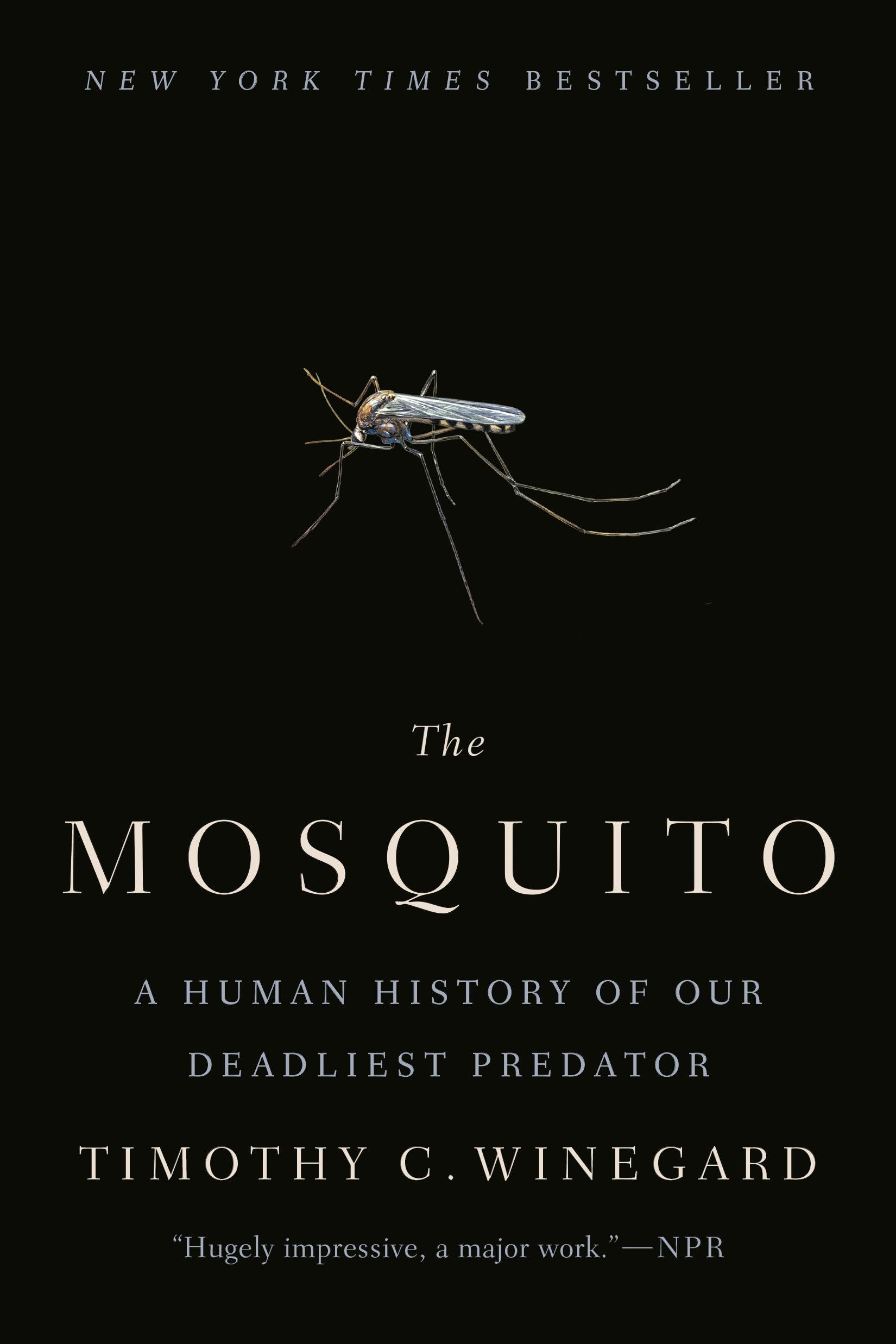

The Mosquito: A Human History of Our Deadliest Predator
Product ID: 212975885
Buy anything from 5,000+ international stores. One checkout price. No surprise fees. Join 2M+ shoppers on Desertcart.
Desertcart purchases this item on your behalf and handles shipping, customs, and support to Thailand.
**The instant New York Times bestseller** *An international bestseller* “Hugely impressive, a major work.”— NPR A pioneering and groundbreaking work of narrative nonfiction that offers a dramatic new perspective on the history of humankind, showing how through millennia, the mosquito has been the single most powerful force in determining humanity’s fate. Why was gin and tonic the cocktail of choice for British colonists in India and Africa? What does Starbucks have to thank for its global domination? What has protected the lives of popes for millennia? Why did Scotland surrender its sovereignty to England? What was George Washington's secret weapon during the American Revolution? The answer to all these questions, and many more, is the mosquito. Across our planet since the dawn of humankind, this nefarious pest, roughly the size and weight of a grape seed, has been at the frontlines of history as the grim reaper, the harvester of human populations, and the ultimate agent of historical change. As the mosquito transformed the landscapes of civilization, humans were unwittingly required to respond to its piercing impact and universal projection of power. The mosquito has determined the fates of empires and nations, razed and crippled economies, and decided the outcome of pivotal wars, killing nearly half of humanity along the way. She (only females bite) has dispatched an estimated 52 billion people from a total of 108 billion throughout our relatively brief existence. As the greatest purveyor of extermination we have ever known, she has played a greater role in shaping our human story than any other living thing with which we share our global village. Imagine for a moment a world without deadly mosquitoes, or any mosquitoes, for that matter? Our history and the world we know, or think we know, would be completely unrecognizable. Driven by surprising insights and fast-paced storytelling, The Mosquito is the extraordinary untold story of the mosquito’s reign through human history and her indelible impact on our modern world order. Review: Put his book on your Bucket List! - An excellent book detailing the history of the mosquito form the age of the dinosaur to the present day. The author takes you on a historical journey and you learn that the dinosaurs may have been weakened to the point of near extinction by the mosquito, and the asteroid impact may have been the coup de grace that sealed their fate. You will discover that the mosquito was essentially engaged in every major combat on the planet, from the earliest civilizations in Mesopotamia to the 300 Spartans, the Indian Wars, the revolutionary war, the Civil War, the first world war and the second world war, the building of the Panama Canal. Youll read about the Malarial parasite and how deadly it is and how it transforms itself to survive. How mosquitoes spread viruses around the world. This is truly a fascinating book. I do believe that it is time to eradicate the mosquito species involved in the transmission of Malaria and other dangerous viruses. This has already been accomplished by a company that has created genetically modified mosquitos that mate with a female and her offspring either dies or produces only males. So it can be done, but the environmental impact needs to be studied some more. It's also interesting that mosquitos have served as a barrier for humans and other mammals to enter certain areas. An example would be the desertcart rain forest. As humans clear cut this area, Mosquitos will attack and what new diseases will force us to move away from these areas? A very good book and well worth the long read. Review: Very interesting, but you need to like history. - The introduction had me hooked, so I excitedly bought the book. The first couple of chapters are very heavily history based, as in way back to the beginning of recorded human history. Of course this book is gonna be history based, but I found myself a little bored reading ancient history. I stopped reading it, but I plan on picking it up again and forcing myself through the ancient history to get to the more modern history which I'm more interested in.
| Best Sellers Rank | #42,596 in Books ( See Top 100 in Books ) #5 in Biology of Insects & Spiders #23 in History of Medicine (Books) #419 in World History (Books) |
| Customer Reviews | 4.4 out of 5 stars 1,080 Reviews |
F**0
Put his book on your Bucket List!
An excellent book detailing the history of the mosquito form the age of the dinosaur to the present day. The author takes you on a historical journey and you learn that the dinosaurs may have been weakened to the point of near extinction by the mosquito, and the asteroid impact may have been the coup de grace that sealed their fate. You will discover that the mosquito was essentially engaged in every major combat on the planet, from the earliest civilizations in Mesopotamia to the 300 Spartans, the Indian Wars, the revolutionary war, the Civil War, the first world war and the second world war, the building of the Panama Canal. Youll read about the Malarial parasite and how deadly it is and how it transforms itself to survive. How mosquitoes spread viruses around the world. This is truly a fascinating book. I do believe that it is time to eradicate the mosquito species involved in the transmission of Malaria and other dangerous viruses. This has already been accomplished by a company that has created genetically modified mosquitos that mate with a female and her offspring either dies or produces only males. So it can be done, but the environmental impact needs to be studied some more. It's also interesting that mosquitos have served as a barrier for humans and other mammals to enter certain areas. An example would be the Amazon rain forest. As humans clear cut this area, Mosquitos will attack and what new diseases will force us to move away from these areas? A very good book and well worth the long read.
P**A
Very interesting, but you need to like history.
The introduction had me hooked, so I excitedly bought the book. The first couple of chapters are very heavily history based, as in way back to the beginning of recorded human history. Of course this book is gonna be history based, but I found myself a little bored reading ancient history. I stopped reading it, but I plan on picking it up again and forcing myself through the ancient history to get to the more modern history which I'm more interested in.
F**L
How The Lowly Mosquito Has Changed Human History
In college I majored in environmental science and had to take several courses that dealt with mosquitoes and the diseases they transmit. Ironically, although I didn't end up working in that field, I did wind up as board member of one of the largest mosquito control districts in the country and learned even more about these pesky little critters. I have been in discussions with several experts (including a board member who dedicated his life to research mosquitoes and has a mosquito named after him) about what, exactly, would happen ecologically if mosquitoes were wiped off the face of the earth. Although no one has the exact answer, the only niche the mosquito seems to have is to transmit diseases between various species. So, removing the mosquito from the world seems to have no impact on the environment. This book discusses the mosquitoes role in history and is very readable. Mosquitoes date back to long before humans and may even have played a role in the demise of dinosaurs. That is literally how long they have been buzzing around. The author tracks the mosquito through history and the diseases that it transmitted, which played huge roles in military history, as well as other aspects of civilization. About the only real complaint I have about the book is the author's anthropomorphizing of the mosquito. By referring to them as General Aedes and General Anopheles he makes it sound like they take sides. Mosquitoes are neutral and only seek to suck your blood. They have no interest in what side you are on, other than that your blood is warm. Aside from that, I highly recommend the book. It might shed some insight into areas of history that have been glossed over about why which side might have won or why civilizations have had more problems than others. Overall this book is a fascinating read!
D**N
History as it Really Happened.
Armies march and meet others in battle. Nations and empires fall. All of these brought about by the actions of humans - right? Wrong. For years I have known that arthropod-borne diseases had affected human history more than is generally thought. Even if you are not killed by the disease it might well make you ineffectual in a battle situation and alter the course of an easy struggle to become a rout. Zinsser wrote about some of this in "Rats, Lice and History,' but his book is dated (1935), he concentrated on louse-borne diseases, and he lacked much of the background and advances available today. Mosquitoes are especially important in this regard because they transmit malaria, yellow fever and dengue, among many other diseases. Now Timothy Winegard has corrected the record and placed the position of mosquito-vectored diseases into their proper historical context in "The Mosquito: A Human History of Our Deadliest Predator.". This is a great read and it will keep the reader involved to the end of its nearly 500 pages. It will also cure the reader of the illusion that we humans have control over historic events. I highly recommend it!
T**R
Who knew mosquitoes as a vector of death have directed the course of history!?!
I grew up in the Mississippi delta without air conditioning and mosquitoes were constant companions in the warm months of the year. I was one of those kids who would follow the mosquito fogger truck around the neighborhood and ride my bike in and out of the emitted insecticidal fog. When I came across this book I had to get it and read it. This book is not so much about the mosquito as it is about the mosquito as a vector for diseases like malaria and yellow fever that undermined military campaigns throughout history as naive forces came in to contact with diseases like malaria and yellow fever to which they had little or no immunity. I learned that sick soldiers are much more of a burden to armies than dead soldiers, malaria was used to treat syphilis (spirochetes cook in the fever), malaria inhibits the blood thinner in mosquito saliva so they have to bite more folks to get their full blood meal, there was no malaria in the New World (but there were mosquitoes) before it came over with the Europeans and Africans, and for now you're only safe in Antarctica. There are lots of other interesting little tidbits strewn throughout the book, but you have to wade through a lot of conflict to get them. That's OK, it was kind of a nice review of major conflicts throughout history.
A**S
The Mosquito’s Guide to Western Civilization
The Mosquito, while beginning and ending on interesting notes, is too much of a simplified retelling of the history of Western civilization to be worth reading. The first chapter explains the mechanism and evolutionary history of mosquito borne viruses while the last chapter describes both the private and public efforts to eradicate such diseases. In between, there is a litany of descriptions of the great wars of the Western world with the repeated refrain that the winning side was aided by General Mosquito. We hear about the Peloponnesian war, the Punic conflicts, the Crusades, the Revolutionary War, the Civil War, the World Wars, the war in Vietnam...all of this seemingly oblivious to the fact that history does not proceed towards modern America as its apex. Even more, the fact that wars are only a part of human history is similarly ignored. If the author could have simply stuck to describing the effect of mosquitos in these conflicts it would have been a much shorter book. Instead, he retells all of this from a mile high perspective. It’s not so much that he gets things wrong as that it’s impossible to do justice to three thousand years of history in a book ostensibly devoted to another topic. What could have been a genuinely fascinating look into the effect of mosquitos on human history turns into a history of Western conflicts. Not recommended unless you are a devotee of military history.
V**R
Fantastic Book!
Fantastic Book! The author writes as if you were having a conversation with him.
H**Y
Highly repetitive and thus not a page turned that I expected - Still quite informative.
He is so focused upon the nefarious mosquito that he seems to miss that he begins repeating himself. He will give a tip of the hat in a chapter to some historical aspect and then in a following chapter go into further detail about the very same factoid. Mostly, he follows a chronological timeline (except when he backtracks). It is not the page-turner that I expected. I have not finished reading but the scary general sense is that I want to encase myself in a plastic bubble slathered with insect repellent. The shock to me is that pregnant women become special targets and victims of this blood sucker. It would be a movie horror film if the actual virus' carried were not so deadly and disabling.
D**D
Libro de historia recomendado
Un excelente libro sobre el papel que jugó y juega el mosquito en la historia de la humanidad. No es un libro de ciencia que trate sobre los descubrimientos epidemiológicos más recientes. Es un libro de historia. Recomendado para los amantes de la historia y de nuevas perspectivas.
D**O
Poche notizie sulla realta ' e difesa dalle zanzare
L'argomento e' interessante ed in alcuni casi trattato con cognizione. Per la maggior parte pero' e' stiracchiato per aumentare le pagine con notizie fuori campo.
L**O
Highly fascinating and informative reading!
I found the topic fascinating and informative. Eye-opening. A fresh and exhilarating look back at history and her past empires - won and lost by General Anopheles (the mosquito)!
W**N
A fascinating topic that will make you view history with a new perspective.
Style is a bit journalistic and use of language a bit too clever for my taste, but the book is thoroughly researched and well constructed. It is estimated that 52 billion of the 108 billion humans who have ever lived died from mosquito-borne diseases The bulk of the book is a sweeping survey of the impact that this had on human history (and evolution). It will make you see familiar events in a fresh light!
M**S
Gruselig, aber wahr!
Übertrifft jeden Horrorfilm, und dabei ist es so real wie die Mücke auf der Haut!
Trustpilot
2 days ago
1 week ago