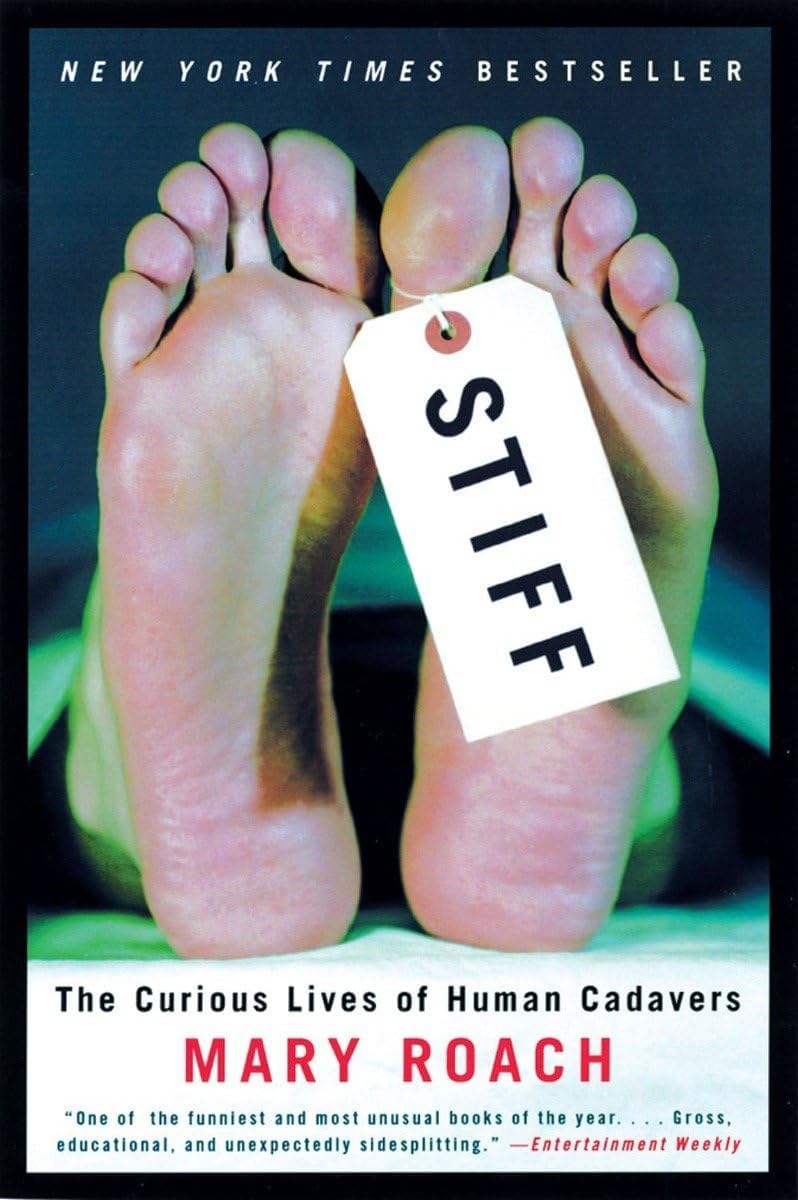
Stiff: The Curious Lives of Human Cadavers
Product ID: 221585
Buy anything from 5,000+ international stores. One checkout price. No surprise fees. Join 2M+ shoppers on Desertcart.
Desertcart purchases this item on your behalf and handles shipping, customs, and support to Thailand.
"One of the funniest and most unusual books of the year....Gross, educational, and unexpectedly sidesplitting."― Entertainment Weekly Stiff is an oddly compelling, often hilarious exploration of the strange lives of our bodies postmortem. For two thousand years, cadavers―some willingly, some unwittingly―have been involved in science's boldest strides and weirdest undertakings. In this fascinating account, Mary Roach visits the good deeds of cadavers over the centuries and tells the engrossing story of our bodies when we are no longer with them. Review: Funny, thoughtful, profound, and surprisingly enjoyable for a book about dead bodies - Having read Mary Roach’s newest book, Grunt, in which she talks about the science of keeping soldiers alive, I decided to read her first one, Stiff, for two reasons. One was to see how much she’d changed as an author, but two – and the bigger reason – was a fascination with the subject. Stiff‘s subtitle is The Curious Lives of Human Cadavers, and the book is about exactly that: what happens to our remains after we die? Like she did with Grunt (and, I’m presuming, all of her books), Roach divides the book into independent chapters, each focusing on different aspects. There’s the bodies that end up in mortuary schools, as well as those that end up dissected by medical students. There are cadavers used as crash testers, those that end up at the Body Farm (where decay is studied, among other things), those that are used to help understand airplane crashes…and those that were used to understand what happened to Jesus and others who were crucified. And there’s much more to be found here, including bodies as compost, as art, and more. It’s a fascinating subject, and one that put Roach on the map – and having read the book, it’s not hard to see why. Done wrongly, the book could seem insensitive, ghoulish, or just depressing. But Roach celebrates these cadavers, reminding the reader just how much has been gained from this research and just how important these bodies have been to not only medicine, but to our society as a whole. At the same time, she never shies away from the discomfort people feel; indeed, one of the most compelling threads in each chapter is discussing with the various people she meets how they manage to maintain a proper emotional balance when they’re working with the dead all the time. Roach is more of a presence in Stiff than she is in Grunt; it feels like more of a first book, and something she might grow away from as she went. But that also feels like a key part of why the book works; after all, death is a fundamentally personal event, and there’s little way to read Stiff and not spend time thinking about what you would want done with your own remains, be it cremation, burial, donation, or more. And Roach builds her own debate into the book, concluding the book with a chapter that finds her pondering what to do with her own remains, having done all these studies and researches into our possible fates. But lest that sound too heavy, Stiff is every bit as engaging and fun as you would hope from Roach’s reputation. Her digressive footnotes and odd asides are still evident, her willingness to ask questions no less charming, and her ability to bring a light tone to even heavy subject matters no less welcome. More than that, she finds depth and thoughtfulness to discuss beyond what you would expect, to the point where you get the impression that she could write a whole second book about bodies and never run out of things to say. That she does all this while being incredibly informative, demonstrating a gift for conveying complex things quickly, and managing to even tell stories, is just testament to her skills as a writer, and the deservedness of her reputation. Review: Compelling and hilarious reading - I defy anyone to dislike a book whose first sentence is "The way I see it, being dead is not terribly far off from being on a cruise ship." Mary Roach's grand tour of the afterlives of corpses makes for compelling--and very often hilarious--reading. The book opens with the first of many colorful scenes, a roomful of plastic surgeons practicing their grotesque (at the best of times) trade on a bunch of severed heads. "The heads have been put in roasting pans--which are of the disposable aluminum variety--for the same reason chickens are put in roasting pans: to catch the drippings." As this passage illustrates, the author keeps the tone of her book light. She is a clever writer, and she makes the sorts of observations of her grim material that the Mystery Science Theater bots might make. But however light her touch, Roach is describing some truly horrific things. There is, for example, the body farm at the Oak Ridge National Laboratory, where bodies go to rot for science, their skin sloughing off and their genitalia bloating in full view of researchers and their guests--who leave with their footwear uncleanably soiled with the "liquids of human decay." There is the graduate student who composted a ne'er-do-well to see how efficacious a means of disposal mulch-making might be for third-world countries. ("And because the man was buried whole, Evans had to go out with a shovel and rake to aerate him three or four times.") And there is Roach's attempt--failed--to verify the details of a 1991 Reuter's article which claimed that "a man who worked in a crematorium in Hainan Province was caught hacking the buttocks and thighs off cadavers prior to incineration and bringing the meat to his brother, who ran the nearby White Temple Restaurant." Roach hired an interpreter to facilitate her discussion with the director of the crematorium she believed had employed the buttock-hacker. But how to explain to the interpreter what she needed to know? "In the cab, I tried to think of a way to explain to Sandy what I was about to have her do. I need you to ask this man whether he had an employee who cut the butt cheeks off cadavers to serve in his brother's restaurant. No matter how I thought of phrasing it, it sounded ghastly and absurd. Why would I need to know this? What kind of book was I writing?" For those with a strongish stomach, Mary Roach's book is, really, a delightful read. And eye-opening. And unlike most books, it may have the quite real effect of influencing your after-lifestyle choices.
| Best Sellers Rank | #698,480 in Books ( See Top 100 in Books ) #1 in Forensic Medicine (Books) #6 in Death #9 in Anatomy (Books) |
| Customer Reviews | 4.5 out of 5 stars 9,076 Reviews |
J**E
Funny, thoughtful, profound, and surprisingly enjoyable for a book about dead bodies
Having read Mary Roach’s newest book, Grunt, in which she talks about the science of keeping soldiers alive, I decided to read her first one, Stiff, for two reasons. One was to see how much she’d changed as an author, but two – and the bigger reason – was a fascination with the subject. Stiff‘s subtitle is The Curious Lives of Human Cadavers, and the book is about exactly that: what happens to our remains after we die? Like she did with Grunt (and, I’m presuming, all of her books), Roach divides the book into independent chapters, each focusing on different aspects. There’s the bodies that end up in mortuary schools, as well as those that end up dissected by medical students. There are cadavers used as crash testers, those that end up at the Body Farm (where decay is studied, among other things), those that are used to help understand airplane crashes…and those that were used to understand what happened to Jesus and others who were crucified. And there’s much more to be found here, including bodies as compost, as art, and more. It’s a fascinating subject, and one that put Roach on the map – and having read the book, it’s not hard to see why. Done wrongly, the book could seem insensitive, ghoulish, or just depressing. But Roach celebrates these cadavers, reminding the reader just how much has been gained from this research and just how important these bodies have been to not only medicine, but to our society as a whole. At the same time, she never shies away from the discomfort people feel; indeed, one of the most compelling threads in each chapter is discussing with the various people she meets how they manage to maintain a proper emotional balance when they’re working with the dead all the time. Roach is more of a presence in Stiff than she is in Grunt; it feels like more of a first book, and something she might grow away from as she went. But that also feels like a key part of why the book works; after all, death is a fundamentally personal event, and there’s little way to read Stiff and not spend time thinking about what you would want done with your own remains, be it cremation, burial, donation, or more. And Roach builds her own debate into the book, concluding the book with a chapter that finds her pondering what to do with her own remains, having done all these studies and researches into our possible fates. But lest that sound too heavy, Stiff is every bit as engaging and fun as you would hope from Roach’s reputation. Her digressive footnotes and odd asides are still evident, her willingness to ask questions no less charming, and her ability to bring a light tone to even heavy subject matters no less welcome. More than that, she finds depth and thoughtfulness to discuss beyond what you would expect, to the point where you get the impression that she could write a whole second book about bodies and never run out of things to say. That she does all this while being incredibly informative, demonstrating a gift for conveying complex things quickly, and managing to even tell stories, is just testament to her skills as a writer, and the deservedness of her reputation.
D**L
Compelling and hilarious reading
I defy anyone to dislike a book whose first sentence is "The way I see it, being dead is not terribly far off from being on a cruise ship." Mary Roach's grand tour of the afterlives of corpses makes for compelling--and very often hilarious--reading. The book opens with the first of many colorful scenes, a roomful of plastic surgeons practicing their grotesque (at the best of times) trade on a bunch of severed heads. "The heads have been put in roasting pans--which are of the disposable aluminum variety--for the same reason chickens are put in roasting pans: to catch the drippings." As this passage illustrates, the author keeps the tone of her book light. She is a clever writer, and she makes the sorts of observations of her grim material that the Mystery Science Theater bots might make. But however light her touch, Roach is describing some truly horrific things. There is, for example, the body farm at the Oak Ridge National Laboratory, where bodies go to rot for science, their skin sloughing off and their genitalia bloating in full view of researchers and their guests--who leave with their footwear uncleanably soiled with the "liquids of human decay." There is the graduate student who composted a ne'er-do-well to see how efficacious a means of disposal mulch-making might be for third-world countries. ("And because the man was buried whole, Evans had to go out with a shovel and rake to aerate him three or four times.") And there is Roach's attempt--failed--to verify the details of a 1991 Reuter's article which claimed that "a man who worked in a crematorium in Hainan Province was caught hacking the buttocks and thighs off cadavers prior to incineration and bringing the meat to his brother, who ran the nearby White Temple Restaurant." Roach hired an interpreter to facilitate her discussion with the director of the crematorium she believed had employed the buttock-hacker. But how to explain to the interpreter what she needed to know? "In the cab, I tried to think of a way to explain to Sandy what I was about to have her do. I need you to ask this man whether he had an employee who cut the butt cheeks off cadavers to serve in his brother's restaurant. No matter how I thought of phrasing it, it sounded ghastly and absurd. Why would I need to know this? What kind of book was I writing?" For those with a strongish stomach, Mary Roach's book is, really, a delightful read. And eye-opening. And unlike most books, it may have the quite real effect of influencing your after-lifestyle choices.
M**I
Morbid yet entertaining
Stiff: The Curious Life of Human Cadavers is an example of a morbid topic turned into a page turning and ironically uplifting read. Stiff is very informative on the history and uses of cadavers while also providing entertainment through Roach’s unique style of writing. Additionally, the book contains numerous gory stories about blood and death, but the real meat of the book is in Roach’s main point of the history and uses of cadavers. She uses real examples of scientists and researchers performing horrific operations on human remains in order to learn the anatomy of our complex species. The chapters are deliberate and in depth and they address a wide range of topics from impact studies for car safety to human composting as a new means of disposal. Roach is additionally accommodating enough to include informative footnotes in places where the subject deviates from common knowledge. One of the best things about this book, besides just the mere content, is the witty style in which Roach employs. She seamlessly integrates jokes and humor into her writing of dead people without being the least bit disrespectful, in my opinion. To make its case, Stiff appeals to both medical interests in the surgeries described and to historical ones in its ample amount of sources on how humans first discovered how our anatomy was designed. The prominence of death in the book however does not lower its accomplishments by any means. If anything, death and dying opens up a new conversation of what to do after we die. The only piece of cautionary advice I have is that certain parts are a bit too bloody and gory, which may lead to sensitive readers not being able to read every page. To oversimplify, Stiff is one of a kind and can be thoroughly enjoyed no matter what medical expertise one has. While prior knowing of the book’s anatomy knowledge is useful in understanding the kind of value it has, it can be advantageous for a multitude of audiences.
M**R
Great Book!
This book is marvelously original. For starters: the subject material. The subject material is interesting to say the least as well as squeamish, gross, weird, detailed, well researched, repulsively descriptive. In summary something that a normal person would not find themselves reading in their freetime. Imagine my utter surprise when I found myself completely enthralled in this book. I woke up deep in a world of cadavers and dead people and actually learned something as well as had a good time doing it. The exceptional reading experience stems from the tone and voice of the author, Mary Roach. Roach uses interjections with random stories, funny experiences, jokes and her personal running commentary to engage the reader. This alone made this book great to me, but another good aspect of the book is the wide variety of fields it covers. Even though some chapters I had no initial curiosity about, others piked my interest. Such as the chapters on crash dummies, promession as well as the history of taxonomy. And lastly, Roach does manage to find a conclusion among the diverse and divergent tangents, topics and fields that make up the book. But be warned, this is not a book for those who can’t stand blood and guts, although if you managed to get through the book ‘All quiet on the western front’ by Erich Maria Remarque then you will be fine. In short, I highly recommend this funny and engaging book to all those who think they can handle it.
M**.
The Book That Made Me Choose Body Donation - A Surprising Guide to Our Final Use
Mary Roach is an enthusiastic globetrotter in search of specific knowledge for her books, often exploring subjects most of us would never imagine. Whether investigating the soul, as in Spook, or human body parts, as in Stiff, she enlightens readers in unexpected ways. Although the books cover very different adventures, the question of the soul quietly returns in Stiff, because the human body and the soul are inseparable parts of living beings. From my perspective, when we leave this world, the spirit continues its journey toward reincarnation. Listening to the Stiff eBook at the gym was a great experience. A small warning: chapter 10 may upset your stomach if consumed right after a meal. Yet the book’s exploration of how the human body can serve science changed my mind — I now favor body donation without restrictions.
E**T
The Beast You Know...
...is better than the one you don't. Ever wonder what happens to you after you die? Like REALLY happens? I don't know how one sets about writing a book detailing what will happen to your dead body, without compromising the dignity of the dead or scaring the s*t out of the living, but Mary Roach somehow nailed it in this extremely tender, funny, and profoundly interesting book. You walk away educated about death (not about dying, which she explains is quite different), but with an intense respect for the human cadaver. The bodies of people who had chosen to donate them are responsible for everything from educating medical professionals to building safer cars to better crime investigations to creating more effective protective gear for military personnel. They even tell us the story of plane crashes when no black box is recovered (and strangely, knowing how I'd actually die in a plane crash makes it a little less scary than what my brain had come up with). The final gift from the previous owners of these bodies is profound, and as Roach points out, well intentioned and sweet. Interestingly, Roach also deals with the ways cadavers return to the earth. Sometimes the concept is more gruesome than reality (plastination) while the opposite is true in other cases (burial). In all cases, you learn the truth - that no matter what, it's going to be gross, and there's not a damn thing you can do about it. Although, strangely, this is also somehow incredibly comforting. At the end of the book, in her discussion of what she would like to do with her own body, the author reveals an unexpected conclusion. You already know that dead people are just plain dead - they don't feel pain, they don't have opinions about what you do to them, and they can no longer express what they want done with their bodies. What Roach comes up with I'll leave for you to find out.
M**S
Great Research
Bits and pieces abut more than I wanted to read, and some sections too lengthy, as filling space to turn it into a novel like ‘Hawaii’. However the majority was educational and extremely fascinating. When one looks at how expensive funerals and burial have become this offered a huge list of alternatives. And, the quips and humor were enjoyed by this reader. VR, Mags
W**Y
Very good, but not for the squeamish
A most interesting book, provided the reader is not among the vast ranks of the squeamish or those who prefer to be ignorant of the physical realities of human existence and what happens to the body after life ends. Roach researched the book well, and what she wrote near the end, on cremation and the more environmentally friendly alternatives to the great heat of cremation, is as timely and pertinent now as when she wrote it.
J**O
Stiff
Ein sehr schönes Buch über die verschiedenen Möglichkeiten was nach dem Tod mit einer Leiche geschieht. Zum Beispiel als Crashtest-Dummies, für Schönheits-OP-Übungen, etc. Ich dachte es würde mehr um die Prozesse im Körper nach dem Tod gehen (Verwesung etc.), aber da hatte ich mich nicht genug informiert. Statt dessen habe ich dennoch viel gelernt darüber, wofür Leichen genutzt werden und kann dieses tolle und auch leicht humoristische Buch nur weiter empfehlen!
T**M
Very informative, very enjoyable
I think I'm quite well-informed, but I learnt a lot from this not-too-serious, not-too-light-hearted book. Having already decided to donate my body to medical science (one day!), what I learnt reassured me that I had made the right decision. Thanks.
V**.
Happens to us all…
Sorry, haven’t read it yet but looks like a novel worth reading. Hey, it happens to us all one day so we should know the gruesome details of becoming a “stiff”!
O**D
Stiff- The Curious Lives of Human Cadavers
A wonderful book, with lots of helpful and humorous information about the human body and what we can all look forward as we age and die! I'm a big fan of Mary Roach's writing style and approach
R**U
Good condition
Good condition. Thank you!
Trustpilot
2 weeks ago
4 days ago