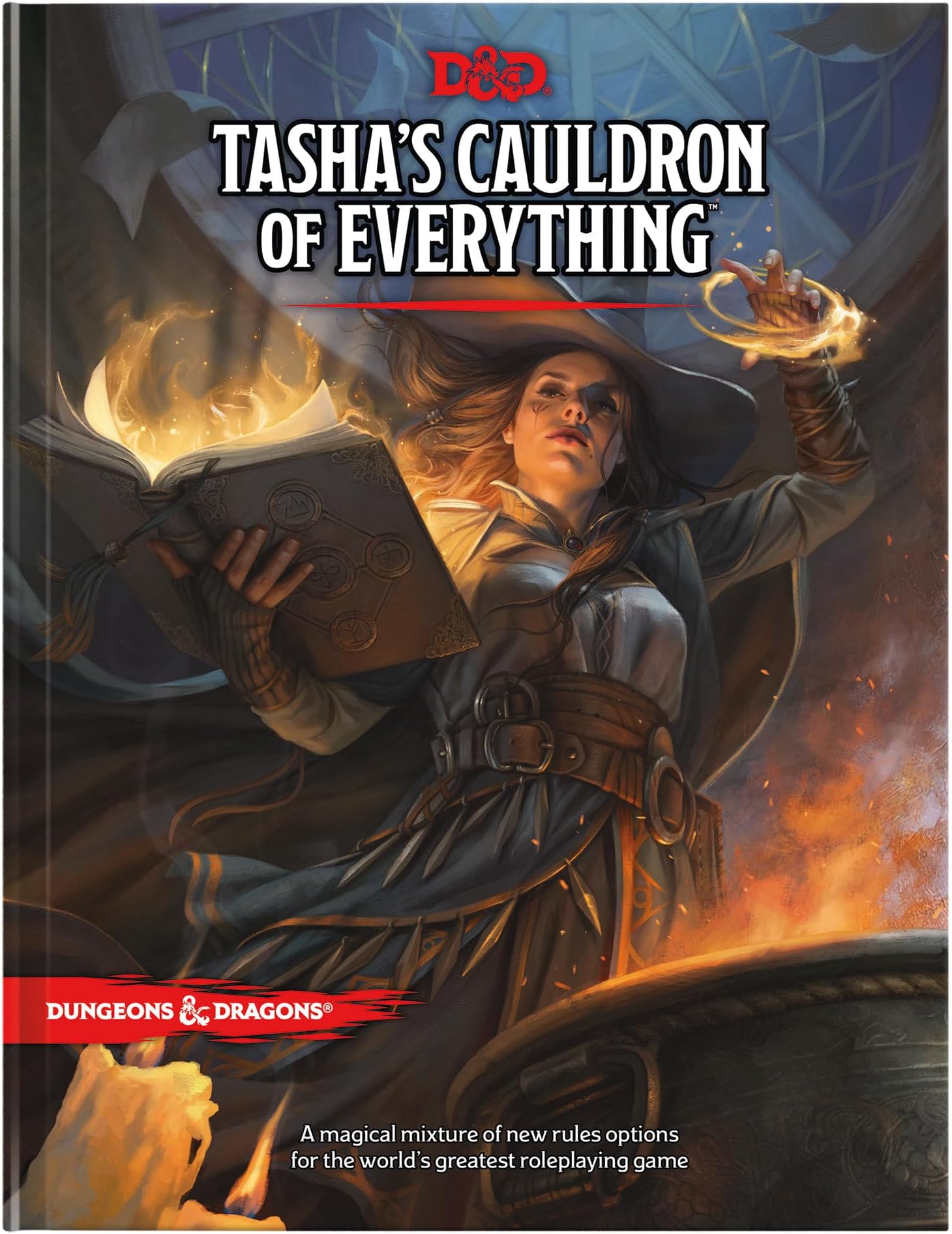
Tasha's Cauldron of Everything (D&D Rules Expansion) (Dungeons & Dragons)
Product ID: 222901051
📚Expanded subclasses for every class
🤝Group patrons with unique perks
🧙♂️New spells, magic tattoos & artifacts
Buy anything from 5,000+ international stores. One checkout price. No surprise fees. Join 2M+ shoppers on Desertcart.
Desertcart purchases this item on your behalf and handles shipping, customs, and support to Thailand.
✨ Brew your legend with Tasha’s ultimate rulebook! ✨
Tasha's Cauldron of Everything is a comprehensive Dungeons & Dragons expansion that enriches gameplay with expanded subclasses, customizable character options, group patrons, new magical items, and innovative rules. Designed for both players and Dungeon Masters, it offers fresh content to deepen storytelling, strategy, and social engagement in every campaign.


| ASIN | 0786967021 |
| Age Range Description | Adult, Teen |
| Best Sellers Rank | #14 in Dungeons & Dragons Game #455 in Paranormal Fantasy Books #648 in Action & Adventure Fantasy (Books) |
| Brand Name | Dungeons & Dragons |
| Color | Black |
| Container Type | Book |
| Customer Package Type | Frustration-free packaging |
| Customer Reviews | 4.8 4.8 out of 5 stars (24,820) |
| EU Spare Part Availability Duration | 57 Years |
| Educational Objective | To enhance players' understanding of game mechanics, provide more options for character customization, and offer new content to enrich gameplay. |
| Global Trade Identification Number | 09780786967025 |
| Grenre | GAMES & ACTIVITIES, Role Playing |
| Included Components | Book, Rules, Subclasses, Class Features, Feats, Group Patrons, Spells, Artifacts, Magic Tattoos, Puzzles |
| Indoor Outdoor Usage | Indoor |
| Is Assembly Required | No |
| Item Dimensions | 8.5 x 0.6 x 11.1 inches |
| Item Dimensions L x W | 15"L x 4"W |
| Item Type Name | rules expansion |
| Item Weight | 1.6 Pounds |
| Language | English |
| Manufacturer | Wizards of the Coast |
| Manufacturer Maximum Age (MONTHS) | 1200 |
| Manufacturer Minimum Age (MONTHS) | 180 |
| Manufacturer Part Number | WTCC78780000 |
| Material Type | Paper |
| Model Name | Tasha's Cauldron of Everything |
| Model Number | C78780001 |
| Model Year | 2020 |
| Number of Items | 1 |
| Number of Players | 6 |
| Operation Mode | Manual |
| Other Special Features of the Product | Expanded Subclasses, Group Patrons, Expanded Rules Options |
| Package Quantity | 1 |
| Power Source | manual |
| Product Style | Physical Book |
| Set Name | Dungeons & Dragons Core Rulebooks |
| Size | 0.6 inches x 8.5 inches x 11.1 inches |
| Subject Character | Tasha |
| Theme | Games |
| Unit Count | 1.0 Count |
L**A
Incredible Resource for DMs and Players Alike
To start with, I want to address the naysaying I've seen about how this book is just "a reprint" of material from other books. First of all that isn't true: this book has a LOT of new content. Second, that isn't a bad thing at all. Not everyone has the money (or the time) to invest in purchasing every single sourcebook and memorizing the lot. The way I see it, this book collects some of the cooler, more versatile systems from some of the more niche books like Theros and the Sword Coast guide, which are mostly for DMs. Yes, this book has a lot in it specifically for DMs as well, but it's got a ton of stuff for players- I'd argue at least half the book. With that out of the way, let's talk about the actual content. The biggest chunk is obviously the new character options. We've got subclasses galore, and most of them are pretty decent, if not great. (I personally favor the phantom rogue and the way of mercy monk as the neatest, but I'm a sucker for dramatics.) While new subclasses are basically a standard in recent releases, this book switches it up a bit by adding psionics elements, as well as subclasses that almost blend two classes together. Want to be a barbarian, but still think druids are cool? Path of the beast is for you! Prefer the ranger class features, but also like the warlock? Choose a fey wanderer! Adding to this is a big host of new options for how you play your standard classes. Some of it is stuff that people have been "house rule"ing for years, but it's nice to see it codified. Toss in a few new feats and some fun new spells, and I think this makes a great package of player-centric content. I will agree that this is sort of "advanced" stuff, though. I wouldn't put this in front of someone who isn't even familiar with the handbook yet. Swapping out class features and changing subclasses and whatnot, that requires a bit of expertise with the standard material. The rest of the book, in my mind, is best suited to homebrewers. There's a lot there to spark your creativity in building your world or your NPCs, including rules to help simplify keeping track of NPC classes, and options for more peaceful, roleplay-motivated players. There's an excellent section on supernatural environments, as well as meta advice for getting your campaign started. The only bits I would say are less useful are the patrons system (which I feel should probably have been placed after the spells/magic items and not before?) and possibly the puzzles, since that's largely things you could invent on your own, and probably don't need outlined. Finally I'm going to mention the art in this book, specifically how inclusive it is. WotC has been pretty good about diversity in 5E, and it really shines here. We have lots of people of color, what appear to be gender-non-conforming characters, explicitly queer characters, and varied ages and body types. We get to see orcs and tieflings doing more than looking sinister. This might not matter to a lot of people, but I really appreciated it. Overall, I think this book is extremely worth it for experienced players and DMs alike. You might not get use out of everything in here, but there's definitely enough to make it worth your while.
C**H
Book was great, only issues are slight physical quality mishaps
The book was what was promised and expected, which goes in depth on: sub classes and new features for each current class , swell as the addition of the Artificer and it's respective sub classes; A large list of new magical items all explained in depth; A formidable list of new spells; and Great information for dm's such as region effects, in depth examples of puzzles, and npc companions that level with the party, and group patrons. The only noticeable problems are what is effecting the physical book itself. - Both hard covers for the book seem to bend away from the pages a bit - The pages seem to be heavily warped when looking at the edges of the pages when the book is closed. - The ink on some pages seems to be abnormally sticky and or abnormally shiny, this does not seem to really mean anything as the color does not appear to fade, but it was noticed. - The book, when opened, creaks quite a bit. Not really anything to worry about or mean much, but also noticed. These issues however, do not effect the books overall quality, they are just nitpicks that can probably be solved by pressing the book under a bit of weight for a bit, but I thought it may be helpful to know if it may be a reoccurring issue. I hope all readers have a great time reading the book, and that you all have some great D&D sessions in the future!
J**D
If you like Xanthar, you'll love Tasha!
A great addition to the 5e DnD world. Cleans up, adjusts & improves many player classes. Adds new class & sub classes. Adds spells & tattoo magic & magical items & weapons. If you enjoyed Xanthar's Guide to Everything, you will definitely enjoy Tasha's Cauldron. It brings new life to many of the old Players Handbook basics. Many of the raters here reduced their stars due to low or bad quality production of the book itself, which gives the impression that the book is not worth buying, but the content inside the book is top notch. I highly recommend it. Just remember to use caution when first opening the book due to the potential for the craftsmanship to be poor, open it slowly & not all the way the first couple times you look through it. Mine arrived with what looked like damp pages, like a book that has been water logged, but when we used caution when opening it, we found no damage at all inside. Tasha's Cauldron is ready, will you partake of her feast?
M**E
Easily the Best 5e Supplement
I don't know about a lot of the other reviews, but my copy came in perfect shape, I don't much notice or care about the art quality, and I don't actually see people talking about what's actually in the book. I'm here to do a game content review. And it's great. Not just great, the game content is literally game changing. I won't talk about the stuff that's in the marketing. My favorite class, Artificer, got a generalized reprint off of Rising from the Last War as well as patron concepts from the same book, and we got magic tattoos. If you've read the blurbs, you already know about these additions to 5e, so I'm here to give my list of the top 3 "Not Immediately Apparent" Reasons to buy Tasha's Cauldron of Everything. 1. The Revised Ranger and the Fable of Fantastic Feature Fenagling -- No point in burying the lead...that's right folks, the most hated 5e class has largely been rebalanced. At least, a critical door has been opened allowing an out for anyone who righteously hates the balance of the base Ranger. They didn't do a hard reprint of the class. What they did to Ranger, and to all the core classes, is eliminate some niche pain points by allowing players to choose additional and/or alternate core class features at certain levels. It's obvious that this is Wizards of the Coast's compromise for in their refusal to fully reprint Rangers, because now Rangers are given the opportunity to completely overhaul themselves by completely replacing the most frustrating aspects of the class with more generally useful abilities. Even though they're more generalized, they're far from weak, and help the Ranger stand out as a unique class. A variant version of each of the core Ranger's abilities exist, and a variant form of pet on par with the Artificer Battle Smith's pet management now exist. I'm currently playing a Ranger, but dipped into another class because mid level Ranger is so underwhelming. This update makes me want to main Ranger again. This will be the longest point I have to make, because the rebalance to the Ranger is the most heavily rebalanced of the classes. Yeah, they they leave the footnote that these changes are optional, but I really don't see why a reasonable DM with access to this content wouldn't allow them. There are some other neat changes. Overall, a lot of classes/subclasses "suffered from specificity." They had hyper-specialized core abilities that had niche benefits. Most, if not all classes, have been given additional core options to better utilize their specialized features. Here are some examples beyond Ranger. Don't like your Channel Divinity options as a Cleric? Use a charge of Channel Divinity to instead Harness Divine Power at 2nd level and gain a spell slot equal to 1/2 your PB (Proficiency Bonus) rounded up. Don't care for the theming of a Wild Shape Druid? Use your charges of Wild Shape to summon a Familiar for a few hours for that tasty Help action and Fantasy drone scouting instead. Feel like you got stuck with crap Cantrips as a Wizard? Suffer no longer with Cantrip Formulas, a level 3 feature allowing you to change a cantrip choice on a Long Rest. This isn't everything, but there's frankly too much to include in a reasonably sized review. Suffice it to say that the book's entire class additions section orbits this point, and is the most critical reason to get the book. 2. Proficiency Bonus Scaling -- A huge change that has come with a lot of the subclasses and new features is scaling off of Proficiency Bonus, or PB. Numerous class abilities now have charges based on Proficiency bonus, making abilities that may normally seem underpowered more viable. An example of this was Unearthed Arcana's Unity Cleric, released in Tasha's as Peace Cleric. Their Level 1 ability, Emboldening Bond, had a single casting per Long Rest and lasted an hour in UA. Its buff was good, but not typically useful enough that an entire hour was necessary. They rebalanced it by giving it a number of charges equal to PB, and made it last 10 minutes, which greatly expands its viability as a core ability for that type of Cleric. A lot of the main rebalance features of the type mentioned in the above section benefit from this, and its a great mechanic. 3. Variation Viability -- A comparison frequently made in the competition between D&D 5e and Pathfinder is that Pathfinder's character customization is leagues better. I've never played Pathfinder, but I have read 2e core book extensively, and I have to agree that it's much more flexible. This entire book, from the new racial design methods, core- and sub-class options, and feats, opens up the flexibility of character design dramatically. It is clearly an effort to take some of the rigidity out of the game while maintaining structure, and, I cannot stress this point enough, it truly does so masterfully. Conclusion: Tasha's Cauldron easily feels like the most necessary of the supplements, while also feeling optional enough that you could live without it if you had to...except for maybe the Ranger updates. I'm a big fan of Eberron, but as a specific setting, that book, while excellent, won't appeal to everyone. This supplement is a must for any DM, and I hope that new DMs build their style off of some of the proposed changes bubbling within Tasha's Cauldron of Everything.
S**J
Very useful book to have
This handbook is just plain amazing, it has tools for DM's it also has the artificer class with 4 subclasses. The book also includes way more subclasses which can be a lot of fun to play as. There are also a lot of fun notes from Tasha that are fun to read. There are also group patrons, and there is more feats and spells. There are also a few magic items and magic tatoos.
T**G
Very useful as a dndbeyond purchase if you're a DM
Solid book with a lot of new and rehashed ua and previously published subclasses and spells. Really enjoyed tasha's bits of snark in her scrolls. Reminded me of bob in the dresden files rpg books or shadowtalk in the shadowrun rpg books back in the old days of Fasa. My favorite new subclass is the twilight domain. Fighters have tons of new options. Wizards will love cantrip formulas. New fighting styles including some that give cantrips. New feats especially the metamgic one will be super popular. It would be fun to run a marvel 1620 5e game with Psylocke of the X-Men being a soul knife rogue. The Chef feat reminded me of Spelljammer. Group Patrons open up for novice DMs new playing styles rather than the typical hack n slash and make it easier to get the players to neat places without railroading them. The magical tattoos bit reminded me of the death gate cycle books which was neat. But, overall I read the book in 6 hours or so and most of the meat could be absorbed by players in less time. If you have a dndbeyond subscription then you can share the book with them for purposes of pc creation and they can read it in Sources if they want to take a look at feats and new spells. Not a great purchase for a player unless you're well off and a collector but a good buy for a DM wanting to buy one book to get the key mechanical bits from many other sourcebooks.
I**I
Best expansion so far!
My favorite expansion so far! the artificer class is a lot of fun and the new spells make for some great role play.
B**D
A Must-Have Book unless...
Fantastic book that gives so much more versatility to life the life of your adventurer the way you want them to live. I know some don't like these books as they 'pollute' the original, but I heartily disagree. Yeah, there are one or two things that appear to give an unfair advantage but hey, it's not across the board. I highly recommend getting this book....UNLESS you plan on getting a DnDBeyond subscription and track your characters via their character creator. Why? The options that you have in this book are not available in your character creator UNLESS you buy the digital book from their website. I wish I had known that as I would have bought them digitally instead.
L**E
Bra pris, snabb leverans
Sonen blev nöjd
G**A
Good for Gamemasters, but poor for players.
The book as always has an awesome presentation and looks. Although, it is devoid of an index, so you will have to use the contents table at the beginning of the book to help you find what you are looking for. The subclasses are lame. They either make no sense, devalorize another class or feat, or are simply dumb. The "new" class artificer does not let me create things much, so what is the point of this artificer? Also, they create silly psionic sub-classes, why not create a psionic class and put these subclasses in there? Silly. Also, they created a Psylocke Marvel super hero sub-class. Ridiculous! Wild magic barbarian, that is the dumbest class in the book. Why not make a shaman sub-class in cleric instead? It would make more sense. This is just to make them like fighters with their Eldritch Knight. For the fighter's part, they received a really bad fighting style, at least poorly created, which is called unarmed fighting. The style completly makes the Tavern Brawler feat obsolete and depreciates greatly the monk's ability to fight efficiently unarmed. The style should read "does two damage instead of one and can cause 1d4 damage to creatures you have grappled. You also do not suffer from disadvantage for fighting against someone who has a weapon." This would have made more sense than having the fighter's hands be as powerful as a sword. Ludicrous! The only class that received somewhat acceptable sub-classes were the bards and monks. But do not expect to fall off your chair, they are pretty ordinary subclasses. The ones found in the player's handbook and Xanathar's book on Everything are by far much better than those. The healer monk found in Tasha depreciate the value of the Monk of Tranquility's usefulness (or vice versa). Enough about the boring subclasses, now the next part group patrons. This part is someone interesting. It expands the patron subject further with lots of ameritrash random tables which I would prefer they use the space for mechanics rather than waste their time on space consuming tables. Taking gamemasters for idiots by creating tons of tables like that is annoying, a simple small paragraph with examples would do the same trick and take a third of the space tables take. Randomness for the sake of randomness if poor and never makes sense in a story. Aside from that, the chapter is good if you want to use patrons. It gives you a good idea of what you should do to create a patron and guidelines on how to use them. Of course, nothing is really necessary here, if you want to buy this book because the patron part interested you, don't. It is nothing you can create on your own with logic, common sense and the history of the world you are playing in (like local guilds, lords, merchants, crimelords, etc.). Do not waste your money on this book just to get the patron section, really not worth it, but it is still useful for kids who wants to become gamemasters. As for the magical miscellany portion of the book, I have mixed opinions on it. The spells are rather lame as usual. DnD spells are very lame in every edition anyways, making spells casters always weaker than fighters (just to tell you, fighters have seven abillity improvements, but other classes have only 5. So a fighter can become much smarter than a wizard if they wanted to... which of course makes no sense and all classes should have either 5 or 7 ability improvements). Anyways, the summons are somewhat better, they last more than a few rounds or minutes. The downside is that you can only summon one creature... so how the heck are necromancers and demonologists able to summon dozens of creatures at the same time in stories and pre-written adventures? Also, like all summons, they are super weak for the level they can be summoned at. Meaning that they get killed in the same round they get summoned or the next, making the spells useless unless you want to make the summon your beast of burden for a very short while. Again, everything to weakened the magic users. As for the magic items part, well, it is the usual DnD thingy, nothing you cannot create on your own, but useful for lazy gamemasters who do not want to create an item's history and list of previous owners and just go "you've found this". Plenty of fun artifact in there. The Dungeons Master Tools portion of the book is where things gets interesting. Lots of nice things in this section. WotC tells explains to us what is fun about rpg and gives us tips and tools on how to make our games fun as a player and gamemaster. They introduce sidekicks for games that are short on players. Guys that are easier to manage than full characters but can still help out a great deal. Again, lots of tables after that part that you could with the environmental hazard. Instead of wasting your time and causing downtime in your game by rolling on a random table, just use your brains, your knowledge of the world and the location the characters are into and you will never use these tables. These are just for lazy gamemasters who know nothing about the gameworld they are using. Other than that, you can still go through them just to get ideas, but never use random tables or cards during gameplay, it bogs down the game and breaks its rythm. The puzzle part is fun. Gives you lots of ideas on making puzzles. They even give you a couple of puzzles you can use. Although, I am certain gamemasters can come up with better puzzles, more suited to their players. Remember the part on guidelines on how to make a good game? Well, this is where it comes in handy too, making a game for your players not you as a gamemaster. Because if you are making your game, the players might not play for long or not come back after this campaign. Make a game your players wants is what the section on gamemaking is all about. Find something everyone would like to play including the gamemaster! I recommand buying it on Amazon while the price is good. Paying the price it is in stores is really not worth it. No more than 50 CAD or 40 USD. But it is a nice addition to your collection compared to the poor prewritten adventures that the DnD universe gave us (from first in the 1970s to today). Nothing compared to let us say, Power Behind the Throne of the original Warhammer RPG. Oh! If you have Xanathar's Book on Everything, it will be a big disappointment when you get Tasha's. It is a let down compared to Xanathar's.
S**N
Echange rapide et apprécié
Le 1 er colis reçu contenait un livre plié du coin bas-gauche au milieu-haut. J'ai donc du faire une demande de retour et pour un autre exemplaire. Tout s'est parfaitement bien passé, j'ai reçu le nouveau livre avant d'avoir eu le temps de renvoyé le modèle abimé ( on a 1 mois pour ce retour gratuit ). Le livre contient des règles de jeu pour D&D 5-ème édition. Il développe le système de jeu présenté dans les 3 livres de base.
N**S
Slightly damaged, but good
Good book and it gives me what I need for my cleric (peace domain) as well as other useful bits and pieces. Sadly the 1st page has separated from the binding at the bottom, which isn't serious, just annoying.
I**G
Creación de acertijos y opciones para jugadores
Pasta dura. Muchas opciones para los jugadores. Recomendable también para crear acertijos como parte de las aventuras, si eres Dungeon Master.
Trustpilot
2 months ago
3 weeks ago