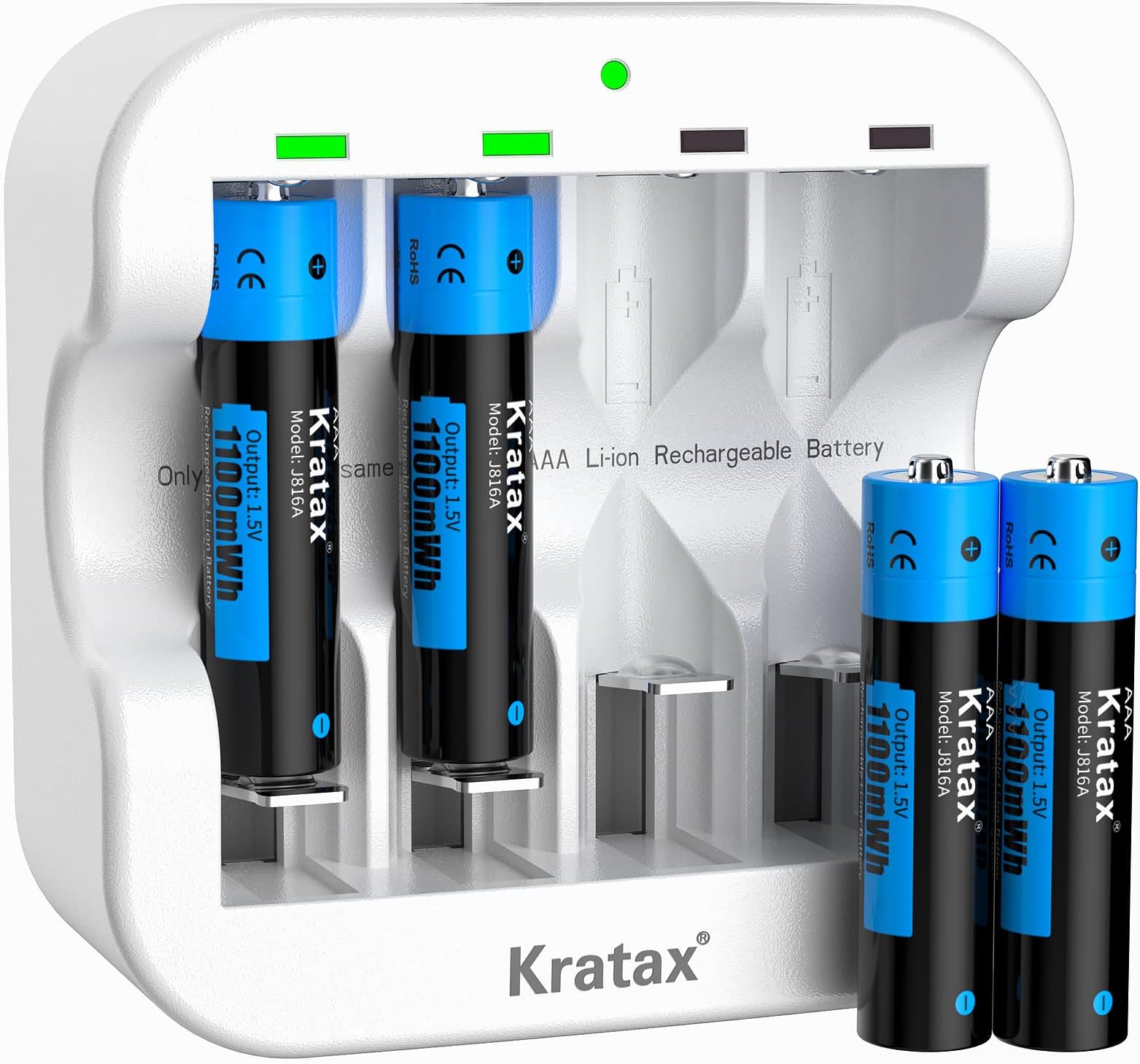
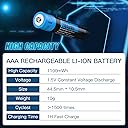
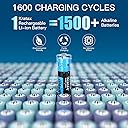
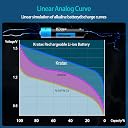
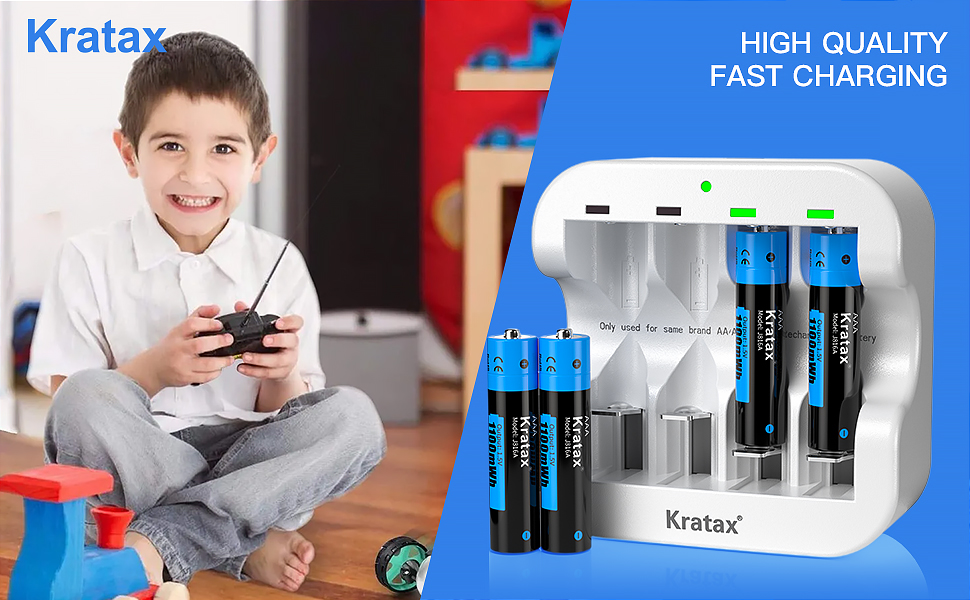
> After several weeks, and each battery having been recharged several times, the charger and all 4 batteries are working well. > Charges fast, especially if you have a 2amp power source (see below). Presumably, you can leave the batteries in the charger when not in use (as is the case with "smart" NiMH chargers) --- but I've never found this explicitly stated. > Capacity — Adequate, comparable to NiCd or NiMH. But, more of that capacity may be usable with rechargeable lithiums (see below). Beware that Kratax and other rechargeable lithium battery vendors rate the batteries in mWh, rather than standard MAh. 1100mWh = 733 MAh --- which is about right for a rechargeable AAA battery whether NiHM or Lithium. > Life per charge — depends on your equipment. Some equipment won’t work properly with less than 1 volt. For NiMH batteries which start with only 1.2 volts, the voltage may drop below 1 volt with ⅔ of the charge still remaining unused. For non-rechargeable alkalines, which start at 1.5 volts, the voltage may drop below 1 volt with ½–⅓ of the charge still remaining unused. Lithiums discharge at 1.5 volts until empty — so the full charge can be used. But, on equipment which works well with only 0.5 volts, you might not notice much difference between NiMH and lithiums. In my MP3 player, the lithiums last roughly 1.5 to 2x longer than NiMHs or alkalines. > Life (charge/recharge cycles). Recharge cycles are never as many as claimed. Most NiMH claim 1000 or so cycles, but I've found that the practical life of high quality NiMHs is only about 125 cycles (defined as being able to hold a charge overnight, and operate my mp3 player for at least 4 hours). Only time will tell how many useful recharge cycles are in the lithiums. > Shelf Life (i.e., how long a charged battery holds a charge). NiMH loose self-discharge over a matter of weeks, months at most; standard non-rechargeable alkalines may last a year or two. Lithium batteries claim to hold a charge for 5 to 10 years (the longer times for non-rechargeable lithiums). So, non-rechargeable lithium batteries are nominally ideal for equipment which is likely to remain unused for years (such as emergency equipment) or low drainage items (e.g. smoke alarms, motion alarms). Why not rechargeable lithiums for such equipment? Do you really want to invest in $7 each for rechargeable lithiums? when you can get non-rechargeable lithiums for $1.50 each? But, beware that shelf-life is in unopened packages, not necessarily when installed in equipment. On many modern electronics (even battery-powered electronics) "off" is not truly "off", but rather, is "standby" -- still draining some power. I find it very suspicious how often my MP3 player was operating well at midnight, when I turned it off, but is completely dead in the morning. > Rechargeable lithiums cost $7 each with a dedicated charger, compared $2 each for rechargeable NiMH. But, in equipment which doesn’t work well with NiMH batteries, your only practical alternative is non-rechargeable alkalines at about $0.50 each. > SHORTCOMING: Since the voltage remains at 1.5v until nearly the moment of complete exhaustion, most battery meters will report “full battery” until moments before the battery is completely drained. If low battery warning is important to you, use NiMH batteries, or investigate other brands of lithium batteries, which are designed to progressively lower voltage as the charge is used. MY USE > Purchased for my mp3 player, which malfunctions when the voltage of rechargeable NiMH batteries drops much below 1 volt. So far, no malfunctions with my mp3 player when using rechargeable lithium batteries. > Will purchase more for my TV remote controls, which simply will not work with NiMH for more than 1/2 hour. LIGHTS — The three different sets of indicator lights are confusing — but all that matters is the square LEDs above each battery. > Single Round LED: Green = charger receiving current. > Square LED above each battery: Red=battery charging; Green=charged > Light on top of batteries: Blue=battery charging; no light if charged or not charging. POWER SOURCE — The charger does not come with a USB adapter. To get the 1 hour charging times claimed, your USB adapter (or port) needs to produce 5v at 2 amps. There is a good chance that the old USB adapter in the bottom of your electronics drawer produces only 0.5a --- you still get reasonably fast charging, but not as fast as with a 2a adapter. A “convenient” multi-USB adapter may not produce the nominal amperage if more than one device is plugged into it — so, for fastest charging, I suggest a single-plug 2amp USB adapter, that you label for use with your battery charger, and use only for that purpose. CAUTION — Lithium batteries are inherently 3.7 volts, and until recently 1.5v rechargeable lithium batteries were not available. Internal circuitry in the 1.5 volt lithiums steps down the voltage from 3.7v to 1.5v. Most 3.7v rechargeable lithium batteries are odd sizes to avoid confusion with standard AAA and AA batteries. > In fact, I have 3.7v rechargeable lithium batteries, and a dedicated charger that I use for a (great) flashlight. My 3.7v rechargeable lithiums are an odd size (a little larger than an AA)—but would physically fit in a spring-adjusting charger meant for 1.5v C-size batteries (but would not charge properly). > Conversely, my spring-adjusting charger meant for 3.7v lithiums will (physically) accommodate AA and AAA size batteries . But 3.7v and 1.5v batteries and chargers are not cross- compatible. > There are similarly at least three different competing designs of lithium 1.5v AA and AAA batteries available at this time, which may not be cross-compatible. The simplest solution is to pick a brand of 1.5 volt lithium batteries, and purchase your batteries and charger of the same brand—typically the charger with 4 batteries is only $3–$5 more than the cost of the 4 batteries. Buy the batteries as a package with the dedicated charger. Caveat—the most common battery design (which are sold with identical chargers), are probably cross-compatible. COMPLAINTS OF OTHER REVIEWERS > Yes, sometimes batteries die early. It’s happened to me many times with NiCds and NiMH. There is more that can go wrong with 1.5v lithiums, because each one has its own built-in computer. So the rate of defective 1.5v lithiums is probably higher than other rechargeables. So, test your batteries when you get them, and return any to Amz that fail. Trying to charge the 1.5v lithiums in an incompatible charger might burn out the tiny computer in the batteries. > Otherwise reading the negative reviews, I have the impression that most problems users are having is caused by improper charging --- mostly using battery chargers not meant for 1.5v AAA or AA lithium batteries. — I suspect than many purchasers bought the batteries only, and attempted to charge them in NiCd or NiMH battery chargers. Indeed I was tempted to do so, since I have an expensive NiCd/NiMH charger, and it would seem that "1.5v is 1.5v" and the batteries/chargers should be cross-compatible. But, both the sellers and review articles claim that the batteries/chargers NOT cross-compatible. Solution, shell out the extra $3–$5 for the same brand and model charger when you purchase the batteries — cheap insurance. Why are the NiMH and 1.5 Lithium battery chargers incompatible? Presumably because the brains of "smart" NiMH chargers are built into the chargers. The "brains" of 1.5v rechargeable lithium battery chargers are built into the individual batteries. Practically speaking, my bet is that the "1.5 Lithium battery chargers" are really just "battery holders", and are essentially empty shells inside, and are incapable of fast-charging "dumb" NiMH batteries. — I suspect that some folks (like me) who have chargers designed for 3.7 lithium batteries may say to themselves “Hey, I already have a lithium battery charger — I don’t need to buy another lithium battery charger”. 1.5v and 3.7v batteries/chargers are not cross-compatible. 3.7v rechargeable lithium batteries are not "smart". Most likely a charger meant for 3.7v batteries would burn out the tiny computer of a 1.5v lithium battery. — One person complained that he/she/them could not charge the 1.5v lithiums with a solar charger (of course not, it wasn't meant to charge lithium batteries). Another person could not charge the batteries from another battery "booster" device. Who knows what voltage/amperage those power sources deliver?