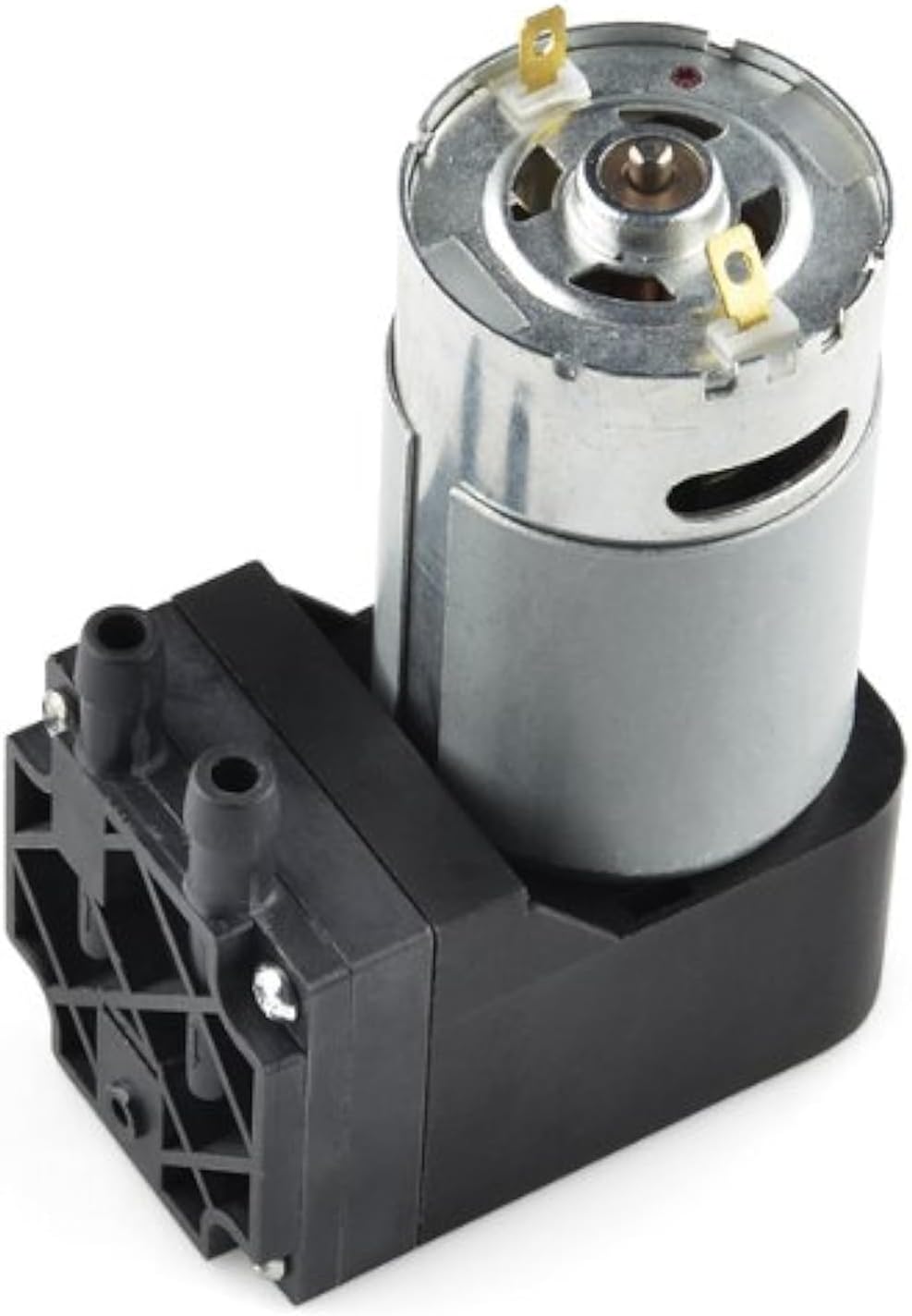

12 Volt Vacuum Pump
Product ID: 257335518
Details
- BrandGeneric
- ColourBlack
- Power SourceCorded
- Item Weight322 g
- Voltage12 Volts
- ManufacturerGeneric
⚡12V Power
💨26 LPM Flow
🔧5 Bar Pressure
🚀 Pump Up Your Performance!
The 12 Volt Vacuum Pump is a high-pressure, electric micro piston air pump designed for efficiency and versatility. With a powerful 12V power source, it delivers a flow rate of 26 liters per minute and operates at a pressure of 5 bar, making it ideal for a range of applications from automotive to industrial use. Compact and lightweight at just 322g, this pump is engineered for durability and ease of use.
| ASIN | B00DYA21PU |
| Best Sellers Rank | #289,745 in Garden & Outdoors ( See Top 100 in Garden & Outdoors ) #3,013 in Outdoor Power Tool Replacement Parts |
| Brand | Karlsson Robotics |
| Brand Name | Karlsson Robotics |
| Colour | Black |
| Customer Reviews | 4.4 out of 5 stars 365 Reviews |
| Item Weight | 0.71 Pounds |
| Manufacturer | Generic |
| Manufacturer Part Number | D2028 |
| Model Number | D2028 |
| Power Source | Corded Electric |
| UPC | 045635496699 |
| Voltage | 12 Volts |
S**M
powerful
super powerful, can suck with enough strength;) see video of my pick & place for electronics
S**R
usable for engine oil change
Update: With a relatively strong plastic food storage box with a rubbery seal at the lid, 3/8" quick connect bulkheads, and 3/8" tubes for fridge ice makers or water filters, engine oil is flowing out continuously. I haven't measured the time but it's may be some 15 min for 6 quart. It is basically nothing if you change at home and surf the web in the mean time. The fastest and quietest and cheapest pump I have heard. I could try the serial connection with two pumps as one reviewer tested. But the 7 quart plastic box isn't holding up too well. If you block the oil flow, the pump can squash the box like what you can do to an aluminum can. I don't understand what's going on in topside engine oil change from the dipstick hole. I can use a hand vacuum pump to get oil out easily. Indeed it filled the small reservoir too fast and contaminated my pump. Why can't someone produce a decent pump for oil without waking up everybody in the neighborhood? This is it. I replaced this with my hand pump and it sucks just as great. How fast you need to take out less than 2 gal? I would say 10 to 30 mins. It doesn't matter for me even for a few hours. I was hoping to siphon the oil overnight but it didn't work. This pump is pretty quiet. It is much quieter compared to my silly tire compressor that worked like it's hammering something hard. My outdoor AC drowns it out, though my AC is not particularly quiet. My coffee bean grinder is louder! The point is since me and my neighbor can live with the AC noise, this pump is nothing in comparison. I have done some research and trials before settling on this. I had a metal hand pump oil changer. It's still in pretty good condition. For me hand pump is silly if you have the alternative. It's not like you can start the pump and the oil will siphon out by itself. You have to pump out every drop yourself. It's not like you add 40 strokes and the oil will all come out by itself. After the oil stopped coming out, I pull the pump handle (rather effortlessly) and some more oil come out. I pumped and then some more come out. It never ends. Unless you know how much oil is burnt away, and you measure the oil you got out, you are never sure enough oil came out. Actually siphon works for 1/4" tubes, but it is just too slow. Overnight cannot make it. 3/8" tubes will be a lot faster but it doesn't fit the dipstick hole too well, becoming airtight. I opened the oil cap and oil filter but still won't work. But there's no problem siphoning from container to container with whatever tube size. A good electric oil extractor is over a hundred, if not hundreds. But why? There's only one cheap oil pump on sale but some complainted that it is slow and I suspect that it's loud, like my silly tire compressor. So I wanted to build my own because I can do it with a handheld tiny vacuum pump. Also the oil can siphon out by itself but it's just too slow. It need just a little help. I've seen the guy using a vacuum cleaner and a homemade reservoir. It took 30 min. The problem is that I can't live with the vacuum cleaner on for 30 min. It would drive me crazy. My shop vac is just as loud. My carpet steamer is louder. I have looked at many pumps with oil in the title. But thick oil and thin oil are different. And for the application only positive displacement pump may work like gear pump and diaphragm pump. Oil will be in contact with the diaphragm and my ruin it if it's designed for water and cooking oil. There are some pumps used for racing that is almost certainly working for engine oil. But I think they are over kill. I tried this one because my handheld vacuum pump tester showed great promise. I could have used the vacuum from my car to drive a reservoir, but that pump is already working hard because of some subtle leaks in the system. It takes over $1000 to replace it. Also, this pump can be used to drive the AC in the car and my engine will work much better at idle and climb. (I noticed that a reviewer did just that.) As one reviewer said, the polarity doesn't matter. One of the connector will be the vacuum. I couldn't find an old 12V outlet adaptor that gives more than 1A. My battery is at the back too far away. I used an old PC power supply that is portable and overkill. As for the reservoir, you only need a big enough airtight juice jug and two bulkheads. I had them for pet projects to pump water. If the quick connect bulkheads don't work for vacuum, it have to work if I glue harder tubes into it. The 1/4" and 3/8" tubes fit each other perfectly, either for fridge ice maker or the softer clear vinyl type. update 2016: I finally figured out that the problem with this pump is that it's two powerful. The flow of engine oil is good, heated or not, until the plastic containers are crushed like aluminum cans. So I brought a vacuum release valve and bulkhead for it. I also used a 9V, less than 1A wall wart and it still crush plastic containers. As for tubings, polyethene tubes used for ice makers and also pneumatics are good. 3/8" OD tubings doesn't go all the way into the dipstick hole of my engine. 1/4" OD are a bit slow, but doable. Haven't try 5/16" tubings.
A**R
Five Stars
great service, item as described, working fine!
W**S
Works better and higher quality than I first expected.
FIRST a point of clarity: Another reviewer commented that the polarity doesn't matter. The terminals are NOT marked + and - which DOES MEAN you can pick whichever terminal you want to be +. Once you pick a terminal to be POSITIVE. MARK IT RED and DO NOT change them again. Changing polarity WILL matter IF you change rotation after running it in one direction for a while. You'll damage the brushes because the pressure and wear pattern on them will be reversed. THAT WILL slightly change the angle of the brushes at the contact point on the commutator . THAT WILL prematurely wear and destroy them. Not TODAY.... But it absolutely WILL happen. It is the reason why R/C electric car controllers using BRUSHED motors generally do NOT have reverse. Because of this it would be better to stick to convention, pick a terminal for + and STAY WITH IT. :-) I too, like another reviewer am interested in using it to vacuum seal. Specifically, I just want a poor man's version of a baggie sealer for food. This appears to be well suited to such a task. I am running mine from a 12v 2A SWITCHING pwr supply which I got HERE: HDView® 12V DC 2A 2000mA Power Adapter Supply UL Listed Certified 2.1mm 5.5mm, CCTV *** Best Quality *** It is a UL listed switching type supply and I measured 11.2 WATTS under full load on the PRIMARY side. Works excellently in this configuration. Add a small case, pwr switch and a simple filter ahead of it to prevent it f4rom sucking crap into the pump and VIOLA! you'll have a winner too! FYI, though (I) have not tried this, theoretically you should be able to get a deeper vacuum by daisy chaining 2 of these.. That is, provided the pump's internal structure doesn't bypass too early ruining the deeper vacuum. I also agree with another reviewer opinion in that the quality is much higher than I thought it would be.
L**E
Bleeding Brake Lines
Every year or two I flush out my brake lines as the brake fluid draws moisture over time and is the main cause of brake cylinders leaking. They eventually corrode due to the moisture in the fluid and the bore of the wheel cylinders will become pitted. If you flush out the old fluid every year or two you will prevent that from happening. It has always worked well for me but bleeding the lines has always been a hassle. I have always used one of those pistol gripped brake bleeders which worked but took a long time. The way I do it is to get some clear plastic tubing that will reach from the farthest wheel to the master cylinder under the hood. That way as I am bleeding the lines I can monitor the level of fluid in the master cylinder reservoir and prevent it from going empty. I found this little pump on Amazon and one of the reviewers said he used it to bleed his brakes. That's what I wanted to know so I ordered it. As you can see in the pictures I took a 1/2 inch plastic LB and mounted a momentary contact switch in the cover and ran one wire to the vacuum pump and the other one to the battery so when it is all hooked up all I have to do is push the button and let the little vacuum pump do the work instead having to pump that pistol grip. I just used it about an hour ago and it worked great. And another nice thing is that the pump was cheaper than one of those pistol grip bleeders.
Trustpilot
1 week ago
3 weeks ago