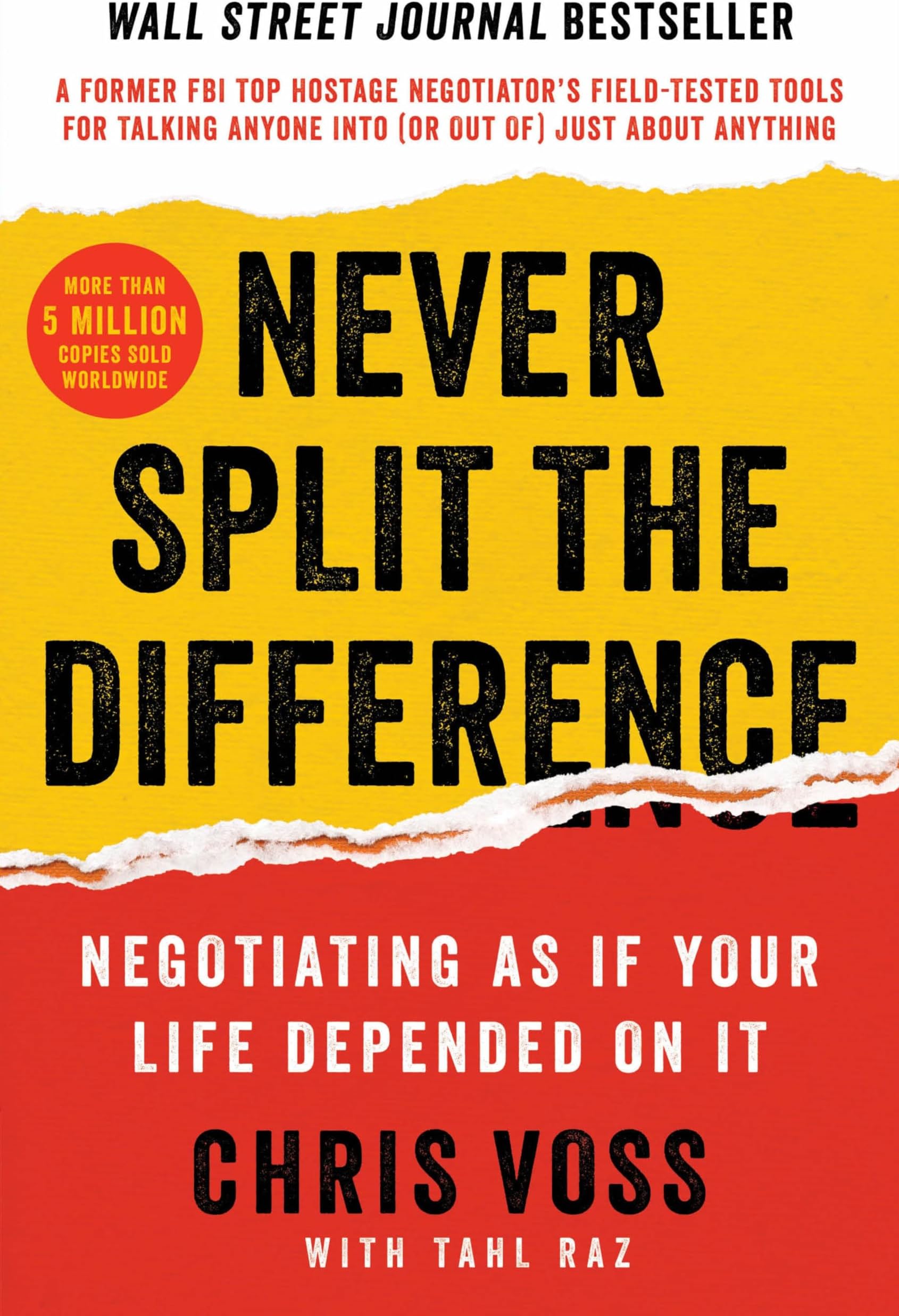
Never Split the Difference: Negotiating As If Your Life Depended On It―Unlock Your Persuasion Potential in Professional and Personal Life
Product ID: 28322790
Buy anything from 5,000+ international stores. One checkout price. No surprise fees. Join 2M+ shoppers on Desertcart.
Desertcart purchases this item on your behalf and handles shipping, customs, and support to Thailand.
A NEW YORK TIMES BESTSELLER A WALL STREET JOURNAL BESTSELLER "This book blew my mind. It’s a riveting read, full of instantly actionable advice-not just for high-stakes situations, but also for handling everyday conflicts at work and at home." ―Adam Grant, author of Think Again This international bestseller, with more than 5 million copies sold, offers a field-tested approach to high-stakes negotiations―whether in the boardroom, in your community, or at home. Life is a series of negotiations, and essential negotiation skills are at the heart of collaboration―whether you are a business executive, a salesperson, a parent , a community leader, or a spouse. As a former FBI hostage negotiator, Chris Voss gives you the tools for effective persuasion in any situation: negotiating a business deal, buying (or selling) a car, negotiating a salary, acquiring a home, renegotiating rent, deliberating with your partner, or communicating with your children. Taking the power of tactical empathy, active listening, and intuition to the next level, Never Split the Difference gives you the competitive edge in any difficult conversation or conflict resolution scenario. This book is a masterclass in influencing others, no matter the circumstances. After a stint policing the rough streets of Kansas City, Chris Voss joined the FBI, where his career as a hostage negotiator brought him face-to-face with a range of criminals, including bank robbers and terrorists. Reaching the pinnacle of his profession, he became the FBI’s lead international kidnapping negotiator. Never Split the Difference distills the Voss method, revealing the communication skills that matter most when it comes to achieving your goals in both your professional and personal life. Step-by-step, Voss show you how to: Establish Rapport Create Trust with Tactical Empathy Gain the Permission to Persuade Shape What Is Fair Calibrate Questions Transform Conflict into Collaboration Spot Liars Create Breakthroughs by Revealing the Unknown Unknowns Never Split the Difference is your definitive source for defusing potential crises, winning people over, and achieving your goals at work and at home with proven negotiating strategies. Review: Essential Reading for Attorneys in Mediation - As a medical malpractice attorney, I’m always looking for ways to strengthen my negotiation skills, and Never Split the Difference by Chris Voss is one of the most practical and eye-opening books I’ve ever read on the subject. Voss, a former FBI hostage negotiator, translates high-stakes negotiation tactics into tools that can be applied in everyday life and professional practice. What struck me most is how his strategies rely less on dominating the conversation and more on understanding psychology, building rapport, and using subtle but powerful techniques to influence outcomes. In the context of mediation, this book is a game-changer. Medical malpractice cases are emotionally charged, and parties often come to the table entrenched in their positions. Voss’s techniques—such as tactical empathy, calibrated questions, and the power of silence—help diffuse tension, uncover hidden motivations, and move discussions forward in a constructive way. I’ve already seen how asking the right “how” or “what” questions shifts the tone from confrontation to problem-solving, which is invaluable in reaching favorable settlements for my clients. The writing style is engaging, filled with real-world anecdotes that keep you hooked while illustrating practical takeaways. Unlike many negotiation books that feel academic or theoretical, this one gives you tools you can apply the same day you read them. For attorneys, particularly those handling mediation-heavy fields like medical malpractice, this book should be required reading. It has changed how I approach negotiation—not just with opposing counsel, but with clients, experts, and even in day-to-day interactions. Review: How to Confront- And get Your Way- Without Confrontation - Everything we assumed we knew was wrong” (p.26), we are not rational, compromise is terrible, and “No” is the answer to getting what you want in and out of the office. These are all concepts that the reader can be expected to wholeheartedly believe and understand by the end of this book. Former FBI hostage negotiator Chris Voss hit the mark with this book, sharing effective tips and tools for negotiating in and beyond your workspace. “Never Split the Difference: Negotiating as Your Life Depends on It” is a 5-star read for those trying to enhance their “deal making skills” whether that be with work or personal relationships. Prior to 2008, Chris Voss was the lead international kidnapping negotiator for the FBI. According to The Black Swan Group, through his 28 year with the Bureau, he was trained in negotiation by the FBI, Scotland Yard and Harvard Law School. Chris has taught business negotiation in the MBA program in several of the world’s best universities and business programs. Voss continues to host seminars and attend guest lectures and is rumored to be working on additional books. “Never Split the Difference”, a euphemism for “never compromise” because compromise on the street often leads to the loss of lives, Was published in May of 2016 and is an extremely powerful book that tells the stories of negotiation when you really can’t afford to lose, like in a situation where you are negotiating for the lives of others. Each chapter includes engaging theories on communication and actionable recommendations on how to improve your communication skills, while telling intriguing stories of the life of an FBI agent. These stories include bank robberies, terrorists and a bunch of different “bad guys”. This book will not only help your business deals, but your personal relationships as well. Voss gives us more than just the advice on what to do, he shows us why they work as well. This book is a fun read full of useful information. The new concepts in every chapter had me highlighting the techniques and lessons that I truly wanted to remember. The most important to me, being that you should never be so eager to solve a conflict that’s result is inconvenient for you. Accepting bad deals is almost always a mistake. Compromise isn’t always the answer, while pushing for a hard “yes” doesn’t get you any closer to a victory, it only angers the other party. And finally, “Driving towards “that's right” is a winning strategy in all negotiations. But hearing “you're right” is a disaster.” (p. 105) Overall this is a wonderful book that teaches the reader that negotiation, at its core, is nothing more than conversations with reactions and results. Getting what you need from others will help set up the rest of your life. Chriss Voss will teach you how to take authority and show dominance in the conversations that will make or break your career. Because of the strong lessons in this book, I believe it would be a great book for most young people to read. Whether they are beginning their college career or creating their own blue-collar business, “Never Split the Difference” by Chris Voss is a great resource for people looking to better their life without looking for a designated “self-help” book. Remember: “... without self-control and emotional regulation…” (p 156) these strategies will not work.


| Best Sellers Rank | #220 in Books ( See Top 100 in Books ) #1 in Business Negotiating (Books) #5 in Leadership & Motivation #13 in Success Self-Help |
| Customer Reviews | 4.7 out of 5 stars 50,796 Reviews |
B**F
Essential Reading for Attorneys in Mediation
As a medical malpractice attorney, I’m always looking for ways to strengthen my negotiation skills, and Never Split the Difference by Chris Voss is one of the most practical and eye-opening books I’ve ever read on the subject. Voss, a former FBI hostage negotiator, translates high-stakes negotiation tactics into tools that can be applied in everyday life and professional practice. What struck me most is how his strategies rely less on dominating the conversation and more on understanding psychology, building rapport, and using subtle but powerful techniques to influence outcomes. In the context of mediation, this book is a game-changer. Medical malpractice cases are emotionally charged, and parties often come to the table entrenched in their positions. Voss’s techniques—such as tactical empathy, calibrated questions, and the power of silence—help diffuse tension, uncover hidden motivations, and move discussions forward in a constructive way. I’ve already seen how asking the right “how” or “what” questions shifts the tone from confrontation to problem-solving, which is invaluable in reaching favorable settlements for my clients. The writing style is engaging, filled with real-world anecdotes that keep you hooked while illustrating practical takeaways. Unlike many negotiation books that feel academic or theoretical, this one gives you tools you can apply the same day you read them. For attorneys, particularly those handling mediation-heavy fields like medical malpractice, this book should be required reading. It has changed how I approach negotiation—not just with opposing counsel, but with clients, experts, and even in day-to-day interactions.
S**A
How to Confront- And get Your Way- Without Confrontation
Everything we assumed we knew was wrong” (p.26), we are not rational, compromise is terrible, and “No” is the answer to getting what you want in and out of the office. These are all concepts that the reader can be expected to wholeheartedly believe and understand by the end of this book. Former FBI hostage negotiator Chris Voss hit the mark with this book, sharing effective tips and tools for negotiating in and beyond your workspace. “Never Split the Difference: Negotiating as Your Life Depends on It” is a 5-star read for those trying to enhance their “deal making skills” whether that be with work or personal relationships. Prior to 2008, Chris Voss was the lead international kidnapping negotiator for the FBI. According to The Black Swan Group, through his 28 year with the Bureau, he was trained in negotiation by the FBI, Scotland Yard and Harvard Law School. Chris has taught business negotiation in the MBA program in several of the world’s best universities and business programs. Voss continues to host seminars and attend guest lectures and is rumored to be working on additional books. “Never Split the Difference”, a euphemism for “never compromise” because compromise on the street often leads to the loss of lives, Was published in May of 2016 and is an extremely powerful book that tells the stories of negotiation when you really can’t afford to lose, like in a situation where you are negotiating for the lives of others. Each chapter includes engaging theories on communication and actionable recommendations on how to improve your communication skills, while telling intriguing stories of the life of an FBI agent. These stories include bank robberies, terrorists and a bunch of different “bad guys”. This book will not only help your business deals, but your personal relationships as well. Voss gives us more than just the advice on what to do, he shows us why they work as well. This book is a fun read full of useful information. The new concepts in every chapter had me highlighting the techniques and lessons that I truly wanted to remember. The most important to me, being that you should never be so eager to solve a conflict that’s result is inconvenient for you. Accepting bad deals is almost always a mistake. Compromise isn’t always the answer, while pushing for a hard “yes” doesn’t get you any closer to a victory, it only angers the other party. And finally, “Driving towards “that's right” is a winning strategy in all negotiations. But hearing “you're right” is a disaster.” (p. 105) Overall this is a wonderful book that teaches the reader that negotiation, at its core, is nothing more than conversations with reactions and results. Getting what you need from others will help set up the rest of your life. Chriss Voss will teach you how to take authority and show dominance in the conversations that will make or break your career. Because of the strong lessons in this book, I believe it would be a great book for most young people to read. Whether they are beginning their college career or creating their own blue-collar business, “Never Split the Difference” by Chris Voss is a great resource for people looking to better their life without looking for a designated “self-help” book. Remember: “... without self-control and emotional regulation…” (p 156) these strategies will not work.
S**M
A Surprisingly Practical Guide to Negotiation — Clear, Engaging, and Easy to Use in Real Life
Never Split the Difference was a fantastic read that completely changed how I think about negotiation. I expected a book full of hard-selling tactics, but instead it’s packed with practical, human-centered strategies that actually work in everyday situations. The way Chris Voss breaks things down makes even tough conversations feel more manageable. What I liked most is how actionable everything is. The techniques — like mirroring, labeling emotions, asking calibrated questions, and staying calm under pressure — are explained with real stories that make them easy to remember. I found myself trying a few of the ideas right away, and it’s surprising how effective they are once you get the hang of them. The book also made me realize that negotiation isn’t just for business deals. It’s something we do constantly: at work, with family, with friends, or whenever we need better outcomes. The strategies here help you communicate more clearly, stay in control emotionally, and guide conversations toward solutions that actually make sense. If there’s a small downside, it’s that some of the examples can be intense since they come from high-stakes FBI situations. But even so, the way Voss translates those lessons into everyday life keeps the book grounded and useful. Overall, this is one of the most practical and eye-opening communication books I’ve read. If you want to improve your persuasion skills, handle conflict better, or just understand people more effectively, this book is absolutely worth picking up.
I**N
who better to guide you in the best techniques for negotiation ...
Let’s get this clear: You don’t get the life you deserve, you get the life you negotiate. That said, who better to guide you in the best techniques for negotiation than someone who was involved in genuinely high-stakes negotiating – world-class ex-FBI hostage negotiator, Chris Voss. Having seen too many B-Grade movies, your perception of dealing with hostage-takers, as was mine, may be assembling an armour-clad SWAT team, getting a clear head shot at the hostage taker, and rescuing the terrified victims. After seeing too many incidents end in disaster for the victims, the FBI turned to using very sophisticated negotiation techniques. Most business negotiators are raised on the “Getting to Yes” approach of Fisher and Ury. One of their keys to negotiating is the assumption that the other side is going to “act rationally and selfishly in trying to maximize their position.” Your task is to get as much as you can. The only people who come close to doing this are those negotiating with other people’s money and who will make an outsized commission irrespective of the outcome. The book’s title, ‘Never Split the Difference’, highlights the deficiencies in this approach. What is splitting the difference in a hostage negotiation? I’ll give you $5m instead of your asking price of $10m and you kill only 8 hostages and free 12? “Negotiation, as you’ll learn it here, is nothing more than communication with results,” Voss explains. The economist Amos Tversky and the psychologist Daniel Kahneman, the founders of the field of behavioural economics, won a Nobel Prize for demonstrating that man is in fact, (and even in business,) a very irrational beast. The beauty of the method Voss teaches is how easy it is to grasp the basics, even if it may take years to perfect these techniques. The method Voss describes was developed because it is easy to teach, easy to learn, and easy to execute. It was designed for police officers who weren’t interested in becoming academics or therapists. They simply needed a highly effective way of changing the behaviour of the hostage-taker, and to shift the emotional environment of the crisis just enough so that they can secure the safety of everyone involved. If indeed you don’t get what you deserve, only what you ask for, you have to ask correctly. So, claim your prerogative to ask for what you think is right. The centrepiece of this book, is ‘Tactical Empathy’ and it works. This doesn’t involve agreeing with the other person’s values and beliefs or giving out hugs, that’s sympathy. Tactical Empathy is contingent on active listening – listening hard and doing so in a relationship-affirming way. Active Listening involves techniques such as Labelling, Mirroring, Accusation Audit, silences and more. I will address only a few. Labelling is repeating your counterpart’s perspective back to them. You will be able to disarm your counterpart’s complaints by repeating them aloud. Labels almost always begin with the same words: It seems like … It looks like… It sounds like … and not “I’m hearing that …” The word “I” gets people’s guard up. There is enough research that indicates that the best way to address negativity is to observe it, without reaction and without judgment. Then label the negative feeling and replace it with positive, compassionate, and solution-based thoughts. “You seem disappointed that the price you were expecting to achieve is being rejected…” Then listen encouragingly so a solution can be found. There are three voices that are useful in a negotiation, one Voss calls the “late-night, FM DJ voice”: it is non-threating, soft, and calming. Talk that starts with “I’m sorry …” and a soft smile, makes people more open to creative solutions because their brains are not freezing in fear or anger. “Mirroring” is feeding back to your counterpart what they have just said. Not the body language. Not the accent. Not the tone or delivery. Just the words. Sometimes repeating only the last three words or the critical one to three words of what someone has just said, will produce the desired effect. Your counterpart will inevitably elaborate, and even reveal more information that will further fuel the negotiation. Mirrors work magic. By affirming what you are hearing, you are showing you understand (not support or concur with) your counterpart’s worldview. “It seems like you want us to let you go.” Or “It seems like you don’t want to go ahead with the sale under these conditions.” When they can say to you “That’s right…” you have connected in a meaningful way that will allow for the exploration of other options. If they had said, “You’re right…” more often than not, they are fobbing you off. “I always try to reinforce the message that being right isn’t the key to a successful negotiation—having the right mindset is,” Voss explains. Negotiation is not a battle between opposing forces. By doing an accusation audit in advance, you can often surface what is their concern upfront and eliminate it. When teaching negotiation, Voss invites students to roleplay. Knowing what is going to bother them, he introduces the process with: “In case you’re worried about volunteering to roleplay with me in front of the class, I want to tell you in advance … it’s going to be horrible… (But) those of you who do volunteer will probably get more out of this than anyone else.” The response is always positive. By listing every terrible thing your counterpart could say about you, you can address it, with playful seriousness, and elicit the useful ‘That’s right…’ reponse. “In the decades since my initiation into the world of high-stakes negotiations, I’ve been struck again and again by how valuable these seemingly simple approaches can be. The ability to get inside the head—and eventually under the skin—of your counterpart depends on these techniques and a willingness to change your approach, based on new evidence, along the way.” This is a remarkably engaging book, that reads like a novel, complete with reports of Voss’s gripping experiences chosen to highlight what he teaches. This is a must read for anyone whose work involves negotiation. For those who are not so engaged, read it anyway even if your most serious negotiation is your noisy neighbour or getting a seat on a “fully booked” flight. Readability Light --+-- Serious Insights High +---- Low Practical High +---- Low *Ian Mann of Gateways consults internationally on leadership and strategy and is the author of the recently released Executive Update.
D**R
So good I'm tempted to keep it a secret and not tell anyone about it: a compendium of working Jedi mind tricks
WHY THIS BOOK MATTERS: We negotiate or persuade dozens of times a day. Then there’s the big stuff that changes the course of life: getting a raise; landing a job offer; buying a car or house. Most of us had no formal training in negotiation, or were taught incorrectly. This book is your secret weapon for mad success. MAIN CONCEPT: Tactical empathy: “This is listening as a martial art, balancing the subtle behaviors of emotional intelligence and the assertive skills of influence, to gain access to the mind of another person.” IS IT FUN TO READ: Finished it in a day. The book’s full of riveting life-and-death hostage negotiations, and Voss spins a damn good yarn. OKAY, BUT IS IT USEFUL?: I highlighted 109 passages and took 20pp of single-spaced notes. There is so much crazy useful stuff in this book that it would be a bargain at 100x the price. For example, Voss advocates getting to “No” before getting to “Yes.” To those schooled in academic negotiation, this may seem heretical. But it makes all kinds of sense: letting your adversary say a solid “no” gives them a feeling of safety, security and control -- a great starting point to a negotiation. The technique of asking calibrated open-ended questions is pure gold (e.g. “How do I do that?” or “What’s important to you about that?”) Funny thing is that I’ve been teaching that technique for years, but only now understand *why* it works so well (thanks, Chris!). Then there’s the step-by-step protocol for negotiating your salary and the 6-step Ackerman bargaining model. There’s mirroring: you repeat people’s words verbatim, so they feel understood. There’s labeling, where you identify the emotion behind what people are saying, thereby deepening empathy. Great quote: “Good negotiators, going in, know they have to be ready for possible surprises; great negotiators aim to use their skills to reveal the surprises they are certain exist.” What I really like about this book was that its techniques were honed by real-life negotiations with actual bad guys. During his 24 years as FBI Lead Hostage Negotiator, time and time again Voss got people released from the grips of determined terrorists and kidnappers. If the techniques work in those critical situations, surely they’re good enough to help you negotiate a raise. In the end, this is a book about not just being good at negotiation, but being great at life. “Never Split the Difference” is serious wisdom, every bit of it earned, conveyed with great humor, storytelling and insight. Read it to be a more effective human. -- Ali Binazir, M.D., M.Phil., Happiness Engineer; Speaking Coach, KNP Communications; author, The Tao of Dating: The Smart Woman's Guide to Being Absolutely Irresistible
E**C
Superb, new take on negotiating and gaining trust
Great book. The author spends a lot of time talking about how awesome he is however the actual negotiation tips that are in the book are quite useful and the examples are pretty good as well. I've used some of the stuff already and it really works. I recommended for everyone because his approach and point of view in techniques from the approach of a hostage negotiator actually are great to get people to talk, talk themselves out of what they want to do into what you wanna do and other interesting approaches. I honestly wish the guy didn't spend so much time saying how great he is and just focused on his approach and some examples. He also sets up his historical experiences with way too much description needed to sell what he's trying to teach. Regardless, it's an excellent book for negotiation techniques I've never seen before
M**N
Chris Voss is great.
Excellent book. Finished it in 4 days. Extremely helpful and well written. If you want to be better at negotiations and working with people this is a must.
M**4
Captivating stories and a great read
A quick and great read that gives helpful insights on negotiation. The stories were captivating and were excellent examples of the theory he teaches. I recommend it.
L**N
Ruined the next book I read
This book is so entertaining, informative, immediately applicable and generally well written, I have hated the writing of every business book I’ve read since. Thanks :(
D**E
Helpful in real life
Its wonderful experience of reading this book, the way of providing details through simplicity and story telling is so good. I also tried the tips in my real life and it worked. Starting is good and somewhere between if you feel bore, don't stop just continue reading and you will find many interesting insights.
C**E
Recommend it
Highly recommend this book , its practical with amazing applications to my job as a business analyst , definitely recommend it
Y**I
Size
I bought this version because of the slight bigger size and better cover quality (it's anyways an small book but can be dealt with.) after looking at some reviews and seeing different versions of the book I was scared that they give me the wrong cover but this is what I wanted.
C**N
Valido e rico di spunti e consigli applicabili nella vita reale
Interessante e ricco di spunti, un manuale su come condurre una trattativa con tecniche reali e utilizzabili nella vita. Ho imparato molto da questo libro, ovviamente non cambia il carattere delle persone ma aiuta a sviluppare una modalità di approccio diversa
Trustpilot
3 weeks ago
1 month ago