We remain fully operational. Our teams are working around the clock to ensure your deliveries continue safely.

DOWNLOAD THE APP


Copyright © 2025 Desertcart Holdings Limited
DOWNLOAD THE APP
Buy anything from 5,000+ international stores. One checkout price. No surprise fees. Join 2M+ shoppers on Desertcart.
Desertcart purchases this item on your behalf and handles shipping, customs, and support to Thailand.
💧 Elevate your water IQ — because clean water is the new luxury.
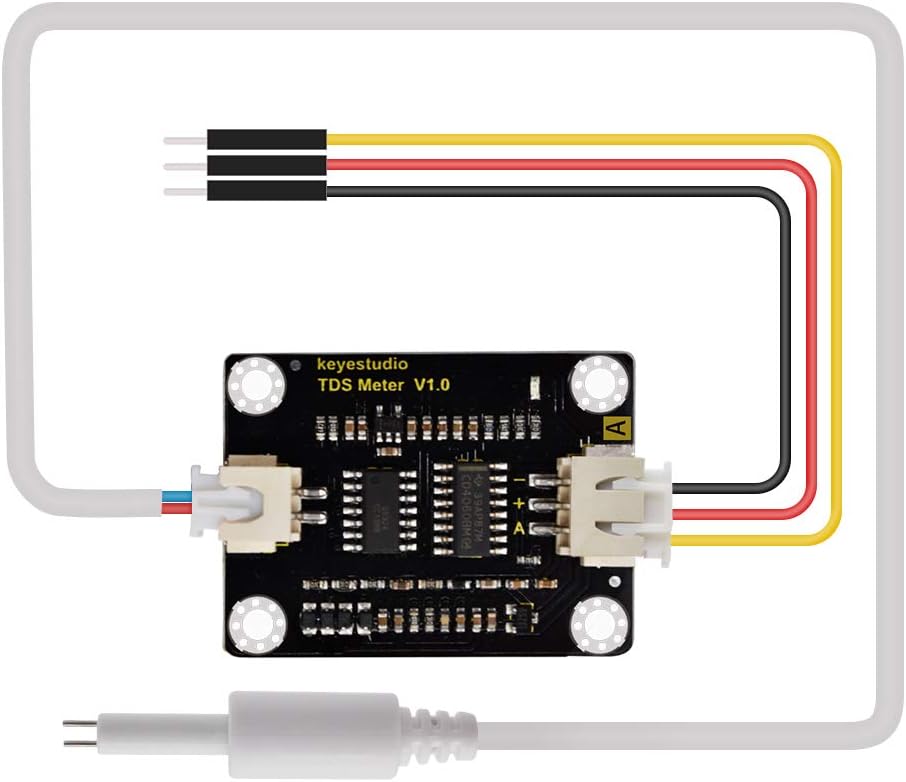
The KEYESTUDIO TDS Meter Probe is a plug-and-play sensor module designed for Arduino users to measure Total Dissolved Solids (TDS) in water, indicating water purity. It supports a wide input voltage (3.3~5.5V), outputs an analog signal (0~2.3V), and features a waterproof 60cm probe with XH2.54 connectors. Ideal for domestic water and hydroponics, it empowers professionals and hobbyists to monitor water quality with precision and ease.
| Best Sellers Rank | #1,259 in Single Board Computers (Computers & Accessories) |
| Customer Reviews | 4.2 out of 5 stars 126 Reviews |
D**R
Exactly what I needed
I bought this and the turbidity sensor to add to my K40 laser cutter setup. This thing turned out perfect. My issue is that it is cooled by water in a bucket in a place I can't see, so it makes it hard to tell if there's algae etc in the water. This sensor gives me instant readings. I just used the example code from the wiki and I was off to the races.
J**E
Works but requires a lot of tweaking
I bought two of these to measure the TDS of the water going into my reverse osmosis system and the levels coming out. This way I know when to change the filters without just blindly doing so every x number of months. The data is logged into Home Assistant and I get a push notification when I need to replace them now. I originally connected these sensors to the analog-to-digital (ADC) on an ESP32 microcontroller, testing it in both the Arduino IDE and ESPHome. The voltage was all over the place and produced garage readings. I ended up using instead an ADS1115 (16-Bit, 4 channel ADC) and connected it to the ESP32 via the I2C interface. This eliminated most of the problems of repeatability and I was finally getting consistent readings. HOWEVER, there was still a lot of variation in readings from one probe to the next. I had to individually calibrate each sensor to correct this. There's sample Arduino for this product online which contains a calibration formula--ignore it, it's completely useless. Instead, I made eight different concentrations of a calibration solution by mixing lab-grade deionized water and table salt. I then plotted the observed voltage at each concentration and came up a linear calibration curve using the least squares means method. (This sounds complex but is rather easy to setup using the "calibrate_linear" filter in ESPHome). I did this for each of the two senors, making a unique calibration profile for each. Everything now works and is reasonably accurate for my needs. I am somewhat concerned about long-term drift but will update this review with my experiences over time.
P**S
Good
good
C**R
Works great... for now (read review)
Leaving 5 stars for now, because it seems to be working, even if it isn't hugely accurate out-of-the-box. Plan on compensating and calibrating (still trying to figure out calibration). I'm using an ESP32 to handle this project, which is long-term "permanent" monitoring of TDS in my freshwater aquarium. Ignore the other review that complained about how much memory is required for compensation code, unless you are using an arduino, I guess. With the existence of ESP32, and the fact that you can program these identically to arduinos in the Arduino IDE, I don't know why you would buy an arduino instead of an ESP32, tbh. Other reviews state that the sensor only goes up to 1000ppm. This is observably false, mine went up to 2500ppm, at least (also unrelated... I need to change my aquarium water!). I didn't seem to hit a ceiling, although obviously there is one. It is possible that the other folks were using 3.3vdc instead of 5vdc, but newer ESP32 boards like mine (and pretty much any that have USB-C input/power) have both 5vdc from USB, and 3.3 via an onboard voltage regulator. I believe it is likely that using 5v is increasing the resolution and max observable PPM. My one concern with long-term use is electrolysis of the probe. It appears to be stainless steel, but I can clearly see the effects of electrolysis etching on the prongs. This could also be a design error in my code: I'm currently running 30 rapid tests and averaging them every second. After I complete the prototyping phase and actually solder everything to a board, I might turn the refresh down on that significantly, so it only runs a test once a second and averages over a longer period of time. Not sure yet how I want to approach that. Regardless, if I begin to see significant electrolysis etching, I will likely reduce this from 5 stars to 3 or even lower, as this would indicate a low-quality steel was used for the prongs.
E**.
Cumple su función
No es el mejor sensor para medir PPM, pero por el precio te saca de un apuro.
C**K
analog output, not a digital number stream
heck it works, but if you want accuracy with your projects the nature of a 0-2.6v analog value is a bit silly when measuring TDS via water conductivity, especially when compensation code fills more than 50% of your program area, would have been better if it was an SPI or similar serial stream that can be queried at a whim to get a fixed number of 0-1023(10 bit number that fits the 0-9999 TDS measurement range) they are cool and the amber power light isn't stupid like some green and blue LED's being run at the same current as red ones so you literally have to snap it off to not be blinded when you leave a setup running at night
G**P
cumple con lo que dice
El pcb pudiera ser mas pequeño
M**A
low life
works for 3 weeks+ - later you need a new one
Trustpilot
1 month ago
3 weeks ago