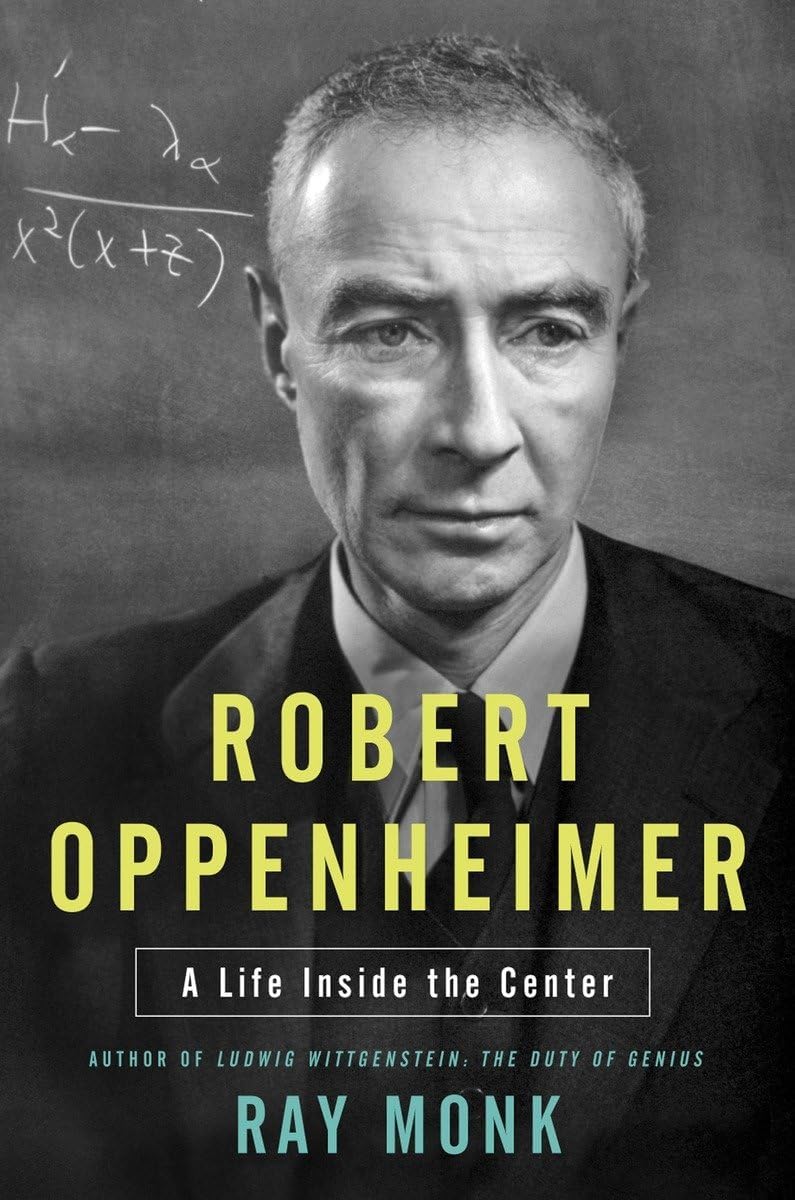
Robert Oppenheimer: His Life and Mind
Product ID: 31916399
🏆Top #77 in Nuclear Weapons History
📚695 pages of deep insight
🔬Detailed atomic physics context
Desertcart purchases this item on your behalf and handles shipping, customs, and support to Thailand.
📖 Unlock the mind behind the bomb — where genius meets controversy.
Robert Oppenheimer: His Life and Mind is a comprehensive, 695-page biography by Ray Monk that delves into the complex personality and legacy of the 'Father of the Atomic Bomb.' Combining rigorous scholarship with compelling storytelling, it explores Oppenheimer’s scientific achievements, political struggles, and moral dilemmas during one of history’s most pivotal eras. Highly rated and ranked among top nuclear history books, this used copy in good condition offers a rare window into the man who shaped the atomic age.
| Best Sellers Rank | #830,765 in Books ( See Top 100 in Books ) #77 in Nuclear Weapons & Warfare History (Books) #277 in Scientist Biographies #1,606 in United States Biographies |
| Customer Reviews | 4.5 out of 5 stars 354 Reviews |
D**N
Great writing about an enigmatic man
Ray Monk’s superb biography of Oppenheimer leaves him a puzzling figure with a lot of contradictions. The same man who tried to poison his advisor and strangle his friend becomes one of the most effective administrators of people in the history of American science. The man who made acerbic and arrogant comments to colleagues and young physicists at conferences was at the same time one of the most respected student advisors who went out of his way to publish papers with his students to help their careers. The man who loved the history, freedom and open spaces of America and who headed the most secret major project in American history became partly through his own fault one of the most reviled Americans in the early 1950’s. Biographers of other great 20th century physicists have been able to pinpoint certain consistent themes in their subjects’ lives. Farmelo’s great biography of Dirac shows the effect of his autistic tendencies throughout his brilliant life; Cassidy’s terrific biography of Heisenberg traces his love of German culture through his childhood leadership of youth groups and all the way through his decision to stay in Germany under the Nazis. But it is extremely hard to find a consistent thread for Oppenheimer. Monk claims it is his love of America that runs through his choices. This seems accurate in many cases. But, despite the paranoia and hatred of his enemies in the early 50’s, some of the questions raised about him do make one wonder how deep that love of America went. It seems that love of his friends, few as they were, challenged or overcame at times his love of country. But friendship was hardly sacred to him either. With his “cock and bull story” that got him into so much trouble, he seemed willing to throw at least one of his friends under the bus. Some of this behavior can be simply explained by fear and self-defense. But there appears to be, for want of a better word, a “disconnect” in several of Oppenheimer’s words and actions. Monk spells these out in detail and, in the first part of the book, cites some childhood experiences (and real traumas) that might well have shaped Oppenheimer’s future life. I am not sure there actually is one consistent thread that can be traced through Oppenheimer’s life except perhaps his love of physics. This book will get the reader to think – about the justification of the Manhattan Project, about the issue of identity in America, and above all about the motives behind Oppenheimer’s actions. It is exceptionally well-written. Monk does as fine a job as can be done of explaining the issues in atomic physics that Oppenheimer dealt with his whole life. If the book has any weakness, it is the limited amount of information about Oppenheimer’s family relationships which, if Monk is right, were not good, and which led to some tragic consequences. But this is a small criticism for a masterpiece of biographical writing. The book is large (695 pages of text) but never boring. I highly recommend this Oppenheimer biography both for clearly laying out the mystery that was Robert Oppenheimer and, to younger readers, the mystery that was the United States in the 1940’s and 50’s.
R**N
Magnificent biography
This was a wonderful biography, full of fascinating bits of information not only about Oppenheimer but just as much about the times he lived in. I've read quite a few books about that era, including another biography of Oppenheimer, and this one just stood out. I would distinguish this biography from typical ones in three ways: (1) There are long but fascinating digressions into other key people. The world of Manhattan in the 19th century is brilliantly limned, for example; Grove is discussed nicely; the milieu of Harvard is nicely drawn. (2) There is a considerable detail about Oppenheimer. The author seems to have completely mastered his subject. Yet the stories are all carefully sourced and seem persuasive. (3) The prose itself is elegant and well-written. I had two complaints about the book, however. First, I felt that the author took an unfairly supportive attitude towards Oppenheimer and an unfairly critical stance against his detractors in the matter of the security clearance. In hindsight, we know that Oppenheimer was blameless in the security leaks at the time, but given that he was certainly less than candid, to say the least, in the past; and given that the security leaks were of a distinctly dramatic nature, it is hardly unreasonable to expect security to err on the side of caution in the granting of a clearance. Although Monk lays out the facts for both sides, he is, perhaps understandably given his affection for such a brilliant and sympathetic man, somewhat uncharitable to those on the opposing side. Second, for some reason I did find the last 20% of the book, after the security hearings, not that interesting, and I sort of skimmed over a lot of it. Be that as it may, I really enjoyed this book, certainly one of the best few biographies I have ever read. My Kindle copy is full of notes and highlighting of interesting facts (I loved the way Oppenheimer didn't go back East at one point partly because he missed the great California wines!). I am a bit unclear, however, how any future authors who do a biography of anyone at all can meet the incredible standard of deep and broad research that Monk brought to this project.
A**R
A fine biography of a brilliant and complex man
When news came of this new biography of Robert Oppenheimer, Oppenheimer fans like myself were naturally inclined to ask, "What's new"? In the past decade or so there have been several portraits and biographies of the father of the atomic bomb, with the culmination of these efforts being Kai Bird and Martin Sherwin's Pulitzer Prize-winning volume "American Prometheus". With so many around, do we need another biography? In this case the answer is a qualified yes. Monk who is the acclaimed biographer of Wittgenstein and Russell has produced a thoughtful and insightful portrait that covers a lot of the same ground as other books but also sheds much clearer insights into Oppenheimer's character and a handful of key events from his life. The UK edition of the book is titled "Inside the Center", both as a reference to Oppenheimer's wish to be at the center of science and policy, as well as an allusion to his own lack of a unifying center. The book is very well-written and presents a judicious balance of detail and broader discussion. The writing is clear and crisp and delivers a solid, authoritative account of the subject matter. Monk's main goal is to illuminate the central dilemma of Oppenheimer's life; that of identity. His second goal is to pay attention to those aspects of Oppenheimer's science which have been glossed over by other biographers. Oppenheimer was a brilliant, complex individual who excelled at a variety of things, an astonishingly quick thinker and wide-ranging intellectual who was as much at home with Sanskrit and French literature as with theoretical physics. Yet he was a man who kept on searching for a core identity that would hold it all together. Monk looks for the root of this crisis in Oppenheimer's rejection of his German-Jewish background. Oppenheimer sought to distance himself from his father's identity as a wealthy, highly successful, self-made Jewish textile importer from New York City. It's not clear why he did this, but it's at least partly because of a self-hatred engendered by anti-Semitism in America. Later on he turned toward Hinduism, and the Bhagavad Gita in particular, as a sort of partial replacement for his Jewish faith. While the Bhagavad Gita is a book of great beauty and wisdom, it places too much emphasis on detachment and the labors themselves rather than on the fruits of those labors. Monk believes that it was partly Oppenheimer's fondness for this philosophy that prevented him from achieving things which men with lesser gifts achieved. A privileged and sheltered childhood combined with his extraordinary intelligence also left him with rather poorly developed social skills. Oppenheimer's ambiguous attitude toward achievement and his capacity for self-doubt was particularly visible during his time at Harvard University, a time which Monk is especially deft at describing. At Harvard Oppenheimer excelled academically, graduating in only three years, but made few friends. His letters from this period provide extremely valuable insights into his core qualities. In them Oppenheimer appears in turn erudite, pitiful, accomplished, insecure and pretentious. They showcase his great gifts as an actor who could project a larger-than-life image and who could mold himself to suit the task and please his audience. These qualities were responsible for both his later successes and downfall. From Harvard Oppenheimer went first to Cambridge where he initially floundered in experimental physics and evidenced serious psychological problems. It was only at the University of Gottingen where he flourished and came into his own as a physicist. These were great times for physics. Quantum mechanics was revolutionizing our understanding of the natural world and Cambridge and Gottingen were at the center of these developments. Monk describes Oppenheimer's early contributions to the applications of quantum theory and his friendship with many of its pioneers including Bohr, Born and Dirac. He quickly established himself as one of the most promising physicists of his generation. Other qualities which were to cause him problems later - his impatience, conceit and arrogance - emerged during his time in Europe. With his quick mind and somewhat underdeveloped social skills Oppenheimer could hurt people as well as intrigue them. But Europe was clearly where he became a confident young scientist out to transform the teaching and practice of physics. Oppenheimer returned to America with a mandate to establish an American school of theoretical physics that was second to none, and by any measure he succeeded. Over the next decade, at Berkeley and Caltech, he mesmerized a group of students who went on to make major contributions to American physics. During the first half of the decade Oppenheimer read widely but was consumed mainly by his science. Monk is very good at explaining some of Oppenheimer's key contributions during this period that have been neglected by other biographers, especially his research on quantum electrodynamics, cosmic rays and mesons. Ironically, his most lasting contribution to physics was the early description of what we call black holes, but somewhat characteristically he was indifferent to this accomplishment in his later years. Monk discusses why Oppenheimer never managed to do work of the highest caliber, and locates the reason partly in the diversity of his interests which kept him from focusing on one thing for too long, partly in his somewhat mysterious view of the frontiers of physics that kept him from confidently pushing ahead, and partly again in his interest in the Bhagavad Gita which emphasizes detachment and a studied indifference to the fruits of one's labors. During the latter half of the 1930s Oppenheimer also became interested in left-wing organizations and activities. This was a common political reaction during those times when fascism seemed to be taking over the world. Oppenheimer's interest was also engendered by a tumultuous relationship with a left-wing medical student named Jean Tatlock. But Monk also makes it evident that while contributing to a variety of left-wing causes, Oppenheimer's heart was never really in it. While Monk has a sure understanding of Oppenheimer's life during this period, I thought that Bird and Sherwin's book provides a more detailed description of his political activities. Monk's account of Oppenheimer's time as director of Los Alamos as well as the technical and political challenges connected with the bomb is quite readable, although this material has been covered to death in other sources, most notably in Richard Rhodes's seminal book "The Making of the Atomic Bomb". It was astonishing how quickly Oppenheimer transformed himself from being a rarefied intellectual who had not even led a university department to one of the best directors of a vast scientific and engineering enterprise that anyone had ever seen. Even those who later became his detractors acknowledged his indispensable role in the success of the Manhattan Project. His quick grasp of every issue - from social concerns to the most hands-on engineering problems - and his charm and persuasive powers were on full display here. The one thing that stands out from Monk's narrative is a concise account of Oppenheimer's fateful security problems, the clearest that I have found in any source. The basic story is now clear: Oppenheimer was approached by his friend Haakon Chevalier on behalf of a communist with a proposal to ferry atomic information to the Soviet Union. Oppenheimer refused right away, but did not report this approach to security officials. While this may have been justified (since no information had been communicated), Oppenheimer then made up a story in which Chevalier had approached three individuals and not one. He further declined to give the army Chevalier's name until much later and confused them even more by telling at least one person that the person approached had been his brother Frank. His evasion and equivocation engendered a deep sense of suspicion in the military establishment. The account makes it clear that while Oppenheimer was a remarkably quick study, he was also incredibly naive and completely underestimated how seriously the security officials would take his story and to what lengths they would go to investigate its perceived implications. In an effort to ingratiate himself to the military establishment, he dug himself deeper, and this behavior would haunt him for the rest of his life. The story also sheds light on an ugly part of Oppenheimer's personality, his willingness to implicate his former students and colleagues to save himself. After the war Oppenheimer was the most famous scientist in the world, a highly sought after government consultant and policy advisor. He stopped doing active work in physics, but still served as an outstanding critic and synthesizer of facts. He was always in touch with the latest research, and as a series of important post-war physics conferences demonstrated, was still considered the leader of the theoretical physics community in America who others looked up to as an incisive and wise teacher. This was especially evident in his selection as director of the prestigious Institute for Advanced Study in Princeton. However Oppenheimer got seduced by power. The same charm and persuasion that made him such an effective leader at Berkeley and Los Alamos also made him powerful enemies in the military and the government, most notably Edward Teller and Lewis Strauss. His opposition to the hydrogen bomb, which was ambiguous in any case, was construed by his enemies as evidence of disloyalty or a lapse of judgement at the very least; it did not matter that many other prominent scientists opposed the hydrogen bomb on sound principles, and it also did not matter that Oppenheimer was a proponent of tactical nuclear weapons. On one hand his enemies were simply jealous since they did not have the kind of influence that he had, but they were certainly helped by his arrogance and lack of diplomacy and compromise, not to mention the inconsistencies in the story he had told security officials at Los Alamos. Oppenheimer also refused to see what direction the winds were blowing and was too enamored of his position in Washington to consider retiring from policy matters, leading Einstein to wisely point out that "Oppenheimer's problem is that he loves a woman who does not love him; the United States Government". Ultimately what Oppenheimer's adversaries did was inexcusable, but he made it easier for them. Monk crafts a careful and clear narrative of world events and Oppenheimer's own actions that led to his shameful security hearing in 1954. The trial was rigged against Oppenheimer from the start and the decision to oust him from power had already been made; it turned out to be the kind of show trial prevalent in the same Soviet Union which its architects so ostensibly detested. Many aspects of the hearing were blatantly unconstitutional, from illegal wiretaps on Oppenheimer's phone to the withholding of key relevant documents used in court from him and his attorney under the guise of national security. It is painful to read through the proceedings, and the whole episode will always be a blot on the political history of this country. The most perverse irony in all this is that time after time, ever since his days as a student in Europe, through both words and actions, Oppenheimer had displayed genuine love and admiration for his country and had proven his allegiance to America. In the end it's best to remember Edward Murrow's statement that "disagreement should never be equated with disloyalty". After his hearing Oppenheimer's political influence effectively ended. However he still continued to be the director of the Institute for Advanced study until 1967, a position that gave him access to some of the world's greatest thinkers. In this capacity he brought together leading intellectuals from both the natural and the social sciences. He also remained a highly sought after speaker and writer, regarded as an authoritative voice on the relationship between science and society. His mastery of the English language is especially evident in his transcribed speeches. In the 1960s, as a gesture of political rehabilitation he was awarded the Atomic Energy Commission's Enrico Fermi award, and he also lived long enough to see Teller and Strauss being shamed and ostracized by the scientific and political communities. Oppenheimer died of throat cancer in 1967, still a famous man, but still striving to be at the center of things. In summary then, Monk has written a fine biography of this complex, brilliant and flawed man, one of the most important individuals of the twentieth century. For those not familiar with Oppenheimer, it's as good a starting point as any other. For the rest, it's still a valuable resource that very clearly illuminates key aspects of Oppenheimer's life and times, some better than in any other biography.
P**Y
Covers the academic side very well
Monk's biography covers all that Bird and and Sherwin left out: the development and course of Oppenheimer's academic life. Monk followed Rabi's suggestion that Oppenheimer had a vacuum because he ignored his Jewishness, which is interesting as well but the coverage of academic development is first rate. The book is a history of the development of physics 1920-50 and of American nuclear science policy in the early 1950s. Monk covers very well the story of how Truman and Eisenhower rejected the proposal to try to reach a nuclear policy agreement with the USSR, and instead went ahead full steam with the USAF's drive to get the H-bomb. I.e., how we ended up in the situation where Dr. Strangelove's policy won. I have a small correction to add. On pg. 410 Monk follows the standard line that Heisenberg did not know how to calculate critical radii. This claim was laid to rest in my American Journal of Physics paper AJP 92, 765-74, 2024. Heisenberg foreshadowed Serber's Los Alamos Primer by formulating the critical radius problem and calculating radii for reactors in 1939. Under captivity at Farm Hall in 1945 he recalled his 1939 work from memory and independently reproduced Serber's 1943 calculation for a bomb. He only knew the fast fission cross sections between two limits. Serber's cross section was midway between the two. It is ludicrous to continue to repeat Goudsmit's misconception that Heisenberg did not understand the difference between a reactor and a bomb. Mathematically, there is no difference in the basic formula for the critical radius, the difference is in the cross sections and neutron production per fission that enter the formula. Otherwise Monk's book is extremely interesting and well worth reading. After reading Bird and Sherwin, in contrast, I had trouble recalling what I'd read chapter by chapter.
A**R
A brilliant treatment of a brilliant and very complex man
Ray Monk is a great biographer whose passion for his subjects is manifest in his books. At the same time he is clear-eyed about their failings. Add to this, in the case of Oppenheimer, that Monk, himself a philosopher, is able to explain the physics behind the bomb, and the particle physics that O and his mostly Nobel-level colleagues were struggling with in the 30s and beyond, in terms that a layperson can (mostly) understand. The book is several books really. It's about how O was shaped by his wealthy New York Jewish origins and the "Ethical Culture" movement, for good and ill. It's about O the theoretical physicist -- a contributor at the highest levels but not, like Bohr or Feynman, a groundbreaking genius. It's about the Manhattan Project and especially O's prodigious talents as a project manager, which "came out of nowhere," as it were. It's about where the great scientists behind the bomb stood generally on the morality of its use and of the use of the "Super" -- the H-bomb. And of course it's about the public humiliation of O during the McCarthy era and his later public rehabilitation. It is with respect to his political activities and his own testimony to the government that O is revealed to be deeply flawed. One gets the sense that his moral failings in this context weighed upon him in later years more heavily than did his role in making Hiroshima and Nagasaki possible. It's not a criticism of the book, but after reading it, I searched for and watched an Edward R. Morrow interview of O when he was director of the Institute of Advanced Studies at Princeton, which interview is readily available on-line. I have to say that I found him to be in manner smarmy, effete and elusive -- not, on the face of it, someone readily to be trusted. But in most quarters, and among his colleagues, he inspired reverence.
A**H
A serious look
It can be argued that after Einstein, Robert Oppenheimer was the most important physicist in twentieth century America. While many very good biographies of Oppenheimer have been written, What separates 'A life inside the Center' from others is this- Ray Monk looks at Oppenheimer as a Physicist. Science is at the core of this book- as it was at the core of Oppenheimer's life. The emphasis on science makes the biography ring more true as a picture of the public and private man. Not that Monk dodges the controversies that surrounded Oppenheimer's life. He is frank about Oppenheimer's political associations, his lack of candor with the US government on many occasions, and, his willingness to sometimes sacrifice others on the alter of his fame. Nonetheless, the biography is balanced. Monk also looks at Oppenheimer's brilliance as a scientist, his determination to make American Physics relevant and his service as the Director of the Atomic Bomb project. Monk marvels at how this life long introvert became a manger, a confessor and a motivator to a group of disparate scientists from all over the world. He rose to the task, Monk contends, because he deeply wanted the United States, not Germany, to have access to the super weapon that could win the war. Another interesting attitude that Monk adapts is a lack of pity for Oppenheimer after his security clearance was pulled in 1953.Many other biographers have treated this as a seminal tragedy in Oppenheimer's existence. While Monk deals with the public fallout, he contends that Oppenheimer still had important academic work to do after losing his clearance, and that his life was not over. Having read several other biographies of Robert Oppenheimer, it is easy to say that this is the one to be read if a reader is only going to read one.
R**S
Thoroughly enjoyable ( but don't expect an easy guide to the physics )
I am only half way through ( I tend to read in bed till I fall asleep, often breaking my specs in the process ) having started this weighty ( and it is ) tome about 10 days ago. To be honest, it is sometimes hard-going for a non-physicist. I mostly expected this to be the case but I also somehow hoped that somehow the physics ( very hard stuff ) would be explained in a way that a layman might have a hope of understanding. I realize that would be a big ask, but I kind of entertained it as a possibility because I thoroughly enjoyed Ray Monk's bio of Wittgenstein and I don't have any philosophy training either ( but then maybe philosophy is inherently easier than physics ). All the above said, I am still getting a lot of enjoyment out of this very dense read - by all means buy it - but don't expect a comprehensible beginners' guide to sub atomic physics ! Or any physics....... The bitching and spying and communist antics and academic rivalry and so on are of course thoroughly entertaining.
J**.
Great book. However, edition I purchased is flawed.
I am repeating a comment by another reviewer. My edition ISBN 978-0-385-72204-9, is missing page 61. Page 81 is in the book twice, where it belongs and on page 61. I got another copy of the book from local library hoping to get a copy of page 61 to insert in my book. Same edition and problem. I also looked online... no luck. If the book was not so excellent, what does one page out of nearly 700 matter? However, it is excellent, so I am intrigued by what I am missing on page 61. The last words on page 60, "...no such thing as..." Sound like a lead for an important clue. About the other 699 pages: I have read multiple accounts about Manhattan project including Pharr-Davis' 1969 biography, 'Lawrence and Oppenheimer'. I have also read Grove's autobiography. Monk's book is a valuable addition. I appreciate Monk's balanced view of the complex relationship between Groves and Oppenheimer. Other accounts make it an either-or choice. Both men were complex. Both men were essential to the project.
D**E
Informative read.
This book had a great combination of personal, political and scientific content. It really gives one a sense of the times and how events shape and are shaped by people like Oppenheimer. Gained an understandable explanation of the physics of nuclear energy and current day issues around centrifuges and such technology. The book, by extension, gives insight to the role of government sponsored fear -- back then the Soviets, workers' parties, red scare, the Cold War, SAC, duck-and-cover for us kids, and all the stories that go with it, including files on Oppenheimer and friends. Not that things have changed -- just the items used for the fear factor.
M**I
mancano delle pagine per un errore di stampa (la 31 è la 81 ripetuta)
mancano delle pagine per un errore di stampa (la 31 è la 81 ripetuta)
S**S
SIMPLY FANTASTIC
THE BEST BIO of Oppenheimer. 10 Year work. Just an extraordinary book!
J**L
A must read for all physicists
A must read for all those who are interested in the life of Oppenheimer. The author have narrated the biography in an unbiased way. Also the book narrates a good account of the conditions prevailing for the development of atom bomb. The scientific inventions associated with nuclear physics is well narrated. In brief a good buy..
T**E
A great work of literature, centred around the life of a great man…
As great a biography as I have ever read – in fact, one of the greatest works of literature I have ever read – this is certainly as good as the other ‘rave’ reviews state. Utterly well-researched; the science does not get in the way (it is applied lightly, with a deft touch, just at the right moment; and in clear, precise language – just as with all the other research); and the writing is fluent and insightful. I picked this up after being awestruck by the RSC’s breathtaking new play ‘Oppenheimer’: wanting to know more about the “father of the atom bomb” – and I was not disappointed. It does the great man justice, without attempting to hide the fact that, as well as being a great scientist, and a greater organizer and inspirer of men, he was a human being – with all the pride and flaws that comes with that. Hard to put down (apart from the fact it’s a hefty thing: even in paperback) – and almost certainly of fundamental importance in vividly documenting an immensely important period of historical, military and scientific development.
Trustpilot
2 months ago
5 days ago