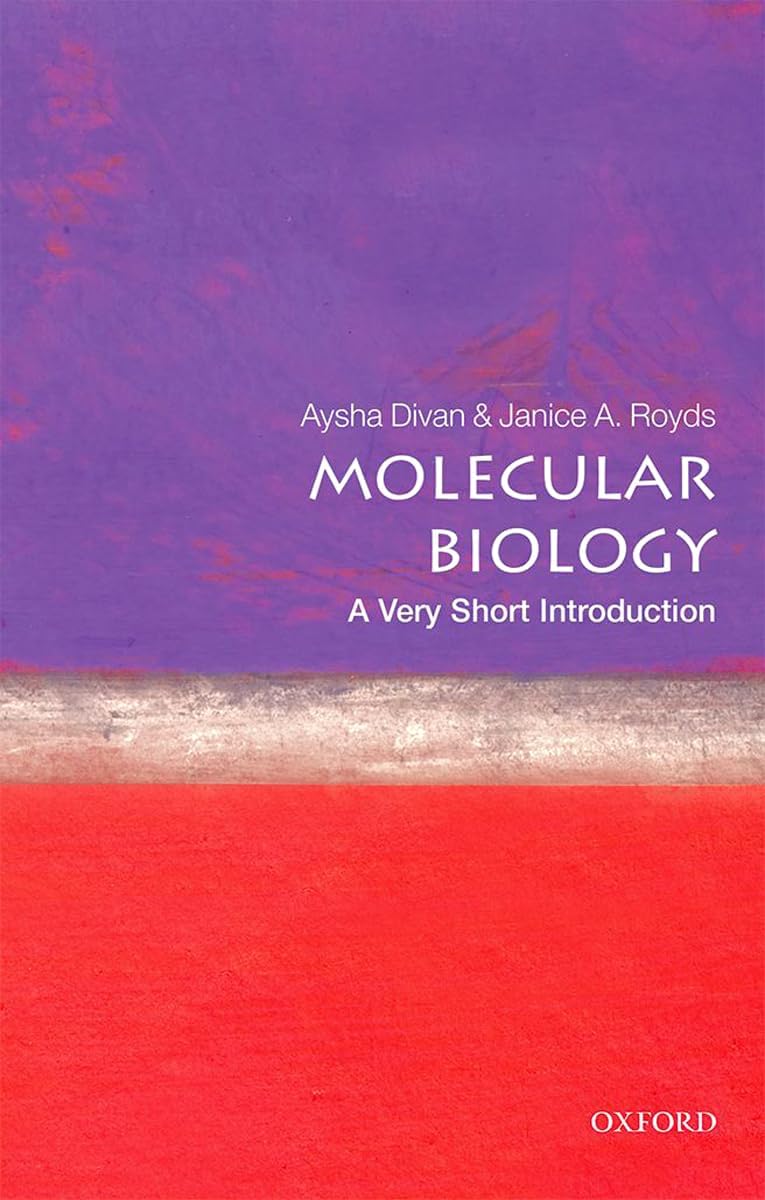
Molecular Biology: A Very Short Introduction
Product ID: 34368484
Desertcart purchases this item on your behalf and handles shipping, customs, and support to Thailand.
desertcart.com: Molecular Biology: A Very Short Introduction: 9780198723882: Divan, Aysha, Royds, Janice: Books Review: Five Stars - Good book, thanks. Review: Four Stars - Very interesting!

| ASIN | 0198723881 |
| Best Sellers Rank | #166,534 in Books ( See Top 100 in Books ) #26 in Molecular Biology (Books) #31 in Biology (Books) #49 in Biochemistry (Books) |
| Customer Reviews | 4.2 4.2 out of 5 stars (88) |
| Dimensions | 0.4 x 4.2 x 6.7 inches |
| ISBN-10 | 9780198723882 |
| ISBN-13 | 978-0198723882 |
| Item Weight | 2.31 pounds |
| Language | English |
| Part of series | Very Short Introductions |
| Print length | 176 pages |
| Publication date | November 1, 2016 |
| Publisher | Oxford University Press |
D**O
Five Stars
Good book, thanks.
M**K
Four Stars
Very interesting!
C**D
Not Good
This is not a very good book. When I started to read these Very Short Introduction books I found them terrrific. Lately I’ve been finding them rather poor. Not sure yet if it is just a coincidence, or if the level of these brief books has been getting gradually much worse than it used to be. They have released a huge number of them. Perhaps this is the reason for the poor editing. The English in this one about molecular biology is truy horrible. Almost the whole book is written in the passive voice, even if in most cases it would not have been necessary at all. Some chapters are relatively fine. Some others are so full of unexplained biology jargon that become basically unreadable. It is as if perhaps one of the authors (the not-so-bad one) wrote some chapters and the other one wrote the others. Leaving aside the annoying jargon-infested and passive voice infested language, the main issue is that it is hard to imagine what readers exactly the authors had in mind. Since there are so many unexplained terms and concepts used throughout the book, this little book seems to assume readers with a solid knowledge of organic chemistry and citology, at the very least.
Y**R
ENLIGHTENING, BUT NEGLECTS DANGERS
Readers with enough background knowledge for understanding the text will benefit a lot from this concise, up-to-date and well-written survey of contemporary molecular biology with some outlook into expected progress. The subject which struck me most is epigenetics, which deals with the possible inheritance of acquired characteristics, often caused by environmental factors (pp.68 ff.). Defined as “a stable heritable phenotype resulting from changes in a chromosome without alterations in the DNA sequence” (p. 66), epigenetic traits can be caused by factors such as diet. Also, possible is “transmitting some fears between the generations in humans (p. 69). The book, rightly so, does not go into broader implications of epigenetics. But, if proven correct, such effects inject into the theory of evolution some elements of Lamarckian inheritance of acquired characteristics, speeding up select evolutionary processes. Given emerging radical changes in human environments the implications of epigenetic inheritance, if indeed operating on a significant scale, may be profound. But these are speculations beyond the domain of this short introduction. The situation is different in respect to genetic engineering and synthetic biology as a whole, which are rapidly progressing and deserve an Oxford Very Short Introduction of their own. The authors devote to them a few pages which meet requirements – with one grave omission: Synthetic biology, genetic engineering and related emerging technologies are easily misused for deliberate mass-killings by fanatics. Thus, taking into account that throughout human history there is no killing tool which has not been used, it is very likely that the dangerous potentials of synthesized viruses will be realized and result in mass-killings, unless harsh countermeasures are adopted. This danger is well recognized in the literature on global catastrophic risks and terrorism. But this book devotes to the very serious risks posed by likely misuses of molecular biology only two by-the-way words “deliberate misuse” (p. 133), while the potential medical and other benefits are discussed at relative length. The result is a biased presentation instead of a balanced assessment of benefits and dangers. I regard this as a serious weakness justifying three stars as the maximum deserved by this book. Professor Yehezkel Dror The Hebrew University of Jerusalem
G**S
I’ve liked other books in this series
I’ve liked other books in this series, but this particular one is not well written. They often use terms that were never defined, leaving the reader to guess at their meaning. The diagrams are not helpful. At least one of the authors needs to use more commas. I know this sounds odd, but there were so many sentences that I had to re-read to figure out where to put a comma to make sense out of the sentence.
L**O
Useful introductory book to proteomics, genomics and genetic engineering study.
M**E
A very helpful short introduction to this mammoth subject that well informs and inspires further reading. Bravo and well done
K**D
C
A**R
You should have a solid cell biology and genetic inheritance background to fully understand what this book is covering.
M**S
Detailed and up to date with clear diagrams, it could have included carbohydrates, lipids and steroids for a more comprehensive picture. The biological properties of water would also be useful.
Trustpilot
3 days ago
5 days ago