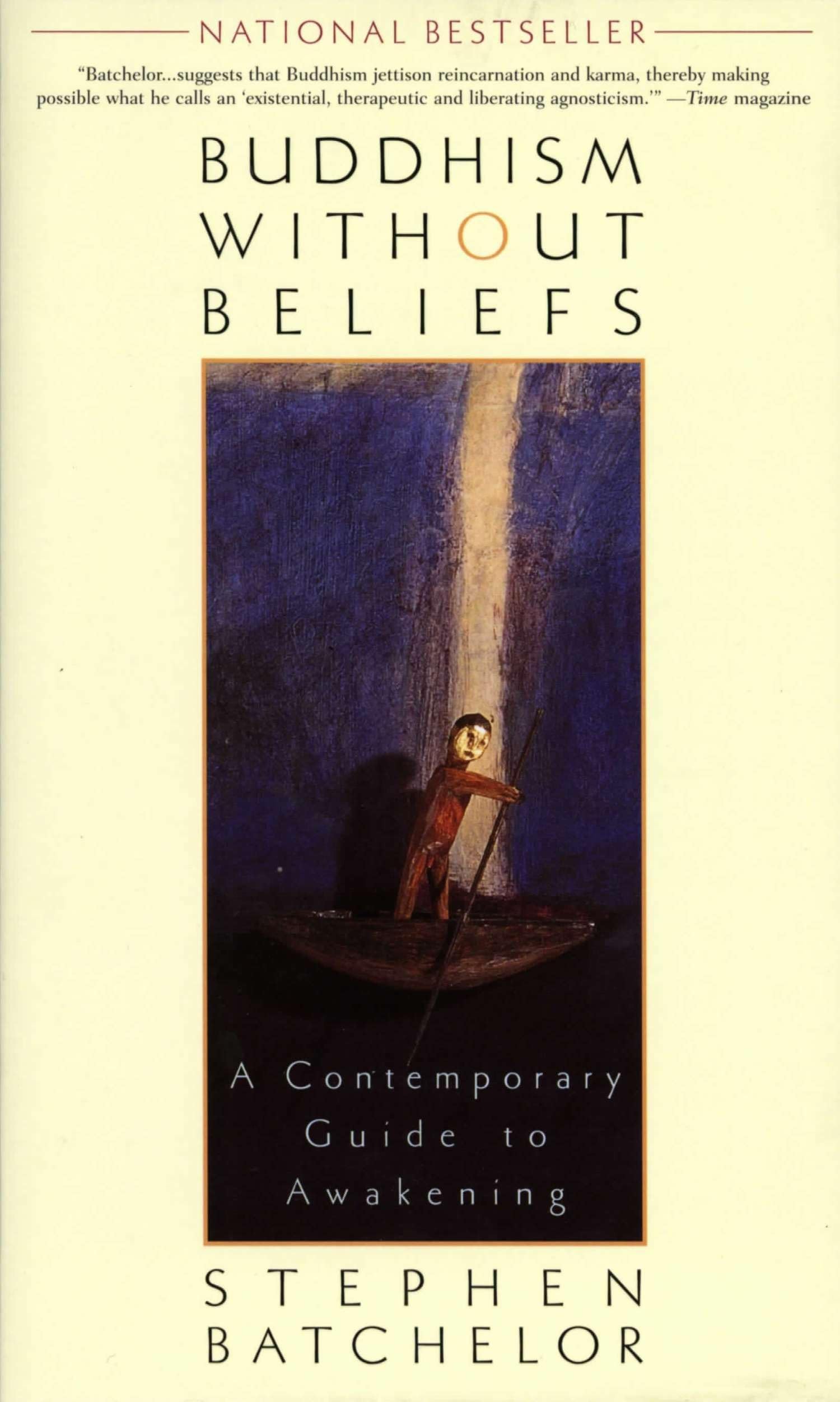
Buddhism Without Beliefs: A Contemporary Guide to Awakening
Product ID: 3717346
Buy anything from 5,000+ international stores. One checkout price. No surprise fees. Join 2M+ shoppers on Desertcart.
Desertcart purchases this item on your behalf and handles shipping, customs, and support to Thailand.
A national bestseller and acclaimed guide to Buddhism for beginners and practitioners alike In this simple but important volume, Stephen Batchelor reminds us that the Buddha was not a mystic who claimed privileged, esoteric knowledge of the universe, but a man who challenged us to understand the nature of anguish, let go of its origins, and bring into being a way of life that is available to us all. The concepts and practices of Buddhism, says Batchelor, are not something to believe in but something to do —and as he explains clearly and compellingly, it is a practice that we can engage in, regardless of our background or beliefs, as we live every day on the path to spiritual enlightenment. Review: No faith necessary - Clear, insightful, and well written. A must read for any rational human in search of a comprehensive set of values that does not depend on a leap of faith. Review: A vision of freedom from the shackles of organized religion and toward self - Absolutely loved this book. Strips away the superstition, smoke and mirrors, the lies of organized religion, its overt hostility to self and indivualization and enforced conformity to mass belief, manipulation and totalitarianism and reveals both the simplicity of the Buddha's revelation, its availability to everyone, his humanity (and lack of divinity). Buddha is not a god, nor is there any god. The universe and the self at macro and micro levels are far more complex and fascinating than the limited mind numbing concept of god and kingship or even ideology allow. Buddha and his teachings are an example to reflect upon and to serve as an inspiration of growth of self, but not to worship or pray to. Meditation and the practice of Dharma (not an "-ism", not a belief) is focused inward on self-growth and betterment which projects to a better life, here and now for all, along with an acceptance of what is and that emptiness provides a fertile foundation for clarity. Prayer, by contrast, is focused outward, a submission to powerlessness of self and a surrender to the forces of a conceptual supernatural entity envisioned before science, before medicine in a violent uneducated society. Where human progress in science expands, the Dharma and Buddha's teaching will likewise grows and maintain relevance while religion remains stuck in a distant past shackled by dogma and manipulation by others. Dharma thrives in self not indoctrination or intellectual bondage. Bravo, as others have stated in reviews, this is truly the book I have been waiting my whole life to read.
| Best Sellers Rank | #61,191 in Books ( See Top 100 in Books ) #116 in Philosophy Movements (Books) #136 in Buddhism (Books) |
| Customer Reviews | 4.4 out of 5 stars 1,453 Reviews |
D**N
No faith necessary
Clear, insightful, and well written. A must read for any rational human in search of a comprehensive set of values that does not depend on a leap of faith.
S**N
A vision of freedom from the shackles of organized religion and toward self
Absolutely loved this book. Strips away the superstition, smoke and mirrors, the lies of organized religion, its overt hostility to self and indivualization and enforced conformity to mass belief, manipulation and totalitarianism and reveals both the simplicity of the Buddha's revelation, its availability to everyone, his humanity (and lack of divinity). Buddha is not a god, nor is there any god. The universe and the self at macro and micro levels are far more complex and fascinating than the limited mind numbing concept of god and kingship or even ideology allow. Buddha and his teachings are an example to reflect upon and to serve as an inspiration of growth of self, but not to worship or pray to. Meditation and the practice of Dharma (not an "-ism", not a belief) is focused inward on self-growth and betterment which projects to a better life, here and now for all, along with an acceptance of what is and that emptiness provides a fertile foundation for clarity. Prayer, by contrast, is focused outward, a submission to powerlessness of self and a surrender to the forces of a conceptual supernatural entity envisioned before science, before medicine in a violent uneducated society. Where human progress in science expands, the Dharma and Buddha's teaching will likewise grows and maintain relevance while religion remains stuck in a distant past shackled by dogma and manipulation by others. Dharma thrives in self not indoctrination or intellectual bondage. Bravo, as others have stated in reviews, this is truly the book I have been waiting my whole life to read.
L**E
Stark and Convincing
Stephen Batchelor has studied in several different countries and Buddhist traditions, but he thinks there is a core of teaching that transcends both the religion and any dogma. "Buddhism Without Beliefs" outlines a spare but elegant way of life and looking at the world that invites humans of every kind into the fold. When Batchelor talks about being “without beliefs,” what he means is separating vital teaching from formal orthodoxy. In the case of Buddhism, he goes so far as to suggest that the notions of rebirth and karma (the idea that our actions influence the course of future lives) may do more harm than good, and that they should be left behind as relics of another time and culture. In place of such creeds, Batchelor focuses on what has always been the heart of Buddhist instruction: the four noble truths, or as he strikingly calls them, the four ennobling truths. These include the fact of our dis-ease with life—what has often been called “suffering” and what Batchelor refers to as “anguish”—followed by the fact of what causes anguish and the fact that there is a way to relieve anguish, and finally a path that allows us to realize and embody that relief. Batchelor also addresses emptiness, the teaching that all people and things are connected in an ultimate sense. "Buddhism Without Beliefs" reminds me of the book of James in the New Testament, in that it is intensely pragmatic, and unsparing in its view of our human faults. It is not, however, without hope; Batchelor is no more upset with his readers than is a doctor diagnosing an illness. Identifying the problem is simply the necessary first step to curing it. The key words in Batchelor’s vision of Buddhism are creativity and freedom. Through practice of the teachings of the Buddha, we seek to obtain freedom from anguish, which is to say, freedom from the wish that the world be other than the way it is. In this freedom, we find the ability to creatively reimagine our lives and produce novel expressions of compassion, among others. This book is short and stark; hardly a sentence in it is without import. (Notwithstanding some of Batchelor’s early fulminating against religious institutions, which goes on just a bit too long.) Many of Batchelor’s insights are startling. He is not proposing something new, but artfully clarifying something very old. Although this book contains a few basic meditation exercises, it is not a book about meditation. And although it makes reference to the life and teachings of a figure called the Buddha, it is, oddly, not a book about Buddhism. It a book about a profoundly human problem, and a solution to that problem that can be embraced by anyone, regardless of age or nationality or faith. To achieve true understanding, of course, would entail leaving behind the need for this book, as one would leave behind a raft after crossing a river. But as long as we find ourselves on the river—which most of us do, most of the time—we need rafts; as long as we are adrift we need guides; and Batchelor is an exemplary one. ~
D**Z
A Response to the Critics
I am so fascinated by the negative reviews of this book. One camp says there was too much Buddhism in it, which is an absurd objection, considering the title. If you didn't want to read a book that had *anything* to do with Buddhism, then this was a poor reading selection and your review shouldn't reflect your stupidity. The other negative camp says Batchelor irreverently strips the substance out of Buddhism, leaving us with his own watered-down version of a spiritual tradition. And while I disagree with this assertion as well, it is at least something logical enough to work with. Prior to reading this book, I always instinctively self-identified as an agnostic, with perhaps a curious interest in Buddhism. I am a psychologist by trade, and therefore a kind of scientist, and I prefer to interact with my environment from the perspective of using the scientific method to filter out things that are not true and clarify things that are slightly less true. I will spare you any unnecessary details about my personal journey from a theistic religion to a kind of nontheistic, optimistic, humanist, agnosticism. I will, however, point out the work of Dr. James Fowler, a kind of hybrid psychologist-theologian, who wrote extensively during his career about the stages of faith, the faith-identity triad, as it parallels to the stages of human development. This is relevant to this book because he outlines six stages of the way a person interacts with faith, and faith here is not necessarily meaning "a religion" or faith in unproven things, but rather the sort of cohesive structure with which each and every person uniquely views the universe and its meaning. Bear with me, this is relevant. As a person progresses along their life, they will evolve along certain relatively predictable stages of personal development. Of course these aren't ranks, or a kind of leveling system like in a video game. The person *has* to integrate certain things in order to move to different ways of integration and this can't be forced, or even taught, but it can be guided. Anyway, how a person interacts with their religious beliefs, or their "faith" in Fowler's sense, is directly related to this stage of personal development. Below is a brief list of the Stages of Faith, and they loosely correspond with age, however a 65 year old person could very easily be a Stage 3. *** The Stages of Faith: Stage 0 - "Primal or Undifferentiated" faith (birth to 2 years), is characterized by an early learning of the safety of their environment (i.e. warm, safe and secure vs. hurt, neglect and abuse). If consistent nurture is experienced, one will develop a sense of trust and safety about the universe and the divine. Conversely, negative experiences will cause one to develop distrust with the universe and the divine. Transition to the next stage begins with integration of thought and languages which facilitates the use of symbols in speech and play. Stage 1 - "Intuitive-Projective" faith (ages of three to seven), is characterized by the psyche's unprotected exposure to the Unconscious, and marked by a relative fluidity of thought patterns. Religion is learned mainly through experiences, stories, images, and the people that one comes in contact with. Stage 2 - "Mythic-Literal" faith (mostly in school children), stage two persons have a strong belief in the justice and reciprocity of the universe, and their deities are almost always anthropomorphic. During this time metaphors and symbolic language are often misunderstood and are taken literally. Stage 3 - "Synthetic-Conventional" faith (arising in adolescence; aged 12 to adulthood) characterized by conformity to religious authority and the development of a personal identity. Any conflicts with one's beliefs are ignored at this stage due to the fear of threat from inconsistencies. Stage 4 - "Individuative-Reflective" faith (usually mid-twenties to late thirties) a stage of angst and struggle. The individual takes personal responsibility for his or her beliefs and feelings. As one is able to reflect on one's own beliefs, there is an openness to a new complexity of faith, but this also increases the awareness of conflicts in one's belief. Stage 5 - "Conjunctive" faith (mid-life crisis) acknowledges paradox and transcendence relating reality behind the symbols of inherited systems. The individual resolves conflicts from previous stages by a complex understanding of a multidimensional, interdependent "truth" that cannot be explained by any particular statement. Stage 6 - "Universalizing" faith, or what some might call "enlightenment." The individual would treat any person with compassion as he or she views people as from a universal community, and should be treated with universal principles of love and justice. *** The reason why this is relevant to this book, and the negative reviews, is that people who find Batchelor to be a heretical Buddhist are roughly at a Stage 3 of personal development. We can all probably call to mind many such Stage 3 people of varying religions. Neither Gautama Buddha nor Batchelor can "force" anyone into their viewpoint (anymore than a psychologist can force someone into another stage of development), and when they read this work, they will most likely be offended, feeling the need to defend their faith-identity triad from a perceived threat. And this is a fairly normal response, to be honest. I'm not suggesting these people are "incorrect" either, but it's interesting to evaluate their defense of the organized religion of Buddhism in light of the understandings that Dr. Fowler contributed, and arguably, that Stephen Batchelor contributed with this work. In this sense I think that it is a wonderful thing that Buddhism has come to the United States, because we are many things, including being generally pragmatic and utilitarian. We are also influenced by the tradition of material realism and the scientific method, some more than others. This at times comes off to traditionalists as being irreverent or flippant, but it comes down to the burden of proof. What is the proof that reincarnation exists? Or that anyone's deity exists, including the deity of the major monotheistic faiths as well as the less acknowledged Buddhist deities... Kwan Yin, the Medicine Buddha, etc.? What is your evidence that karma is some intergalactic referee blowing the whistle and giving you a yellow card? Which is not to say that none of these things exist, but it is to say that we each have the responsibility to be present in our own lives, to be little objective scientists, questioning everything, and choosing to move beyond or remain ambiguous (until better evidence presents itself) about those things that are unproven or have been proven untrue. And this is what this book is about. Building yourself a light. Learning to question your existence with friendly curiosity, and not needing to be bound by the social control valves of religions.
A**O
Not as “beginner” friendly as you think
It’s a well written book, no doubt. But I don’t advise this one specifically if you’re looking for a beginner book. I went into it with a simple mindset and was left more confused.
S**T
Exactly as titled - a guide to the dharma practice without religious requirement
Clear, and beautifully written - lots of quotable passages that are illustrative of the essential point - the practice is the key Specific belief and/or tenets aren’t
D**E
Healthy and attitude changing
This book is a keeper to refer to for many years to come. I look forward to my second reading with as much enthusiasm as I did when I first bought it. This path can be more easily interpreted by western minds, without instilling any concerns about conflicts with other belief-based religions. In this way a Christian (or any other religion) reader can start to few other paths without challenging any of their "beliefs". Any work that brings different sects / faiths / belief structures to more common and positive ground is healthy and may facilitate contructive and peaceful change. There are many paths to enlightenment. This book illuminates one such path, that can also be followed by most believers of other faiths. Did Sittharra state something like - let each of you go out and serve, but let no two of you take the same path? As a Christian, I found the book to be outstanding, attitude changing, healthy and constructive reading. Another good book to help understand other viewpoints is "The World's Religions" by Huston Smith. March 2012 - This is a great book as well "What makes you not a Buddhist?" by Dzongsar Jamyang Khyentse Rampoche
S**S
Buddhism with out the mythology
I am very glad I found this book. I am a new Buddhist having recently come out of Christianity. The reason I left Christianity is because of the mythology and ignorance that pervades the churches. I was very happy to find in Buddhism more of a psychology free of the faith of the other religions. However the more books and Buddhist scripture I read I started seeing the same myth making about Buddha and the same orthodox establishment with a hierarchy saying to submit to authority and believe in reincarnation and karma also saw a lot of conditioned rituals like robes, sitting positions for meditation,and carry overs from Asian cultures that do not belong.This book dismisses the need for the institutions of Buddhism and the need to believe in the super natural myths of Buddhism to be a Buddhist.He believes in an agnostic Buddhism where we need not accept reincarnation and karma as doctrine. I thank this author for confirming my convictions of what true Buddhism is. I can continue on my pursuit of truth keeping Buddha's original teachings of the 4 noble truths and the 8fold path and others without wearing a robe and sitting in painful cross legged positions in a temple with a shaved head. Buddha taught how to free yourself from mental suffering by understanding the source of it as believing you are your ego and that circumstances are permanent.This author brings us back to what is necessary.
S**I
Simple, Honest and Eye opening...
Firstly the book is quite expensive, and to make it worse, it arrived damaged...Really disappointing... Anyway, let's head to the book review, which is the main part : Soo- I'm currently reading it and I had heard a lot bout this book befo- how it's super refreshing and a diff take on Buddhism- and honestly, that's what made meh want to pick it up!! And I'm glad I did!! Even tho I haven't completed it yet, I can already say it’s one of those books that really makes uh think without forcing anything on uh. It strips away the religious layers and presents Buddhism more as a philosophy for life- something that's practical and relatable even today! Stephen Batchelor writes in a way that's clear, honest, and very grounded. No heavy jargon, no feeling of being "preached to" just simple reflections that hits somewhere deep... I also checked out other reviews, and honestly, most people have said the same, that this book feels like a breath of fresh air, especially if you’re someone curious bout Buddhist ideas but not into the religious side of it. Overall, even thou my book came a little messed up (sighhhh), the content inside makes it totally worth it. I’m really enjoying the journey so far... Let's seeee what's ahead!
L**B
Succinct and inspirational
Would 100% recommend - this book is inspirational, insightful and very easy to digest. The author succinctly delivers an in-depth explanation on Buddhism from a secular point of view. I accidentally ordered two copies but will not be returning one - I will definitely be gifting it so others can benefit from the wisdom.
U**S
Not enough stars
Remarkable, very Insightful and inspiring book. Would give it 10 stars if I could
D**N
A wonderful book
This is a wonderful book that I could not put down. Brilliantly written and with millions of nuggets of wisdom
N**N
Le Bouddhisme pour nous tous
Apres des sejours en Birmanie, au Cambodge, au Vietnam et autres pays asiatiques, fascinee par le bouddhisme mais un peu (ou plutot beaucoup !) perdue entre les differnentes orientations de cette pensee ce livre m'a passionnee. Il est clair, concis et bien construit. Je le recommande a tous en particulier bien sur aux non croyants et a tous ceux qui veulent mieux comprendre sans se plonger dans d'enormes ouvrages specialises J'ai un regret: j'aurais aime l'offrir a des amis malheureusement je n'ai pas trouve de traduction francaise.
Trustpilot
2 weeks ago
2 weeks ago