Buy anything from 5,000+ international stores. One checkout price. No surprise fees. Join 2M+ shoppers on Desertcart.
Desertcart purchases this item on your behalf and handles shipping, customs, and support to Thailand.
⚙️ Drive Innovation Forward with DROK’s Dual Motor Powerhouse!
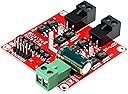
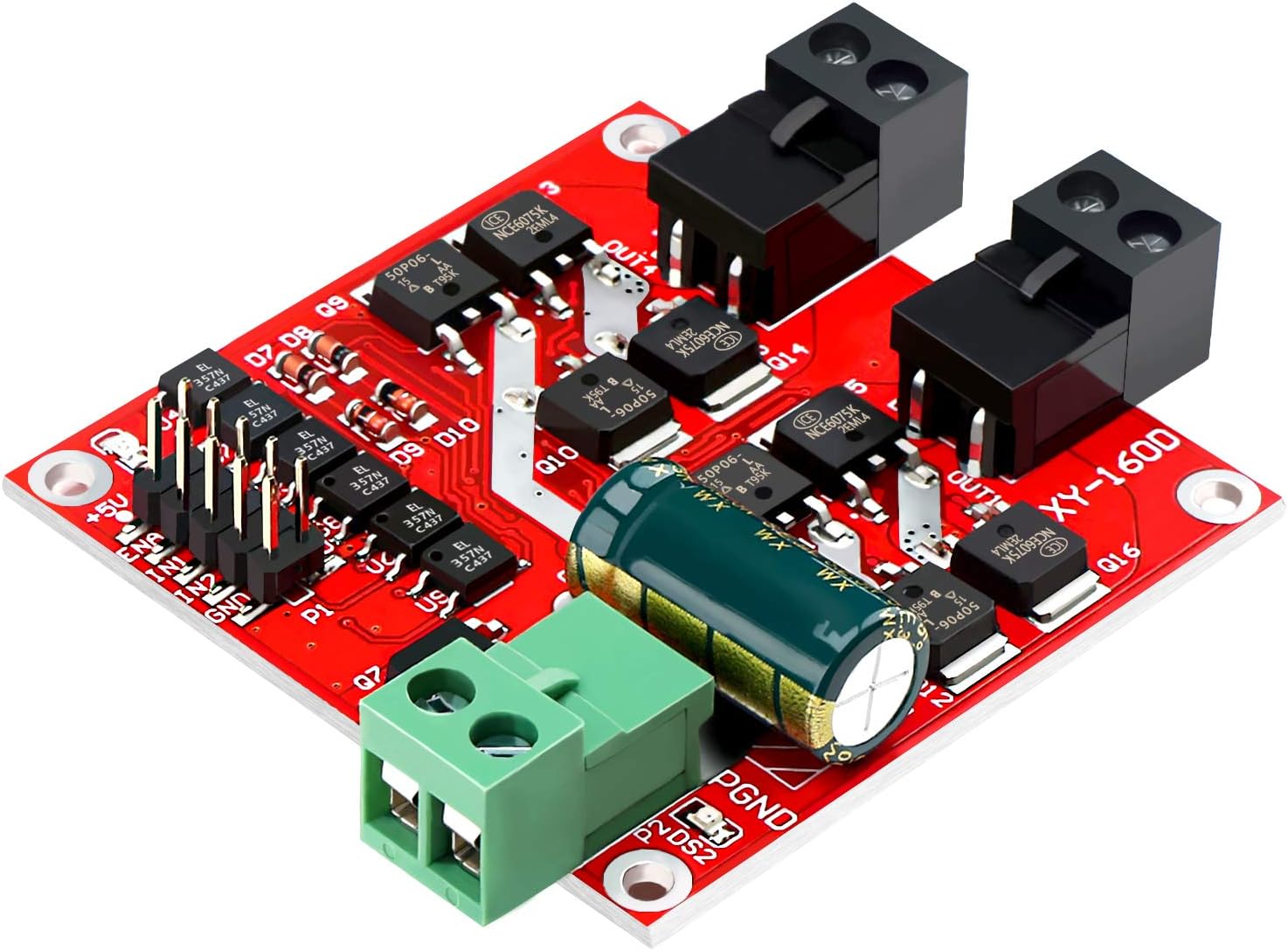
The DROK Motor Driver is a high-performance dual H-bridge motor controller designed for professional-grade DC motor management. Operating within a wide voltage range of 6.5V to 27V and delivering up to 7A per port with a total power output of 160W, it offers precise PWM speed control and reliable forward/reverse motor rotation. Its built-in under-voltage protection and durable connectors make it an essential tool for millennial professionals seeking dependable, efficient motor control solutions.


| ASIN | B06XGD5SCB |
| Best Sellers Rank | #67,319 in Industrial & Scientific ( See Top 100 in Industrial & Scientific ) #35 in Motor Speed Controllers |
| Brand | DROK |
| Brand Name | DROK |
| Color | Red |
| Customer Reviews | 4.4 out of 5 stars 192 Reviews |
| Manufacturer | DROK |
| Material | Metal |
| Material Type | Metal |
| Model | 200206_OZ |
| Part Number | 200206 |
| Smart Home Compatibility | Not Smart Home Compatible |
| UPC | 701822755689 |
| Unit Count | 1.0 Count |
G**N
Flawless performance. Highly recommended! Here's some help getting started
This unit is perfect for my application with a couple of 2-3 amp DC motors and worth far more than the cost. I require frequent direction changes and large starting current spikes, but the board stays cool and doesn't need heat sinks. The connectors have screw terminals and removable snap lock connectors which are excellent. The documentation looks great on glossy paper but needs some clarification. Here's a few tips and a Arduino test setup: 1) This double H-bridge can run two motors independently of each other. 2) Each motor can run forward, reverse, brake, full speed forward, and full speed reverse. 3) Categories of inputs (you provide these) to the board are: a) Main power (up to 15 amps) that is used to drive both motors. Read the instructions around voltages, current, peak current, fuses, etc... b) Control logic for Motor A c) Control logic for Motor B d) 5v power you provide into the board for it's logic processing, etc.. with very little current draw. 4) For the main power input, you need a capable power supply. I'm using a 10amp battery charger. 5) You must feed 5v into the board. The board has 5v (and ground) pins for each motor, but you only need to provide 5v and ground on one set of pins. 6) Each motor needs three 5v logic inputs. For motor #1 they are labeled IN1, IN2, and ENA1. 7) The two pins labeled IN1 and IN2 are fed from any two GPIO(Arduino) pins with HIGH or LOW to control the mode of the motor such as forward, reverse and brake. See the control logic table in the instructions. 8) The pin labeled ENA1 REQUIRES!!! a PWM output from Arudino. You MUST NOT apply a steady voltage from something like a potentiometer or DAC output. 9) Here's a basic test setup for Arduino UNO if you need it: Connect 5v and ground to H-bridge, Connect main power Connect motor(s), you just need motor A for this test Connect Ardunio pin2 -> H-bridge pin IN1 Connect Ardunio pin3 -> H-bridge pin ENA Connect Ardunio pin4 -> H-bridge pin IN2 Create a test sketch as follows: void setup() { pinMode(2, OUTPUT); pinMode(3, OUTPUT); pinMode(4, OUTPUT); } void loop() { digitalWrite(2, LOW); //forward digitalWrite(4, HIGH); //forward analogWrite(3, 178); //pin 3 is PWM, 178/255 = (about) 70% speed. Max is 255. delay(1500); digitalWrite(2, HIGH); //reverse digitalWrite(4, LOW); //reverse analogWrite(3, 76); //pin 3 is PWM, 76/255 = (about) 30% speed. Max is 255. delay(3000); } Hope this helps get you started.
S**C
Works as Advertised
Works great with my Arduino Uno. Powering a 12v wiper motor.
H**K
Does not work without PWM, but with it, it works fine.
I am completely re-writing my review on this thing. I am using a Raspberry Pi 3 to drive the board. Here are some points to consider when using this board: 1. I applied 5V and a ground from my PI3 to the boards control pins per the instructions. This activates the power light for the control pins and sets all the control pins to just under 5V or HIGH. At first, this was not clear but after I figured it out, I could then adjust my programming to work with it. 2. I can activate Motor 1, perfectly. I can activate motor 2 perfectly. I have a major issue of activating both at the same time. If I try this, the boards seems to get confused on which one it is driving. To test this problem, I set a 1000ms delay between starting the first and second motors. They both turned on and ran for the allotted time frame of 5000ms. It seems that board needs a delay between turning on the separate outputs. In addition, the more the resistance on the motors, the longer this delay needs to be. In other words, if I put the chassis on a stand, the delay needs to be about 500ms. If I put the chassis on the ground with the wheels touching the ground, it has to be well over 1000ms delay. My conclusion is that there is interference or confusion in the board when performing both tasks at the same time. I am going to try to power the controller with a Arduino Uno and see if this makes a difference. It could be that this board is not meant to work with a PI3. I will post my results here for future buyers to understand this product more as the instructions are not very useful at all and the companies website is horrible and does not even mention this product in anyway. Update: I was able to figure out the issue with this board. Using the Arduino, I wrote code first enable the motors at full speed. I had the same jumpy result as with the PI3. I then switch to PWM and it works perfectly. FINALLY. Apparently this board only can handle a slow increase in speed when handling more than one motor at the same time. Either way, product does not do what is says so I cam keeping with 2 stars.
J**O
Helped replace a $500 Motherboard!
So the motherboard for my Apollo 835 Dual Swing Gate finally kicked the bucket after 20 years. While a replacement motherboard for my gate model was available for purchase, they were charging 500 bucks for it (and I was pretty sure I could do it for 50 bucks or less) The actuators that came with the dual swing gate kit operated at 12 volts with a fuse on the board limiting them to 3 amps. This made this dual L298 motor driver perfect in my quest to replace the motherboard. This dual L298 configuration has a similar pinout to just a single L298 board, except there are two of them. It still requires 12 volts to run the motor and a separate 5 volt to power the L298. The 5-volt pins for the L298 are connected so you only need a single pair of power cables. After writing some code for an Arduino Nano to mimic the original motherboard operation and rewiring each Swing gate actuator to work with the Nano and this motor driver. I was able to successfully replace the motherboard with about 20 dollars worth of new parts. A 3 Amp fuse is placed in series between the motor and the motor driver to prevent the motors from being damaged or if an object interferes when the gate is opening or closing. The motors don't have too much torque behind them, and the gates aren't heavy to move. While its current installation isn't pretty lol, it does not rain a lot where I am, and it also sits inside a weather-resistant metal box. I haven't had any issues for the past 3 mo since I installed this. (other than updating the programming on the Nano to fix some kinks) 11/10 saved 470 bucks.
A**R
To Glen
To Glen, I don't do much with electronics but in the process of building a project it came to my attention a microcontroller was needed. My skills are in fabrication of wood and metal. If it's made of wood or made of metal I can build it. When it comes to arduino and writing code with understanding its been challenging. The code you provided gives me something to work with where it's so hard getting a straight answer out of people. Between work, home responsibilities, kids and grand kids I don't have tge luxury of time to learn all the details of writing code. I learn what I can when I can. Thanks for unselfishly posting that
M**E
Worked fine, direction inputs are active low as per included documentation
I used this to replace 2 sets of relay modules, for my solar tracker. Used 12 volts for motors and used UnexpectedMaker's feather S2, which runs at 3.3 volts to drive the enable and direction pins. In my case I used active high, to drive the direction inputs, and reversed the motor leads, that way I did not have to make changes to my software for driving the horizontal and vertical actuators.
D**A
It works.
Works pretty much like a high power L298N setup. I am not an expert and may be running this in a less than ideal manner but it does work with an arduino uno as expected. I have it working with two motors by connecting the in pins to arduino digital pins. Then I connect the two separate enable pins (ena and enb I believe) to PWM pins on an arduino. You also need to connect the 5v line and ground line to the hbridge board. However I discovered you can just connect to 1 sets of the 5v and ground and it seems ok to run both. Overall it works well. I haven't ran it super hard but its powering a pair of 5a 12v drill motors without issue.
E**A
Arrived broken
I ordered three drivers. One of the drivers arrived broken and unable to use (it was missing the piece that connects to ground and power)! Planning to return to get my money back.
C**L
Puissance de sortie et rendement
Je mets l'accent sur la puissance de sortie car celle proposée par exemple par les modules L298 limitent la sortie à 2A alors que là avec 7A on fait face à la plupart des applications. Pilotage indépendant de 2 moteurs dans les 2 sens avec entrées PWM pour la variation de vitesse. Je l'emploie avec un Arduino UNO. Le variation de vitesse va de 0 à 100% (je dis bien 100% plus de découpage mais tension maximale). Pour la sécurité en cas de coupure d'alimentation alors que les moteurs sont à pleine vitesse le fabriquant conseille l'utilisation d'un relais pour protéger le dispositif de l'effet dynamo des moteurs qui induirait des tensions inverses sur les transistors à effet de champs (puisque plus alimenté par la coupure d'alimentation), moi j'ai mis un pont redresseur sur le moteur (entrées alternatives sur les bornes du moteur, la sortie plus vers le plus de l'alimentation et la sortie moins vers ... le moins (vous l'aurez deviné). La tension inverse reçue par les transistors est au maximum de 0,6V ce qu'ils supportent sans problème.
J**L
It works and it's perfect.
The chip didn't come in a box so the I/O pins got bent during the shipping. Aside from that, instructions are clear and got it to work within half an hour. I'm so happy with my purchase that I'm buying another one.
J**.
Good board, make sure to supply correct logic voltage
These are really nice motor controllers. Please be aware 5v input is NOT 5v input. It needs to match the high level logic voltage. If you are running a 3v3 microcontroller, supply 3v3 to this pin. If you supply 5v to that pin and run a 3v3 microcontroller, nothing will happen and the board will appear broken.
M**D
Fonctionne super bien
Super, marche très bien!
R**B
Logic supply voltage must match control signal voltage
The instructions clearly show the supply voltage for the logic circuit as 5V. This is wrong or misleading. If your control logic signals are 3.3V then the logic supply voltage must be 3.3V or it will not work. Several hours lost trying to debut that! Otherwise it seems good so far.
Trustpilot
1 week ago
2 months ago