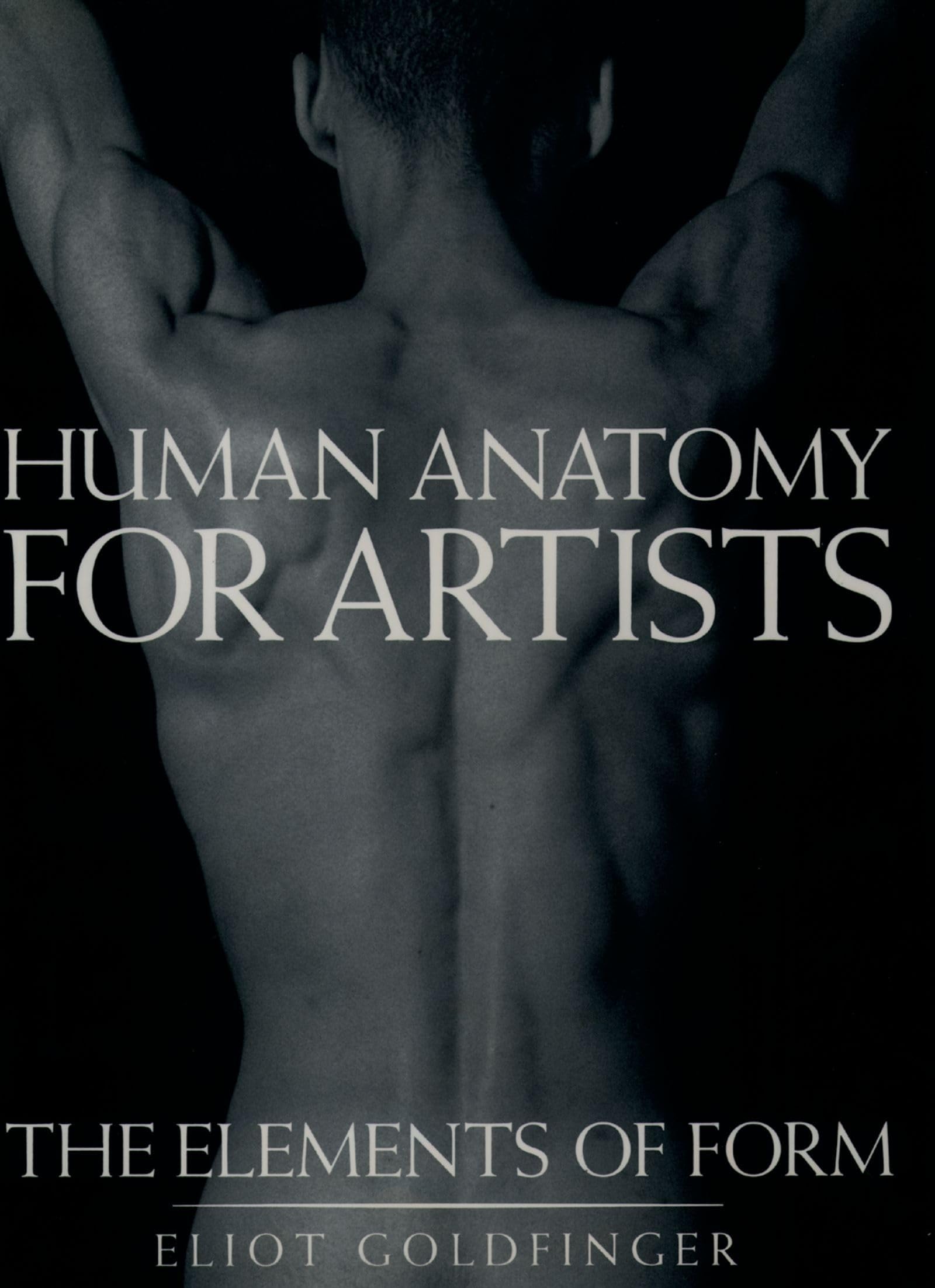
Human Anatomy for Artists: The Elements of Form
Product ID: 4171381
Buy anything from 5,000+ international stores. One checkout price. No surprise fees. Join 2M+ shoppers on Desertcart.
Desertcart purchases this item on your behalf and handles shipping, customs, and support to Thailand.
The power of the image of the nude--the expressivity of the flesh--has inspired artists from the beginning. An understanding of human form is essential for artists to be able to express themselves with the figure. Anatomy makes the figure. Human Anatomy for Artists: The Elements of Form is the definitive analytical work on the anatomy of the human figure. No longer will working artists have to search high and low to find the information they need. In this, the most up-to-date and fully illustrated guide available, Eliot Goldfinger--sculptor, illustrator, scientific model-maker, and lecturer on anatomy--presents a single, all-inclusive reference to human form, capturing everything artists need in one convenient volume. Five years in the making, and featuring hundreds of photos and illustrations, this guide offers more views of each bone and muscle than any other book ever published: every structure that creates or influences surface form is individually illustrated in clear, carefully lit photographs and meticulous drawings. Informed by the detailed study of both live models and cadavers, it includes numerous unique presentations of surface structures--such as fat pads, veins, and genitalia--and of some muscles never before photographed. In addition, numerous cross sections, made with reference to CT scans, magnetic resonance imaging, and cut cadavers, trace the forms of all body regions and individual muscles. Information on each structure is placed on facing pages for ease of reference, and the attractive two-color format uses red ink to direct readers rapidly to important points and areas. Finally, an invaluable chapter on the artistic development of basic forms shows in a series of sculptures the evolution of the figure, head, and hands from basic axes and volumes to more complex organic shapes. This feature helps place the details of anatomy within the overall context of the figure. Certain to become the standard reference in the field, Human Anatomy for Artists will be indispensable to artists and art students, as well as art historians. It will also be a useful aid for physical and dance therapists, athletes and their trainers, bodybuilders, and anyone concerned with the external form of the human body. With the renewed interest in figurative art today, this will be an especially welcome volume. Review: More full body illustrations would be nice - This book is a reference guide to the human anatomy for artists. The approach here is a part-by-part look at the different section of the body. Each area focused has illustrated muscles and bones with accompanying photo of a model by the side. We can clearly see where different layers of muscles are attached to the bones The photo reference is very useful and provides clarity than using illustrations alone. The downside is the author isolates the parts too much. If the topic is on the arm, only the arm is shown with very little of the shoulder. Amazingly, there are no full body illustration showing the muscles. The only full body illustrations show the schematic form, e.g. muscle boundaries. So while every part is explained and illustrated well, it's still a bit difficult to get the whole picture. Most of the examples are static. The body is not doing anything. Again, it's hard to see how the body really works when place in different positions like walking, sitting or twisting. Well, this is a reference book, for bodies in different positions, it's better to get a figure drawing book that focuses on poses and gesture drawing. Also, a great bulk of the examples are for male bodies. It would have been perfect if more female bodies were included for comparison. The accompanying text is comprehensive in explaining the structure and how the parts work. Ultimately, this is a very useful reference guide for any artists who wish to look up any part of the body. It's recommended for beginner to advanced artists. 4.5 out of 5 stars. (More pictures are available on my blog. Just visit my desertcart profile for the link.) Review: Just Perfect - 'Human Anatomy for Artists: The Elements of Form' by Goldfinger is just perfect, especially if you want to know where the muscles actually attach to bone, something many anatomy books for artists simply don't cover. The Goldfinger book, for each muscle or group of muscles, has one or more side-by-side series of illustration and photos that shows: - the naked bones in a given area with highlights that show you the surface areas where an individual muscle attaches, even if that muscle is an underlying muscle that normally is completely covered by surface muscles. - the muscle or muscles in question attached to their bones in isolation (no other muscles illustrated). - all the muscles in the given area to show the relation ship between them and the muscle that is the subject of the series, even if the muscle in question is virtually covered up. - a photo of a well-toned human model in the same pose as the illustration series with labels to the various muscles. - one or more cross-sections (up to five or more) of the area being illustrated with each muscle labeled to show clearly how the muscles over-lap and lay across each other and the underlying bone. - if necessary, the model will be shown in a pose that shows how an underlying, virtually hidden muscle is important to the artist when the subject is in a certain pose (e.g., an underlying muscle can lift and change the form of the surface muscles when it is in contraction and/or the body is in a certain pose). - a series of 'mass' diagrams that may be of use in building a 'shorthand' for the muscle or group in question. - It's not just a picture book. It has a lot of descriptive text for each of the series of illustrations, and covers aspects important to artists, such as the different types of muscle fibers, etc. I counted at least 17 of these series dealing just with attachments to the clavicle, but I might have missed some since the organization is by area (trunk, neck, upper arm, forearm, etc.) and there are a lot of attachments to the clavicle from more than one of these areas. Also, there may be more than one series dedicated to a given muscle or group of muscles so that it is shown from back, front, side, and/or above, sometimes. The illustrations are as good or better than the best I've ever seen in any other anatomy book, especially ones for artists, which can be sketchy to a degree. I really don't think you need a library of anatomy books if you get just this one.
| Best Sellers Rank | #105,310 in Books ( See Top 100 in Books ) #95 in Drawing Specific Objects #102 in Arts & Photography Study & Teaching #148 in Figure Drawing Guides |
| Customer Reviews | 4.6 out of 5 stars 335 Reviews |
P**A
More full body illustrations would be nice
This book is a reference guide to the human anatomy for artists. The approach here is a part-by-part look at the different section of the body. Each area focused has illustrated muscles and bones with accompanying photo of a model by the side. We can clearly see where different layers of muscles are attached to the bones The photo reference is very useful and provides clarity than using illustrations alone. The downside is the author isolates the parts too much. If the topic is on the arm, only the arm is shown with very little of the shoulder. Amazingly, there are no full body illustration showing the muscles. The only full body illustrations show the schematic form, e.g. muscle boundaries. So while every part is explained and illustrated well, it's still a bit difficult to get the whole picture. Most of the examples are static. The body is not doing anything. Again, it's hard to see how the body really works when place in different positions like walking, sitting or twisting. Well, this is a reference book, for bodies in different positions, it's better to get a figure drawing book that focuses on poses and gesture drawing. Also, a great bulk of the examples are for male bodies. It would have been perfect if more female bodies were included for comparison. The accompanying text is comprehensive in explaining the structure and how the parts work. Ultimately, this is a very useful reference guide for any artists who wish to look up any part of the body. It's recommended for beginner to advanced artists. 4.5 out of 5 stars. (More pictures are available on my blog. Just visit my Amazon profile for the link.)
A**R
Just Perfect
'Human Anatomy for Artists: The Elements of Form' by Goldfinger is just perfect, especially if you want to know where the muscles actually attach to bone, something many anatomy books for artists simply don't cover. The Goldfinger book, for each muscle or group of muscles, has one or more side-by-side series of illustration and photos that shows: - the naked bones in a given area with highlights that show you the surface areas where an individual muscle attaches, even if that muscle is an underlying muscle that normally is completely covered by surface muscles. - the muscle or muscles in question attached to their bones in isolation (no other muscles illustrated). - all the muscles in the given area to show the relation ship between them and the muscle that is the subject of the series, even if the muscle in question is virtually covered up. - a photo of a well-toned human model in the same pose as the illustration series with labels to the various muscles. - one or more cross-sections (up to five or more) of the area being illustrated with each muscle labeled to show clearly how the muscles over-lap and lay across each other and the underlying bone. - if necessary, the model will be shown in a pose that shows how an underlying, virtually hidden muscle is important to the artist when the subject is in a certain pose (e.g., an underlying muscle can lift and change the form of the surface muscles when it is in contraction and/or the body is in a certain pose). - a series of 'mass' diagrams that may be of use in building a 'shorthand' for the muscle or group in question. - It's not just a picture book. It has a lot of descriptive text for each of the series of illustrations, and covers aspects important to artists, such as the different types of muscle fibers, etc. I counted at least 17 of these series dealing just with attachments to the clavicle, but I might have missed some since the organization is by area (trunk, neck, upper arm, forearm, etc.) and there are a lot of attachments to the clavicle from more than one of these areas. Also, there may be more than one series dedicated to a given muscle or group of muscles so that it is shown from back, front, side, and/or above, sometimes. The illustrations are as good or better than the best I've ever seen in any other anatomy book, especially ones for artists, which can be sketchy to a degree. I really don't think you need a library of anatomy books if you get just this one.
R**N
In depth, thorough and the best I have seen
I have bought many anatomy books and tutorials now and I really wish I had found this book sooner. Eliot Goldfinger has put a great deal of effort into this book and it really shows. Not only does he go through the bones, proportions and muscles of the human form, he also has many extras that help to understand what exactly is happening underneath the skin. He explores only the muscles that affect the surface but these are done thoroughly. Drawings of the muscles' origins and insertions, the muscles around them and also a photo of the muscle on a model help the reader to get a clear picture of what is occurring beneath the skin. Other extras such as cross sections of the limbs and fat layers just add to the depth of an already great reference. I would recommend this book to anybody who has an interest in art and the human form as it is really the best that I have seen.
R**N
The best for anatomy loving artists
The best book there is out there, never seen anything better. (And I have seen a lot) I am a sculpture and use it a lot, in fact I can't do a sculpture without it. The drawings are great and clear, the text very informative though a bid deep sometimes. The pictures of the well chosen models are great! Wish they were bigger but than the book would need a lot more pages...
P**G
Very Pleased with Book
I recently got this book and really love it. It is exactly what I've been wanting. It shows you -- all on the same page -- every muscle, its origin and insertion on the skeleton, what it looks like alone, where it falls in the muscles surrounding it, and finally what it looks like on the surface of the living model (in a small photograph). I had been working with the Anatomy Coloring Book, which is a very good book also, but felt I needed to understand where each muscle is attached to the bone. I was looking up this information muscle by muscle from a medical dictionary -- but it was rough going. Goldfinger's book has it all already! And it is presented visually all on the same page so you can see it at a glance and really understand it. The body is so complex -- it is still going to be rough going to get to the point of understanding where I want to be, but I think this book will be my most helpful resource in getting there.
R**N
A little heavy on the text, but a very thorough anatomy book.
This book covers from the skeletal system to muscles, from head to toe, very thoroughly. Pictures are nice and clear. All important muscles feature full explanation on its origin, insert, function etc in text, and frontal and side view as well as in context of the whole muscle group along with a photograph of the real body part flexing with the related muscles. I find this book a little heavy a the text part, but images and photographs make up for it and make this book the most complete, and thorough anatomy book.
A**I
If you think seriously about anatomy this is an absolute must have.
I've seen a lot of anatomy manuals and this is in my opinion the best and truly the only one you will need. I've read complaints that it has not enough photos of bodies inside and has too many descriptions… Well to me it has all the photographs you will need to properly identyfiy any body part that contributes to a surface form of the human flesh. The author guides you one by one through all of them, each chapter preceded by an overall description of its content before getting into detailes. Unlike certain users I found copious descriptions of every bone and muscle to be essential for understanding and their recognition in life - they are more informative than the pictures themselves because give a full picture of for ex. a muscle behavior and aspect in different situations and in contrast to other muscles and bones surrounding it. I believe that before approaching the human body and depict it in a correct way, let it be from life or from memory, one must recognize all of its sub-forms and also now why they are there. And this book will provide you with all the knowledge necessary to achieve it. It is not of course the only book/material you'll need in order to master the depiction of the human body but it is most certainly the most important and maybe the one you should start with.
B**N
Quite comprehensive
I haven't taken as much time to look through it as I should yet. However, I saw this book recommended by people a couple times and I can see why. Flipping through it, there is definitely a great amount of information. Personally I was looking for a reliable book to reference and learn from on my illustrative journey. This definitely seems like it'll be very useful
M**O
Lo mejor de lo mejor
No se puede dejar pasar
A**H
Excellent book.. fully loaded
Too much in detail. Very good visual quality of figures Good to have for artists and medical students
W**T
Excellent reference, a must have
An amazing book with exhaustive and complete reference of muscles, not for the beginner and not to be intended as the only anatomy book you will read. It is a book that you grab after having read a section of a more general artistic anatomy book to further investigate the human form and the underlying structure. Nontheless it contains a useful section on bones and it provides clear scheme-like illustration to explain shapes and functions, and the text is clear and while being technical it's not intimidating or obscure.
M**E
Précis et complet.
Très précis et très complet. Montre le corps sous toutes ses faces. Le modèle a une musculature parfaite pour qu'on puisse voir le détail des muscles, Mon professeur de sculpture l'a également jugé utile.
D**I
解剖学秘密の本
解剖書は1冊では無理。無限の人体変化を伴うので。さまざまの書を自家薬籠、自分のものにしなければ ならない。といった点で、この書は主要な図として人体の断面、切断面を腕なら腕をA、B、C、Dと区切って表している。 実は切断面ごとの図が、この図解が画家にとって最後の筋肉収縮伸長、骨の形状、接続を理解する最終の難関なので、切断面を つないでいく流線が人体の外郭線でありその表現の帰結、頭脳がデッサン画家の優秀度の基準であると 考える。最高の五つ星を与えて、さらに無限の乗数を、評価を与えよう。
Trustpilot
3 days ago
4 days ago