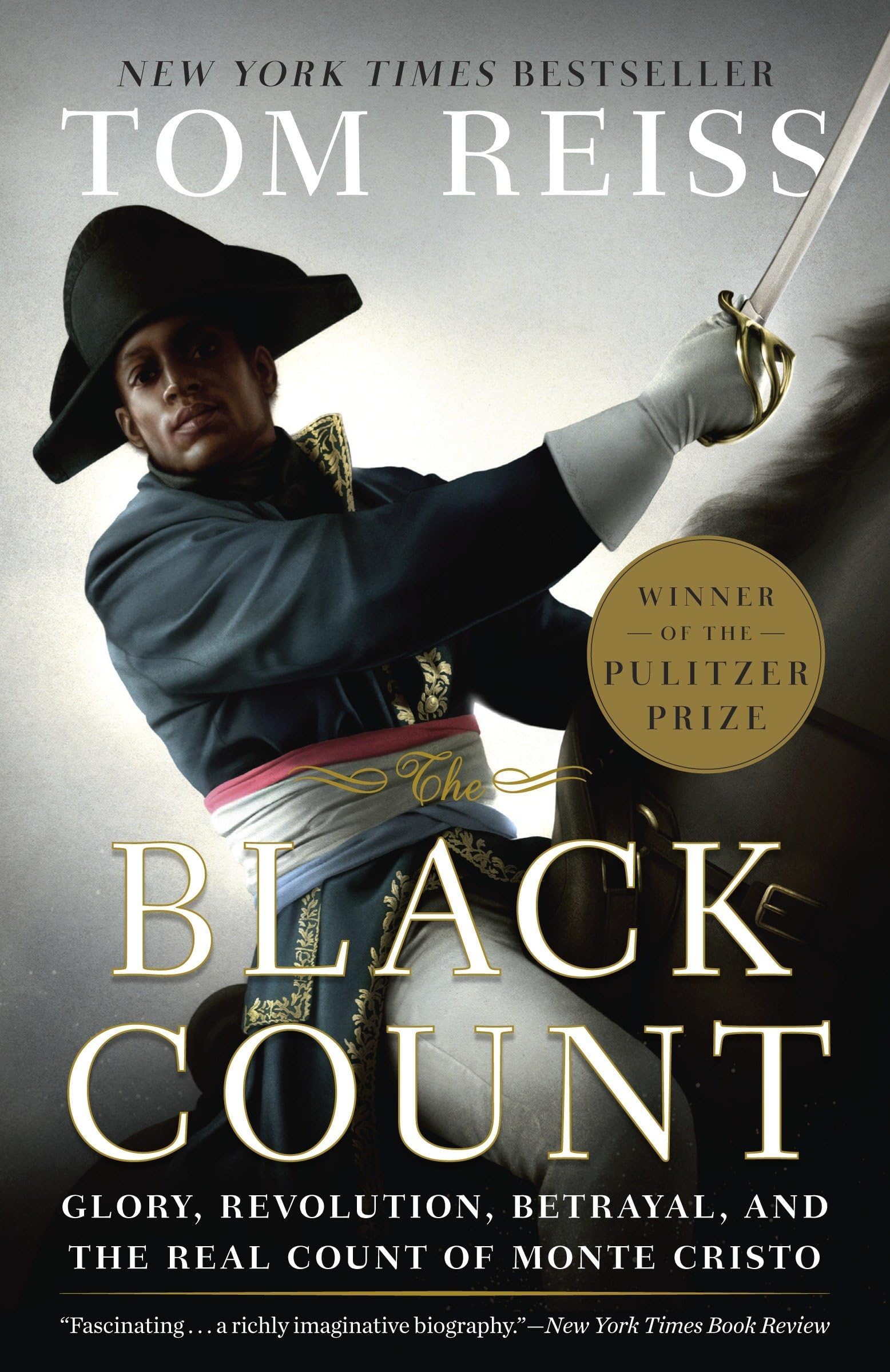

The Black Count: Glory, Revolution, Betrayal, and the Real Count of Monte Cristo
Product ID: 424205302
⭐4.5-star reader rating
🌍Authentic European settings
📚Deep historical research
Buy anything from 5,000+ international stores. One checkout price. No surprise fees. Join 2M+ shoppers on Desertcart.
Desertcart purchases this item on your behalf and handles shipping, customs, and support to Thailand.
📖 Unlock the untold saga behind literary legends — don’t miss the real story!
BLACK COUNT offers a rigorously researched, captivating exploration of the true Count of Monte Cristo, blending historical fact with literary legacy. Perfect for readers craving authentic European history and the origins of classic adventure tales.


| Best Sellers Rank | #444,179 in Books ( See Top 100 in Books ) #157 in European Literature (Books) #1,803 in Biographies & Autobiographies (Books) #1,857 in European History (Books) |
| Customer Reviews | 4.5 out of 5 stars 2,422 Reviews |
T**N
Good book 👍🏻
Good product. Good book. 👍🏻
H**9
ben raccontato!
Ho conosciuto l'autore ai tempi che ha lavorato ancora su questo libro. Nel maggio 2007, durante il suo percorso italico da Taranto a Bolzano per ripercorrere i luoghi dove il nostro eroe aveva combattuto e dove è rimasto prigioniero, ho avuto modo di intrattenermi con il Reiss, purtroppo senza essere in grado di potergli fornire materiale utile alle sue ricerche. Leggendo il libro mi sono reso conto che di ricerche approfondite si tratta, perché tutto ciò di cui scrive è ben documentato - il libro non si basa su congetture o dicerie, ma su riscontri documetali verificabili. Un bel libro su un personaggio (Dumas nonnno) che ha ispirato sia i romanzi sui 3 moschettieri che il conte di Montecristo. A quanto vedo non esiste per il momento un'edizione italiana.
B**B
A little Ehh
Not as thrilling as described and a little monotone
L**A
Obra muito interessante edição fraca
A obra é muito interessante e bem escrita, lê-se como um romance. Mas a edição não corresponde - letra minúscula, papel fraco e amarelado, formato incomodo. O esforço de leitura pode deteriorar a apreciação da obra.
S**Z
The Black Count
This is a biography of General Alexandre Dumas, father of the novelist and a man who experienced and achieved a great deal in his amazing life. His son was not yet four when he died in 1806, but obviously hero worshipped him and incorporated many of the tales of his life, told by his mother, into his novels. In fact, his fathers life reads very much like a novel and is an astounding account of a man who was born the son of a slave and lived through a revolution and the rise of Napoleon. The first part of this book looks at the early life of Alexandre Dumas, who was himself the son of a Marquis, a French nobleman in hiding on the French sugar colony of Saint-Domingue, and Marie Cessette Dumas, who was a slave. Saint-Domingue was a place where the sons of impoverished noble familes could strike it rich, as sugar was a scarce and luxurious commodity. The Marquis, known then as Antoine Alexandre de I'Isle, had effectively come 'to sponge' off his younger brother, who had married the daughter of a plantation owner. Eventually he had four children with Marie Cessette Dumas, although when he eventually returned to France he took only his youngest child, Alexandre, with him. Alexandre must have had a difficult time in Paris. Although 'men of colour' lived a free life in France, he still came up against racism at every turn. Eventually, he set up on his own, taking his mothers name, and joining the army as a dragoon. The author recreates the history of that period so well you almost feel you are living through it. We read of Alexandre's great skills as a swordsman, his incredible strength and agility, his renowned good looks and intelligence. These were abilities he used to climb through the ranks of the army as the French Revolution erupted and the army was reformed. When he was billeted with the Labouret family and fell in love with their young daughter Marie-Louise, his father accepted her lovers proposal, but asked that the wedding be postponed until Alexandre became a sergeant. Within a year he was a general, with ten thousand men under his command... We read of the Revolution, the Committee of Public Safety and the unleasing of the Terror, when everyone was under suspicion and heads rolled. Also, there is much of his fathers life that Dumas the novelist incorporated into his writing. An example of this was when Alexandre Dumas was imprisoned in the fortress of Taranto, which is obviously the basis of the Count of Monte Cristo. This is only one example, but the author deftly ties together stories, both real and exaggerated, which the author weaved into his novels. Overall, this is a fascinating account of a man and a time, incredibly well written and researched. The author obviously had a great deal of respect for the man he was writing about and this is both history and biography at their best.
U**A
Superb!
This historical biography is based on the life of the famous author, Alexandre Dumas’s father, Thomas-Alexandre, known as Alex Dumas. After time spent in the War of the Polish Succession that ended in 1738, Frenchman Alexandre (Antoine) Davy de la Pailleterie, a future marquis, left France to seek his fortune in Saint-Domingue, the island of Hispaniola. At that time, the Spaniards owned, Santo Domingo, the east side of the island, and the French owned the west, Saint-Domingue (Haiti). Because of sugar planting, Saint-Domingue was one of the wealthiest islands in the world. Antoine moved in with his younger brother, Charles, who had married well and became a well-known sugar planter. Antoine scrounged off his brother for a decade, kept several slave mistresses, and refused to work. Charles and Antoine’s relationship ended violently. Antoine fled with three of his brothers’ slaves, one of which was his latest mistress. To probably resist arrest, Antoine moved up into the highlands, a densely wooded mountains, eventually settling in Jérémie, an isolated area of Haiti. There, he changed his name to Antoine de l’Isle—Antoine of the island. Antoine purchased a mistress for a very high price, Marie Cessette Dumas. Marie Cessette bore him four children. The eldest child was Antoine’s favorite, Thomas-Alexandre, born in 1762. When Antoine returned to France, he would eventually send for fifteen year old Thomas-Alexandre. Antoine sold Marie Cessette and their other three children. In France, Antoine made sure his son was well educated. Thomas-Alexandre became an excellent swordsman. As a young man, Thomas-Alexandre, enlisted in the dragoons, and rejected his father’s surname, Davy de la Pailleterie, and took his mother’s surname, Dumas. He would never again be known as Thomas. Instead, he used Alexandre (Alex) Dumas. He even listed his father as Antoine Dumas. As a Lieutenant Colonel, Alex, who was later commissioned as a General, married Marie-Louise Labouret of Villers-Cotterets, France. They would have three children: two daughters and Alexandre Dumas, Jr. their last child, the future author, was born 10 years later. The book is filled with an enormous amount of French history, some of which includes the shrewd General Bonaparte. At one point, General Dumas and Bonaparte fought together. General Dumas sailed to Egypt with Bonaparte. General Dumas appeared to be a loving husband and good father. On the front, he was a courageous, strong-minded, intuitive leader, unbiased toward his troops. From his men he received much devotion and admiration. His flaw was sometimes not using tact and being too critical. He had high expectations of a soldier’s performance. Yet his bold criticism toward inept superiors or those favored by superiors cost him promotions or unkindness later in life. General Napoleon showed farsightedness concerning his own future ambitions. However, he appeared to be intolerant of criticism expressed by General Dumas, and inflated his own self-importance when he and Dumas were generals. Napoleon was willing to cruelly exploit others for his own gain, especially concerning the Rights of Man decree. When Napoleon became emperor, the law, previously decreed by former King Louis XVI of France, April 4, 1792, which provided citizenship for all property owning free men of color on the islands, became invalid in 1800. In France, interracial marriages as well as interracial education were outlawed. People of color who had lived free in France were to be rounded up and sent back to the colonies. They could no longer live in Paris or the surrounding suburbs. This appears like history repeating itself. German citizens had experienced this during the Second World War, and currently Dominicans of Haitian descent are being denied citizenship because of their place of birth. Without giving too much away, this is a superb historical biography, well written, full of information, and a pleasure to read. The history in France and on the island, Saint-Domingue, will amaze you. I took my time reading this book. Surprisingly, Alexandre Dumas, author of The Three Musketeers, incorporated some of his father’s famous expeditions when writing his book. The author, Alexandre Dumas, expresses a genuine, tender love and admiration for his father, General Dumas. This book deserves five stars.
Trustpilot
1 month ago
1 week ago