

Buy anything from 5,000+ international stores. One checkout price. No surprise fees. Join 2M+ shoppers on Desertcart.
Desertcart purchases this item on your behalf and handles shipping, customs, and support to Thailand.
⚡ Upgrade your network, upgrade your life!
The TP-Link TX201 PCIe Network Card delivers ultra-fast 2.5 Gbps Ethernet speeds, supporting a broad range of operating systems including Windows and Linux. Its auto-negotiation feature ensures optimal connectivity across multiple speeds, while Wake on LAN adds remote management convenience. Designed for versatile installation with included brackets, it’s backed by a 2-year warranty and 24/7 support, making it the smart choice for professionals seeking reliable, high-performance networking.
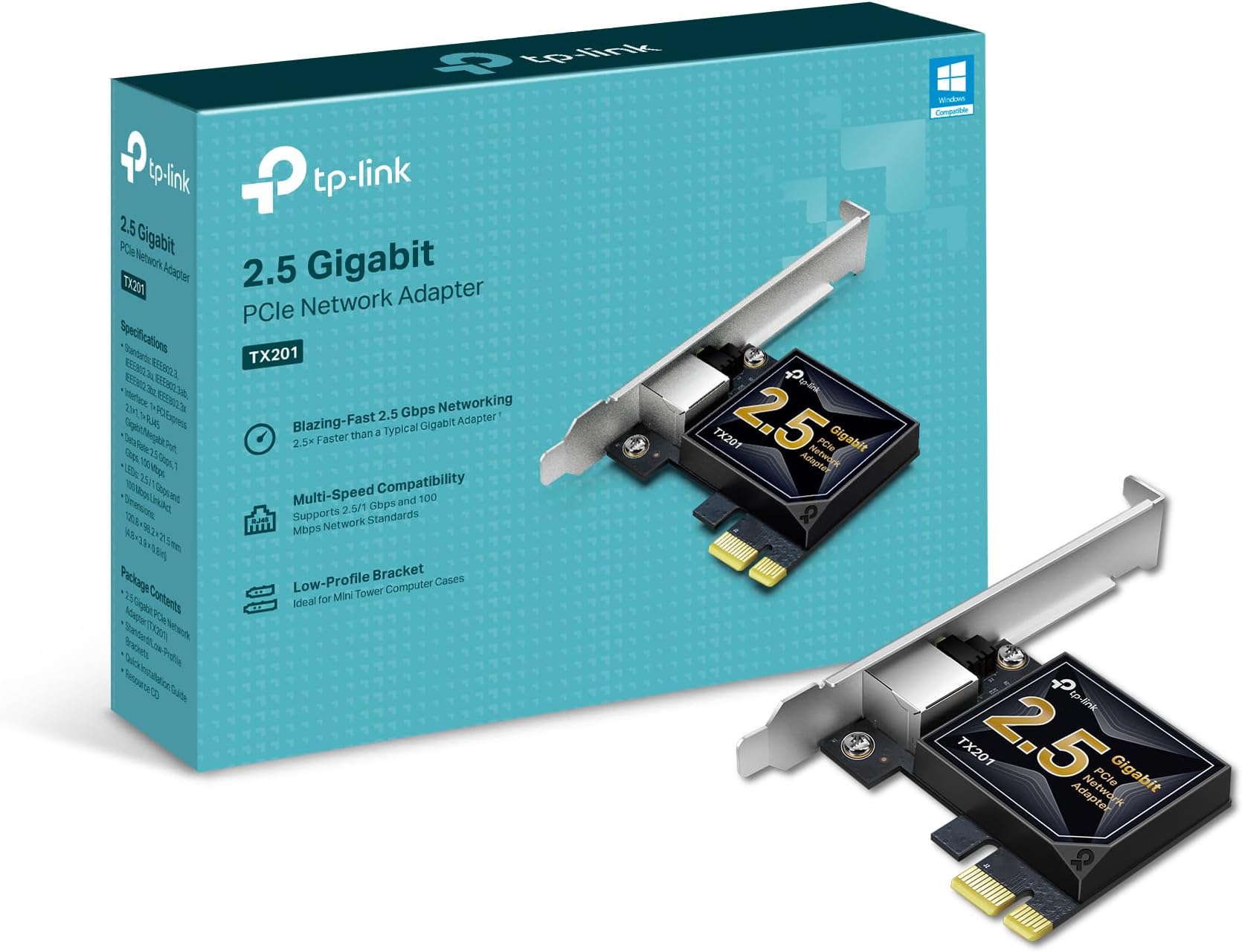


| ASIN | B0BG685PKM |
| Best Sellers Rank | #3 in Internal Computer Networking Cards |
| Brand | TP-Link |
| Built-In Media | 2.5 Gigabit PCIe Network Adapter (TX201), Resource CD, Standard/Low-Profile Brackets |
| Color | Black |
| Compatible Devices | Desktop |
| Compatible Operating System Family | Linux, Windows |
| Customer Reviews | 4.7 4.7 out of 5 stars (2,036) |
| Data Link Protocol | Ethernet |
| Data Transfer Rate | 2500 Megabits Per Second |
| External Testing Certification | Não aplicável |
| Hardware Interface | Ethernet |
| Item Dimensions L x W x H | 4.76"L x 3.07"W x 0.85"H |
| Item Type Name | Network card |
| Item Weight | 1.76 ounces |
| Manufacturer | TP-LINK |
| Mfr Part Number | TX201 |
| Minimum Required Operating System Version | Windows 7 |
| Model Number | TX201 |
| UPC | 840030707834 |
| Warranty Description | 2 year manufacturer |
A**N
Great value for the price
I've purchased 5 of these for my Lenovo Tiny PC servers in my homelab setup as I have a Trendnet 2.5GB switch. These cards are excellent value for the money. Linux, HomeAssistant, and Windows all recognized them immediately and got them running almost instantly. Great plug-n-play solution to upgrade network speed of your devices.
B**B
Good network card that does what it says
I bought one to upgrade my second PC to 2.5 gig speeds and it worked great. Easy install, went to 2.5 instantly and has been reliable.
R**K
Simple Install and it works great.
The integrated NIC circuit failed on a 7YO Dell Studio PC that I infrequently use but do keep the s/w updated. Without a network interface, updating the s/w was difficult. I found an empty PCIe slot on the MoBo and gave this TP-Link 2.5GB NIC card a try. It worked perfectly. Win11 recognized it and loaded the necessary driver and I was up and running in a matter of minutes. I did update the driver after I confirmed everything worked, using the supplied mini cd but in hindsight, I’m not sure that was necessary. I would recommend this card to a relative or friend if they needed a NIC card.
K**R
POST/boot hang after installation
I ran into a weird POST/boot hang after switching to an ASRock Z490 Phantom Gaming 4/ac and adding a TP-Link TX201 2.5GbE PCIe NIC. With the TX201 installed, the machine would sometimes refuse to boot / hang during POST. What fixed it I put a small piece of tape over PCIe edge connector pins B5 (and even B6) on the NIC. After that, the system booted normally and the card worked fine in the OS. Why this works (the reasoning) PCIe has some “old-school” pins that the motherboard uses before the OS ever loads: B5 = PRSNT2# (presence detect) This is part of the hardware “card present / lane width” detection logic. If a motherboard BIOS/UEFI is picky (or buggy) during PCIe enumeration, a device can cause the firmware to stall while it’s trying to validate presence/configuration. By isolating B5, you’re basically forcing the board to be less strict about that early presence-detect logic and letting PCIe link training/device enumeration complete in a different code path. In plain English: you’re bypassing a firmware edge case that can hang POST. “But the TX201 says PCIe 2.1… why would this happen?” “PCIe 2.1” on many add-in cards is largely a compatibility claim, not a guarantee the device behaves like a 2008-era card electrically/firmware-wise. The TX201 is an Intel 2.5Gb controller-based NIC (varies by revision), and modern PCIe devices can still trigger weird BIOS timing/initialization issues on certain boards/BIOS versions. This is usually a UEFI enumeration bug, not the NIC being “too new” or “too high-end.” Why it still worked even when I taped B6 (+12V) B6 is +12V slot power. I taped B5 and B6 and the NIC still worked, which tells you something useful: Many low-power PCIe cards (NICs, USB cards, etc.) run entirely from the 3.3V rail provided by the slot and barely (or never) use slot 12V. So disconnecting B6 (+12V) didn’t matter for this NIC because it’s likely 3.3V-powered internally. That also reinforces that the original issue wasn’t “power” — it was detection/initialization during POST. Why this matters (and why it can save you money) If your system won’t boot with a NIC installed, it’s easy to assume: “My motherboard won’t support high-end / 2.5Gb / newer NICs.” But this kind of hang can be a firmware edge case during PCIe enumeration, not true incompatibility. A simple presence-detect workaround (taping B5) can get you booting and running normally without buying a different motherboard or NIC. Note / caution This is obviously a DIY hack: Prefer taping B5 only long-term (leaving power pins alone is cleaner). Also worth trying BIOS updates, toggling PCIe Gen settings (Gen3/Gen2), or disabling fast boot, but the tape fix can confirm it’s an enumeration/presence-detect problem quickly.
A**S
Quick and easy to install, and works great
Network Card was purchased for a 13-year-old Dell XPS with a malfunctioning Ethernet port. Installing the device was quick and easy. Windows 10 detected it and installed the driver for it. I finally have constant connection to the internet again. It works great with Broadband speeds. There is no fiber internet available where I live.
D**N
Seamless installation
Like most TP-LINK products, this NIC just works. Easy to install and started working without any issues (windows 10)
M**K
Great NIC no issues
I got FIOs and realized my main work computer was only using 1/2 my available bandwidth, so I bought this card. I am able to easily hit the 2 Gig bandwidth now that my ISP provides. I looked at other nics and this one was cheaper. I find it a good value for the money. I just plugged it into my computer and it just worked, no driver issues. Im running Ubuntu 25. I like the small form factor of the card. Seems fairly durable. I would recommend buying this again.
U**S
Excellent Choice - You will not be disappointed
Comes with alternate bracket, small quick start paper, two inch abbreviated CD, and the TX201 Network Card. Installation is quick and easy, just open the cabinet and insert the card into an available short PCI slot on your motherboard. Rather than fuss with the CD, just go to the TP-Link download website (listed on the quick start paper) and obtain the software. Save to a new folder because it's an RAR file and needs to be extracted. If you don't already have an RAR extractor, get a copy of 7 Zip and install that first. Once you extract the RAR file, run the .exe file to install the network driver. Once it's installed, you will find it in Device Manager. Here you can disable your old driver. (Windows 10). On speedOf.Me, my speed increased drastically.
A**A
Muito bom
O**A
I picked this up to finally get the most out of my high-speed internet plan. Most motherboards are still stuck with standard 1G ports, and this card is a very affordable way to bridge that gap. The Setup: Installation was a breeze. It’s a small card that fits easily into a PCIe x1 slot, and it even includes a low-profile bracket if you’re working with a slim desktop case. It’s built well and feels like a quality piece of hardware that should last. One Important Tip: When I first plugged it in, Windows recognized it immediately, but I noticed a weird issue: my download speeds were great, but my upload speeds were stuck and wouldn't hit that 2.5G mark. I found that the "standard" drivers Windows installs automatically aren't quite enough. To fix this and truly unlock the full 2.5G upload speed, go directly to the Realtek website and download the latest drivers for the RTL8125 chipset. As soon as I installed the official drivers from the source, the upload cap vanished and everything worked perfectly. Final Verdict: It’s a fantastic, reliable card for the price. Just save yourself the troubleshooting time and grab the drivers from Realtek right away
G**2
Mi internet no es muy rápido pero se siente más estable con este adaptador de 2.5GB.
R**B
I installed this TP-Link 2.5G card today and it was super quick to set up. Windows 11 picked it up right away, so I didn’t even need the driver CD they toss in the box (kinda funny they still include a cd rom???… I don’t know anyone with a CD drive anymore). I ran a few speed tests using my 3.0 Gbps service, and the card got really close to the 2.5 Gbps it advertises, so I’m happy with that. For the price, it did exactly what I needed without any headaches. I have been buying TP LInk products since TP Link came out about 30 years ago.
L**.
Funciona muy bien, hay que descargar e instalar drivers para que funcione bien.
Trustpilot
4 days ago
1 month ago