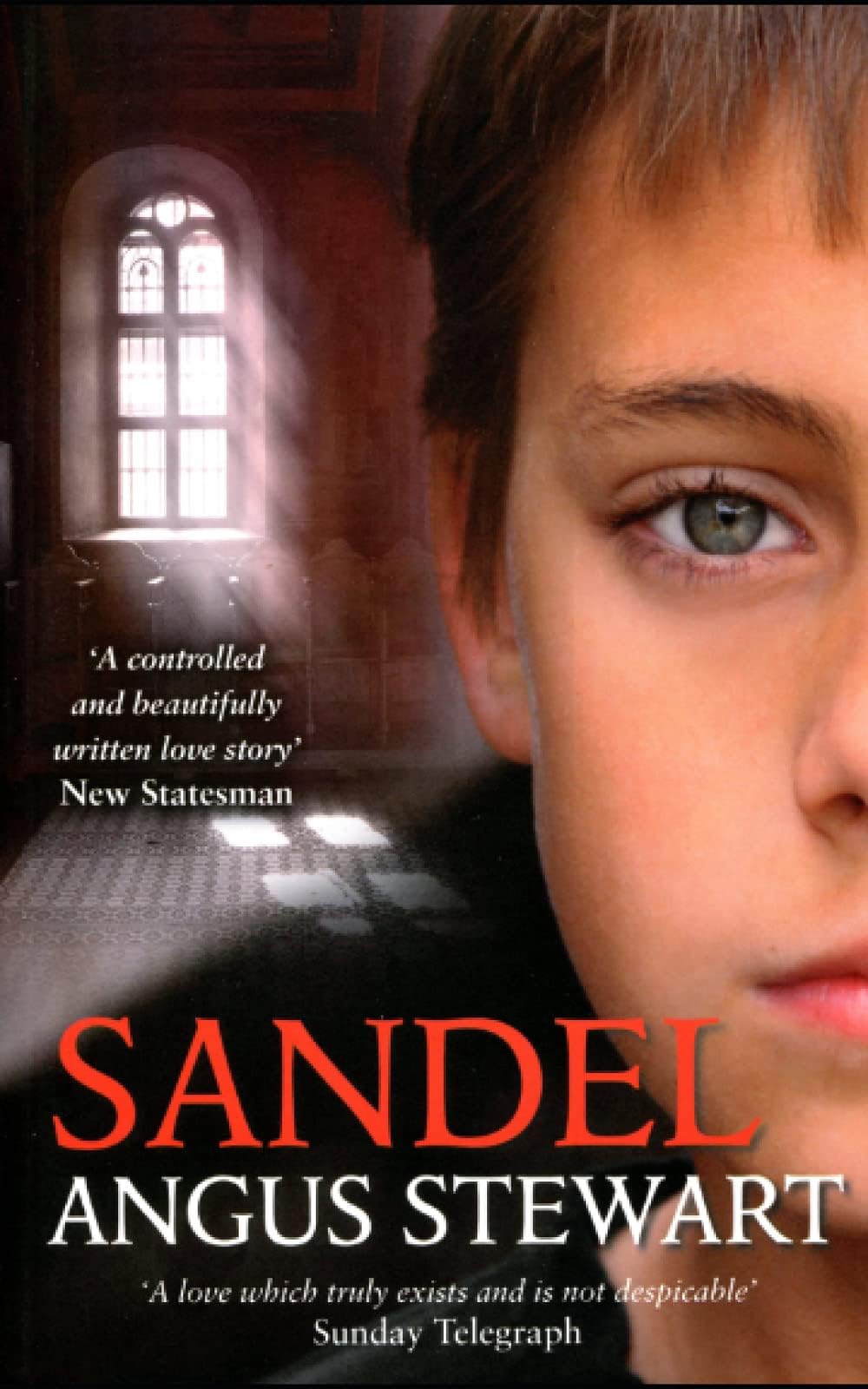

Sandel
Product ID: 50543896
Buy anything from 5,000+ international stores. One checkout price. No surprise fees. Join 2M+ shoppers on Desertcart.
Desertcart purchases this item on your behalf and handles shipping, customs, and support to Thailand.
Set in the 1960s in an Oxford college, when being gay was still an offence punishable by imprisonment, Sandel tells the story of a love affair between an undergraduate (David Rogers), and a cathedral choir boy (Antony Sandel). Tony - beautiful, provocative, mischievous, sensitive and sometimes overwhelmed by the intensity of his own feelings - bewitches Rogers. Both are talented musicians, and Sandel's astonishing voice, which Rogers explores as his accompanist at the transient moment of glory which precedes it breaking, is soon central to the relationship. Sensual, profound, often funny and never sentimental, Stewart provides a definitive analysis of same-sex love in the context of a relationship that reveals love as the one agent of the human condition that can set us free. The setting of the novel in an Oxford college (actually Christ Church, which the author attended) and the well-observed description of life in an English choir-school - short trousers, boats on the river, afternoon tea and cricket before Evensong - along with the stylistic quality of the writing, places Sandel in a tradition made famous by Evelyn Waugh ( Decline and Fall' and Brideshead Revisited ). There are echoes too of Maurice , the novel by E M Forster, published after his death in 1970. On both sides of the Atlantic, Sandel became formative reading for a generation of boys growing up in the 1970s who knew their feelings fell outside the heterosexual male stereotype, and it remains a gay cult novel today. But its fundamental message holds good for all people in all eras whatever their sexual persuasion, and is delivered with great subtlety and skill by a master craftsman. AUTHOR Angus Stewart was born in 1936, the son of John Innes Mackintosh Stewart, the novelist and Oxford academic who wrote bestselling crime fiction as Michael Innes. He was educated at Bryanston School in Dorset, and later at Christ Church Oxford. Stewart's first published work was ‘The Stile’ (1965), which won the Richard Hillary Memorial Prize. Sandel , which is in many respects autobiographical, came in 1968. Before and after its publication, Stewart lived for long periods in Morocco. In 2016 his personal memoir, Tangier (1977), was reissued in a new edition, including photographs by the author. His experiences there explain a great deal about the autobiographical nature of Sandel , and his exposure to Tangier’s legendary artistic community, which included Paul Bowles, Tennessee Williams, Francis Bacon, Alan Sillitoe, Ruth Fainlight, Rupert Croft-Cooke, Alec Waugh, William Burroughs, Gavin Maxwell, Francis Bacon, Joe Orton and others, prepared the way for his second novel, Snow in Harvest (1969). Sense and Inconsequence: Satirical Verses’ followed in 1972, with a Foreword by W H Auden. A third novel, The Wind Cries All Ways , which includes a startling description of the author’s incarceration in a Tangier mental asylum, has yet to be published. After his mother's death in 1979 Stewart returned to live in England, and died in Oxfordshire twenty years later. Review: Sandel - Pedophile David Rogers goes over the top luring and grooming precocious 13 year old orphan Tony Sandel so he can molest him. In Rogers fantasy mind of course Sandel is an equal partner in the affair, because after all, a 13 year old orphan who will do anything for adult attention must be a super boy, better than his peers. Sandel's crazy aunt of course sees nothing wrong with an adult male engaging in sodomy with her 13 year old nephew. The novel is a work of art though and funny. The author has a sense of humor. There are a lot of surprises and plot twists awaiting the reader. Review: A really good book, but ... - Though perhaps inevitable, I nonetheless found the ending disappointing. It was also abrupt.
| Best Sellers Rank | #3,899,073 in Books ( See Top 100 in Books ) #2,053 in LGBTQ+ Literary Fiction (Books) #64,760 in Literary Fiction (Books) |
| Customer Reviews | 3.5 out of 5 stars 232 Reviews |
R**O
Sandel
Pedophile David Rogers goes over the top luring and grooming precocious 13 year old orphan Tony Sandel so he can molest him. In Rogers fantasy mind of course Sandel is an equal partner in the affair, because after all, a 13 year old orphan who will do anything for adult attention must be a super boy, better than his peers. Sandel's crazy aunt of course sees nothing wrong with an adult male engaging in sodomy with her 13 year old nephew. The novel is a work of art though and funny. The author has a sense of humor. There are a lot of surprises and plot twists awaiting the reader.
A**R
A really good book, but ...
Though perhaps inevitable, I nonetheless found the ending disappointing. It was also abrupt.
T**Y
Not Acceptable or Excusable in Any Era!
Besides dealing with a subject which is, rightfully, anathema today (child sexual abuse), although it was apparently less controversial when the novel was first published in the sixties, SANDEL is not particularly well-written or portrayed. There are, to be fair, quite sonorous sections but there are also sections that are confusing from a point of view/perspective situation. The main character - a young boy at first so charming, open and expressive - devolves into pettiness and the plot tumbles with him; the behavior of both 13-year-old Tony and 19-year-old David, especially when the latter takes up his position as a teacher, is deplorable, regardless of which decade / era it portrays. "Ah - but it's just fiction, a cute love story, a reflection of more innocent times..." Not so. I am liberal, open-minded and gay, but still am be convinced that in the 20 and 21 centuries a decent novel must reflect at least a modicum of morality and realistic (not to say normative) behavior. Young love can indeed be sweet and, even if not sexually innocent, can perhaps be moving, and the first half of this book reads just so. But, although the love might be real, mutual and somewhat socially/ethically acceptable in its time and circumstance (the British prep school with all its covert sex and implied transgressions), when a young man takes up the mantle of a teacher and carries on so deplorably with the head boy, it is tough to defend or portray this in any tolerable manner. Stewart tries, but fails to do so. Much better for similar subject matter is Campbell's "Lord, Dismiss Us."
R**N
A book to treasure, each detail rings true
Such a treasure, this book, reading it slowly so not far enough into it to answer how narrated. But so far each detail rings true, often understated but redolent of the turbulence and uncertainties of growing up gay, spiked with the open, direct and spontaneous (I think) utterances of the younger boy, who, unencumbered by the trappings of early adulthood cuts to the essence of whatever's going on. Love it, love it!
J**.
not what I expected
The book was confusing, didn't flow well, and seemed to go no where. It either ended weirdly and abruptly, or the entire book didn't download. No idea what I read or what their relationship was.
A**R
A MESS.
A confusing jumbled mess with characters coming and going out of nowhere. Not an easy read by any stretch of the imagination, with no hook at all. At no point did the story “grab” me. I read the entire book hoping that I would be interested at some point, in vain. There was no narrative flow at ALL, just jumped from here to there without any solid consistency.
S**N
It's good to see this fairly historic little book back in ...
It's good to see this fairly historic little book back in print. It's a sensitive subject these days and this book reveals the gulf between modern thoughts on this subject and 1960's thought. The book is not easy. There are many esoteric passages which I frequently needed to reread for meaning. In between however, his descriptions of the way that both Peter Greaves and Tony Sandel made David feel were vivid and convincing. This was a man writing out of personal experience; the book is clearly, at the very least, partly autobiographical. He is at his absolute best when joyfully describing the way the boys move and behave; when he leaves intellectual conjecture behind and deals with actual reality. It's amazing that this book was so well received back in 1968. The subject matter would have had the press howling with dismay were it to come out now. It shows how things have changed. One extreme to the other perhaps. Well worth reading.
W**R
Execellen read
Well written very enjoyable and insightful
T**C
A moving and beautiful story, though hard to read in places.
I found this to be an unusual book. A little difficult to read in places as it seemed to be a bit all over the place, but I think it's one of those books you have to read carefully, with no distractions, and probably have to read more than once. David Rogers, a 19-year-old guy, falls in love with the "beautiful" 13-year-old choir boy, Tony Sandel. If anything the younger boy seems to do most of the "hinting" for a relationship, and a sexual one at that and tries to steer it in such a direction, though I believe David too wanted such a relationship to develop but he seemed a little more reserved about it, at least initially. Some of the adult characters in the book realised what was going on between the two boys but did vary little about it other than trying to use gentle persuasion, when in reality they would have probably informed the police, especially considering it was written in the late 60s when homosexuality was illegal below the age of 21, or so I believe. There are no sex scenes as such those it is intimated that such an act took place between the pair of them. I actually enjoyed it vary much and I really felt for the younger boy as he seemed to be vary lonely and had yet found a true friend in the older boy, and I often find myself wondering how he is now getting on with his life after David. I will certainly be reading this book again as I am sure it's one of those books that the more you read the more you realise about the whole story. It was a moving and beautiful story of forbidden love and two boys coming to grips with what they were feeling. Note on the Kindle version: No proplems whatsoever on my Kindle Fire HDX.
C**N
Magnifique roman d'amour
critique du livre (anglais) " SANDEL" d' Angus Stewart 2015 Bonne littérature anglaise... Il ne s'agit pas ici d'un nième roman de gare mal ficelé et truffé de dialogues insipides. Le livre est en anglais; quoique je ne maitrise plus bien du tout la langue je la comprends encore suffisamment mais j'avoue perdre aussi sûrement bien des nuances. Car le livre est tout en suggestion, en introspection, en délicatesse même si le sujet reste un peu scabreux au départ, ou au moins limite. J'ai découvert ici le plus beau roman d'amour que j'aie lu. On compare cet oeuvre avec " Les amitiés particulières" de R Peyrefitte... Je le trouve nettement supérieur quant à l'expression des sentiments amoureux des protagonistes. Il est d'ailleurs difficile de comparer ces deux livres: dans l'un il s'agit d'amour entre adolescents, dans un contexte d'adultes un peu trouble, dans ce livre-ci il s'agit d'un amour toujours retenu mais parfois plus que sensuel entre un jeune adulte et un tout jeune garçon. Je recommande vivement sa lecture même si la langue utilisée n'est pas toujours basique et facile à traduire avec exactitude.
B**O
Una voce fuori dal coro
Ho trovato questo libro davvero coinvolgente. Tratta un tema senza dubbio controverso e dibattuto. Tuttavia lo fa nella maniera semplice, romantica e ingenua tipica dei ragazzi di quell'età. I personaggi sono ben caratterizzati. A volte un po' difficile relazionarsi, poiché ambientato in un collegio degli anni 60, per cui distante anni luce dallo stile di vita dei ragazzi "moderni". Trovo comunque che sia un libro semplice, appassionante ed intelligente. Va letto senza pregiudizi e preconcetti, lasciando spazio all'esplorazione dell'animo e dell'istinto umani. Nota linguistica sull'edizione originale in Inglese: Salvo qualche termine o espressione desueta, ho trovato la scrittura molto scorrevole. Per chi ha comunque un'ottima conoscenza dell'Inglese. Per fortuna poi esiste il dizionario sul Kindle ;)
K**R
Curious reading.
I believe this is considered a 'Gay Classic' from the times prior to our 'liberation' . While it is erotic in places it's not overly so, with a huge amount left to the reader's imagination. I was confused by the ramblings at the start of David's university career and the constant interruptions of his friend with unhelpful suggestions, as to finding religion as a panacea to his mental wondering. It may have been typical of university thinking in England at that time, but was decidedly foreign to my thoughts as I struggled to find myself. I suffered from a good Scottish Presbyterian upcoming, which didn't consider homosexuality as a possibility, not in mid 1960's. Tony is definitely a manipulative young man, while David is decidedly unsure, however by the final chapters all seems well. Until the final accident at the airport, which leads to everything going astray. The story ends poorly at Glenelgin school, which incidentally sounds very similar to certain school which had Prince Charles as a pupil, with Tony, reluctantly, declaring undying love for David, while still saying he might experiment first ! Odd.
M**U
Authentic, albeit controversial, love story
Potentially much controversial love story, yet authentic and sincere, as part of the sometimes non-standard human youth experiences.
Trustpilot
2 months ago
2 weeks ago