We remain fully operational. Our teams are working around the clock to ensure your deliveries continue safely.
DOWNLOAD THE APP


Copyright © 2025 Desertcart Holdings Limited
DOWNLOAD THE APP
Buy anything from 5,000+ international stores. One checkout price. No surprise fees. Join 2M+ shoppers on Desertcart.
Desertcart purchases this item on your behalf and handles shipping, customs, and support to Thailand.
🎤 Cut the cords, not your vibe — wireless freedom that keeps you in the spotlight!
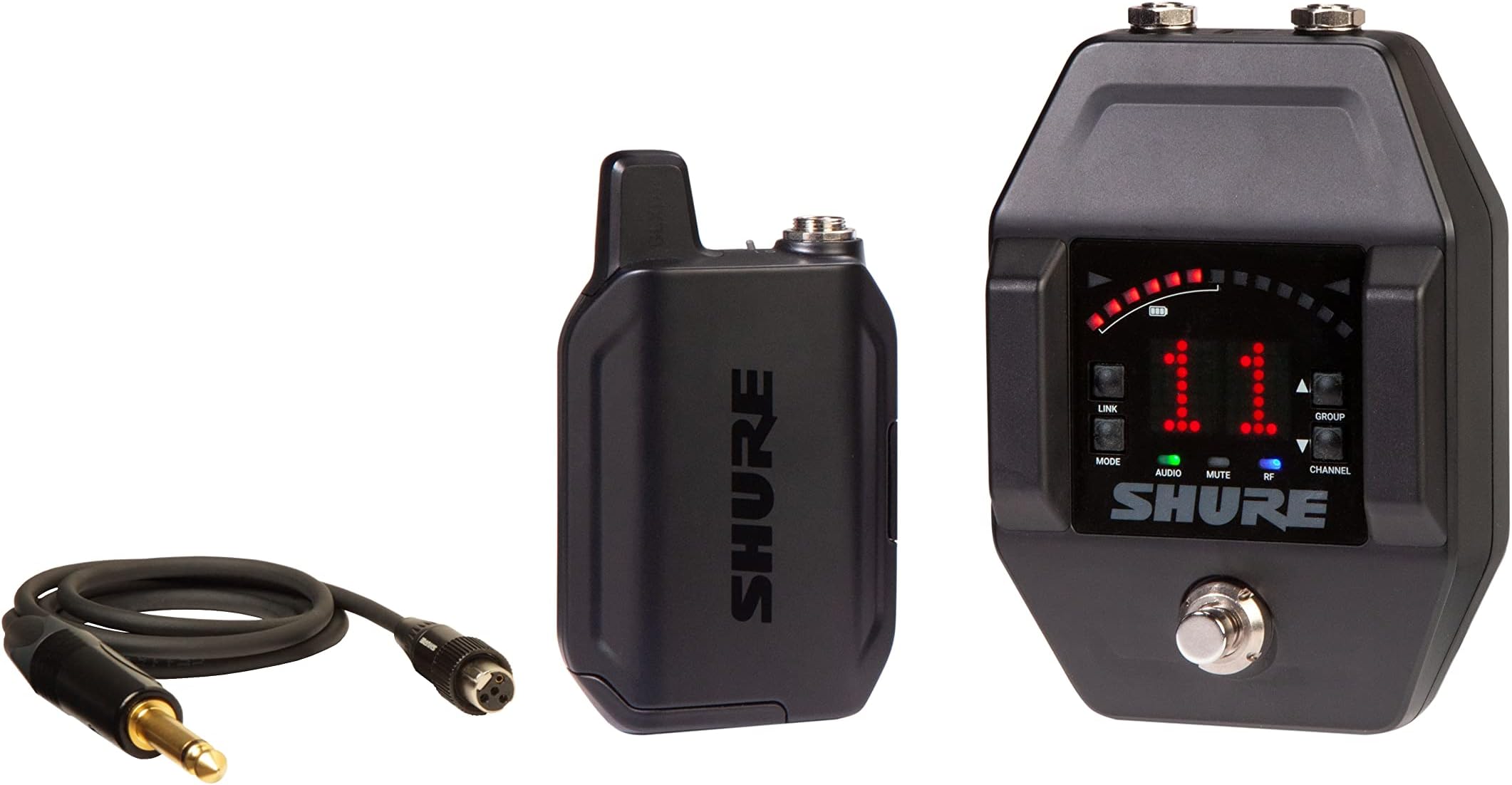
The Shure GLXD16+ Dual Band Pro Digital Wireless System delivers professional-grade wireless freedom for guitarists and bassists, featuring dual-band technology for robust, interference-free audio, a 12-hour rechargeable battery with quick charge, and a pedalboard receiver with premium cable. Designed for seamless setup and multi-instrument versatility, it ensures crystal-clear sound and reliable performance on any stage.


| ASIN | B0BSP3NDDR |
| Antenna Location | Singing |
| Audible Noise | 103 Decibels |
| Best Sellers Rank | #5,170 in Musical Instruments ( See Top 100 in Musical Instruments ) #44 in Wireless Microphone Transmitters & Receivers |
| Brand | Shure |
| Built-In Media | GLXD6+ guitar pedal receiver, GLXD1+ bodypack transmitter, WA305 instrument (guitar) cable, SB904 lithium-ion rechargeable battery, PS24US power supply, USB-C charging cable and user guide. |
| Color | Black |
| Compatible Devices | Guitar, Bass |
| Connectivity Technology | USB |
| Connector Type | USB |
| Customer Reviews | 4.5 out of 5 stars 306 Reviews |
| EU Spare Part Availability Duration | 2 Years |
| Enclosure Material | Metal |
| Hardware Platform | Karaoke Machine, Television |
| Impedance | 150 Ohms |
| Item Dimensions | 12.17 x 9.06 x 3.27 inches |
| Item Weight | 1 Pounds |
| Manufacturer | Shure |
| Mfr Part Number | GLXD16+-Z3 |
| Microphone Form Factor | Handheld |
| Model Name | GLXD16+-Z3 |
| Model Number | GLXD16+-Z3 |
| Number of Batteries | 1 Lithium Ion batteries required. (included) |
| Number of Channels | 1 |
| Polar Pattern | Unidirectional |
| Power Source | Battery Powered |
| Recommended Uses For Product | Singing |
| Signal-to-Noise Ratio | 103 dB |
| Special Feature | Rechargeable, Wireless |
| UPC | 042406695954 |
| Unit Count | 1.0 Count |
| Warranty Description | 2 Year Limited |
P**A
The solution to so many problems!
Shure hit a homerun with the GLXD16. I had a number of problems. The obvious one is that I wanted to be wireless. There were additional considerations in my case, which I will enumerate because I can’t imagine that I am unique in this. I have several basses. One has unbelievably hot Bartolini pickups. It actually overdrives some of my pedals with the volume all the way up. One is a Stingray-5 with much more typical output. One is a beautiful old Warwick with passive pickups. These have radically different voices and radically different output levels. Because they go into my pedal chain at such different voltages, it is difficult to get all three of them sounding good on the same night. I’ve wanted to go wireless for some time, but it wasn’t my highest priority in gear acquisition. I recently upgraded my amp to a Hartke stack with an LH1000 head. I love the rig. It’s beautiful. But I didn’t realize in the store that this thing does not have a standby switch and it takes a good 30 seconds for the tubes to warm up. Suddenly, switching guitars on the fly is big, big problem. So I need to figure out how to normalize voltage into my signal chain, and also figure out how to mute the signal while switching instruments. I looked into mute pedals, signal splitters and pre-amp pedals to boost the passive bass. I also considered using the effects loops so I could use the passive-input jack and still go through the same effects chain, but floor pedals really aren’t meant to take line-level signal. Then if I’m going to use two different input jacks – would I have to buy two wireless receivers? Every solution just added more complications, more wires, and caused as many problems as it solved. Then I decided to look at wireless options before making any decisions, and I am so glad I did. When I discovered the Shure GLXD16, everything came together. First off… The GLXD6 is a first-rate wireless receiver. It includes the GLXD1 transmitter which is a unit that already has a proven history – working with the older GLXD4 receiver. It has two other features that are incredibly useful to me, and probably to many other musicians as well. -A built-in tuner mode, that also mutes the signal. This is not a unique feature: there are dedicated tuning pedals that do this, but having it integrated into the receiver opens one slot on your pedal board and is just amazingly convenient for switching instruments. -It will support multiple transmitters – and it allows you set input signal levels (-20 to +12 dB) AND REMEMBERS THEM FOR EACH TRANSMITTER! You can switch instruments on the fly and know that your signal chain is ready for any of them. The GLXD4 did this also, I believe. This is not new to Shure, but I never seriously looked into a wireless unit until recently. Boom. All my problems solved in a single purchase. I’m wireless. I have customized input boost/pad for each bass. No more dangerous crackle when I switch instruments. I bought a second GLXD1 transmitter. Now I use one for the passive instrument and one for the actives. Soon I will have a third so that each active instrument can have its own fine-tuned input padding. PROS: -These devices feel like they were built from weapons-grade titanium. They are heavy and solid, clearly meant to withstand the rigors of the stage. -Reception range is amazing. The GLXD4 apparently has better range, but unless you are running up the aisles of a 10,000 seat arena, I don’t think you are going to have a problem with this. -Sound quality is uncompromised. This is particularly important for bass players, as cheap wireless units rarely have an adequate frequency response curve. -Easy to use and setup. For one instrument, this works out of the box. There are a lot of things you can do to customize and optimize signal in situations where you have a lot of wireless signal on the stage. For most users, just plug in and go. -Instant recognition and linking of transmitters. BEWARE: -This is not a “con”, just something you MUST be aware of to get things to work as advertised. This needs 12 volts and 250 ma. This shouldn’t be a big problem. There are many guitar pedals that require more than 9 volts these days, and plenty of pedal power supplies that allow you to choose between 9,12,18, and in some cases even 24 volts. I’ve used this through a Voodoo labs 4x4 and currently a Strymon Zuma and it performed perfectly with both. Just use the correct power supply and you’ll be fine. CONS: The ONLY thing about this that bugs me is the power jack. It’s not loose. But it doesn’t really have a satisfying grab either. Of course, if you have your stuff Velcro-ed and zip-tied properly, you won’t have to worry about it, but take it into account when setting up your pedal board.
F**R
Completely eliminated random wireless issues other systems had!
I've tried with limited success both the Line6 G30 and G50, the Boss WL50 and the original GLX system and none of them were perfect. Several bars we play at have random interference issues and we've always kept spare instrument cables handy just in case but after playing quite a few shows at all those venues with this new system, I can confidently say that I believe this system has solved the problems. I don't know if it's purely due to the extra frequency it's able to use or what but these venues that plague local musicians with random interference problems seem to not affect this system. Everything is crystal clear, not static, no signal drop out, nothing. It just works. Battery life vs the other systems is substantially better other than the previous gen GLX since they share the same battery. Battery life is at least 2x as long as the Line6 packs. Built in tuner is nice but not necessary and the fact that the antennas are internal is nice (strictly comparing to the L6 G50) Lastly, I was worried that my nice Mogami gold cable I was using with my G50 wouldn't work but the G50 transmitter and the GLX transmitter both use the same mini XLR pin layout so that works with this new system.
A**A
Outstanding Performance and Zero Noise
A marvel, solid, very easy to use, zero noise. Highly recommended.
J**Y
A great performing wireless guitar and bass system.
Picked this up recently and am extremely satisfied with the performance. For ten years I used the Line 6 G30 and it performed well. Starting having interference issues so moved to the Boss WL-20 and the WL-50 pedalboard model as well. They worked well for the last six years but recently have experienced interference and drop-outs. As you all know the 2.4 GHz frequency band is extremely congested as it’s used for cell phones, routers, microwaves and other gear. The selling point on this Shure unit is that it can operate on both 2.4 GHz as well as 5.8 GHz. I installed it on my pedalboard and have used it on about a half dozen venues where I’ve had issues with my Boss wireless which only operated on 2.4 GHz. After turning on I hit the channel button to auto scan and it finds the cleanest frequency. There are three selectable groups indicated by 1, 2 or 3 as the first digit on the receiver. After scanning it will display the channel as the second digit. If it’s a number, then it’s a 2.4 ghz frequency. If it shows a letter, then it’s locked onto a 5.8 GHz frequency. Everywhere I’ve played previously that have had issues, the receiver has chosen a letter, meaning it’s on the 5.8 GHz band which obviously indicates that it encountered congestion on the 2.4 GHz band. It has been clear, with zero interference and no drop-outs. Range is advertised as 100 feet and unless you’re playing a gigantic stage and wandering further out then I have no doubts it will stay solid at the stated range. Battery life is amazing. Several four hour gigs still show battery level having a couple hours left so the advertised 12 hour battery life while on 5.8 GHz seems accurate. You will get even more battery life if it’s on a 2.4 GHz frequency. The battery level LED indicators on the receiver are also helpful to keep check on the remaining battery life. Tuner is also very good, quick and accurate even on the low B string if a five string bass guitar. Plus both the receiver and belt pack transmitter are metal and very sturdy. Only negative I can think of is the proprietary cord from the transmitter but I just bought a spare as well as a spare battery that is easily replaceable. One thing to mention also regarding charging the beltpack transmitter. After researching and watching videos, if your transmitter is blinking red or staying red and not going to the green light which indicates it’s charged, turn it off, hold down the link button on the transmitter and turn back on and keep holding the link button until the light goes out. This resets the unit and then you’ll have the solid red charging indicator light while charging and it will go solid green when fully charged. It’s an outstanding wireless system and I couldn’t recommend it more. Fairly expensive but….absolutely worth it and can imagine many years of satisfied use.
M**S
Reliable and easy
They don’t give you much literature. A step by step quick start guide would be nice, but with the help of ChatGPT and YouTube I got the battery charged and got things up and running. Clipping the unit onto my guitar strap didn’t work too well and fell off on stage. So I bought a Velcro case and it’s nice and solid. The cord is really long and flimsy so I bought a shorter one; a Mogami. Much better. Now I just make sure the battery is charged and away we go. Reliable, great sound, no latency, and nice range. It’s kind of expensive, and for the money I think shure should give you all the extras I bought which came to about $100 more because Mogami ain’t cheap. But oh well. Love it. Love the built in tuner which saves space on my pedalboard.
N**E
It's super reliable... at dropping signal
I've tried two of these now with the same result. I bought it at full price and was riddled with drop outs so I returned it. I saw it again on a lightning deal during prime day and decided to try again as it was too good of a price to pass up. Maybe the first one was just a bad unit? (Spoiler alert, it wasn't.) At first, everything seemed like it was going to be awesome. I charged the battery to full, then took it for a spin. Everything paired quickly and seemed great. My studio is in the corner of a very large finished basement so I walked around. Everything was great. Walked up to the main level and walked around... no drop outs. Impressive. Walked up to the second story... still no drop outs. I was shocked. I was in the furthest corner of the second story and still jamming away. Then I walked back down to the basement. I got 2ft from it... drop out. Not even for a note or two, it dropped for about 10 seconds. "Hmm... that was weird." So I played more while right next to it. When I'm close to it, I'm lucky to go two minutes without a significant drop out where it has to rescan and reconnect. I have tried every group and troubleshooting technique in the manual with no results. I do have 3 wireless access points in the house, though they're not super close to my pedal board. Next gig is in a few weeks but I don't trust this thing at all. If the wifi really is the problem then if you live in a super connected house like mine this is probably a non-starter. Before I bought this I tried the Line6 G50 and I had no issues with that one at all. My only beef with it was it didn't fit on my pedal board, but I might just have to move some stuff around and make it fit because it at least worked, despite being a bit dated. Additionally, once the rubber cover is pulled back on the body pack to charge the battery you can't get that flap to go back on, which was quite frustrating as well. (UPDATE: This was not a problem with the second unit, only the first.) In summary, this could be environmental. But if it can’t hang in my house I have no idea how it would hold up in a venue. During practice it would drop out for sometimes twenty seconds, once perfectly timed starting with the first note of a lead and lasted the entire thing, so I certainly won't experiment with it live and just must be returned. My other gripe with it (other than the fact that it doesn't work), I would opt for one without a tuner if it could be smaller. Because of the inconsistency, even if I had kept it, I would have to keep a tuner on my board anyway. I have a very hard time believing anyone would have 100% consistency in a venue with this unit and you'd have to switch to cable at some point. If you rely on this tuner, where does that then leave you? Nowhere good. So this unit either needs a direct in bypass or drop the tuner.
C**S
Wireless freedom, wired sound.
There are some inexpensive wireless solutions out there. I guess some of them may be ok, but frankly, as someone who has worked as a live sound professional, wireless devices terrify me. I've seen horrible devices ruin shows, but I've also experienced well made devices that were completely trouble/worry/problem free, set it and forget it. I looked around and thought long and hard before I a purchased this device for a couple reasons: I'm going to have a pedal board with me anyway. And a tuner pedal. Any little wireless device the plugs into my existing tuner pedal runs a high risk of being stepped on and broken. On the other hand if the receiver IS the tuner pedal, it's more durable than the little plug in things and easier than carrying around a separate receiver that I have to put on top of my amp or somewhere else. It also makes power easy. This is a digital device, and its a well known name in wireless reliability. The technology allows the signal to find a clean frequency space, and hop around if needed to stay clean. That means the sound quality should always be good. The rechargeable battery in the transmitter pack means I don't have to worry about having a fresh set of batteries for a show. Battery life on the pack is claimed at more than enough to do a sound check and a show, even if the pack accidentally gets left on for the couple hours in between the two. Now you have the reasons, you have to wonder if my expectations have been met, and it works as I hoped - the answer is yes, yes, yes. The tuner feature is every bit as good as the dedicated tuner pedal I was using. My sound has not changed or been altered in any way by the device that you can distinguish by listening. Even though I have a large/powerful multi-band wireless router in my practice room, there is no interference from that. In short, sometimes if you want a solid product, you simply have to pay for it, and there are no shortcuts. Yes, I might try a $40 wireless system if I just wanted to not have a cord from my amp to my guitar in my bedroom or something, but for playing out - I simply don't trust it. I can go to a show with the band and know that this won't let me down, and I won't let the guys in the band down, and we won't let the audience down. And the peace of mine is worth it.
R**S
Great wireless performance!
I bought this wireless system to replace my line 6 system that kept failing me show after show. I tried it out for the first time at a large St Patrick's Day Outdoor Show we played and it performed flawlessly. Although not shown in the video, the bass player and I both left stage and walked all the way around the entire crowd and there was only a slight Dropout of signal when we got to the very back. I actually bought extra transmitters for each of my guitars to make guitar changes on stage easy and quick. One thing I will mention is you must turn off one transmitter before turning another on. You can only run one at a time. The battery life is incredible. The foot switch tells you how much battery life you have left and all you have to do to pick the best channel is hit one little button and then the transmitters will pick up that channel automatically. Although I don't use it, the tuner on it is also very accurate. This was a well worthwhile investment if you are a serious musician.
Trustpilot
3 weeks ago
5 days ago