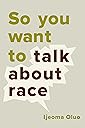
So You Want to Talk About Race
Product ID: 55736305
Desertcart purchases this item on your behalf and handles shipping, customs, and support to Thailand.
In this #1 New York Times bestseller, Ijeoma Oluo offers a revelatory examination of race in America Protests against racial injustice and white supremacy have galvanized millions around the world. The stakes for transformative conversations about race could not be higher. Still, the task ahead seems daunting, and it’s hard to know where to start. How do you tell your boss her jokes are racist? Why did your sister-in-law hang up on you when you had questions about police reform? How do you explain white privilege to your white, privileged friend? In So You Want to Talk About Race , Ijeoma Oluo guides readers of all races through subjects ranging from police brutality and cultural appropriation to the model minority myth in an attempt to make the seemingly impossible possible: honest conversations about race, and about how racism infects every aspect of American life. "Simply put: Ijeoma Oluo is a necessary voice and intellectual for these times, and any time, truth be told. " ― Phoebe Robinson , New York Times bestselling author of You Can't Touch My Hair Review: A must read for everyone. - A must read for everyone. A book that discusses a myriad of topics within race, racism, and social justice. Read if you love... - non-fiction - unlearning biases and learning - learning about social justice This is another one that's been on my TBR for way tf too long (big shoutout to the basically three years where I didn't read non-fiction). This is a must read for everyone. I feel like there are so many eloquent reviews on Goodreads and I'm struggling to put into words why you should read this. Oluo is candid and direct, often to the point of confrontation. But in a good way. A way that makes you take a deep breath and actually think about the topic, the question, what was said. I inhaled the audio, but I really want to go back and highlight so much in my kindle copy because there is SO MUCH to learn about social injustice! Content warnings: racism; racial slurs; police brutality; hate crimes; bullying; classism; cultural appropriation; misogyny; xenophobia; sexism; and more Review: I can't reduce this book to a headline. It's too important. - What author would write a book with a target audience that is likely to consider reading it, much less paying for it, akin to wishing for a root canal? Apparently, Ijeoma Oluo. I am a white, sexagenarian, male, and former CEO. I am, therefore, a r#cist. (And yes, I am being sensitive to the censors who will look at this before posting it.) And I accept that because this isn’t about me. My personal tolerance is irrelevant. If a picture says a thousand words, an action is worth ten thousand pictures. That is how we should judge each other. From my very privileged position in America, I have had a bird’s eye view of the systemic, institutional privilege (which in the negative is discrimination) that currently defines virtually all Western institutions today, including virtually all corporations. Women have not shattered the corporate glass ceiling because the corporate institution was designed and built by men. Blacks have not achieved equity in the economic arena because it was designed by white men. Which is why, as Ijeoma points out, it really doesn’t matter if the man in charge is a racist or a misogynist or not. The #MeToo and Black Lives Matter movements are all about gender and racial discrimination. What has enabled misogyny and racism, however, is the definition and allocation of power in our institutions and our society. Tolerance is great, but it’s nowhere near enough. Until we challenge the structure of power, we will not address the underlying cause of social and economic injustice. Here are the main takeaways I got from this book: - It’s not about me or Ijeoma. This is about structural injustice. - It’s not about the tone of the discussion. This is about structural injustice. - It’s not about intent. This is about structural injustice. - It’s not about who is right and who is wrong. This is about structural injustice. - It’s not about who can use what words. This is about structural injustice. In the end, the great strength and the great weakness of our political economy is our over-riding emphasis on the individual and his or her opportunities and rights. There’s nothing wrong with that per se. But in this crowded, technologically enabled world we live in, it’s not enough. We can live individually but we can only be judged collectively. Our insistence that every conversation be about me, or you, or Ijeoma, or that person over there, is blinding us to the degree that we really are all in this together. Scientists used to view the environment as a collection of independent and discrete parts. There was a prairie here, an Arctic ice field there, and a rain forest someplace a long way away. They now realize, however, that there is only one ecosystem and what happens in the rain forest is just as important as what happens in the Iowa corn field. Other scientists have discovered the same thing about the other hard and soft sciences. Biology and economics don’t cut it any more. We have to think in terms of evolutionary biology and behavioral economy. Real understanding lies not just within a functional discipline, but also in the spaces that separates them and the overlaps that interconnect them. So, I go back to my original question. Why did Ijeoma write this book? I won’t pretend to know the answer but it is clear that she has a genuine desire to see us face the issue. And after reading this book it is clear that the desire is genuine. And while it is theoretically true that if she is successful she will have to find something new to write about, so what? That is exactly the kind of binary, digital thinking that is at the heart of the problem. Life is not either/or. It is, with tolerance, and/but. Ijeoma has a perspective. And the tone is sometimes a bit harsh. But how could it not be? In the end I think the most amazing and laudable thing about her language is that she obviously worked so hard to keep a lid on her passion. If she were white, we would elect her to high office. Am I appropriating Ijeoma’s book by writing this review? Yes. But that’s irrelevant. I am not her. And my appropriation is going to paint racism with a white brush and, potentially, demean that pain. But that is the thinking of a binary thinker—either/or. And that, in the end, is what we have to overcome. Tolerant people are not binary thinkers. Tolerance is not a function of embracing the other side of the binary issue. It is about eliminating the binary divide. Ultimately, the racism talked about here is about institutional models of power that disadvantage one group over another. (And, as Ijeoma points out, there are many.) In the end, I won’t say this was the most pleasant read. It was, however, a good read. It made me think. And for that I am grateful to the author. I won’t say, “well done,” because that would be an appropriation, as if I could evaluate how well she had represented her pain. I can’t. It’s hers, not mine. I will say, however, that “I listened.” And I listened because you were clear and authentic. And I do thank you for that. A must read. Period.
| Best Sellers Rank | #607,008 in Books ( See Top 100 in Books ) #33 in Civil Rights & Liberties (Books) #99 in Discrimination & Racism #130 in African American Demographic Studies (Books) |
| Customer Reviews | 4.7 out of 5 stars 14,874 Reviews |
K**N
A must read for everyone.
A must read for everyone. A book that discusses a myriad of topics within race, racism, and social justice. Read if you love... - non-fiction - unlearning biases and learning - learning about social justice This is another one that's been on my TBR for way tf too long (big shoutout to the basically three years where I didn't read non-fiction). This is a must read for everyone. I feel like there are so many eloquent reviews on Goodreads and I'm struggling to put into words why you should read this. Oluo is candid and direct, often to the point of confrontation. But in a good way. A way that makes you take a deep breath and actually think about the topic, the question, what was said. I inhaled the audio, but I really want to go back and highlight so much in my kindle copy because there is SO MUCH to learn about social injustice! Content warnings: racism; racial slurs; police brutality; hate crimes; bullying; classism; cultural appropriation; misogyny; xenophobia; sexism; and more
G**R
I can't reduce this book to a headline. It's too important.
What author would write a book with a target audience that is likely to consider reading it, much less paying for it, akin to wishing for a root canal? Apparently, Ijeoma Oluo. I am a white, sexagenarian, male, and former CEO. I am, therefore, a r#cist. (And yes, I am being sensitive to the censors who will look at this before posting it.) And I accept that because this isn’t about me. My personal tolerance is irrelevant. If a picture says a thousand words, an action is worth ten thousand pictures. That is how we should judge each other. From my very privileged position in America, I have had a bird’s eye view of the systemic, institutional privilege (which in the negative is discrimination) that currently defines virtually all Western institutions today, including virtually all corporations. Women have not shattered the corporate glass ceiling because the corporate institution was designed and built by men. Blacks have not achieved equity in the economic arena because it was designed by white men. Which is why, as Ijeoma points out, it really doesn’t matter if the man in charge is a racist or a misogynist or not. The #MeToo and Black Lives Matter movements are all about gender and racial discrimination. What has enabled misogyny and racism, however, is the definition and allocation of power in our institutions and our society. Tolerance is great, but it’s nowhere near enough. Until we challenge the structure of power, we will not address the underlying cause of social and economic injustice. Here are the main takeaways I got from this book: - It’s not about me or Ijeoma. This is about structural injustice. - It’s not about the tone of the discussion. This is about structural injustice. - It’s not about intent. This is about structural injustice. - It’s not about who is right and who is wrong. This is about structural injustice. - It’s not about who can use what words. This is about structural injustice. In the end, the great strength and the great weakness of our political economy is our over-riding emphasis on the individual and his or her opportunities and rights. There’s nothing wrong with that per se. But in this crowded, technologically enabled world we live in, it’s not enough. We can live individually but we can only be judged collectively. Our insistence that every conversation be about me, or you, or Ijeoma, or that person over there, is blinding us to the degree that we really are all in this together. Scientists used to view the environment as a collection of independent and discrete parts. There was a prairie here, an Arctic ice field there, and a rain forest someplace a long way away. They now realize, however, that there is only one ecosystem and what happens in the rain forest is just as important as what happens in the Iowa corn field. Other scientists have discovered the same thing about the other hard and soft sciences. Biology and economics don’t cut it any more. We have to think in terms of evolutionary biology and behavioral economy. Real understanding lies not just within a functional discipline, but also in the spaces that separates them and the overlaps that interconnect them. So, I go back to my original question. Why did Ijeoma write this book? I won’t pretend to know the answer but it is clear that she has a genuine desire to see us face the issue. And after reading this book it is clear that the desire is genuine. And while it is theoretically true that if she is successful she will have to find something new to write about, so what? That is exactly the kind of binary, digital thinking that is at the heart of the problem. Life is not either/or. It is, with tolerance, and/but. Ijeoma has a perspective. And the tone is sometimes a bit harsh. But how could it not be? In the end I think the most amazing and laudable thing about her language is that she obviously worked so hard to keep a lid on her passion. If she were white, we would elect her to high office. Am I appropriating Ijeoma’s book by writing this review? Yes. But that’s irrelevant. I am not her. And my appropriation is going to paint racism with a white brush and, potentially, demean that pain. But that is the thinking of a binary thinker—either/or. And that, in the end, is what we have to overcome. Tolerant people are not binary thinkers. Tolerance is not a function of embracing the other side of the binary issue. It is about eliminating the binary divide. Ultimately, the racism talked about here is about institutional models of power that disadvantage one group over another. (And, as Ijeoma points out, there are many.) In the end, I won’t say this was the most pleasant read. It was, however, a good read. It made me think. And for that I am grateful to the author. I won’t say, “well done,” because that would be an appropriation, as if I could evaluate how well she had represented her pain. I can’t. It’s hers, not mine. I will say, however, that “I listened.” And I listened because you were clear and authentic. And I do thank you for that. A must read. Period.
R**Y
Clear, moving, informative, and truthful. Highly recommend.
This book is a great place to start in a journey toward understanding racism. I am speaking as white person who has been learning about racism for a few years now. I had some familiarity with the issues the book addresses but also found this book to be very educational. It illuminates many core issues such as microaggressions, the school-to-prison pipeline, addressing racism as a system and not just individual acts of hate, police brutality, the use of the “N” word, and more in a way that is accessible, moving, and clear. Oluo expertly balances personal stories with facts and statistics, and in doing so she paints a clear and detailed picture of the harm and scope of racism, all while giving advice throughout on how to address it. This book was written for a wide range of people; for example, it has sections addressing white people in particular as well as sections written for Black people. The book is both sensitive and truthful; how the author takes the time to explain these important and difficult issues, how she includes painful personal stories, painstakingly shares statistics that prove systemic racism, and provides critique for the common missteps that white people make is truly an act of care. I hope many people will support Oluo’s labor by purchasing this book and sharing it widely.
B**A
Race and American Socialization
So You Want to Talk About Race?” uses various illustrative analogies to make a key recurring argument: how we define racism plays a big role and how we combat it. By reducing American racism to only its most overt forms (n-word, neo-nazis, KKK robes, etc.) we allow American society to perpetuate racial stratification. The book serves as an aid to White people having difficulties grasping the more common, less sensationalized aspects of American racism, and arms all readers with the contextual tools needed to engage in constructive race talk and action. Although, there is one thing I disagree with. As this book argues, whereas White racism can have detrimental effects on Black’s ability to benefit from social institutions, reverse (anti-White) racism hardly ever serves to adversely impact the lives of Whites beyond maybe ruining their day. While merited, this argument is a little faulty. There are environments where African Americans hold discrete amounts of power and authority, with which they can effectuate prejudices. Reverse racism is a real thing and ought to be indicted where it is pernicious. However, where people who scream “reverse racism” go wrong is where they see efforts being made to redress past and present racial injustices and disparities (pro-Black aims) and shout “Hey! That’s racist!” No, it’s not. It’s race-based not racist. And reverse racism is still nowhere near as common or detrimental as anti-Black racism since Whites are the majority group. Still, a brilliant read and very informative, I will share and apply what it has taught me.
C**L
I Typically Don’t Write Out Reviews, But. . .
This is such an important topic. If I could make this book required reading for every household in America right now, I would. I’ve seen Ijeoma speak a couple of times in Seattle and I’ve read her work for quite some time now, but this book was still not at all what I was expecting in the best way possible. She really makes one think, but she does so in a way that you can tell she’s practicing what she is preaching. While I recognize how much progress I’ve made through the years to deprogram myself from the fallout of growing up in a white supremacist society and recognize my privilege, I also realized during my reading how much more I need to improve. For instance, how can each of us find the intersectionality with our privileges, as she discusses in one of the chapters? Luckily, the author provides actionable recommendations as she calls out areas where she too needs improvement as well. This book answered so many questions I’ve been wondering, but was too afraid to ask because I don’t want to put that burden on my non white friends. My mind is reeling at all the information and ideas, but for now I’m going to take some time and really process what I just read. She takes a super heavy topic, makes it accessible, and does so in a personable way which allows the reader to relate in unexpected ways. If I could only recommend one book I’ve read within the past year to people, it would be this one. Nicely done, Ijeoma! I look forward to cheering you on in your inevitable continued success and reading more of your work.
E**Y
A Book For The Curious & Committed to Justice
've been a fan of Ijeoma Oluo's writing for several years, having followed her around on social media, as well as been a contributing member of The Establishment for a while. When I heard she was writing a book about race I was...well thrilled probably isn't the right word. SO YOU WANT TO TALK ABOUT RACE was so many things for a mixed person like me, who benefits from an overwhelming amount of privilege. Going into it already with an appreciation for Ms. Oluo's writing, I expected to be challenged, to maybe even be a little defensive, to want to put down the highlighter and pen occasionally so I could pick up the band-aids for my emotional ouchies. Which I did. What I DIDN'T expect was to see myself in the pages from another side. But something so wonderful about both Ijeoma's writing in general, and SO YOU WANT TO TALK ABOUT RACE specifically, is its accessibility; so often as a mixed person with one white parent and a parent who is both Filipino and Italian I've felt like when it comes to race there's just nowhere where I belong. I look white to most people and know I have white privilege so for most of my life that was how I identified. Indeed, during the majority of my time reading Ms. Oluo's book I was either learning (for example, while I "knew" that many police organizations had historical ties to racist origins, I did not know the extent, or the depth of where they grew from. I also spent much of the book feeling horrified and/or angry at the way Ijeoma was treated by friends, colleagues, even her family. These feelings of horror at acts of blatant racism or mere ignorance come from a place of privilege, I know. Despite the fact I nodded along to many sections (I ALSO HAVE A DEGREE IN POLITICAL SCIENCE!!) including the chapters about the white washing and sexism in the tech industry, where I work. I knew that I couldn't understand what it was like to be affected by these kinds of marginalizations. That is until I got to the chapter about the model minority myth - which I was intimately familiar with, my grandfather having served white Americans his entire life - and I almost cried. The stories he told me about what he had to do to leave the Philippines and become a citizen, the way the Navy, who he's so proud to have served in, treated him, all came to my mind. Race is complicated, as this book makes clear. Ultimately though this book wasn't about me. SO YOU WANT TO TALK ABOUT RACE was written TO me, and everyone else reading it. And while I won't "spoil" the ending, I'll say that by the conclusion, when I got to the last chapter and the question within, I didn't have to hesitate even for a moment with my answer. I have a feeling that the more time readers spend with Ms. Oluo's writing - if they truly seek to absorb it - they won't have to either.
B**N
so helpful and informative
It seems the author wrote this book with the understanding that people were going to get triggered and stop reading at a certain point. It starts off straightforward and somewhat like a job training type approach. Slowly, over the course of the book, the author shares more personal details, more of her passion and heart and longing for a better world. She shares the why behind her book from the beginning, making it clear that the lives of non white people are at stake. She saves the heaviest hitting chapter for almost the end, hoping anyone who made it that far might consider what she has to say, despite the difficulty in hearing it. Finally, a call to action in any way we can safely manage, with many suggestions as to how to go about that. There were some parts of the book I didn’t agree with. For me, this did not detract from the importance of the overall message. I care about this issue and I’m willing to set aside some disagreements to work together for positive change. The author believes this change is possible and cites evidence. Her solution does not involve violence, or a major overall of government. Her solutions are extremely doable. Piece by piece, one step at a time. I’m grateful for this book and the impact it had on me, and all the things I learned.
N**I
Life-changing
This book had me on the edge of my seat. It was as if my life was being played on a major movie screen. So many times we as colored people feel in so many instances like we were the bad guys for feeling the way we do towards systemic racism, but through this book I'm far from being alone. My eyes are truly opened now, and I will be a man of talk and action. Sooo good!
J**A
Amazing book.
Opened new horizons on my everyday life and on how I encounter race. It helps you understand better and think about how you affect other people.
V**V
This book takes no prisoners and an absolute must-have
This book is meant to make the very broad, nuanced and very often difficult subject of race accessible to those who wish to discuss it and it does so very well. Ijeoma's prose is empathetic, engaging, easy to follow, laden with historical examples and contexts, and backed by credible data and sources. She wants to get you talking about it. She also does not sugarcoat a thing. For marginalised people, but ESPECIALLY black people, this may be a bit of a draining read in places. I highly recommend it, but Ijeoma lays extremely bare her own personal experiences, ones that resonated with me and might do the same for you in a way that may leave you raw, bitter, cynical, hurting, scared, frustrated, uncertain, livid, and a host of other things, not the least of which is Tired. She makes you feel. That might be more than you want to deal with at times, but, if nothing else, it reinforces that you are not alone. There is also plenty of levity and working optimism, so it is not all bad. Many sections are addressed to white people, but, like she, I recommend it to everyone, especially if you're part of a marginalised group and know something doesn't sit well with you or if you come across something racially charged, but have no idea how to approach or articulate it or if you even should. It's a great help in that regard. The title also does the book a bit of a disservice, because it discusses INTERSECTIONALITY, which is of paramount importance. Race intersecting with things like gender and sexual identity, mental health, ability, others, and their impacts. It's something of all-around guide to people of today, incredibly relevant and handy to have and handles the topic thoughtfully. Not only does she challenge white people, but black people, others, the system, and, actually, herself. She challenges us all to be better, more mindful, considerate and inclusive. The tragedy of this book is that it needed to be written at all, but it's absolutely wonderful, worth your time, your money, and your consideration.
G**A
FANTÁSTICO
Me está encantando! Lo recomendaría a cualquier persona!
A**R
Gut nachvollziehbare Aufklärung über ein wichtiges Thema
Die Autorin macht eine Auslegeordnung über den momentanen Rassismusdiskurs in den USA und erklärt wichtige Konzepte und Standpunkte. Das Buch ermöglicht es jedem, sich in die Rolle einer andersfarbigen Minderheit zu versetzen.
م**د
Book delivered in bad condition and return problems
I think everything related to this book was not in order. It was delivered in a bad condition with cuts and folds in the back and scratches in the front. Ordered an exchange but haven't received one yet and it has been nearly 2 months.
Trustpilot
2 days ago
1 day ago