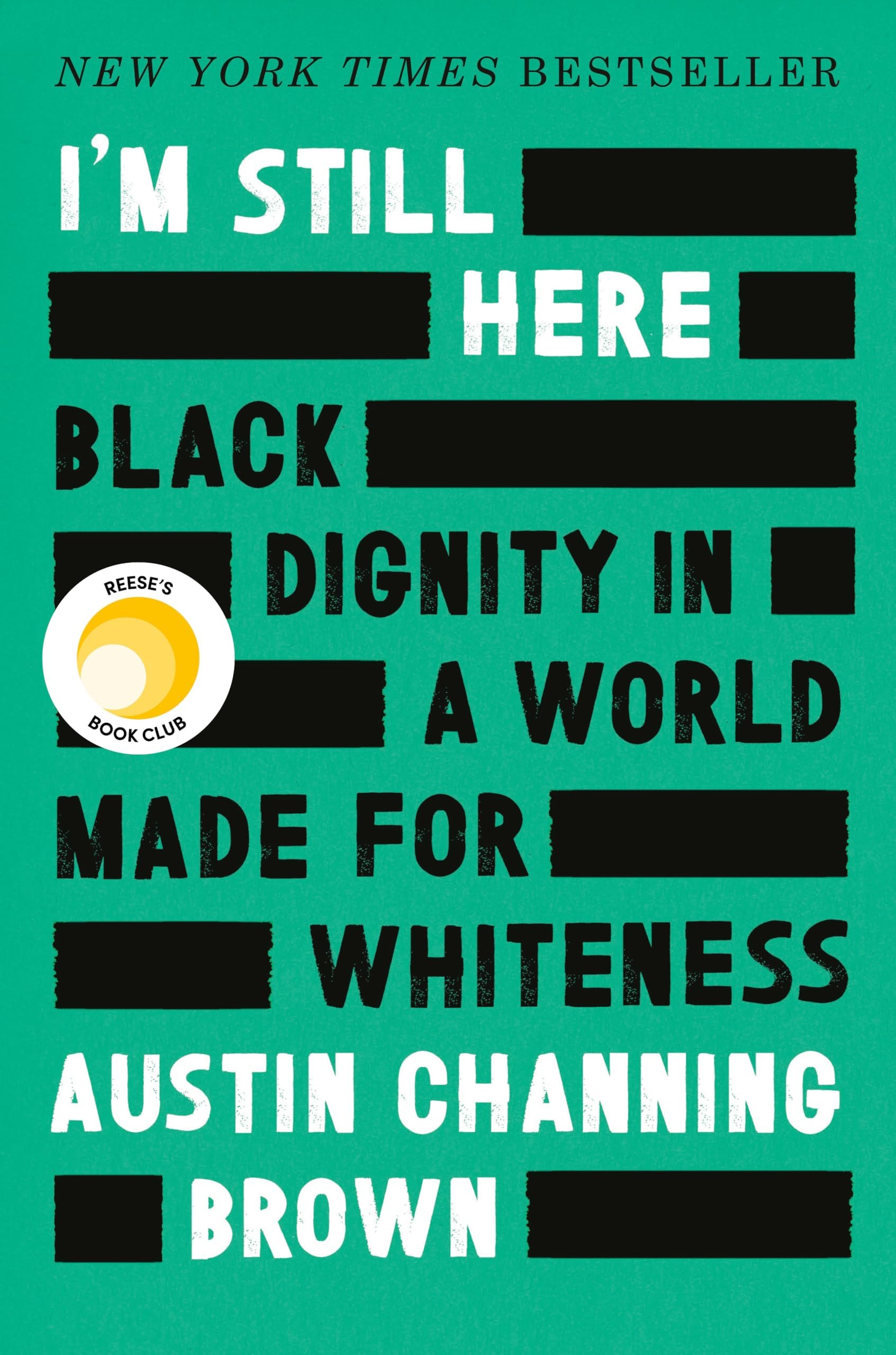
I'm Still Here: Reese's Book Club: Black Dignity in a World Made for Whiteness
Product ID: 63939215
Buy anything from 5,000+ international stores. One checkout price. No surprise fees. Join 2M+ shoppers on Desertcart.
Desertcart purchases this item on your behalf and handles shipping, customs, and support to Thailand.
NEW YORK TIMES BESTSELLER • REESE’S BOOK CLUB PICK • From a leading voice on racial justice, an eye-opening account of growing up Black, Christian, and female that exposes how white America’s love affair with “diversity” so often falls short of its ideals. “Austin Channing Brown introduces herself as a master memoirist. This book will break open hearts and minds.”—Glennon Doyle, #1 New York Times bestselling author of Untamed Austin Channing Brown’s first encounter with a racialized America came at age seven, when she discovered her parents named her Austin to deceive future employers into thinking she was a white man. Growing up in majority-white schools and churches, Austin writes, “I had to learn what it means to love blackness,” a journey that led to a lifetime spent navigating America’s racial divide as a writer, speaker, and expert helping organizations practice genuine inclusion. In a time when nearly every institution (schools, churches, universities, businesses) claims to value diversity in its mission statement, Austin writes in breathtaking detail about her journey to self-worth and the pitfalls that kill our attempts at racial justice. Her stories bear witness to the complexity of America’s social fabric—from Black Cleveland neighborhoods to private schools in the middle-class suburbs, from prison walls to the boardrooms at majority-white organizations. For readers who have engaged with America’s legacy on race through the writing of Ta-Nehisi Coates and Michael Eric Dyson, I’m Still Here is an illuminating look at how white, middle-class, Evangelicalism has participated in an era of rising racial hostility, inviting the reader to confront apathy, recognize God’s ongoing work in the world, and discover how blackness—if we let it—can save us all. Review: Gave me great insights but little hope - Well. If the reader is looking for a book that provides some hope for racial reconciliation, at least at the level Ms. Brown would like to see, this may not be it. It is powerfully written, eye opening, thought provoking, and poignant. It is also angry, unforgiving, and implacable. It was difficult for this white woman to read, yet I did my best not to judge, not to argue or defend along the way, but just to listen. And there is a world of pain, hurt and anger to listen to. Easy to see why she is fed up. I see that I have been pretty clueless about many of the assumptions I've held, maybe the biggest one being that lack of access to opportunity and fair treatment are the biggest racial projects that need work. Those sound like a piece of cake compared to what the author seems to be saying. The clue I think is in part of the title: Black Dignity. To be tolerated, accepted, included and given a voice in white organizations and institutions as a black person is too superficial for Ms. Brown. What she seems to be getting at goes deeper, to the dignity of feeling one ‘belongs’ in ways I find more difficult to comprehend, maybe because I haven’t experienced being so ‘out’ of the majority culture as have other groups. She gives very little if any credit for what most white folks would call progress, considering little of it meaningful change at best, and at worst, hurtful and exhausting to blacks. The picture she paints certainly make the white people in her orbit look painfully clumsy and oblivious, if at times well meaning. They often made me squirm in discomfort so I can only imagine Ms. Brown’s experience. Bottom line, I appreciated most the parts where she is recounting her own experiences and how she feels about them. Though difficult to accept, I can say it gave me much more insight into what some blacks experience and it continues to sink in in new ways as I process. But it has taken away any of my naïve expectation that we can solve this in a way Ms. Brown would find meaningful any time soon. That seems to be her take also. I'm left with the conviction that maybe for now, the best thing a white person can do is to simply open themselves up to these stories of pain and anger, keeping judgement, argument or defense to a minimum for the moment, difficult as that may be. And let it work on you. For our black friends and neighbors to be sincerely and compassionately heard and for white people to be present and open to some hard truths, is surely a necessary step if we have any hope of healing racial wounds. As I was reminded recently, listening doesn’t have to mean agreeing. Agreement/disagreement questions can be saved for another day. Review: Next level Anti-racist Memoir - Wow. Wow. Wow. Wow. Wow. This book is powerful. It is “next level.” In fact, I would say it is the next level in our journey as human beings toward anti-racism within our world. Austin Channing Brown, an African American woman, named like a white man, understands and explains racism toward Black people in America in ways I’ve never understood and think many white people are oblivious to. She addresses white supremacy, white privilege, white ignorance, white fragility, white guilt, white shame. Every chapter was like a sucker punch to the gut. I couldn’t put this book down. This book caused me to repent of things like white supremacy and privilege because I am white and even though I am not American, I can see how this plays out in Australia too. But now that I live in America, I don’t want to be part of white racism against Black people. I don’t want to be part of the problem, and this book will teach anyone just how humungous the problem really is. My two favorite chapters were 4 and 5. I read chapter four to my husband (who is white American) and he was reeling. We were both shocked as we learned how Black history is bypassing in school curriculum; how we white people have a tendency to run away from our complicit guilt—to deny what our ancestors have done to Black people, people of other races and the Indigenous. I cried as she touched on the history of lynching. I resonated with the sentiments of the white person who said, “Doing nothing is no longer an option for me.” Chapter five explained how many unidentified racist behaviors and comments can occur within one short day in the workplace. A white woman touching a Black woman’s hair without permission. White people assuming that Black people are poor and must be looking for the “outreach center,” rather than recognizing a co-worker or the possibility that this is your co-worker! White people showing offence when Black people don’t eat with them or are wearing headphones while working, even though the White people also use headphones. Black people being told by the boss about email complaints and asked how they can perform better, instead of asking how the White person might perform better and be kinder to the Black person! When a Black person expresses any form of negativity its interpretation is exaggerated by the White person. Using the Black employee to educate White people about racial issues. Thinking that all Black people look the same and mistaking one Black colleague for another. White colleagues interpreting Black colleagues to other White colleagues in order for their ideas to be considered or accepted. Every white American needs to read this book. And other cultures would benefit from it too. Black people will love this book and hopefully find a little healing and comradery in its pages. They may also become angry as they realize just how much racism persists. Phenomenal book, thank you Austin. PS, I love your name!


| Best Sellers Rank | #78,867 in Books ( See Top 100 in Books ) #202 in Discrimination & Racism #226 in Black & African American Biographies #416 in Sociology Reference |
| Customer Reviews | 4.7 out of 5 stars 11,635 Reviews |
D**E
Gave me great insights but little hope
Well. If the reader is looking for a book that provides some hope for racial reconciliation, at least at the level Ms. Brown would like to see, this may not be it. It is powerfully written, eye opening, thought provoking, and poignant. It is also angry, unforgiving, and implacable. It was difficult for this white woman to read, yet I did my best not to judge, not to argue or defend along the way, but just to listen. And there is a world of pain, hurt and anger to listen to. Easy to see why she is fed up. I see that I have been pretty clueless about many of the assumptions I've held, maybe the biggest one being that lack of access to opportunity and fair treatment are the biggest racial projects that need work. Those sound like a piece of cake compared to what the author seems to be saying. The clue I think is in part of the title: Black Dignity. To be tolerated, accepted, included and given a voice in white organizations and institutions as a black person is too superficial for Ms. Brown. What she seems to be getting at goes deeper, to the dignity of feeling one ‘belongs’ in ways I find more difficult to comprehend, maybe because I haven’t experienced being so ‘out’ of the majority culture as have other groups. She gives very little if any credit for what most white folks would call progress, considering little of it meaningful change at best, and at worst, hurtful and exhausting to blacks. The picture she paints certainly make the white people in her orbit look painfully clumsy and oblivious, if at times well meaning. They often made me squirm in discomfort so I can only imagine Ms. Brown’s experience. Bottom line, I appreciated most the parts where she is recounting her own experiences and how she feels about them. Though difficult to accept, I can say it gave me much more insight into what some blacks experience and it continues to sink in in new ways as I process. But it has taken away any of my naïve expectation that we can solve this in a way Ms. Brown would find meaningful any time soon. That seems to be her take also. I'm left with the conviction that maybe for now, the best thing a white person can do is to simply open themselves up to these stories of pain and anger, keeping judgement, argument or defense to a minimum for the moment, difficult as that may be. And let it work on you. For our black friends and neighbors to be sincerely and compassionately heard and for white people to be present and open to some hard truths, is surely a necessary step if we have any hope of healing racial wounds. As I was reminded recently, listening doesn’t have to mean agreeing. Agreement/disagreement questions can be saved for another day.
E**J
Next level Anti-racist Memoir
Wow. Wow. Wow. Wow. Wow. This book is powerful. It is “next level.” In fact, I would say it is the next level in our journey as human beings toward anti-racism within our world. Austin Channing Brown, an African American woman, named like a white man, understands and explains racism toward Black people in America in ways I’ve never understood and think many white people are oblivious to. She addresses white supremacy, white privilege, white ignorance, white fragility, white guilt, white shame. Every chapter was like a sucker punch to the gut. I couldn’t put this book down. This book caused me to repent of things like white supremacy and privilege because I am white and even though I am not American, I can see how this plays out in Australia too. But now that I live in America, I don’t want to be part of white racism against Black people. I don’t want to be part of the problem, and this book will teach anyone just how humungous the problem really is. My two favorite chapters were 4 and 5. I read chapter four to my husband (who is white American) and he was reeling. We were both shocked as we learned how Black history is bypassing in school curriculum; how we white people have a tendency to run away from our complicit guilt—to deny what our ancestors have done to Black people, people of other races and the Indigenous. I cried as she touched on the history of lynching. I resonated with the sentiments of the white person who said, “Doing nothing is no longer an option for me.” Chapter five explained how many unidentified racist behaviors and comments can occur within one short day in the workplace. A white woman touching a Black woman’s hair without permission. White people assuming that Black people are poor and must be looking for the “outreach center,” rather than recognizing a co-worker or the possibility that this is your co-worker! White people showing offence when Black people don’t eat with them or are wearing headphones while working, even though the White people also use headphones. Black people being told by the boss about email complaints and asked how they can perform better, instead of asking how the White person might perform better and be kinder to the Black person! When a Black person expresses any form of negativity its interpretation is exaggerated by the White person. Using the Black employee to educate White people about racial issues. Thinking that all Black people look the same and mistaking one Black colleague for another. White colleagues interpreting Black colleagues to other White colleagues in order for their ideas to be considered or accepted. Every white American needs to read this book. And other cultures would benefit from it too. Black people will love this book and hopefully find a little healing and comradery in its pages. They may also become angry as they realize just how much racism persists. Phenomenal book, thank you Austin. PS, I love your name!
N**N
This Book was amazing
As a woman who is also African American, the first word just hooked me right away “White people can be exhausting” when I read that I thought no truer words could be spoken. I read this book for my English class, at first I didn’t want to read it because it was only 192 pages and I wanted to challenge myself with a longer book. But when I read the first words and just had to read more. And I am so glad I did. I felt like it was actually me in the book like it was my life with just some minor changes. The author not only talks about the struggle of being a black woman but she also talks about not fitting the expectations of others even within your own race. She talks about the struggles of not being “black enough” when she goes to her dad’s all-black neighborhood for the summer from her mostly white Catholic school. I love how she doesn’t just talk about not being accepted in white culture but black too how sometimes people of color “talk white” and are an “oreo” and feel that just don’t belong anywhere. I felt like she was me at that moment because I went from an all-white private school to a very diverse public school and I felt l would never fit in I was to black for white people and to white for back people. Anyone who has experienced that would definitely love this book. Also her writing style I enjoyed very much how she went back and forth between her young and older self and how she explained how everything she experienced as a black woman stuck with her and made her who she is. One thing I remember because it stuck with me was a trip she took when she was in college. It was a tour of the south and slavery. It was a half black half white tour. At first, the author was excited to go on the tour and learn but when she heard things like “happy slaves” and “it wasn't our fault because we weren’t there” it really shocked her and changed her view on how white people really want to teach American American history. She also went to a museum where she saw pictures of black people lynched or burned and white people just standing there and smiling proud of what they have done. That made her stomach drop. Finally, at the end of the trip, one of the African American girls got up and spoke on how white people were just so evil. This book made my heart stop in more ways than one. I would highly recommend it to African Americans of all ages and even people not of color. It is hard to stomach some of the things we still have to go through because of how we look but once we stand up and don’t back down we can look back and be proud of our accomplishments.
D**N
almost there
i admit i went into this book wanting to learn certain unnamed things and so the fault in my almost but not quite satisfaction in the book lies with me. i wanted more concrete examples throughout the book to help me better understand and while there were some very concrete examples, dense me needed more. that said, this is a beautifully written book. intelligent and delivering the information needed to cut through the surface of what we only think is happening in order to reach what is truly going on. i can remember the first time i saw a black person i was in first grade. two black girls were in my class and i was fascinated by them. yes, that was me, wanting to touch their hair and it took how many decades for me to understand how that would make a person feel as an object to someone else's curiosity. oh my gosh, NOW i get it. and it shouldn't have taken decades for me to realize this. while i wanted most to be friends with the two black girls in my class, they steered clear of me. very likely they sensed my curiosity and of course were not interested in being the objects of such open fascination. reading this book has helped me understand more fully. the trouble with me is that now that i've read the book, where exactly do i go from here? i think that this in itself is good testimony to why this is a good book.
C**D
Wow! Eye opening, convicting, and beautifully written.
This was a very quick read. The author sucked me in immediately and I could not put the book down, other than to wipe my tears and refocus my vision as I recognized myself in too many scenes I now realize as unintentionally racist. I can’t believe Austin’s publisher had to convince her she is a writer, it is clearly part of her soul, and I am glad for those who encouraged her to share these words with a wider audience. You must read this book. It doesn’t take a lot of time, but it could be the most transformative hours of your life. The author has an absolutely magical art for putting words together, not just painting a picture, but communicating the emotion of the scene she describes. This is a powerful gift, something I believe was written into her DNA by the God she so clearly adores, to be used for the edification of all who read this. In a perfect world, every “nice white Christian” (as I have always seen myself) in America would read this, and open our eyes to how often we push minority co-workers, neighbors, fellow church members, and friends into fitting into a version of themselves that we are comfortable with. I pray this author writes many, many more books. I will read all of them. Especially the ones that make me squirm, because those are the ones I need.
V**R
Be Shocked, Absorb the Lessons, Change Your Perceptions and Behavior
I'm an 83 year old White Guy and did not think I had a racist bone in my body. I was wrong. I discovered I have a lot of racism going on within me, not intentionally, it is ignorance rather than malice, but it is there and it is hurtful to people of color and to my own self esteem. This book opened my eyes and motivated me to make changes. The author bares her soul and shares deep insights. Some of it is very hard to take. All of it is very real. Much of it is her own experiences, insightfully written up and very raw. Her very personal involvement and commitment are apparent on nearly every page. Her book is not an east read, not because of her writing, but because of its emotional impact. Some may not be able to handle it. But if you are fertile ground, like in Jesus' Parable about the Sower of Seeds, you will experience a Great Awakening from having read this book!
A**R
Wonderful book that everyone should read
I read this book in one sitting. Went between the ebook and audiobook and both were excellent. Austin Channing Brown shares her experience as a Black Christian woman, when even her name challenges people's assumptions about her. She shares her experience with the many microaggressions she deals with daily at work in the Christian nonprofit, at her school and in college, how often she has to be cognizant of white fragility, how she has to listen to the confessions of white guilt. She explains the burden that places on Black people every day. I appreciated her sharing her love of the library and reading, her experience as a student in predominately white schools and the burden some teachers would place on students to be the spokesperson for their race. Her love for her Black church and learning about Black Jesus was touching. Her thoughts on Obama's election and the Black Lives Matter movement really resonated with me. I really enjoyed her interlude to her son and overall appreciate her sharing her experience. I hope it opens people's eyes. I was so happy that Reese Witherspoon chose it for her bookclub pick, as I think a lot of people need to read this and become more aware of their behavior. There will be no change without people's willingness to learn.
T**N
Powerful messages from a Black woman's lived experience (in the U.S.)
Powerful messages from a Black woman's lived experience (in the U.S.), here for you to digest and absorb at your own pace. Austin Channing Brown is a wonderful writer, deftly correlating her personal stories to larger systemic issues. She covers a wide variety of her encounters, occurrences, and trials that span school, religion, work, age, and more. While the topics and stories can be challenging for those of us who are white, such as her chapters on white fragility and nice white people, open your mind, focus on empathy, and embrace it as a learning opportunity. We can—and must—do better. It was particularly interesting to hear how her childhood in a middle class, Christian, Black family in the Midwest surrounded by white communities (at school, church, and socially) shaped her perspectives. She had many of the stereotypical benefits, such as family and financial stability, well-funded schools, and access to university-level education. Yet she was immersed in white culture that emphasized her membership in the out-group (not white) and limited her exposure to many aspects of Black culture. She goes on to discuss how this affected her at later stages in life and the personal growth she experienced. "Instead of offering empathy and action, whiteness finds new names for me and offers ominous advice. I am too sensitive, and should be careful with what I report. I am too angry, and should watch my tone when I talk about my experiences. I am too inflexible, and should learn to offer more grace to people who are really trying." Before you ask your Black friend about their traumatic stories—yes, they most likely have them—settle in and absorb Austin Channing Brown's experiences.
J**N
Thought provoking and inspiring
I was confronted with my own biases and encouraged and challenged by Austin’s stories and honesty. Highly recommend this book.
J**L
Should be required reading for all white people of faith
I learned of this book via another author, Nadia Boltz-Weber, who’s recommendation came in the wake of the murder of George Floyd. Austin Channing Brown powerfully articulates her story as a Black women of faith. Her words move and enlighten me, a white women of faith. My heart is broken in the deeper realization of how BIPOC live in a constant state of fear. I am awestruck by the spirit of persistence & perseverance in the midst of “the shadow of hope” that the author bears witness to. “White people are exhausting”.....yes Austin, you are so accurate. Your memoir will fuel my anti racism work.
S**A
A book that will change my thinking
A book that is not only well written, but also stimulates thought. Have I really always behaved correctly towards my fellow human beings as I assume? Could they have been hurt by some comment from me - unintentionally, of course, but that doesn't make it any better. After this book, I will first of all talk to my friends and colleagues to find out whether I have ever offended or hurt them, better pay attention to how I treat others and stand up for others when I notice any (racist) injustices. The part in which Austin Brown reported her day in the office particularly shocked me. How can you treat someone like this and didn't recognize it? In addition, the letter to her - at the time still unborn - son took me away. About all the joy about the unborn also the worries you have as colored parents. I wasn't aware of that before. In conclusion, I can say that this is one of the few books that will change my thinking and acting. Thank to Austin Channing Brown for this really important book.
C**S
Required reading
I devoured this book. Austin writes with a poetic voice that is beautifully crafted while laying bare the harshest realities. this book will make you think, will open your eyes (if you are white) to a world we are so often blind to, and will challenge you to ask important and necessary questions. if you take this book seriously you will not be able to walk away unchanged, it will prompt you to join her in saying, “Doing nothing is no longer an option for me.” I will be thinking about this book for a long while to come.
W**V
An accessible and very necessary read
Austin Channing Brown does a brilliant job of explaining the history and persistence of structural racism and the impact on black people in the present day through the lens of her own experience. The book is personal and persuasive, but very much grounded in the wider context of life in the US (still relevant for British readers!). I felt like I read it quickly but the book encapsulated a lot of issues, and I'd recommend it for anyone wanting to know what others' experience every day and may not talk about. Her own journey, as described through the book, brings to life her own growing understanding of race and identity, and how her thoughts have evolved in a way other readers should relate to.
Trustpilot
1 month ago
2 months ago