We remain fully operational. Our teams are working around the clock to ensure your deliveries continue safely.

DOWNLOAD THE APP


Copyright © 2025 Desertcart Holdings Limited
DOWNLOAD THE APP


Buy anything from 5,000+ international stores. One checkout price. No surprise fees. Join 2M+ shoppers on Desertcart.
Desertcart purchases this item on your behalf and handles shipping, customs, and support to Thailand.
🎸 Elevate your sound with 149 effects in a pedalboard-sized powerhouse!
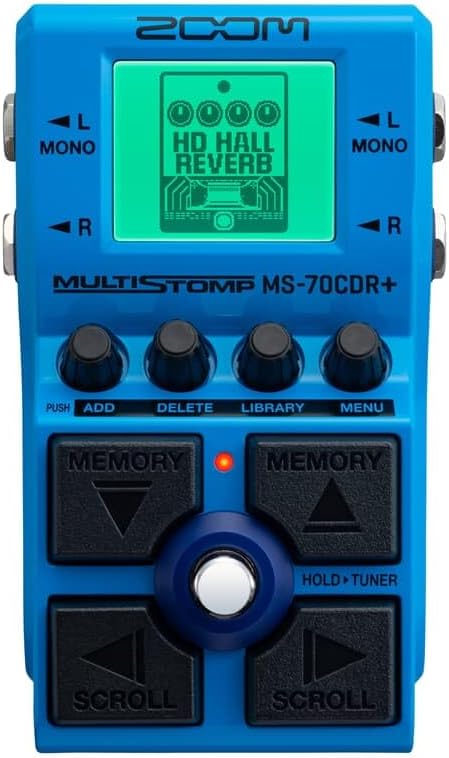
The Zoom MS-70CDR+ is a compact, battery-powered multi-effects pedal offering over 140 high-quality chorus, delay, reverb, and modulation effects. Featuring 24-bit/32-bit audio processing, stereo I/O, and the ability to chain up to 6 effects simultaneously, it delivers professional-grade sound in a rugged metal chassis. Ideal for guitarists and keyboardists seeking versatile tone-shaping on the go, it combines studio-level audio clarity with intuitive controls and up to 7 hours of battery life.


| ASIN | B0CY5DWS46 |
| Amperage | 16.0 |
| Audio Output Effects | Modulation, Chorus, Delay, and Reverb |
| Best Sellers Rank | #2,904 in Musical Instruments ( See Top 100 in Musical Instruments ) #9 in Electric Guitar Floor Multieffects |
| Brand Name | Zoom |
| Color | blue |
| Connector Type | USB Type-C |
| Controls Type | Knob |
| Customer Reviews | 4.4 4.4 out of 5 stars (202) |
| Hardware Interface | USB |
| Item Dimensions | 5.24 x 3.11 x 2.4 inches |
| Item Dimensions L x W x H | 5.24"L x 3.11"W x 2.4"H |
| Item Weight | 15 Ounces |
| Manufacturer | Zoom |
| Manufacturer Part Number | MS-70CDR+ |
| Model Name | MS-70CDR |
| Model Number | MS-70CDR+ |
| Power Source | Battery Powered |
| Set Name | Guitar Effects Pedal Presets |
| Signal Format | Analog |
| Style | Blue |
| Unit Count | 1.0 Count |
| Voltage | 28.0 |
| Warranty Description | 1 year - replacement. |
B**.
A smorgasbord of fun effects
Just so you know, I'm using this pedal as a desktop effects unit for synths, samplers and drum machines, so I can't comment on its performance with guitars. That said, for the money, this is an excellent multi effects unit. Build quality is compact and sturdy. Operating it with my hands, the navigation buttons are easy to use. The effect adjustment knobs are smallish, though, and may be a bit of a challenge to adjust for those with bigger hands. Bypass operation is also a little awkward, but since I won't be depending on this in a live situation, it's ok. Stereo ins and outs, and a surprisingly nice backlit display. This unit can be battery/AC adapter powered, and as usual, you have to provide your own AC adapter if you wish to go that route. Note that for whatever reason, they recessed the port for the AC adapter, so some people have reported trouble attaching an adapter plug. As long as the barrel of your adapter plug isn't too chunky, you should be ok, but you've been warned. Sound quality is good for most of the effects - they've built some decent delay, reverb, chorus and phaser algorithms into this unit. May not compete with $$$ dedicated effects, but the Zoom MS-70CDR+ offers a lot of sonic bang for the buck! Aside from the bread and butter effects they also included a few unusual algorithms that are sure to reward those adventurous souls among us. Anyway, if you're looking for a 'Swiss Army Knife' effects unit for your synths, samplers and drum machines, the Zoom MS-70CDR+ is well worth checking out! :)
S**1
Innovative design with tons of value
The Zoom MS-70CDR+ (Multi-Stomp) is an updated version of a multi-effects pedal by the same name (Minus the “+”) that was released around 2013. I never owned the original, but have had some favorable experiences with Zoom products in the area of budget multi-effects units (G1Xon) and recording devices (R4 MultiTrak recorder). For whatever reason, Zoom has not gained widespread popularity for their guitar pedals, though the original MS-70CDR was very well-regarded by those that owned one, particularly for its chorus and delay sounds. In my early experience owning the MS-70CDR+, I’ve been really impressed with the device. It has some limitations, as all products do, but relative to the price point (around $120 U.S.), it’s an insane value once you consider how much it would cost to try and compile just a few of the effects in there in standalone pedals. Here are my thoughts on what I liked and didn’t like about the pedal. --- PROS: --- Innovative Design – Zoom’s (guitar effects) reputation is for budget gear in a plastic enclosure meant for beginner players, but that does not describe the MS-70CDR+ at all. Everywhere you see light blue on the pedal is metal, and only the sides and back are plastic. I’ve owned and sold tons of pedals and never come across a design layout quite like this. The whole thing is the size of a BOSS compact pedal, but they’ve managed to cram 5 large switches on the bottom part, plus 4 encoder knobs, and a decently-sized screen. I would say that only the metal bypass switch and the two lower black buttons are easily “footswitch”, but all of them are great to operate with your finger, and being able to hit the ancillary buttons is less important on this device compared to the looper in the same pedal line. Audio Quality – If there is one thing Zoom does well, it is audio quality and digital encoding, and this unit features “24-bit A/D/A and 32-bit processing”. What this means is better clarity and less risk of effects clipping or distorting than the digital effects of years past. Effects Selection – If you’re interested in the Multi-Stomp, the primary draw is the sheer value and number of effects available. For just over $100, you can purchase this one pedal and have access to dozens of delay, modulation, reverb, and other effects (filters, dynamics, EQ’s, and a tuner accessible by long press on the bypass switch). Moreover, these can be run in chains of up to 6 effects, though some of the CPU-hungry algorithms may require you to use a few less. This pedal is great for covering niche effects that maybe you don’t want to buy a dedicated pedal for, but would use on occasion if available. Something like a chorus or a shimmer reverb is a good example of that for my playing. No, the quality doesn’t rival Eventide, Strymon, or other premium brands, but some of them are quite good. Moreover, the number of parameters offered for some of the effects is quite impressive. For example, the pedal has a Dual Delay, which is great for a U2-style “dotted eighth plus quarter note” style of delay. I have other pedals that can accommodate dual delay lines to some degree, including the BOSS DD-200 and MXR Joshua. But few dual delays can handle tap tempo time sync, modulation, and control over the relative mix and feedback of each delay line – the MS-70CDR+ does this and sounds really good. Oh, and those competitor pedals I mentioned cost twice as much as this one, and do not include a library of 149 effects. Battery Power – This is big one for me. A pedal like this would be great on a pedalboard for its flexibility, but the real appeal is taking some of that effects functionality you would get in something like a Helix and placing it in a small pedal that can run on two AA batteries for 7 hours. I pulled the trigger on the MS-70CDR+ when I realized how useful it would be for acoustic guitar. I can create simple signal chains with reverb, EQ, pitch shifting, and a slight hint of compression – no power cable required. --- CONS: --- MIDI Capabilities – If the MS-70CDR+ were fully MIDI-capable, it would a powerhouse unit for pedalboards. Unfortunately, the connectivity is only MIDI over USB (which requires a USB “host”), and I believe the control is limited basically to program changes, which means flipping through presets. The U.I. on the unit itself is actually quite good, but if you’re a power user looking to activate a particular chain of effects with a particular set of parameters via MIDI, this probably isn’t the unit for you. (Maybe check out something like the Helix ONE in that case.) However, the number of sub-$200 digital units that have any meaningful MIDI capabilities is pretty sparse, so I think it’s a little silly to ding the MS-70CDR+ on MIDI when it does so much for so little. Poor Access to 9V Jack – This one was sort-of an “own goal” by Zoom, as there must be design reason why the circular 9V power jack is recessed almost a full centimeter into the unit, but I’m not sure what it would be. If you have a right-angle power plug (as many are), it might not work. Moreover, the unit reportedly draws 500mA of current, which is a pretty huge number and in excess of what many standard power supplies for pedal boards could supply. The issues power the device are mitigated somewhat by the option to power using a USB-C cable and, of course, the ability to use it with batteries, which I plan to do almost exclusively. Mobile App Requires Cable & Is Not Free – This one seems to drive people nuts, and if you see any reviews of the MS-70CDR+ where there’s a bunch of reduced scores, chances are pretty good it’s due to anger over the phone app. For whatever reason, Zoom made a phone app available to use with the pedal, but it costs 99 cents. I did pay this and actually find the app pretty useful. I also handles firmware updates, which is a nice side-benefit, but if you’re designing six-pedal signal chains from scratch and re-naming and re-ordering them, it’s a bit easier to do on the app. Note that you need a USB Camera Connection kit for some Apple products, in order to hook it up to the USB-C jack. Also, I find it annoying that you cannot work on patches while “offline” and disconnected from the device. I would love to work on my presets and browse the effects library while waiting somewhere on my phone, but it needs to connect to the pedal to do that. --- CONCLUSION: --- I really can find little fault with this insanely-valued pedal. The encoder knobs are a little small and fiddly, and the workflow on the pedal does have a slight learning curve. However, everything about the pedal is fully intuitive and even if you only liked a fraction of the effects, it would still be well worth owning. To me, this is the perfect Swiss Army Knife to pair with an amp modeler like Tonex ONE, or to use with acoustic guitars, synths, or other instruments.
A**N
HUGE improvement over last vesrion!
First of all, massive improvement sound wise from the 1st version which I own. Keep in mind, this DOES NOT have distortion models, which I don't need but for some that's a deal breaker. The new "Shimmer+" reverb is leaps and bounds over the last shimmer, which they have if liked the sound of the old one. To my ears, overall the sound is much better. Build quality great. I love the bigger navigation buttons. They are big enough to tap with you toe if you play barefoot or are just really talented with shoes, but I really don't think that was their goal. The old MS-50 had navigation buttons that were just kind of difficult to use. Even with your hands. If you are looking for major league sounds or a step above this, then I would go for the "Line 6 HX-One." It's a little pricier but the sounds are definitely better and there are way more of them. But.... With this pedal you can put up to 5 effects (I think, it may be 6) per patch, which makes it way more flexible. There isn't a footswitch jack for momentary footswitch but again, you can reach the navigation buttons with a little work. Summary: If you are looking for something that can do multiple jobs and not take up a ton of space on your pedal board then this is hard to beat at this price point. It makes a fantastic utility pedal that can cover a bunch of different tasks.
C**R
Not good enough for guitar for recording. More than good enough for Synths.
It's weird how digital effects don't sound that great with guitars into tube amps, but sound fantastic when something that's also digital is pushed through them. My Behringer synth clones sound amazing through any virtual pedal chain I put together. The selection of pedals is pretty impressive. The way you chain them, logical. The display a lot better than you expect it to be. This is an outstanding product, just not for what it was intended for. Also, the power connector is insanely dumb. Anybody adding this to a pedalboard is probably going to need to get a razor and physically shave a normal 9v plug to make it fit the stupid non-standard power connector. That was such a pain to deal with it loses a star. That said, this is a pretty compact effects processor that does a great job with other digital things. Not so much tube things. I haven't found a "can't live without this" setting yet, but I'm sure I will. It has that vibe.
L**0
Vraiment content du produit.Contrairement à ce que je pensais il n'est pas en plastique mais bien en métal sur le dessus ainsi que le bouton d’allumage au pied (à par les boutons de navigations ,les potentiomètres et la partie inférieur du boitier qui sont en plastiques). Pour info il peut mémoriser 100 presets sachant qu'il en a déjà 80 de tout prêts ( intégrés dans son format d'usine) ils peuvent être modifiés et enregistrés pour personnaliser vos effets. Il y a vraiment de quoi faire avec,je le recommande.
L**.
Best hai.. vocal ke liye bhi best hai . Aur instrument ke liye bhi best hai.
Z**C
Good sounds, can connect to app on phone using camera adapter, overall very good pedal
V**D
A seriously awesome pedal! A treasure chest of Chorus, Modulations, Delays, Reverbs and plenty more! Combine it with the MG50+ in front of the pedal chain and you'll have most effects covered. Because this one lacks drives and pre amps. Work great in 'Patch mode' for building tones for entire songs, or you can use it as a switchable stomp box functioning as a multitude of individual effects. Because that is the only issue I have with multi FX units in general, switching out individual FX mid song is a pain with 'patches'. The only other pedal you'd probably need is an expression or Wah pedal.
A**T
Das Zoom MS-70CDR+ ist ein echtes Multitalent im Pedalformat – und das meine ich wörtlich: 149 Effekte auf engstem Raum für einen zum Testzeitpunkt aufgerufenen Preis von rund 149 Euro – das ist preislich pro Effekt tatsächlich kaum zu schlagen. Der Fokus liegt klar auf Modulation, Delay und Reverb, aber es sind erfreulicherweise auch einige Dynamik- und Filtereffekte an Bord, was den Einsatzbereich deutlich erweitert. Schon beim Auspacken wird klar: Hier geht’s um Funktion, nicht um Show. Die Verpackung ist spartanisch – eine dünne Pappschachtel, keine Schutzfolie, kein unnötiger Kunststoff, kein Zubehör. Ökologisch gesehen begrüßenswert, aber rein praktisch muss man vorbereitet sein: Weder Netzteil noch Batterien (2x AA) sind enthalten. Beides wäre sinnvoll, um direkt loslegen zu können. Der Stromanschluss erfolgt wahlweise klassisch per 9V-Netzteil mit innenliegendem Minus oder über USB-C. Letzteres funktioniert, aber nur mit einem geeigneten Netzteil störgeräuschfrei. Alternativ kann der USB-C-Port auch zur Verbindung mit einem Mobilgerät dienen – die dazugehörige App „Guitar Lab“ kostet zwar extra (ca. 99 Cent), ist aber trotzdem der angenehmere Weg, um sich durch die Vielzahl an Effekten zu navigieren. Denn am Gerät selbst macht das wenig Freude. Das liegt vor allem an den Drehencodern, die zugleich als Taster dienen. Ihre Platzierung ist unpraktisch, die Bedienung fummelig und sie reagieren recht schwergängig. Wer spontan live Eingriffe vornehmen möchte, wird hier an seine Grenzen stoßen. Für Studioanwendungen ist es gerade eben noch okay, aber keineswegs komfortabel. Das Display ist ein einfaches, beleuchtetes Punktmatrix-LCD – nicht schön, aber zweckmäßig. Eine der großen Stärken des MS-70CDR+ ist die Möglichkeit, bis zu sechs Effekte gleichzeitig in Serie zu schalten. Damit lassen sich komplexe Effektketten aufbauen – etwa ein Reverb, Delay, Chorus, EQ, Kompressor und Bitcrusher in einem einzigen Pedal. Allerdings ist „bis zu sechs“ dabei wörtlich zu verstehen: Entscheidend ist, wie viel Rechenleistung die einzelnen Effekte beanspruchen. Ein einfaches Delay oder EQ benötigt kaum Ressourcen, während hochkomplexe Shimmer-Reverbs oder Ambient-Halls deutlich mehr Leistung fressen. In der Praxis lassen sich meist fünf bis sechs Effekte gleichzeitig nutzen – es sei denn, man kombiniert mehrere leistungshungrige Algorithmen. Dann kann es vorkommen, dass das Gerät schlicht keine weiteren Effekte mehr zulässt. Was hierbei negativ auffällt: Am Gerät selbst ist nicht ersichtlich, wie viel Rechenleistung ein Effekt benötigt oder wie viel noch verfügbar ist. Erst in der App „Guitar Lab“ sieht man zumindest eine grobe Indikation, wie stark die CPU pro Effekt belastet wird – dort erscheinen die Effekte mit einem kleinen Balken, der den ungefähren Ressourcenverbrauch visualisiert. Dieses wichtige Feedback hätte ich mir auch am Gerät selbst gewünscht – vor allem beim Zusammenstellen komplexer Ketten, wo man andernfalls mit Trial & Error experimentieren muss. Die Effektqualität ist insgesamt wirklich überzeugend. Hall, Delay, Chorus, Phaser, Flanger – alles klingt gut bis sehr gut, einige Effekte sogar erstaunlich hochwertig für die Preisklasse. Zwar erreicht das Gerät keine Strymon- oder Empress-Sphären in Sachen Räumlichkeit oder Detailtiefe, aber es liefert einen ehrlichen, musikalisch brauchbaren Sound. Auch Shimmer-Reverbs und ambienttaugliche Modulationen sind drin. Die Dynamiksektion mit Kompressoren, Limiter und Exciter sowie die Filterabteilung mit Para-EQs und Resonanzfiltern machen das Pedal zu einem echten Allrounder. Was leider fehlt: Distortions und Sättigungseffekte – das bleibt anderen Geräten vorbehalten. Wer mehr „Schmutz“ braucht, muss hier auf externe Lösungen setzen. Im Studio nutze ich das MS-70CDR+ daher primär als Effektgerät für Synthesizer, Drumbus oder einzelne Spuren – nicht für’s Mastering, aber für kreative Klanggestaltung absolut geeignet. Was man wissen sollte: Einige Effekte arbeiten zwar in Stereo, andere wandeln das Eingangssignal kommentarlos in Mono. Das ist weder am Gerät noch in der App erkennbar – schade. Auch das Kunststoffgehäuse wirkt nicht gerade roadtauglich – auf der Bühne hätte ich da wenig Vertrauen. Immerhin: Die Schalter sind ordentlich, das Klicken gibt haptisches Feedback, aber insgesamt merkt man dem Gerät an, dass der Fokus auf Funktionalität und Kostenersparnis lag. Unterm Strich ist das Zoom MS-70CDR+ ein vielseitiges Werkzeug für Musiker*innen, die viel Klang für wenig Geld suchen und mit ein paar Einschränkungen leben können. Für präzise Bedienung oder robuste Live-Anwendung gibt es bessere Alternativen, aber für kreative Studioarbeit, Sounddesign oder das kleine Homerecording-Setup ist dieses Pedal ein echter Geheimtipp. Vorteile + Enorme Effektvielfalt (149 Effekte) + Sehr gutes Preis-Leistungs-Verhältnis + Serienschaltung von bis zu 6 Effekten möglich + Vielfältige Einsatzmöglichkeiten (Gitarre, Synths, Studio) + Viele Effekte in Stereo nutzbar + Stromversorgung via USB-C möglich + App-Steuerung über Guitar Lab (iOS/Android) + Ökologisch reduzierte Verpackung ohne Plastik + Über USB auch MIDI! Nachteile - Drehencoder schlecht positioniert und schwergängig - Kein Netzteil oder Batterien im Lieferumfang - Keine offizielle Desktop-App - Mono-Konvertierung bei manchen Effekten - CPU-Auslastung nicht am Gerät sichtbar – nur in der App erkennbar
Trustpilot
1 week ago
1 month ago