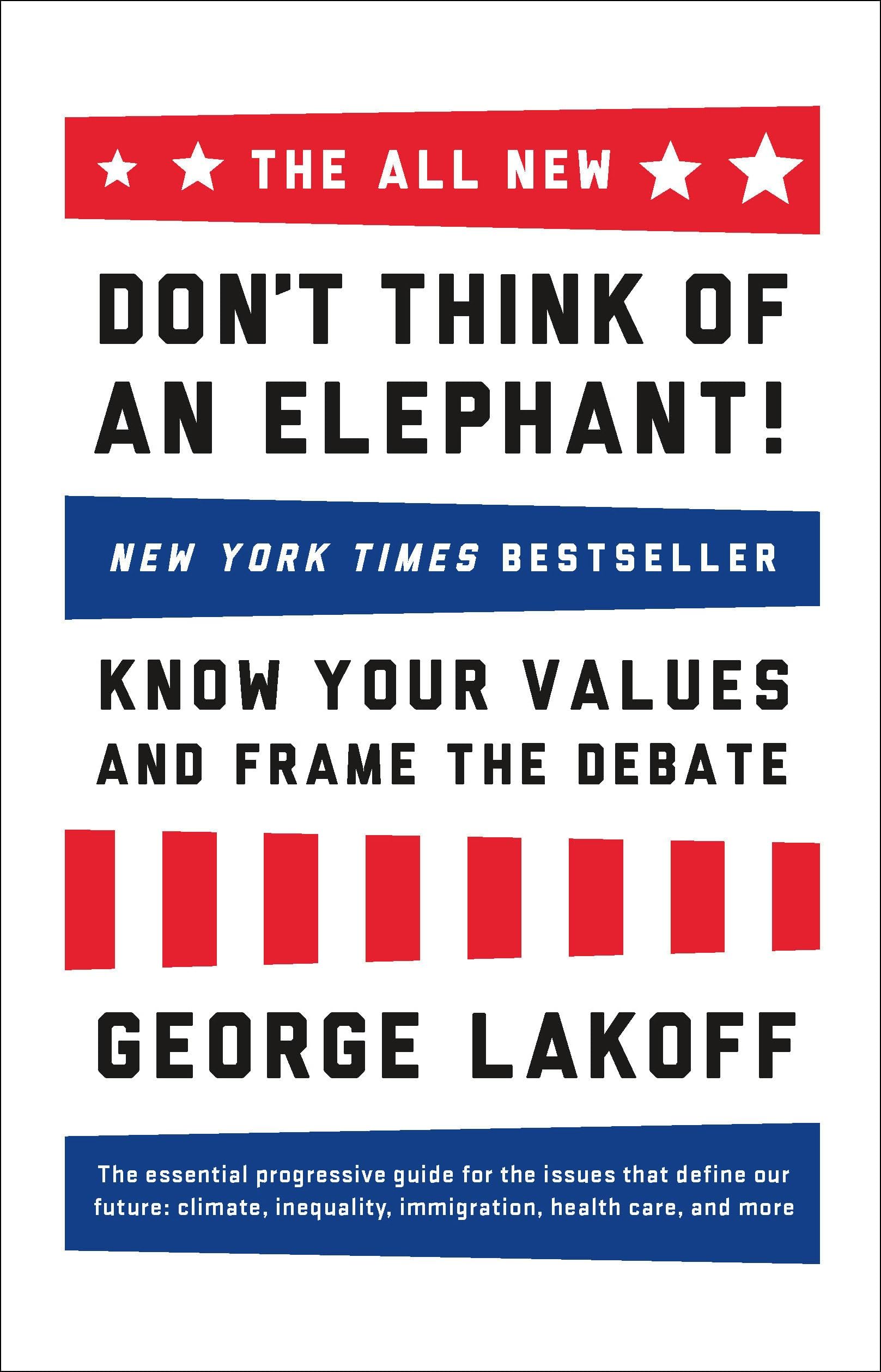
The ALL NEW Don't Think of an Elephant!: Know Your Values and Frame the Debate
Product ID: 6659155
Buy anything from 5,000+ international stores. One checkout price. No surprise fees. Join 2M+ shoppers on Desertcart.
Desertcart purchases this item on your behalf and handles shipping, customs, and support to Thailand.
“[Lakoff is] the father of framing.”— The New York Times “An indispensable tool for progressives—packed with new thinking on framing issues that are hotly debated right now.”—Jennifer M. Granholm, former governor of Michigan Ten years after writing the definitive, international bestselling book on political debate and messaging, George Lakoff returns with new strategies about how to frame today’s essential issues. Called the “father of framing” by The New York Times, Lakoff explains how framing is about ideas —ideas that come before policy, ideas that make sense of facts, ideas that are pro active not re active, positive not negative, ideas that need to be communicated out loud every day in public. The ALL NEW Don’t Think of an Elephant! picks up where the original book left off—delving deeper into how framing works, how framing has evolved in the past decade, how to speak to people who harbor elements of both progressive and conservative worldviews, how to counter propaganda and slogans, and more. In this updated and expanded edition, Lakoff, urges progressives to go beyond the typical laundry list of facts, policies, and programs and present a clear moral vision to the country—one that is traditionally American and can become a guidepost for developing compassionate, effective policy that upholds citizens’ well-being and freedom. Review: spot on information. - Mr. Lakoff's book is a primer on talking to people on the right in a way that will more likely create understanding. Mr. Lakoff makes a cogent case that the primary issue is the way in which an issue is "framed." When we start to argue our point using the terminology of our opponent. it's giving your opponent the home field advantage. Not only have we assured we will lose the argument, we also practically assure that we will never find a meeting of the minds. We need to begin from a standpoint of shared values. The current antagonism between progressives and the right has a life of its own, and can poison any discussion from its beginning. This book offers positive ways to approach that problem. The final and most useful section is "How to respond to Conservatives." It offers many good guidelines. There are so many suggestions, I read that section several times to take it all in. Even though I avoid debates because of the anger they inevitably create, after reading the last chapter, I almost felt like seeking out a conservative to try to have a positive dialogue, and now I feel far more ready whenever that kind of conversation comes up. Review: I needed this book growing up, and I Hope more progressives take notes - This book helped me understand my father better, and by extension, contextualized my upbringing and political situations which I found difficult to understand upon fully entering political discourse around 2017. My father believed in freedom and limited government, but every policy he suggested (police, military, borders, anti-social safety nets etc) suddenly sounded like echoes of the alt right that had infiltrated online communities that I had grown to recognize for its flourishing hatred and toxicity. This book explained so many ideas around these issues much more pragmatically than previous books i read on the subject. It deserves to be shared among anyone who calls themselves a progressive or a leftist or anyone who wants a better future for children. I just want kids in the future to be able To enjoy internet communities without fear of rubbing shoulders with neo-Nazis. This book provides an excellent analysis of a wide variety of issues, which I hope more people can use to construct more helpful discourse frames.
| Best Sellers Rank | #138,163 in Books ( See Top 100 in Books ) #100 in Elections #239 in Cognitive Psychology (Books) #286 in Political Conservatism & Liberalism |
| Customer Reviews | 4.6 out of 5 stars 1,092 Reviews |
D**F
spot on information.
Mr. Lakoff's book is a primer on talking to people on the right in a way that will more likely create understanding. Mr. Lakoff makes a cogent case that the primary issue is the way in which an issue is "framed." When we start to argue our point using the terminology of our opponent. it's giving your opponent the home field advantage. Not only have we assured we will lose the argument, we also practically assure that we will never find a meeting of the minds. We need to begin from a standpoint of shared values. The current antagonism between progressives and the right has a life of its own, and can poison any discussion from its beginning. This book offers positive ways to approach that problem. The final and most useful section is "How to respond to Conservatives." It offers many good guidelines. There are so many suggestions, I read that section several times to take it all in. Even though I avoid debates because of the anger they inevitably create, after reading the last chapter, I almost felt like seeking out a conservative to try to have a positive dialogue, and now I feel far more ready whenever that kind of conversation comes up.
A**R
I needed this book growing up, and I Hope more progressives take notes
This book helped me understand my father better, and by extension, contextualized my upbringing and political situations which I found difficult to understand upon fully entering political discourse around 2017. My father believed in freedom and limited government, but every policy he suggested (police, military, borders, anti-social safety nets etc) suddenly sounded like echoes of the alt right that had infiltrated online communities that I had grown to recognize for its flourishing hatred and toxicity. This book explained so many ideas around these issues much more pragmatically than previous books i read on the subject. It deserves to be shared among anyone who calls themselves a progressive or a leftist or anyone who wants a better future for children. I just want kids in the future to be able To enjoy internet communities without fear of rubbing shoulders with neo-Nazis. This book provides an excellent analysis of a wide variety of issues, which I hope more people can use to construct more helpful discourse frames.
J**U
A Sharp Book with Clear Views — plus Rigid Frames and Blind Spots
George Lakoff’s *Don’t Think of an Elephant* is one of those books that immediately sharpens your awareness. Once you read it, you’ll never look at political language the same way again. He shows, with clarity, how conservatives and progressives use different metaphors (“Strict Father” vs. “Nurturant Parent”), and why conservatives have been so effective at shaping public opinion with phrases like “tax relief” or “family values.” For that contribution alone, this book is worth reading. It gives language to the hidden power of framing and shows how words don’t just describe reality — they create it. That said, the more deeply I read, the more flaws and contradictions I noticed. Some are subtle, others glaring, and together they reveal the limitations of Lakoff’s framework. ### Where Lakoff Shines * He reveals how metaphors structure our thinking at a subconscious level. * He exposes the cleverness of conservative messaging and the struggles of progressives to keep up. * He pushes us to take language seriously, not as decoration but as the foundation of thought and politics. ### Where Lakoff Stumbles 1. **Rigid Binary Thinking** Lakoff reduces politics to two mutually exclusive family metaphors: Strict Father (conservative) vs. Nurturant Parent (progressive). But real life is more complex. Humans are multi-framed beings, switching between strictness and nurture depending on context. Reducing an entire ideology to one metaphor is as limiting as the frames he critiques. 2. **Frames as All-Encompassing** Lakoff claims we can’t think outside of frames, yet people constantly shift perspectives in an instant. Trauma, humor, art, or even a single slogan can flip someone’s worldview overnight. Frames are powerful, yes, but not absolute. 3. **The “Repetition” Fallacy** He insists slogans only work after years of repetition. But history shows otherwise: “Black Lives Matter,” “Me Too,” or “I Have a Dream” resonated almost instantly because they tapped into existing truths. Humans are multi-track; they don’t need decades of conditioning to recognize authenticity. 4. **Progressives Defined by Opposition** Lakoff urges progressives to “advance their own frame” rather than repeat conservatives’ — yet much of his book does exactly the opposite. He critiques conservative framing at length, while offering little in the way of a consistent, positive progressive frame. Ironically, this repeats conservative slogans more than it advances a new vision. 5. **The “Fact-Based” Superiority Claim** He insists progressives are rooted in facts while conservatives are stuck in rigid moral frames. But facts without resonance don’t persuade. Recent elections showed Democrats often attack Republicans but struggle to articulate inspiring alternatives. Frames grounded in compassion, dignity, and vision carry more weight than endless fact-checking. 6. **Selective Blindness** Lakoff argues conservatives dominate media, universities, and think tanks, but he writes from UC Berkeley — one of the most progressive universities in the country. Most mainstream media lean progressive. His claim ignores these realities and weakens his argument. ### The Bigger Lesson What *Don’t Think of an Elephant* reveals — unintentionally — is the danger of being trapped inside your own frame. Lakoff diagnoses the problem brilliantly but then succumbs to it himself. His insights are sharp, but his rigidity blinds him to counter-examples and alternative ways of thinking. A sustainable frame must be consistent **within and without**. It cannot just apply to “us” while excluding “them.” Otherwise, as we see with current events, a victim frame quickly flips into hypocrisy. True empowerment requires universality: compassion, dignity, and clarity for all. ### Final Word This book is an interesting read, but take it as a doorway, not the whole house. Lakoff shows us how frames divide, but he doesn’t show us how to transcend them. For that, you’ll need to look beyond strict/nurturant binaries and toward approaches that honor our full humanity — our emotions, boundaries, clarity, and choice. Read this book, but read it critically. It will sharpen your vision — and also teach you the danger of letting any single frame define your world.
C**G
Decodes why people fall onto one side or the other & how to explain those in the middle
As I read I took notes in the margins & have thought back on what I read. An excellent summation of the two sides of America life.
C**T
Will really help you undertand the GOP and Left positions.
Professor George Lakoff is the democrat's equivalent of the GOP's Frank Luntz. We may have won the election with Biden and the two Georgia senators giving us the edge, but the decades long investment the Republicans have put in to their messaging style (framing the issues)( and word choices runs circles around the Democrats' attention to this. The first twenty pages are worth it. Reaally. Lakoff retired a few years ago from Cal Berkeley, ,and does not seem current on his FB page, but you can get an idea of his theories on his FB page or other postings.This is a revision of the 2004 book. I read it then and felt I needed to really get this concept. I only wish Lakoff were posting, what with the uprising of QAnon and other conspiracy movements. I have a hunch right now (early Feb 2021), that these whack jobs have bushwacked even the savvy Republicans and all their careful coordinated messaging and propaganda. What would Lakoff have to say NOW!?
W**R
Great Delivery, interesting book
The Delivery was excellent, the company that shipped me the book was very fast and awesome. The Book itself: Quite intriguing on how the book itself "frames" it's own beliefs. The book takes conservative believes way out of context. Mis-applies James Dobson positions and creates it's own system out of a misunderstood position. But, again, the book is practicing what it preaches. The author is using his own framework to create a position that he believes is legitimate. So, well done there. I find it interesting how he calls the conservative beliefs strict and those strict self reliant beliefs lead to success, when most conservatives believe that immoral people are those who are with the most money at this point in history. Also, the author speaks of the liberal position as "progressive;" framing the idea that the liberal position is progressing in a positive light, when in reality, it's not.
S**E
Don't Yell!
This is an updated version of what was originally published in 2004. It is well known that conservatives have been doing a better job in formalizing their message and getting the wording right for at least 20 years. Much of it dates back to 1994 and the help of Frank Luntz, Newt Gingrich and his GOPAC memo Language Matters. Lakoff takes it several steps further and says their message and discipline has more to do with "Framing" , which is distinct from catchy phrases and emotion laden words, though both are important. Conservatives have framed their main constituent body as those who buy into the "strict father" basic family structure. It has religious and moralistic implications with far reaching implications. Progressives, on the other hand, could be more aptly described as buying into the "nurturing parent" family structure. Lakoff emphasizes that progressives buy into the myth that if they simply lay out the facts conservatives will see the error of their ways. It's not that simple. If the facts clash with the framing of the recipient, they will have no bearing. People vote and support political views based more values and morals, and they often conflict with economic self interest. Conservatives have understood this for decades have have used it to craft their message and win elections at the Congress, Senate and state office level. He doesn't address why they have been less successful at the Presidential level. This is a good primer on understanding the conservative brain and how progressives can tailor their message to win some arguments. Lakoff, says "Make no mistake, there is a 25-30% block of conservatives that amateurs won't 'win over'", but with proper use of framing it might be done. Lakoff spells out what we as progressives can do at the family Thanksgiving table and our personal contacts to maybe win some arguments and sway some opinions. The first thing is, "don't use their language". The second is "treat them with respect", and the third is "don't yell". There are other tips, but these are what have stuck with me.
J**H
Thank You, Cliff Pearson
My friend Cliff Pearson said this was the most important book on American politics I could possibly read. I am grateful to him for introducing it to me but my praise thereof is not unqualified. Author George Lakoff is convinced that people's attitudes on political or social issues are fixed long before they can participate in politics by their perception of what works in their families of origin. Conservatives see the world through a "strict father" mentality; liberals see it through a "nurturant parent" mentality. I have two objections (related to each other) to this frame. I think it works for social conservatism but not necessarily for economic conservatism. (Lakoff's separate observation that the different types/emphases of conservatism re-enforce each other is of course entirely correct but that is not what I am trying to say.) Everyone knows that the period 1933-1968 was much more socially conservative than contemporary America, but it was also more economically LIBERAL. People could not vote four times for Franklin Roosevelt while believing in the super-rich as the rightful "fathers" of the American economy (unless they voted for Roosevelt because he WAS super-rich). Libertarianism is a form of anti-authoritarianism (or at the very least CAN be blended with it) and is doing better today when fathers are less strict. My second objection to the "strict father" as the essence of conservative thought is that most fathers try to be BOTH strict and nurturing. Lakoff partially anticipated this complaint by observing that many people are what he calls "biconceptual." If biconceptualism had the sort of political impact he thinks it does, however, there should be many more swing voters. Of course, it does neatly explain how many people voted for Obama twice and then Trump. This is probably because both Obama and Trump were better FRAMERS of the issues they wanted to talk about than Hillary Clinton was. (Of course, we shouldn't rule out sexism as a factor in both of her Presidential defeats, which ALSO doesn't mean she was the BEST candidate both times.) The essence of Lakoff's argument is that the liberal or conservative way of talking about an issue looks like common sense, or doesn't, based on how many IDEAS each side is able to get into more people's heads. This is what Lakoff means by "frames." Lakoff might not be right about everything, but still, every progressive should read this book. The best chapters are 9-11, the last of which goes beyond poetry to become a classic. Chapter 14 could easily be re-worked and made into the 2020 Democratic platform, especially if Elizabeth Warren is the nominee (she is the only person still in politics whom Lakoff mentions by name and I assume he is a major force in her campaign). Even some biconceptual people could be made into committed progressives if they read the book. Four stars.
J**O
Interesante para comprender la política estadounidense
Al principio, el autor describe un mecanismo bastante interesante en el cual supuestamente se basa que nuestras afiliaciones políticas sean unas u otras, y que según el autor, podemos alterar para conseguir convencer a otras personas de nuestros principios. A partir de ahí, me parece más un manual para que los demócratas americanos no sigan perdiendo elecciones.
T**O
Reflexões Importantes
Apesar de ter sido escrito a mais de 10 anos, esse livro nos fornece importantes respostas para alguns dos nossos dilemas atuais. Lakoff nos mostra que a esquerda muitas vezes se ilude ao achar que a argumentação lógica e racional é a única saída para impedirmos o retrocesso político, social e moral que estamos presenciando no mundo inteiro com o avanço de radicais de direita. O autor sugere que uma abordagem mais eficaz parte do desenvolvimento de valores e afetos que traduzam para os eleitores as ideias de progresso social e político.
E**T
Die Macht der alternativen Fakten
Wer verstehen will, auf welchen Werten und welcher Psycho-Logik konservative US Politik aufbaut, an welche Instinkte sie erfolgreich appelliert und warum Argumente dagegen sinnlos sind, sollte dieses Buch unbedingt lesen. Für mich war wieder einmal erstaunlich, wie Semantik "richtig" eingesetzt verschleiert und manipuliert.
P**O
It’s a light in the dark
Fantastic! Everyone would read it. If you are real democratic you have to read it. easy language and simile exsample.
A**E
WORST QUALITY PAGES
The quality of the book is questionable at best. It’s barely been a couple of weeks and the pages have already started coking out of their binding. I expected the quality of the book to be much higher considering the price of the product. Absolutely disappointed in the product. I suggest buying it from a bookstore near you.
Trustpilot
3 days ago
4 days ago