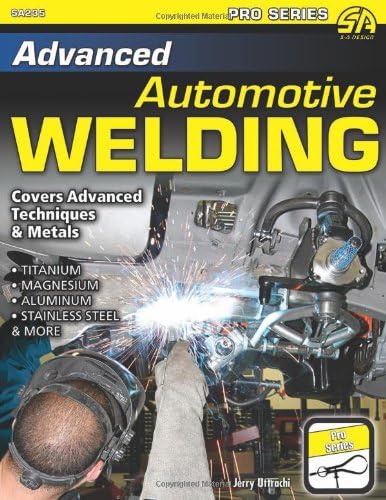
Advanced Automotive Welding
Product ID: 7178903
Desertcart purchases this item on your behalf and handles shipping, customs, and support to Thailand.
Welding is an essential skill for the avid car enthusiast, car builder, and fabricator. Engines, exhaust, intake, suspensions, frames, all can be welded for repair and fabrication purposes. While many introductory or entry-level welding books are available on the market, this is the first book to comprehensively cover advanced techniques, complex joints, advanced processes, and working with a variety of materials, including aluminum, Chrome-moly, stainless steel, carbon steel, titanium, and magnesium. American Welding Society Vice President Jerry Uttrachi is a master welder and he reveals all major welding processes and techniques, so you can repair and fabricate using advanced materials and complete complex projects. TIG, MIG, oxy-acetylene, and stick welding techniques are illustrated for a wide range of automotive applications. Uttrachi details how to make a butt joint, single pass butt, double pass butt, joggle joint, lap joint welds, and numerous other varieties of joint weld Review: The One Book You Can Use to Actually Teach Yourself to Weld - On Your Own! - If you know nothing about welding, I am convinced you could teacher yourself to weld with any of the major processes, just from reading this book. I do not make that statement lightly! While having experience in all four major methods of welding (Oxy/Acetylene; Stick; MIG and TIG), I really only consider myself "proficient" in the latter two, "capable" in Stick and Oxy (gas) is still a mystery to me. After reading the first page of Chapter 1, I now understand what my problem is (being a retired educator who enjoyed working with metal, I've had experience at becoming expert at diagnosing "learning disconnects" and rarely is the answer "the welding machine is stupid" (the weldor's equivalent of a public school student's "the calculator is stupid" - when they fail to get the correct answer). Not only does this text hand out some key "welding wisdom," it lays out a system (and order) of learning the various welding methods it covers. It will make sense to you (if you've never tried welding before), or gave you insight to why you're maybe not as good with one method as others (if you've had some experience welding). There are sufficient "application" projects at the end of each chapter to give you as much practice as you may want/need. Despite my overall enthusiasm for this text and belief this could be used as a stand alone text, there are some limits (all good really). 1) It only covers welding techniques (as well as some metal cutting processes) - there is no coverage of brazing, or soldering (get Richard Finch's Welder's Handbook for excellent coverage of those topics). 2) A book of 176 pages can't cover it all re: Welding, but it will get you far enough that you could then pick up one of the 600 page texts used in professional trade schools/courses without being overwhelmed. 3) As the title implies, this is a text about automotive welding, so if you want to learn how to weld steel girders to build a bridge, or thick steel plate for a yacht, this is not the book for that. 4) The only other comment I will add is that this publisher has a similar text titled Basic Automotive Welding, it is a different text, but different authors - you do not need it before going to this book! Review: Really interesting - First of all: I'm not a welder. I have done some gas welding in the past, but that's it. This book covers all of the major types of welding (MIG/TIG/oxy/stick) and talks about the advantages and disadvantages of subtypes (spray arc, short arc, pulse arc, etc.) He goes into detail about the power sources and types of power delivery. What kinds of filler metal get used. He even gets into detail about the hardening and annealing that goes on, and what's happening with the metal around the weld. For all the types of welds he describes, he goes on to use an example of where you might want to use that kind of weld in real life, in an automotive setting. Examples include: repairing aluminum cylinder heads, roll bars, floorpans, and other projects. I don't think you want this book if you're trying to learn to weld. But you do want this book if you're trying to decide on the best process to use for a particular project, and if you want to understand what's happening to the metal when you're welding it. Even if I never pick up a welding torch I am really glad I bought this book.
| Best Sellers Rank | #3,257,546 in Books ( See Top 100 in Books ) #810 in Car Customization |
| Customer Reviews | 4.1 out of 5 stars 55 Reviews |
X**A
The One Book You Can Use to Actually Teach Yourself to Weld - On Your Own!
If you know nothing about welding, I am convinced you could teacher yourself to weld with any of the major processes, just from reading this book. I do not make that statement lightly! While having experience in all four major methods of welding (Oxy/Acetylene; Stick; MIG and TIG), I really only consider myself "proficient" in the latter two, "capable" in Stick and Oxy (gas) is still a mystery to me. After reading the first page of Chapter 1, I now understand what my problem is (being a retired educator who enjoyed working with metal, I've had experience at becoming expert at diagnosing "learning disconnects" and rarely is the answer "the welding machine is stupid" (the weldor's equivalent of a public school student's "the calculator is stupid" - when they fail to get the correct answer). Not only does this text hand out some key "welding wisdom," it lays out a system (and order) of learning the various welding methods it covers. It will make sense to you (if you've never tried welding before), or gave you insight to why you're maybe not as good with one method as others (if you've had some experience welding). There are sufficient "application" projects at the end of each chapter to give you as much practice as you may want/need. Despite my overall enthusiasm for this text and belief this could be used as a stand alone text, there are some limits (all good really). 1) It only covers welding techniques (as well as some metal cutting processes) - there is no coverage of brazing, or soldering (get Richard Finch's Welder's Handbook for excellent coverage of those topics). 2) A book of 176 pages can't cover it all re: Welding, but it will get you far enough that you could then pick up one of the 600 page texts used in professional trade schools/courses without being overwhelmed. 3) As the title implies, this is a text about automotive welding, so if you want to learn how to weld steel girders to build a bridge, or thick steel plate for a yacht, this is not the book for that. 4) The only other comment I will add is that this publisher has a similar text titled Basic Automotive Welding, it is a different text, but different authors - you do not need it before going to this book!
A**R
Really interesting
First of all: I'm not a welder. I have done some gas welding in the past, but that's it. This book covers all of the major types of welding (MIG/TIG/oxy/stick) and talks about the advantages and disadvantages of subtypes (spray arc, short arc, pulse arc, etc.) He goes into detail about the power sources and types of power delivery. What kinds of filler metal get used. He even gets into detail about the hardening and annealing that goes on, and what's happening with the metal around the weld. For all the types of welds he describes, he goes on to use an example of where you might want to use that kind of weld in real life, in an automotive setting. Examples include: repairing aluminum cylinder heads, roll bars, floorpans, and other projects. I don't think you want this book if you're trying to learn to weld. But you do want this book if you're trying to decide on the best process to use for a particular project, and if you want to understand what's happening to the metal when you're welding it. Even if I never pick up a welding torch I am really glad I bought this book.
M**C
Four Stars
Love the book.
N**P
Great book
After reading several reviews, this sounded like a well written book full of accurate information. I have to say that I agree. As an amateur / hobby welder, this book is full of information to help understand how and why processes work, and how to achieve better welds. I think this is a great book for anyone with an interest in welding.
D**C
Good for beginners
It's a good book that goes into theory of welding processes & certain applications. For a beginner it's a good book.
N**S
Great book on welding
The diagrams, illustrations, and photos are all first class. Very easy to see a lot of stuff. Of course, welding can't really be learned by reading a book; you have to practice but I think there is enough here to get started. Maybe more time could be spent on using lead for car repairs - we don't always need to weld. Also perhaps a little more high level advice in a few places would be helpful, for example, when you want to buy a MIG welder instead of a TIG welder. Perhaps also some more suggestions as to where to buy all the equipment you will need. But really a well written book and easy to understand. A complete beginner might need to read it two or three times.
W**N
One Star
Not at all what I expected. No much info in book about basic welding.
D**.
Great book for any type of welding
I got this for my son after reading the reviews that it is not just for automotive welding. My son told me it was a great book and he learned a lot of great techniques.
D**P
good book
Good book
T**T
Basic DIY welding types well explained
Different welding methods well explained. Best book of TIG welding that I have read with nice example cases, too.
Trustpilot
1 month ago
1 week ago