Buy anything from 5,000+ international stores. One checkout price. No surprise fees. Join 2M+ shoppers on Desertcart.
Desertcart purchases this item on your behalf and handles shipping, customs, and support to Thailand.
๐ท Elevate your photography game โ because your moments deserve pro-level clarity!
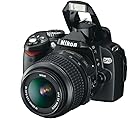
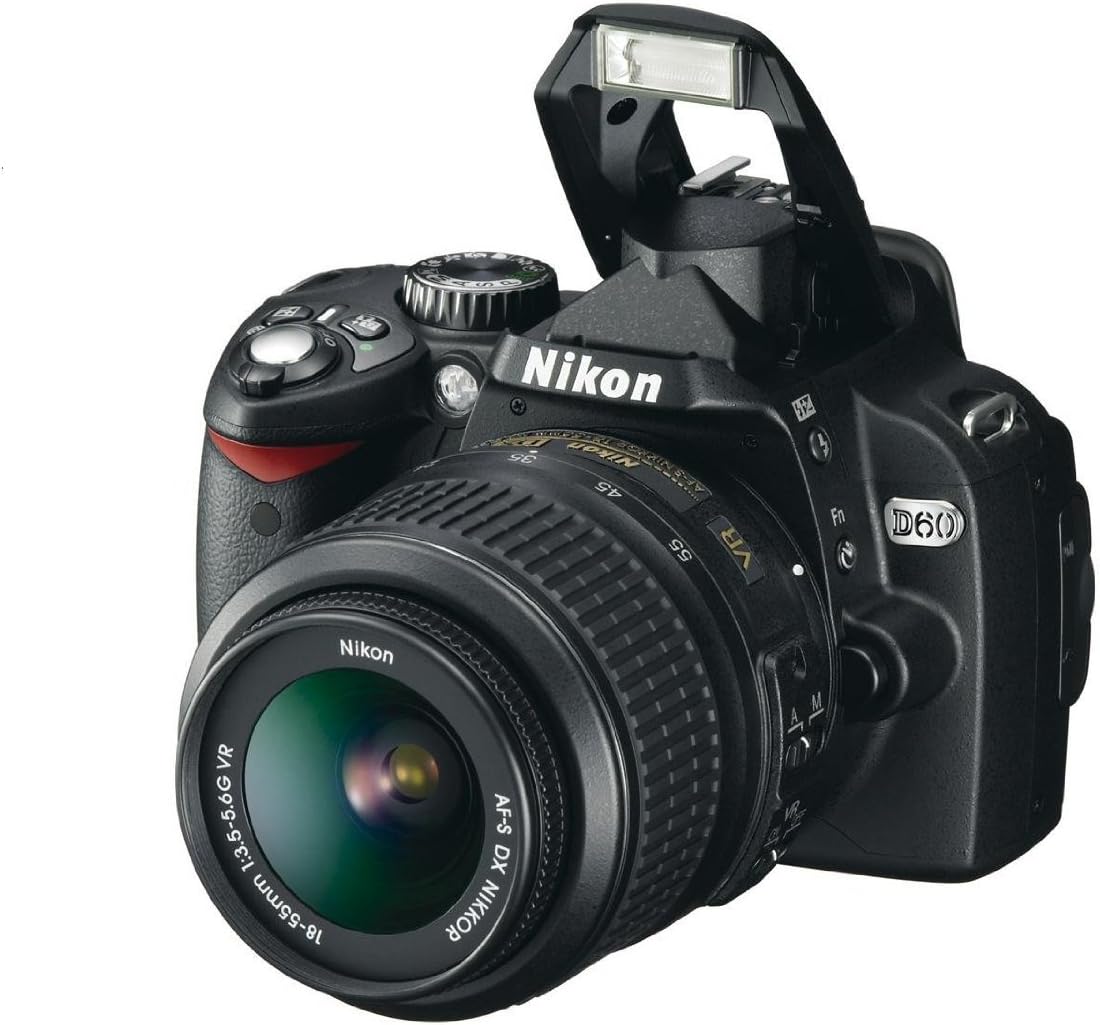
The Nikon D60 DSLR combines a 10.2MP sensor with an 18-55mm f/3.5-5.6G AF-S DX VR Nikkor zoom lens, delivering high-resolution images with vibrant colors and optical image stabilization. Featuring a 3 fps shooting speed, advanced 3D Color Matrix Meter II for perfect exposure, and built-in Wi-Fi, this camera balances professional-grade performance with user-friendly operation, ideal for both aspiring photographers and seasoned pros.
| Brand | Nikon |
| Model Number | B0012OGF6Q |
| Model Year | 2008 |
| Display Size | 2.5 Inches |
| Shooting Speed | 3 |
| Optical Zoom Range | 3 x |
| Focal Length (wide) | 18 Millimeters |
| Focal Length (tele) | 55 Millimeters |
| Aperture (wide) | 3.5 f |
| Min. Aperture (tele) | 5.6 |
| AF Points | Phase Detection |
| ISO Range | 100-1600 |
| Viewfinder Type | Optical |
| Viewfinder Magnification | Optical |
| Lens type | 55 millimeters |
| Lens Configuration | Zoom |
| Wi-Fi | Yes |
| Image Stabilization | Optical |
| Included Components | Camera Body & Lens |
| Shooting Modes | Movie |
| Color | Black |
| Battery Type | Rechargeable Li-ion (EN-EL9) |
| Batteries Included | Yes |
| Product Dimensions | 11.71 x 16.69 x 30.51 cm; 743.89 g |
P**4
I've been using Canon PowerShot point-and-shoot digital cameras for the past 6 years, and because they're so small, portable, and unobtrusive, I've ended up taking a lot more photos that I ever did, because I had my camera with me. The good thing is that I've taken a lot more pictures, and most of them have been very good (the camera gets much of the credit here). But the bad thing is that I started to reach the limits of what a point-and-shoot camera can do. The biggest problems I had with my compact point-and-shoot camera was the lag between shots and the generally poor performance in low-light settings. For most shots, these weren't big problems, but when they were a problem, they were a huge problem, and there's not much you can to solve it without moving to a better camera. I don't think I'm the first person to reach a brick wall when using compact digital cameras, which is why there are now some excellent options that don't cost a fortune. After reading a lot of reviews for digital SLR cameras online, I narrowed it down to two choices: the Sony A300 or the Nikon D60. I love my compact Canon, but I wasn't all that impressed with the Canon dSLR's that I looked at, either in terms of price or features. The Sony is priced very competitively and offers some great features, such as auto-focus and image stabilization built into the camera itself, not relying on the lens. The A300 also has live preview on the LCD screen, which the D60 doesn't offer (live preview is what you get on a compact camera: you see what you are shooting as you take the picture). Finally, the A300 has more focus points than the Nikon. I spent a long time in several stores doing side-by-side comparisons of these two cameras. After many test shots, I finally chose the D60 for the following reasons: it felt more compact and less heavy than the Sony, I liked the way the lens felt when I was zooming, its LCD menu system was much clearer and more intuitive, and the Nikkor family of lenses is unbeatable. With a dSLR, it really gets down to which line you want to commit to for future lens purchases. I wasn't sure I wanted to go with Sony, when Nikon is well-known for quality optics. I ordered the D60 from Amazon and I'm glad I did, since they have a 30-day price match policy. If the price of the camera decreases within 30 days of your purchase, all you have to do is email Amazon, and they'll credit you with the difference. The price of the D60 went down three times after my purchase (it's even lower now, but I've passed my 30 days), and Amazon was fast to process the refund for each decrease. Please note that it's your responsibility to check on the current price. Amazon will not notify you that the price has gone down, and why should they? So if you do buy this from Amazon, be sure to check every couple of days to see what the current price is. As for the camera and the lens, I couldn't be happier. I love how it feels and how easy it is to use, at least for basic shots. Of course it won't fit in my pocket the way my point-and-shoot did, but it's not nearly as huge or heavy as I'd expected. The kit lens has VR (vibration reduction) which is a good thing to have, and it's well balanced with the compact body of this camera. In other words, the camera doesn't point down under the weight of the lens. Everyone who has tried out my new camera has commented on how compact and ergonomic it feels. The camera works extremely well in low-light settings, with or without flash (you can defeat the flash if you want, and I find that in many situations, I get better results that way). The flash is a lot more powerful than what you get on a compact camera, and the coverage is more even. So far, I've mainly used the "auto" mode, but I've taken some pictures in macro mode. It's graat to be able to take pictures in rapid succession, without having to wait the way you do with a point-and-shoot. Most important of all, the image quality is outstanding. The difference is noticeable and consistently better than what I was getting with my point-and-shoot. The LCD menu is intuitive and visually appealing. That was one of the reasons I went with the Nikon in the first place, and I haven't been disappointed. By pressing the right button as you move the mode dial, you can see a description of what each mode does, which is very helpful. It's sort of like having a "help" system built into the camera, without having to carry around the instructions. Having said that, the instruction manual is really quite good. It won't teach you everything you need to know about digital SLRs, but it does a good job of explaining the camera's features. Nevertheless, I recommend buying a more extensive guide book which is specific to the Nikon D60 (there is one by David Busch which is currently available, and several more are scheduled to appear within the next couple of months). So, I love this camera, especially at the very reasonable price point. However, there are some things that you should consider before making a final decision. First, the D60 will only provide auto-focus with Nikkor AF-S lenses. That means that most Nikon "prime" lenses will require manual focusing. That wasn't a big deal for me, but it is a limitation. Second, the D60's 3 focus points put it at the low end for this feature. Third, the D60 uses SD cards, while the Sony uses Compact Flash cards, as do many higher-end dSLRS. This isn't really a plus or minus, since SD cards are generally less expensive than Compact Flash, but some users say that Compact Flash cards may be more durable in the long run (they're larger and thicker). Finally, unlike the Sony, the D60 does not provide live preview. In other words, you don't see the image on the LCD until after you have taken it. With all of that, I'm very pleased with my decision and I am having a lot of fun with my Nikon D60. If you're ready to move up from your point-and-shoot to a dSLR, you cannot go wrong with the D60.
T**N
Purchased for my granddaughter but it didnโt work. Seller immediately provided a refund.
T**T
After doing much reading and going back and forth trying to decide which camera was the one for me I went for the Nikon D60 - Price wise the Nikon is a little less than the Canon but if you are looking for an SLR camera you can spend a few bucks more to get the better quallity item, in my case after much web surfing I learned that the Canon has issues with service and the equipment itself, more than Nikon. As a customer I should be able to buy something and get what I paid for, if such item doesn't work 100% out of the box I should be able to get a new one and not have it sent for repair (then what is their quallity control good for?) - I barely found any issues with the Nikon brand, I found more praises that anything else. The picture quallity is stunning, easy to use (I'm one that plays first then reads the manual) - colors are superv - the only thing I did not like is that it doesnt have "live view", meaning that you can't see on the screen what you are getting ready to shoot at, you have to use the viewfinder. But even then, after using it and seing the results I don't care for that feature any more, I rather have a camera that is going to give me great pictures and a warranty that is going to cover it as well, the camera itself comes with a one year but the lens comes with a 5 year warranty from Nikon. It also has a feature that allows you to add filters after you have taken the picture, keeping the original intact. The viewfinder is very brigh and of good size. I also looked for a good and convinient bag for it and the best I found was the Mytho Swiss Gear (model GA-7865-02F00) that you can find for 49.00 bucks at your local electronics store. And as a last note, I love buying from Amazon, they have good prices and good customer service.
M**N
I've had my D60 for two months now, and only have just gotten familiar enough with it to feel that I can competently write a *useful* review for it. "Right Out Of The Box" reviews cannot really stand in for a good, solid understanding of what you're holding. I quite like it. I now know what IT likes, doesn't like, and how to fix its mistakes. Pros: 1. Quite lightweight 2. Sturdy 3. Very quick boot-up time. 4. Battery lasts a flabbergasting amount of time (camera on all day? No problem!) because of its chary use of power. A word to the wise: Either have it on or have it off. Do not toggle back and forth. "On" and in its powersaver mode saves more power than turning it off when sporadically taking photos. This might be due to the sensor cleaner (it cleans on start up and shut down). 5. It thinks about as fast as you do. 6. Acceptable buffer space for taking multiple shots 'on the go'. 7. Most controls are intuitive (still SOME menu-hunting, though. Some important crap is just plain buried in the menus). 8. Does *amazing* things with grey/blue lighting. Its favorite situation seems to be a cloudy or partly cloudy/overcast day. 9. Noise levels are acceptable at least up to 800 ISO, which is nice. Past that, though, you're pushing it. The result is still workable, though, which is an achievement. 10. SDHC Compatable -- I use a 16gb card. 11. Active D-Lighting mode is nice if you're still going to insist on shooting in jpg. Almost completely useless if using RAW. Be prepared to make use of your buffer and shoot multiple pictures of the same thing for redundancy; it tends to not always choose the place you wish to focus. *Especially* when using Dynamic Area mode with Autofocus. It's sometimes seems to me like all I'm managing is blurry pictures, faster than ever. If I take more, it's more likely I get one that's usable. Cons: 1. Often picks strange/insane exposures, ISO levels, etc, if left on Automatic Mode. I had it once, in full daylight, choose 760 ISO. WHY? God knows. It will generally err by underexposing a photo. This is at least more 'fixable' than overexposing, so that's your silver lining. 2. Over-saturates the yellow/orange spectrum, and consistently creates photos that are too 'warm'. 3. Hunts a lot in low lighting, no matter the ISO. When you've gotten so frustrated as to set it at "HI" (3200), give up. That said, when it DOES find its target, it captures it well. 4. The flash is not impressive (except impressively BRIGHT) especially with the limitations it creates with external flash (and with how it jumps to the conclusion that you need it even in full daylight), but generally you do absolutely fine without it. If it tries to pop up the flash, just hold it down. That's what I do. LOL. 5. The Nikon Transfer software has issues at times; it locks up and freezes often when transferring things off of HDHC cards of the size I use. I suggest buying a card reader (8-15 dollars depending how multifunctional you want it to be. Targus Digital TGR-CRD25 Universal 25-in-1 Memory Card Reader/Writer possibly) for less general frustration. If you DO NOT have a card reader, you cannot access the card through the camera. This means if you DO have a problem, there's no way to get your information off the card. You CANNOT bypass Nikon Transfer if it screws up. Information transfers only one way -- from the camera to the computer. The camera does not show up as a drive on either a Mac OR a PC, and not only THAT, your virus software might pop up thinking that Nikon Transfer is a trojan (it boots immediately upon plugging in the camera or a card reader with NEFs on it. This makes a Windows virus scanner wig out). 6. It makes it very hard to trust that what you see in the camera's preview mode will be what you see on your computer. This is mainly because it IS untrustworthy. With that in mind, I can't recommend that you trust the in-camera editing software either. Take a pass on this feature. - Be prepared to shoot in RAW and learn how to use a digital darkroom. I use Adobe Camera Raw, tho I suspect that in some instances, Nikon's own software would translate the information better. It just depends on how you want your finished product to look. Unfortunately, if you let the camera create your photo as a jpg, you're stuck with whatever fool choices it has made, unable to 'fix' the error. Don't trust this camera's color rendering! :P It's *so* much better to just clean it up in post-processing. - With all that out of the way: IF you shoot in RAW, and IF you take the time to post-process your photos, the work it does is simply jaw-dropping. This little camera can do some AMAZING work, if only you devote the time to nurturing your photos after the fact. Fortunately, once you have yourself a digital darkroom (Nikon's own, Adobe's, or other third-party programs that can process a NEF file), you'll find it very easy to get into the swing of things. You'll not want to go back once you experience the freedom that RAW brings. Don't worry; it only sounds complicated. This camera, for the price, is a gem. I might seem to be smacking it around, but I'm only pointing out the places where it means MORE WORK FOR YOU. If you're willing to put in the work, it's just an astounding little go-anywhere friend.
L**S
Review for the Nikon D60 with 18-55mm VR Nikkor lens Cons: -No live preview (fine if you were a film SLR user like I was, but not so fine for point and shoot step-ups) -Lens must be AF-S to autofocus (Lens must have inner moter to autofocus) -Autofocus is considerably slow -Alot of grain present at 1600 ISO -Only 3 Autofocus points -Uses unique .NEF raw format (so not many programs can edit it) -Included lens it not that high end, (it does not smoothly blend out the BG at times) Pros: -Very well priced on behalf of Amazon -Excellent VR system -Sensor Cleaning -Ergonomic Design -Ease of use ++ -Lightweight -Sharp pictures -In-camera Retouch -Vibrant colors -Simple GUI (Graphic User Interface) -Its a NIKON!!! I did my homework comparing this camera to its predecessor, the Nikon D40. I took about 2 weeks going to local photo shops, comparing various cameras side by side, as well as quality, and for the price, the D60 took the gold I heard alot of reviews recommending the D40 over the D60, but I decided to go against the flow and purchase the D60. Purchased it from Amazon for a staggering $517 (~125 $$ cheaper than a local photography store), very prompt shipping on their part FEDEX :)/USPS :(. I got this camera today, and I am pleased to say this is an awesome camera for its price. First of all, you are going to get a quality product from Nikon, (in my opinion, one of the best camera brands), along with an excellent 18-55mm VR Nikkor lens. You also get the nice camera neck strap (which was an extra back in the '70s :)). This camera takes amazing pictures! I went outside to my garden and shot a couple of flower test shots, very satisfying! The quality is very sharp, even at a 100%. The colors are also very vibrant and lively. The camera is also relatively light, as compared to the Nikon FM-2 we already own. It is also nice to know that this camera comes with the VR lens, allowing you to take pictures with 3X slower shutter speed, as claimed by Nikon. Another plus of this camera is the fact that it has the sensor cleaning, which if you own 4 lens like I do, comes in very handy, to keep your pictures "dust free". It is also nice to know, it cleans the sensor everytime you turn it on and off. It also features an orientation sensative LCD screen, which if you rotate the camera, the screen rotates as well. However, Nikon could have made more autofocus points (9 + would have been fine). They also could have added the shaft to the lens mount, to autofocus AF lenses. I would definately recommend this camera to others for its simplicity of use. It has intuitive LCD menus, easy to navigate through, and perfect for the beginning DSLR user! *Please do not base your purchase off of this sole review, as some of the above info may be slightly off. :)
Trustpilot
3 days ago
2 months ago