We remain fully operational. Our teams are working around the clock to ensure your deliveries continue safely.

DOWNLOAD THE APP


Copyright © 2025 Desertcart Holdings Limited
DOWNLOAD THE APP
Buy anything from 5,000+ international stores. One checkout price. No surprise fees. Join 2M+ shoppers on Desertcart.
Desertcart purchases this item on your behalf and handles shipping, customs, and support to Thailand.
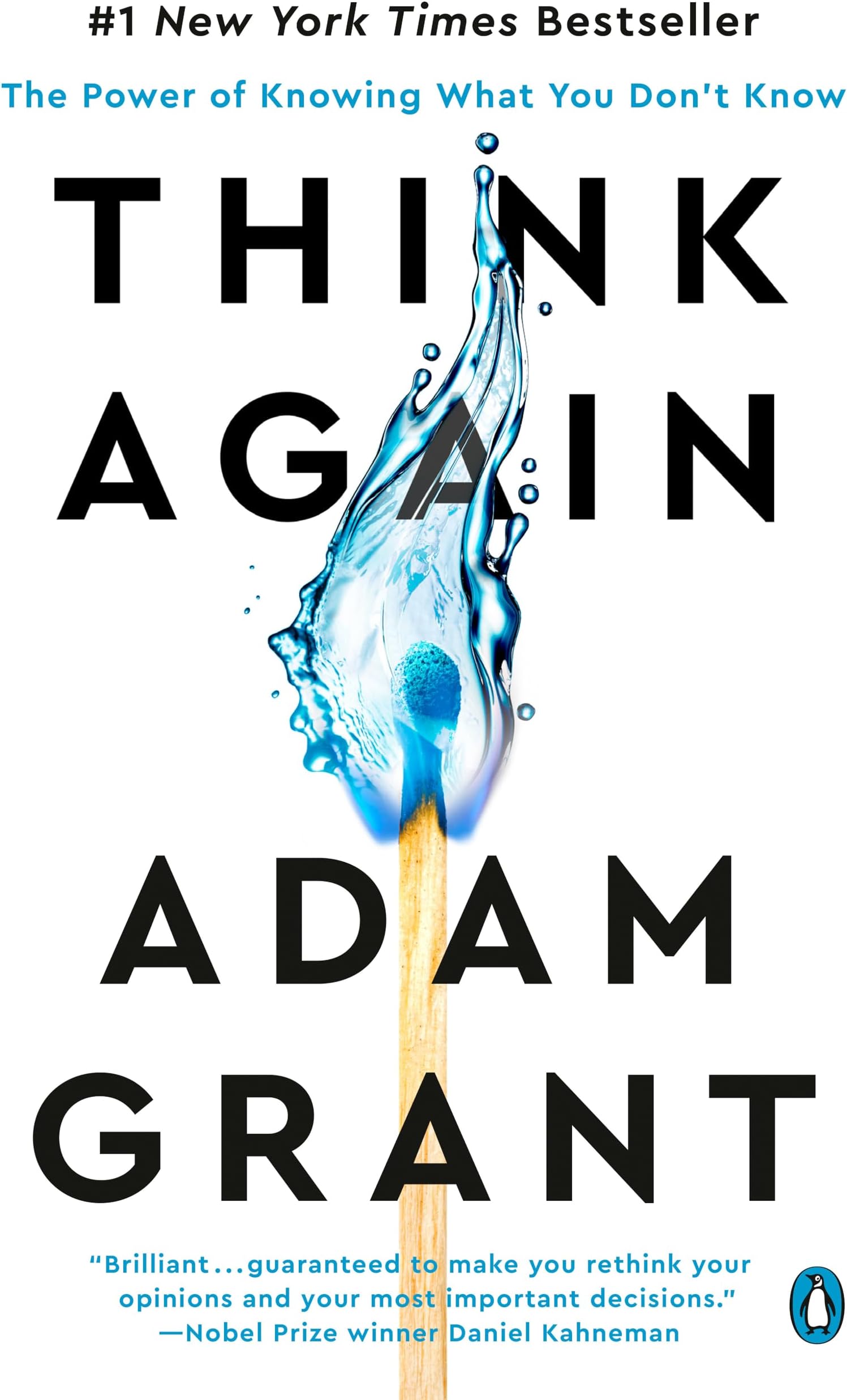
Buy Think Again: The Power of Knowing What You Don't Know by Grant, Adam (ISBN: 9781984878120) from desertcart's Book Store. Everyday low prices and free delivery on eligible orders. Review: This is a great book - Great ideas, challenges how you think and why - with good ideas for ways to discover if changing someone’s beliefs is possible. A stimulating read Review: Good, if flawed - First, a note on the hardback edition. To put it bluntly: the book (in said edition) is bloated to look bigger, thicker. The font is (unnecessarily) large, the space between the lines is ample, the divisions of chapters too frequent. Etc. It's an edition made so the book looks bigger, perhaps thinking the bigger the book, the better it is. Yet this thinking goes against a maxim in literature: the good, if brief, is twice as good. On the content, no major complains. The books reads well and it is obviously written by an expert and passionate author. Yet it is too diverse, and in the end the point of the whole text gets somehow lost. This is a self-help treaty, a know-yourself better publication and a psichology volume - all in one and never fully settling for one of these fields. It is a good work, but the reader does not find a clear line to follow or fall for. In conclusion: a worthy read of a few interesting (and helpful) ideas, marred by undefinition and, I'm afraid I must insist, an edition that seems to be made to impress the reader.

| Best Sellers Rank | 93 in Business, Finance & Law 263 in Society, Politics & Philosophy 1,186 in Psychological Schools of Thought |
| Customer reviews | 4.5 4.5 out of 5 stars (10,300) |
| Dimensions | 13.79 x 1.6 x 21.36 cm |
| ISBN-10 | 1984878123 |
| ISBN-13 | 978-1984878120 |
| Item weight | 1.05 kg |
| Language | English |
| Print length | 320 pages |
| Publication date | 26 Dec. 2023 |
| Publisher | Penguin Books |
M**K
This is a great book
Great ideas, challenges how you think and why - with good ideas for ways to discover if changing someone’s beliefs is possible. A stimulating read
R**A
Good, if flawed
First, a note on the hardback edition. To put it bluntly: the book (in said edition) is bloated to look bigger, thicker. The font is (unnecessarily) large, the space between the lines is ample, the divisions of chapters too frequent. Etc. It's an edition made so the book looks bigger, perhaps thinking the bigger the book, the better it is. Yet this thinking goes against a maxim in literature: the good, if brief, is twice as good. On the content, no major complains. The books reads well and it is obviously written by an expert and passionate author. Yet it is too diverse, and in the end the point of the whole text gets somehow lost. This is a self-help treaty, a know-yourself better publication and a psichology volume - all in one and never fully settling for one of these fields. It is a good work, but the reader does not find a clear line to follow or fall for. In conclusion: a worthy read of a few interesting (and helpful) ideas, marred by undefinition and, I'm afraid I must insist, an edition that seems to be made to impress the reader.
A**R
Not just entertaining, it's incredibly important
In todays polarised world, I believe this book is one of the most important books anyone can read right now. It discusses 3 areas; how to rethink your own assumptions, how to encourage others to rethink their assumptions, and how to encourage society to rethink assumptions. It covers a lot, but the point that stuck with me the most is that things are never as simple as black and white. The grey area in between 2 binary options is where the most productive conversation takes place. An example from the book is gun control - this issue is not as simple as gun control or no gun control, its an extremely complex issue with an extremely wide grey area in the middle. The key is accepting that you don't have to attach yourself to one of the binary options, it's OK to accept that its a complex issue and that you can agree with points from both sides. This doesn't mean you're contradictory, it means you want to understand.
@**S
Worth a read
In the book “Think Again” Adam Grant takes us through the process of why, in life we need to think about our brief systems, our confidence in certain subjects and use this in business as well as our social life. If we all thought more deeply, while we might agree to disagree, maybe thinking again would help us understand other people better. Some of you may recall the Space Shuttle Columbia disaster on February 1, 2003, when the Space Shuttle Columbia (OV-102) disintegrated as it reentered the atmosphere, killing all seven crew members. Without going into the some of the detail technical details, some of the tiles on the outside of the shuttle fell off when it took off. But this had happened before and so people thought "so what? they have fallen off before, why does it matter?" In this case the result of the tiles falling off was fatal. Adam also talks about the Dunning–Kruger effect which is a cognitive bias where people will overestimate their ability. Adam goes onto say "If we're certain that we know something, we have no reason to look for gaps and flaws in our knowledge - let alone fill or correct them.” Adam also talks about research where rival American Football teams worked together to try and create a level of co-operation after generations of ingrained rivalry and aggression. Certainly worth a read.
M**N
Must read
One of the best books I have read. If more people approached life questioning their beliefs using this methodology the world wouldn't be the ridiculous mess it is. Read it.
D**S
Makes you question what you thought you knew - a bit like rethinking!
I’d heard Adam Grant talking on his podcast and liked what he had to say, so I picked up the book with excitement. The simple tenet of the book is that rethinking our plans, answers and decisions is a good thing and a fixed mindset closes us to opportunities and potentially better alternatives. My enduring feeling having read the book is discomfort. Not because I don’t like what Adam says, but because, through a smile and gritted teeth, I agree with most of his ideas, opinions and perspectives. The problem is, he made me question the decisions I’ve made in work over the years and my modus operandi. Adam talks about the Dunning Kruger effect, which is something I’d come across during my doctoral research. I was a little starstruck that not only was this something AG thought fit to write about, but he actually knew these scholars! The Dunning Kruger effect basically describes the phenomenon where people who think they’re highly capable are usually quite the opposite. Check out pg 38 I liked his description of how to deal with an argument and hostility. Instead of going head to head, you can rethink your position and sidestep. What a great way of viewing confrontation: a dance, where you can choose to parry, thrust or tango. You can step out of the discussion and talk about the discussion. By talking about the discussion instead of being in the discussion, it gives both parties the opportunity to gain perspective, and change perspective if they so choose. Adam also talks about complexifying a problem. When two parties are at opposite ends of the pole, setting out the complexities of the particular issue can help parties recognise that this either/or argument about which they’ve been at odd actually has a number of other arms - more like the spokes of a wheel, if you will. It helps to diffuse this idea of ‘my way or the highway’ and helps people rethink, reach agreement on some elements and compromise on others. My main take home from the book is this idea that it’s good to question our own decisions. Adam gives lots of data and examples of where this has paid dividends and consistently yielded better results. If one day we’ve said something is red and tomorrow we’ve reflected on the data, rethought it and tomorrow say it’s pink, that’s ok. One thing I’ve held on to over the years is my consistency of opinion. There are many occasions where colleagues have asked me something or other about an issue from a few days ago and I’ve found myself with no memory of it (at least not in the way they describe), and I’ve given them the same answer twice. I’ve always thought, phew!… what I lack in instant recall I make up for in consistency. But if you read Think Again, flexibility is valued over consistency. Getting it right is valued over getting it to match. Henceforth I shall take a new approach and consider that a change of direction from north to north west is not about having gotten it wrong the first time, but about thinking again and coming up with a better idea. As Maya Angelou said, ‘Do the best you can until you know better. Then when you know better, do better.’ Good book. If you want to step out of your comfort zone and learn something about yourself and others, this book is worth a read. It felt like a long read, but the fact I read the whole thing in Adam’s voice may have had something to do with it (the joy of podcasts)!
N**A
Speed and Quality
very pleased with the speed of the delivery and the book's condition
L**A
The book looked like it was used before extremely dirty, put me off
M**E
It is amazing book , concept and it is really well written- The art of question what we already know is intriguing and also exiting
J**A
Love how this books makes us aware of our own self-serving bias. If you are planning to find out how to lead better, interact better or just learn better, then this is the book for you
G**G
I liked it a lot, I liked the style of author's writing and he also provided many examples and stories that actually help readers to understand and remember the content of the book for quite some time. It changed the way that you think about conflicts and helps you to have better constructive conversation with friends that have different opinions, You will be more welcoming to change your own mind and be aware of the biases that you might have.
S**A
If we ask any person in the world to look back into the past & question if they have any regrets of having not done,or doing a thing wrongly,or missed opportunities of better growth in their life and so on, then it's no surprise, if we hear almost 100% of the people having regretting the way they did or felt that,if only they have put some more thought and done differently.They wished that they should have paused for a moment or for some time,to think differently or have done in a better way."Think Again" by Adam Grant is a book about taking time to "Rethink"..He says that or rather puts his point of view in front of us in a scientific manner telling us why "Rethinking " is necessary.The writer very vividly categorized our reactions or thinking in four differnt ways i.e preaching, prosecuting, politicking and viewing scientifically.With his rich experience as an organizational psychalogist at Wharton,extensive research,quoting examples of the notable people who failed miserably by not rethinking at the right time and the ones who succeeded extensively by constantly rethinking,has put forth his sincere views in the book with an intent to bring the readers closer to 'reasoning and more reasoning,' and not to miss the chances of "Rethinking" on a day to day basis.To be honest, for the first time,I felt that as to why I should write a review at all(as usually I do after reading a book)? Perhaps it may be because I wanted to satisfy my ego, or I wish to say something about the book like a few of the other readers do after reading a book, to feel good.Well I am not sure,but here, I am writing this review feeling happy,though to write a review on a book of this kind is far different than writing on a fictional one. I like to say that here is a book that should be read by every reader who holds interest in reading, not to promote Adam Grant but for the feel good factor for themselves and about their surroundings.Reading this book,we realize that we spend days,months,years and perhaps even decades in orthodox thinking,blind beliefs and unproductive living based on which our actions,discriminations,accusations, overthinking, jugements etc depend, without a thought or concern for the actual facts or truth,bringing misery to ourselves as well as to the people around us.We also understand that no product, experience, event etc can be considered as an ideal or ultimate and that there is always a room for improvement and the best way is always to act and think scientifically.The mention of famous personalities and how they were able to remain at the top for long, while others couldn't do so, was well illustrated with the examples like that of ' Mike Lazaridis and Black Berry(mobile phone)',the forcasting & predictions of 'Jeane Pierre vs Kjirste Morrell,the humbling British physicist Andrew Lyne(admiiting his wrong in front of a large audience),the success story of Wright brothers, Brad Bird and his failures before he won Oscar awards,the debates between Harish Natarajan vs Debra, Daryl Davis the black piano player vs a white supermacist,the innovative educator Ron Berger (*Even I wished that I should have been a student of him) and many more such real life stories of rise and fall makes the book intresting and the reading authentic.After reading the book I could find a few of the complexities with in me too which I was holding for long and realize that I too am happy for being wrong as it means that, I have come a little closer to being right.This is a book with most page markers that I have ever read.
Trustpilot
1 week ago
1 day ago