We remain fully operational. Our teams are working around the clock to ensure your deliveries continue safely.

DOWNLOAD THE APP


Copyright © 2025 Desertcart Holdings Limited
DOWNLOAD THE APP


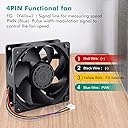

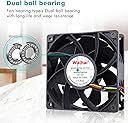


🌪️ Dominate heat with the fan that never quits!
The Wathai 120mm PWM computer case fan delivers a blistering 5300 RPM speed and 230 CFM airflow, engineered with dual ball bearings for an ultra-long 67,000-hour lifespan. Designed for high-performance PCs, mining rigs, and servers, it features intelligent PWM speed control for dynamic cooling efficiency and a 4-pin connector for easy BIOS customization. This powerhouse fan balances raw cooling force with smart noise management, making it a must-have for professionals demanding peak system performance.


| ASIN | B07SGWNV5J |
| Air Flow Capacity | 530 Cubic Feet Per Minute |
| Amazon Bestseller | #377,670 in Industrial & Scientific ( See Top 100 in Industrial & Scientific ) #904 in Electronic Cooling Fans |
| Brand Name | Wathai |
| Compatible Devices | Desktop PC, Server |
| Cooling Method | Air |
| Customer Reviews | 4.5 4.5 out of 5 stars (438) |
| Item Dimensions L x W x H | 12L x 12W x 3.8H cm |
| Manufacturer | Wathai |
| Material Type | Plastic |
| Maximum Rotational Speed | 5300 RPM |
| Noise Level | 58 Decibels |
| Power Connector Type | 4-Pin |
| UPC | 702334356784 |
| Unit Count | 1.0 Count |
| Voltage | 12 Volts (DC) |
| Wattage | 22.8 W |
J**G
Extrêmement puissant et donc bruyant à vitesse élevée. Très efficace
A**Y
Update: I've now had 3 of these fans fail in the same way only a few hundred hours after being put into service. They will fail to reach full speed and start making a noise. Eventually they will jam completely. After dissecting all 3 I found a failed capacitor can jammed between the rotor and the stator coils. Removing the can and reassembling (without replacing the capacitor) the fans will work at partial speed but not the full 5300 RPM. I'm reducing my rating to 1 star as these fans are NOT reliable and will fail prematurely regardless of the operating conditions. Whether it's a bad batch of capacitors or a bad design, I can't say, but a failed capacitor causing mechanical failure of the fan after only a few hours in service is unacceptable. Original review: I have a small single room ventilation system which was previously using Noctua industrial 3000 RPM fans. I bought two of these to try as upgrades, one for intake and one for exhaust in an HRV type setup. The exhaust fan seems OK after 2 weeks, but the intake (installed in a bottom to top airflow configuration taking outside air in via a filter) started making awful noises after about 48 hours and seized altogether after 3 days. I removed it and got it spinning again on its edge, reinstalled it, and within 2 hours it seized again. It’s seen air temperatures between about -2C and 10C, and would see a range from -35C to about 40C in that installed position, which the Noctua Industrial fan has handled just fine for over 2 years. So I’m rather disappointed, to say the least. I tried replacing the lubricant with some multigrade oil to see if this will help. As I said, the performance is exciting, but I can’t really stomach the prospect reliability issues in this system.
A**N
Amazing air output and noise level! I found operating it at a low 3-6 watts, it is moving as much air as most of my other 120mm fans. Crank it up to full power of 20+ watts and it's like facing a 30+ mph headwind. Thankfully I purchased a speed control to go with this. Unless you are mounting this fan inside a sound proof chamber you'll definitely need one to restrain the noise. I purchased this fan for cooling under my tractor canopy so the noise isn't that bad compared with the tractor diesel engine spinning 2500rpm. Most of the time I'm using the speed control at about 1/2 of maximum. But it's wonderful to crank it up when the outside temps are getting high. Size is correct match for 120mm mounting. The speed control I used is 4 pin version so fan connected right up. I haven't had any problems with operation. Get a speed control that permits setting a minimum speed also helps. Overall I am very, very pleased. I've bought several other Wathai fans and this one is just as well built as the others. I will definitely to buy Wathai fans.
K**N
In accurate size - it’s actually 92-93mm not 120
R**S
First, this "12V" dc fan's manual casually mentions that it can be damaged if run more than 20% above 12V rated voltage. It's *remarkably* thoughtful to design it to survive at the lead-acid car battery voltage 14.4V since most people I know call a cigarette lighter plug "12v." Now I don't need to add voltage regulation before hooking it up to to my car (or my 10 x AA Ni–MH power pack that runs between 13v and 14v)! They even include instructions on how to swap the wires in their plug if you have different polarity on your device. (I also bought the "Dual Ball Centrifugal Fan High Airflow" model from the same manufacturer, and it's equally superb, but as a "reasonable quietness outweighs sheer air flow" alternative, which also works beautifully even mounted flat against a solid surface.) I *almost* wired a PWM controller sharing the same power source, but I was in a rush so I used a simple power PWM controller as the power source instead of a constant 12V with PWM signaling speed and, while it doesn't get the fan below 50% power, that level isn't terrible if you have something else making noise in the room, so in a pinch that's an option for many projects using the fan. For those who are less comfortable with the details of electrical engineering the my amatuer self (but somehow have a 12v pulse-width modulation power regulator hanging around?), I should note that I get extremely non-linear scaling behavior using it (cut-in around 5% to 10% pulse width), ramp up to about 80% fan speed at about 25% pulse width, and the remainder of the speed is spread over the last 75% of the pulse width. As I write this, I realize the relationship is probably roughly logarithmic starting at the cut-in and I suspect (since I don't want to rip apart one of my two favorite fans of all time) there's a cap or inductor or something smoothing out my pulses before they hit the brushless motor controller IC so it's just seeing a very dirty reduced input voltage when I have a PWM wired in. At 100% speed, it's about as annoying as a vacuum cleaner (not nearly as loud, but much more piercing and distinct overtones). At half speed, the annoyance is about the same as an air window conditioner unit. I cranked it up to 100% and verified the advertised speed and discovered as some (possibly useful) characteristics. I recorded the sound of the fan and found the fundamental resonant frequency is 600Hz, which divided by 7 for the seven blades making each revolution, is about 85 Hz, or (multiplied by 60 to convert Hz to RPM is) 3600 RPM. If you are still reading, you must be looking for something wrong with it. Sorry, I can't find a single thing to complain about. :-)
Trustpilot
3 weeks ago
4 days ago