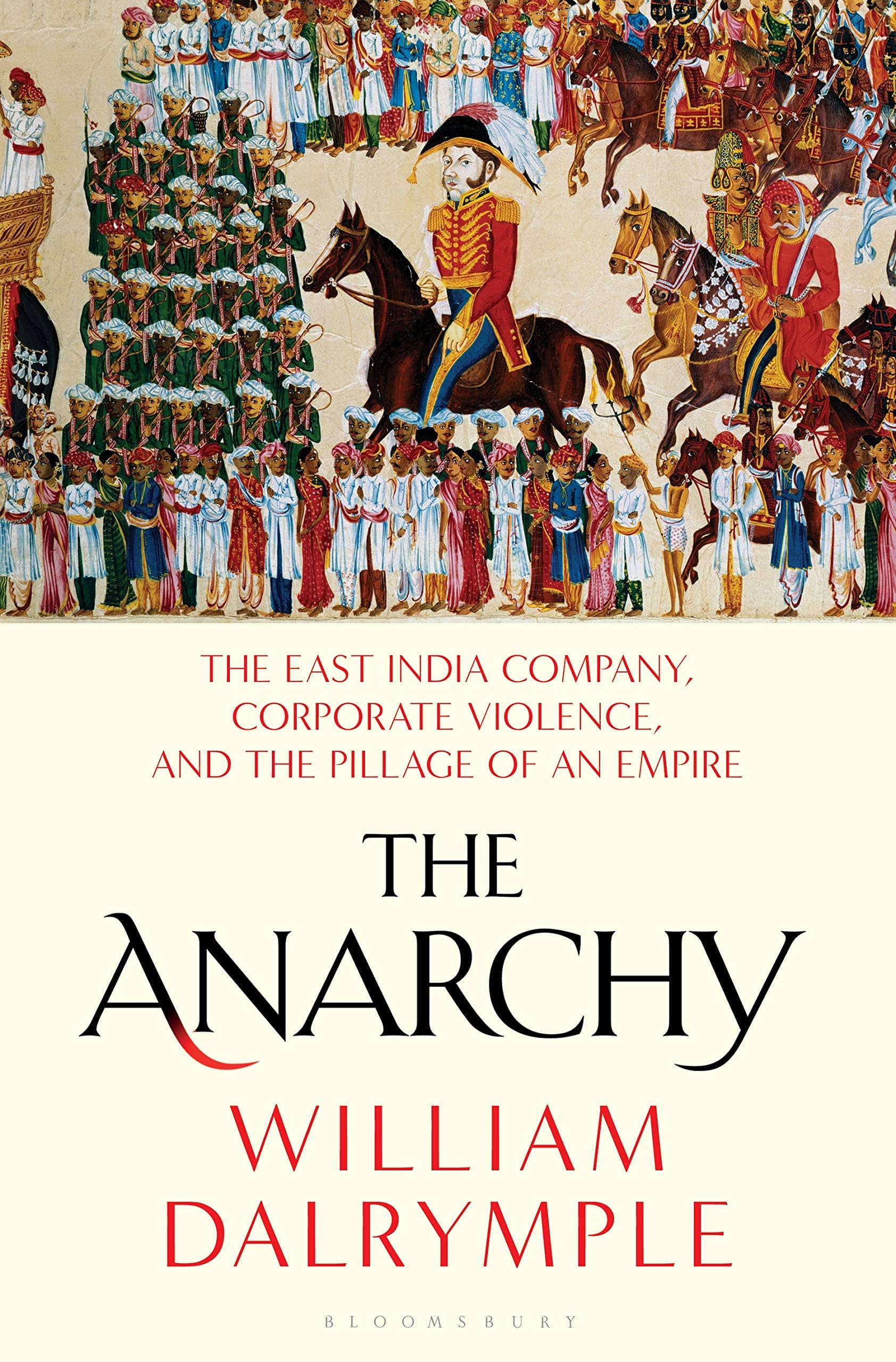
The Anarchy
Product ID: 97467959
Buy anything from 5,000+ international stores. One checkout price. No surprise fees. Join 2M+ shoppers on Desertcart.
Desertcart purchases this item on your behalf and handles shipping, customs, and support to Thailand.
Finalist for the Cundill History Prize ONE OF PRESIDENT BARACK OBAMA'S FAVORITE BOOKS OF THE YEAR NAMED A BEST BOOK OF THE YEAR BY The Wall Street Journal and NPR “Superb … A vivid and richly detailed story … worth reading by everyone.” - The New York Times Book Review From the bestselling author of Return of a King , the story of how the East India Company took over large swaths of Asia, and the devastating results of the corporation running a country. In August 1765, the East India Company defeated the young Mughal emperor and set up, in his place, a government run by English traders who collected taxes through means of a private army. The creation of this new government marked the moment that the East India Company ceased to be a conventional company and became something much more unusual: an international corporation transformed into an aggressive colonial power. Over the course of the next 47 years, the company's reach grew until almost all of India south of Delhi was effectively ruled from a boardroom in the city of London. The Anarchy tells one of history's most remarkable stories: how the Mughal Empire-which dominated world trade and manufacturing and possessed almost unlimited resources-fell apart and was replaced by a multinational corporation based thousands of miles overseas, and answerable to shareholders, most of whom had never even seen India and no idea about the country whose wealth was providing their dividends. Using previously untapped sources, Dalrymple tells the story of the East India Company as it has never been told before and provides a portrait of the devastating results from the abuse of corporate power. Bronze Medal in the 2020 Arthur Ross Book Award Review: Marvelous Colonial History - William Dalrymple is a wonderful historian and researcher of Anglo-Indian history who seems to know all the relevant archives (including private ones) in every language all of which he seems to be fluent in. Of his quartet (this book, 'White Mughals', 'The Return of the King' and 'The Last Mughal'), this is the best for providing an overview of the British conquest, the other three more interesting for their focus on key episodes, the relationship of the East India Company to the Mughal government in Hyderabad ('White Mughuls'), the invasion of Afghanistan ('The Return go the King') and the 1857 Sepoy revolt in Delhi ('The Last Mughal'), which was a turning point in Anglo-Indian relations. For this reader, the most eye-opening paragraph of this book was this (page 14): 'India then [1608 when the first East India ship showed up in India] had a population of 150 million - about a fifth of the world's total - and was producing about a quarter global manufacturing.... In comparison, England then had just 5 percent of India's population and 3 percent of the world's manufactured goods.' Of course there's some statistical BS going on here (even if you can believe statistics from 1608) since 5 percent of 'India's population' was 1% of the world producing 3 percent of it's goods. Today India represents about 19% of the world's population and produces 3.27% of world GDP. Maybe the Raj didn't turn out so well for India, despite what neo-imperialists like Niall Ferguson say. Dalrymple isn't in Ferguson's school. The heyday of Anglo-Indian relations for Dalrymple lasted from about 1750 until 1810, when there was a lot of friendly fraternizing between the cultures, and every 16-year old younger son of an English baronet could ship out to India and, assuming he didn't succumb to disease in the first year, acquire a fortune, a Bibi and a harem. 'White Mulghals' describes this culture well, though even better are the memoirs of William Hickey. Dalrymple is especially a connoisseur of the poetry, painting, festivals and court intrigues of the era. His 'Forgotten Masters: Indian Paintings for the East India Company' is a delight. Of course, an historian like Dalrymple of past centuries is relying on written records and cultural artifacts of elite culture, so a reader should assume that the voices of the poor and illiterate (90% of India at the time?) are unheard, except as they may have been seen causing mayhem (the Sepoy mutiny) and described by the literate in letters or show up in letters and petitions dictated to scribes, probably at exorbitant cost. A final note, about White Mulghals, which was the most affecting of the books to me. It tells the story of the love affair of James Kirkpatrick, the British resident (essentially ambassador) to the Mughal court at Hyderabad with Khair un-Nissa, a young noblewoman descended from the Prophet, who becomes pregnant by Kirkpatrick at age 14. Kirkpatrick was 36, and the affair nearly ruins his career with the East India Company. Then, because she was a Muslim. Today it would certainly ruin his career because of her age, which seems not to have been a problem then, but life then was much shorter. Kirkpatrick dies at 41; Khair un-Nissa dies 8 years later at 27. Review: A great book, with many references and factual information. - I have been reading William Dalrymple’s books for the last few years - White Mughals, Return of a King, The Last Mughal, and now this book - The Anarchy. It was a fantastic read, gripping, though sometimes comes across biased, especially when narrating stories of war strategies, exploits, and plundering by British East India Company’s Generals and Governor Generals. Speaking of war, this book has a large dosage of it - to be clear, the war strategies and wins by the EIC. Sometimes History becomes irrelevant for what is not being told, speaking of which, the loot and plunder of EIC become monotonous in this book, halfway through, as it was not balanced with wins of native rulers. Though I was not looking for a feel-good book, I was looking for a balanced narrative. I skipped some of the gory details about how the psychotic Ghulam Qadir tortured Shah Alam. The author did write about how Burke and Charles James Fox and other parliamentarians who tried to bring some sense of accountability to the anarchist EIC. This was revealing. However, the fact that Indian revenues propped up the entire British society for decades, came in the way of the Crown taking any manful action to control the suffering of the natives. The details about the Bengal famine will make anybody’s heart sink. In today’s age, Clive would be prosecuted and hanged in the town square for all his misdeeds and greed. As fate would have it, he shot himself to death. The chapter on Tipu will make you wonder that the propaganda started by the British about Tipu’s fanaticism is still finding followers. Tipu consulting Brahmin astrologers for conducting wars, his generous donations to temples, and the general love of his people towards their ruler Tipu were all in a new light. Tipu however was not as sagacious as his illustrious dad, Haider, who foresaw what EIC would do to native kingdoms and forged alliances to defeat EIC. Perhaps some of the negative narratives we hear about Tipu were real to some extent but they seem very exaggerated. He had enmity with Marathas, who peddled the same propaganda that EIC did. In the end, history is history, whether we like it not, but the final words by the author making it appear as a result of greed by a corporation has totally missed the point. This was and will remain forever as, misdeeds and greed of European imperialist powers. EIC is just a symptom of such greed and unbridled supremacy and arrogance. Someday all of those criminals must be prosecuted. One other interesting fact about EIC was that their expansionist and degutting policies were foreseen by American patriots in 1773. From the book: Patriot John Dickinson described EIC tea as ‘accursed Trash’, and compared the potential future regime of the East India Company in America to being ‘devoured by Rats’. This ‘almost bankrupt Company’, he said, having been occupied in wreaking ‘the most unparalleled Barbarities, Extortions and Monopolies’ in Bengal, had now ‘cast their Eyes on America, as a new Theatre, whereon to exercise their Talents of Rapine, Oppression and Cruelty’. - Dalrymple, William. The Anarchy (pp. 27-28). Bloomsbury Publishing. Kindle Edition. EIC dumped the tea that they could not sell elsewhere in the American colonies, with jacked up taxes. This event triggered the American Revolution when the tea was dumped in the Boston harbor. It is striking that what American patriots foresaw about EIC was missed by native Indian rulers of that time. As Karma would have it, this lack of vision in the 18th century had contributed in coalescing Indian peoples as one, united under tyranny, leading to the Indian Union of today.

| Best Sellers Rank | #59,999 in Books ( See Top 100 in Books ) #1 in India History #8 in Colonialism & Post-Colonialism #44 in Economic History (Books) |
| Customer Reviews | 4.4 out of 5 stars 9,025 Reviews |
B**R
Marvelous Colonial History
William Dalrymple is a wonderful historian and researcher of Anglo-Indian history who seems to know all the relevant archives (including private ones) in every language all of which he seems to be fluent in. Of his quartet (this book, 'White Mughals', 'The Return of the King' and 'The Last Mughal'), this is the best for providing an overview of the British conquest, the other three more interesting for their focus on key episodes, the relationship of the East India Company to the Mughal government in Hyderabad ('White Mughuls'), the invasion of Afghanistan ('The Return go the King') and the 1857 Sepoy revolt in Delhi ('The Last Mughal'), which was a turning point in Anglo-Indian relations. For this reader, the most eye-opening paragraph of this book was this (page 14): 'India then [1608 when the first East India ship showed up in India] had a population of 150 million - about a fifth of the world's total - and was producing about a quarter global manufacturing.... In comparison, England then had just 5 percent of India's population and 3 percent of the world's manufactured goods.' Of course there's some statistical BS going on here (even if you can believe statistics from 1608) since 5 percent of 'India's population' was 1% of the world producing 3 percent of it's goods. Today India represents about 19% of the world's population and produces 3.27% of world GDP. Maybe the Raj didn't turn out so well for India, despite what neo-imperialists like Niall Ferguson say. Dalrymple isn't in Ferguson's school. The heyday of Anglo-Indian relations for Dalrymple lasted from about 1750 until 1810, when there was a lot of friendly fraternizing between the cultures, and every 16-year old younger son of an English baronet could ship out to India and, assuming he didn't succumb to disease in the first year, acquire a fortune, a Bibi and a harem. 'White Mulghals' describes this culture well, though even better are the memoirs of William Hickey. Dalrymple is especially a connoisseur of the poetry, painting, festivals and court intrigues of the era. His 'Forgotten Masters: Indian Paintings for the East India Company' is a delight. Of course, an historian like Dalrymple of past centuries is relying on written records and cultural artifacts of elite culture, so a reader should assume that the voices of the poor and illiterate (90% of India at the time?) are unheard, except as they may have been seen causing mayhem (the Sepoy mutiny) and described by the literate in letters or show up in letters and petitions dictated to scribes, probably at exorbitant cost. A final note, about White Mulghals, which was the most affecting of the books to me. It tells the story of the love affair of James Kirkpatrick, the British resident (essentially ambassador) to the Mughal court at Hyderabad with Khair un-Nissa, a young noblewoman descended from the Prophet, who becomes pregnant by Kirkpatrick at age 14. Kirkpatrick was 36, and the affair nearly ruins his career with the East India Company. Then, because she was a Muslim. Today it would certainly ruin his career because of her age, which seems not to have been a problem then, but life then was much shorter. Kirkpatrick dies at 41; Khair un-Nissa dies 8 years later at 27.
G**N
A great book, with many references and factual information.
I have been reading William Dalrymple’s books for the last few years - White Mughals, Return of a King, The Last Mughal, and now this book - The Anarchy. It was a fantastic read, gripping, though sometimes comes across biased, especially when narrating stories of war strategies, exploits, and plundering by British East India Company’s Generals and Governor Generals. Speaking of war, this book has a large dosage of it - to be clear, the war strategies and wins by the EIC. Sometimes History becomes irrelevant for what is not being told, speaking of which, the loot and plunder of EIC become monotonous in this book, halfway through, as it was not balanced with wins of native rulers. Though I was not looking for a feel-good book, I was looking for a balanced narrative. I skipped some of the gory details about how the psychotic Ghulam Qadir tortured Shah Alam. The author did write about how Burke and Charles James Fox and other parliamentarians who tried to bring some sense of accountability to the anarchist EIC. This was revealing. However, the fact that Indian revenues propped up the entire British society for decades, came in the way of the Crown taking any manful action to control the suffering of the natives. The details about the Bengal famine will make anybody’s heart sink. In today’s age, Clive would be prosecuted and hanged in the town square for all his misdeeds and greed. As fate would have it, he shot himself to death. The chapter on Tipu will make you wonder that the propaganda started by the British about Tipu’s fanaticism is still finding followers. Tipu consulting Brahmin astrologers for conducting wars, his generous donations to temples, and the general love of his people towards their ruler Tipu were all in a new light. Tipu however was not as sagacious as his illustrious dad, Haider, who foresaw what EIC would do to native kingdoms and forged alliances to defeat EIC. Perhaps some of the negative narratives we hear about Tipu were real to some extent but they seem very exaggerated. He had enmity with Marathas, who peddled the same propaganda that EIC did. In the end, history is history, whether we like it not, but the final words by the author making it appear as a result of greed by a corporation has totally missed the point. This was and will remain forever as, misdeeds and greed of European imperialist powers. EIC is just a symptom of such greed and unbridled supremacy and arrogance. Someday all of those criminals must be prosecuted. One other interesting fact about EIC was that their expansionist and degutting policies were foreseen by American patriots in 1773. From the book: Patriot John Dickinson described EIC tea as ‘accursed Trash’, and compared the potential future regime of the East India Company in America to being ‘devoured by Rats’. This ‘almost bankrupt Company’, he said, having been occupied in wreaking ‘the most unparalleled Barbarities, Extortions and Monopolies’ in Bengal, had now ‘cast their Eyes on America, as a new Theatre, whereon to exercise their Talents of Rapine, Oppression and Cruelty’. - Dalrymple, William. The Anarchy (pp. 27-28). Bloomsbury Publishing. Kindle Edition. EIC dumped the tea that they could not sell elsewhere in the American colonies, with jacked up taxes. This event triggered the American Revolution when the tea was dumped in the Boston harbor. It is striking that what American patriots foresaw about EIC was missed by native Indian rulers of that time. As Karma would have it, this lack of vision in the 18th century had contributed in coalescing Indian peoples as one, united under tyranny, leading to the Indian Union of today.
M**9
An excellent read of a most astonishing history
I went into this book a little bit leery because of the title; I was not looking for an anti-capitalist rant, but the title suggested that it might be one. In fact I was pleasantly surprised at how even-handed he put every party's failings and successes equally on the page. For every atrocity committed by the British, plenty were committed by Indians against each other. There were peaceful and cultured Mughal rulers and ocasionally British Reagents, and there were also horrible and bloody minded tyrants on both sides. There is also great beauty in the descriptions of the better parts of Mughal culture, and the solid morality of the British when it came to honoring their vanquished foes, hat in hand. Neither side comes out particularly clean, but both are fighting for what they believe in. This is a fascinating, wide sweeping story of epic proportions - battles of empires, armies, merchants together with palace intrigue, defections and betrayal. Alliances continually forming, falling apart and switching sides as pragmatic rulers shift to adapt the ever changing situations. It's no spoiler to say that the British eventually conquered over all, and remained in charge of India until 1947. This is the story about how a commercial trading empire laid the foundation for the coming of the British Raj, and the final sunset of the once great Mughal empire, which had already started to crumble from within upon the arrival of European traders in the mid-1700s. In this book one comes to realize just how fragile any country really is, and it does not take a lot for the dominos to topple. There are many parallels to today's geo-political climate, and indeed to just about any time period in human history. The sands are ever shifting, and we have been very lucky to live in a time of relative peace and prosperity compared to most of human history. This books shows just how little it takes for that to change. I highly recommend this book to anyone who is interested in world history, the history of the British Empire and the history of India. Come with an open mind.
M**7
A substantial work of history
I certainly learned a great deal in the first 100 pages, having never studied the history of India pre- independence. The author has definitely made a major contribution to scholarship with this book. It is amazing to learn that the English conquest of a India had never been accurately represented in modern historiography. It certainly deserves 5 stars for the investigation and compilation involved. That said, I found 300 pages of battle re-telling rather tedious and I wished that I could have read a more well-rounded account. The author has a point of view and, given the effort expended, is certainly entitled to present it, but by the 2/3 point, I longed for a different perspective. I would have liked to learn more, for example, about the sepoys who bore much of the burden of the battles he recounts. And more about the trading the company did. And daily life in the company’s outposts. I certainly understand that was not the author’s motive, but, by the same token, battle after battle is just tedious after a certain number of them. He tries to stoke interest - “ the Mughal Empire almost won that one!” - but one knows the end result. I also found the astonishment about the battles being waged by “a corporation” to be a little anachronistic. In the era, corporations were not at all like today, when founding one is utterly routine and automated. Back then, they were tightly controlled by and linked to their sovereign. And while the violence committed by the EIC was on a vastly different scale, given the size of India’s population and the sophistication of the Mughal elite, than what happened when English companies brought settlers to North America, it’s not terribly different qualitatively from what happened here. One should also think of Drake’s privateering under royal letters of marque. There are many things to say about the deeds of the EIC in India but “shockingly anomalous” would not be a phrase which I would employ in such a context.
G**G
"Great Man" History of the EIC
In "The Anarchy," William Dalrymple gives us a colorful, well-written cautionary tale about the rise and fall of the British East India Company, but the narrative doesn't give the reader the full picture. Instead he presents a curiously narrow, old-fashioned Great Man type of history. We learn a lot about the personalities and activities of a small number of prominent men, including Brits like Clive and Hastings; various European soldiers and high level company representatives; as well as rulers and generals from the Mughals, Marathas, and other groups. There's lots of information on famous battles and political intrigues, with plenty of lurid descriptions of raping and pillaging and torturing and shameless profiteering, together with swashbuckling action. Dalrymple does a wonderful job evoking the culture and atmosphere in India (especially among the indigenous and European elites) from the seventeenth to the nineteenth century, and gives us a solid feel for the goals and outlook of the various contending leaders. He also draws interesting lessons from the rapacity of an unregulated EIC, with its own army and navy, which he briefly discusses in relation to modern multinational companies in the concluding pages. What is missing is a clear, balanced picture of the broader landscape. We don't, for example, learn much about the everyday activities of lower-level company employees or the Indian merchants, farmers and manufacturers that helped the EIC to become so wealthy. Most significant, though, in a history focusing on the development of one of the earliest multinationals, is the lack of much actual economic history. His focus on land battles and the Rape of Bengal gives us a glimpse of how the British fought off various competitors to earn the right to skim off enormous agrarian revenues from eastern India, but the reader gets very little sense of the other vast revenue streams the EIC received from goods like tea, opium or textiles. Also conspicuously absent is a well-balanced discussion of the place of India in the evolving global capitalist system. Dalrymple does tell us quite a lot about the EIC's board of directors in London, and I did learn some interesting tidbits about the way British strategy in India was affected by the loss of her American colonies and the growing threat of Napoleon's activities in Europe and Egypt around 1800. But we learn almost nothing about the important synergies between British activities in India and other parts of Asia (especially China), the role of bullion from the New World in financing the early trade of the EIC, the way British maritime dominance helped secure EIC's global sea trade, or the way Indian raw materials helped to finance the Industrial Revolution in Britain. It's impossible to get a clear understanding of how and why the EIC was able to dominate so much of India without understanding these factors. But the focus on the EIC's political and military exploits makes for an exciting narrative and fits in well with Dalrymple's thesis abut the role of corporate violence in EIC's rise. And of course duels, cannonades, harem intrigues, boardroom skullduggery and the courtly entertainments of Nawabs and Rajas make for more interesting reading than discussions of trade balances, textile production or the activities of petty traders or farmers.
D**R
A State Disguised As Merchants
William Dalrymple tells how a single business operation replaced the Mughal empire to rule the Indian subcontinent. The East India Company was a first major multi-national corporation, and an early example of a joint stock enterprise. Most events occur between 1756-1803, around the time of the American and French revolutions. The story begins in 1599 with the charter of the Company, during the reign of Queen Elizabeth I and the lifetime of Shakespeare. The Company was preceded by Walter Raleigh and Francis Drake and included veteran Carribean privateers, state sponsored pirates who attacked the Spanish armada for gold and silver. The first Company voyage brought back spice from Indonesia by robbing a Portuguese ship. Outdone by the Dutch in the spice trade, the Company began trade in India with the benefits of a British monopoly, license to raise an army and seize territory, all endorsed by the Crown. At the time of the Company's expansion of power the Mughal Empire had been weakened by a series of invasions and internal conflicts. Increasing intolerance had pushed Maratha rebels under Shivaji to strike north from the Deccan plateau in the late 17th century. Sikhs struck south from the Punjab. Prince fought against prince. In 1739 the Persian warlord Nader Shah sacked Delhi, and made off with the spoils of an empire. The period is known as the Anarchy. Construction of fortifications at a British port in Bengal provoked the local Nawab and Mughal army to destroy the trading post in 1756. Captured British were thrown into the so-called 'Black Hole of Calcutta' where a significant number died from trampling and suffocation. Robert Clive, a violent and ruthless soldier of fortune hired by the Company, would defeat and plunder the Mughals and oust the French from Bengal, returning home the richest man in Europe. In 1764 the Company put down a Mughal rebellion, and replaced the empire as tax collectors of the wealthiest lands on the subcontinent. The Company amassed a private army twice the size of Britain's. Draught, famine and Company hoarding caused a massive bailout in 1773 by the Crown. Tea shipped west triggered the American revolution, and opium shipped east resulted in war with China. At it's height the Company accounted for half of the world's trade. Much is covered during forty years. Warren Hastings, Clive’s successor as governor of Bengal, attempted to reform the worst excesses of Company rule, and was put on trial by his rival countrymen. His successor would be Cornwallis, the general who surrendered the American colonies to Washington. Tipu Sultan, ‘Tiger of Mysore’, was sought as an ally by Napoleon, until he was foiled by Nelson at the Nile. Tipu was defeated by Wellington of future Waterloo fame. Dalrymple doesn’t mince words about events that occured, nor do eyewitnesses of the period. On British incursions before the battle of Plassey: ‘What honor is left us when we take orders from a handful of traders?’. On the handover of the Mughal empire after the battle of Buxar: ‘The entire transaction took less time than the sale of a jackass’. All was realized under withering fire of artillery, executed by Indians armed and trained by the Company. Dalrymple's unifying narrative source is the Mughal court historian Ghulam Hussain Khan's epic 'Review of Modern Times'. He also scoured the India Office collection in London and National Archives in Delhi. As noted in the introduction 'English and Mughal records of the period are extensive'. Primarily a military account, his contribution is gathering and presenting it all in an entertaining and edifying manner. His talent for storytelling is clearly shown. For a look at what corporate capitalism can be, this is a fascinating case. The Company thrived more than 200 years ago. Some things have changed, others have not. Territorial takeover is frowned upon, but economic conquest is far from over. Corporations, lobbyists and politicians can effectively do the same work. The will to profit, avoid regulation and taxes, is intrinsic. Dalrymple does not state this explicitly in the text, but the parallels are evident.
I**D
Corporations Gone Wild
In The Anarchy: The East India Company, Corporate Violence, and the Pillage of an Empire, William Dairymple tells the story of the East India Company’s ruthless conquest of the Indian subcontinent. We all know the story of Britain’s imperial rule over India in the nineteenth and early twentieth centuries. However, in The Anarchy, Dairymple reminds the reader that Britain did not conquer India. It was conquered in the eighteenth century by a private corporation, the East India Company, and then handed over to Britain. The book could have been called “Corporations Gone Wild.” The East India Company initially sent its representatives to India to obtain permission to set up commercial trading sites. But, over time, those representatives engaged in military actions to gain control of greater and greater swaths of the subcontinent. Eventually, the East India Company controlled the entire subcontinent. And they treated it like a corporate asset. They sent all valuable possessions of the prior rulers back to England, they taxed the local residents into abject poverty and they forced local artisans to produce goods for the Company at slave wages. Dairymple does an excellent job of describing the Company’s diplomatic and military actions in India that led to the subjugation of the subcontinent. And he shows how the East India Company used its influence in London to lobby members of parliament, many of whom were Company shareholders, to obtain government support for their purely private enterprise. But, Dairymple is clearly appalled that a private enterprise like the East India Company was permitted to subjugate an entire subcontinent. He seems to believe that, at some point during the East India Company’s takeover of India, the home office in London should have reigned in its employees and prevented their military activities. But because all of their activity was, apparently, perfectly legal, the home office presumably told their employees “You’re good to go. Keep up the good work.” The story, as told by Dairymple, is an indictment, not only of the East India Company, but of corporate culture in general, where all actions are undertaken solely for the benefit of shareholders. He suggests that powerful corporations in our own time are similarly cruel and greedy (though possibly not on the same level) because they continue to act solely for the purpose of increasing income for shareholders. I tend to disagree with Dairymple. The laws currently governing corporations impose a fiduciary duty upon the officers and directors to act in the best interests of the shareholders. In fact, corporate lawyers sometimes have to remind officers and directors that, if they fail to act solely for the purposes of increasing income for shareholders (without violating the law) they will be in breach of their fiduciary obligation. Thus, while it would be nice if, as Dairymple suggests, corporations used their power to act more in the public interest, they will probably not do so until the governing laws are amended to provide that the officers and directors have an obligation to act for the benefit of third parties, such as employees and the public good, as well as for shareholders. Because of all the names and places that are not familiar to the casual reader, this is not an easy read. Thus, this book is not for everyone. However, I give this book four stars and recommend it highly for anyone interested in the history of the Indian subcontinent, the rule of England over the subcontinent or this rarely told story of early corporate power.
C**R
One of the most important stories in world history barely known today
Near every page was a mind blow to me. I read 100 books a year, much in history, and studied history as a kid in university. I am preparing for a trip to India and am reading two dozen books on it. None has been better or more revealing than this. I had a rough sense of what the EIC but really no understanding of how one company effectively created the empire in India as a company with a military at one point larger than Britain’s itself. There are virtually nothing remembering it in London today, no blue plaques etc. The characters who ran it — near socialpathic in many cases — were as amazing as any of it. Professor Darymple is a great historian in the greatest tradition: meticulous research and detail, but never lost in the weeds; drives with fairness to uncover and convey information; writes beautifully and engagingly.
F**K
the writer lets it play like a movie in your mind
one of best book I have read...
A**M
Excellent history, for once written also from the side of the vanquished.
As all previous books of this author, this is an excellent historical account of what happened when a British 18th century corporation managed to subdue a country with little or no control from anyone. My only regret is that the title, in my opinion, gives a relatively little idea of what the book is all about and may not attract the casual reader to the real content of the book. I picked it up just because of the reputation of the author. My whole historical perspective of this country has now completely changed (I had read other books, written by the victors...), and how much more sense the modern condition of Indian subcontinent makes once I have this period clarified and illuminated by this book.
L**L
Damaged by amazon.
Pages ripped, but package intact.
J**P
British Rule Summarised
The Anarchy: The East India Company, Corporate Violence, and the Pillage of an Empire by William Dalrymple is a meticulously researched and compellingly written historical account that delves into the rise and fall of the East India Company (EIC). Here are the key aspects of the book: Historical Insight Dalrymple provides a vivid and detailed narrative of the EIC, from its inception as a modest trading entity in the early 17th century to its transformation into a powerful corporate juggernaut that controlled vast swathes of India. The book chronicles the period from 1599, when the EIC was established, to 1803, when it conquered Delhi, marking the beginning of British colonial rule in India. Corporate Exploitation and Violence The title "The Anarchy" reflects the chaotic and violent period in Indian history during which the EIC exploited local rivalries and leveraged its growing military power to establish dominance. Dalrymple highlights the corporate greed and ruthless tactics employed by the EIC, emphasizing how it operated more like a predatory private enterprise than a traditional colonial power. The book underscores the devastating impact of the EIC's policies on Indian society, economy, and polity. Personalities and Politics Dalrymple brings to life a range of historical figures, from EIC officials like Robert Clive and Warren Hastings to Indian rulers such as Mughal Emperor Shah Alam II and Nawab Siraj-ud-Daula. He examines their motivations, strategies, and the interplay of personalities and politics that shaped this tumultuous era. The narrative is enriched by Dalrymple's use of primary sources, including letters, diaries, and contemporary accounts, which provide authenticity and depth. Literary Style Dalrymple's writing is both scholarly and accessible, making "The Anarchy" suitable for both academic audiences and general readers interested in history. His storytelling prowess keeps the reader engaged, and his ability to contextualize historical events within broader social and economic trends adds layers of understanding. Critical Reception "The Anarchy" has been praised for its thorough research, balanced perspective, and engaging prose. Critics have lauded Dalrymple for shedding light on a critical but often overlooked aspect of colonial history and for his ability to convey the complexities of this period in a nuanced manner. The book has also sparked discussions about the legacy of colonialism and the role of corporate power in shaping world history. William Dalrymple's "The Anarchy" is a masterful account of the East India Company's rise to power and its profound impact on India. It offers valuable insights into the mechanisms of corporate exploitation and the historical consequences of unchecked corporate power. The book is a must-read for anyone interested in the history of India, colonialism, and the dynamics of corporate imperialism.
E**N
meesterlijk
Zeer leesbaar. Het toont de EIC als een soort handelsmafia.
Trustpilot
4 days ago
2 months ago