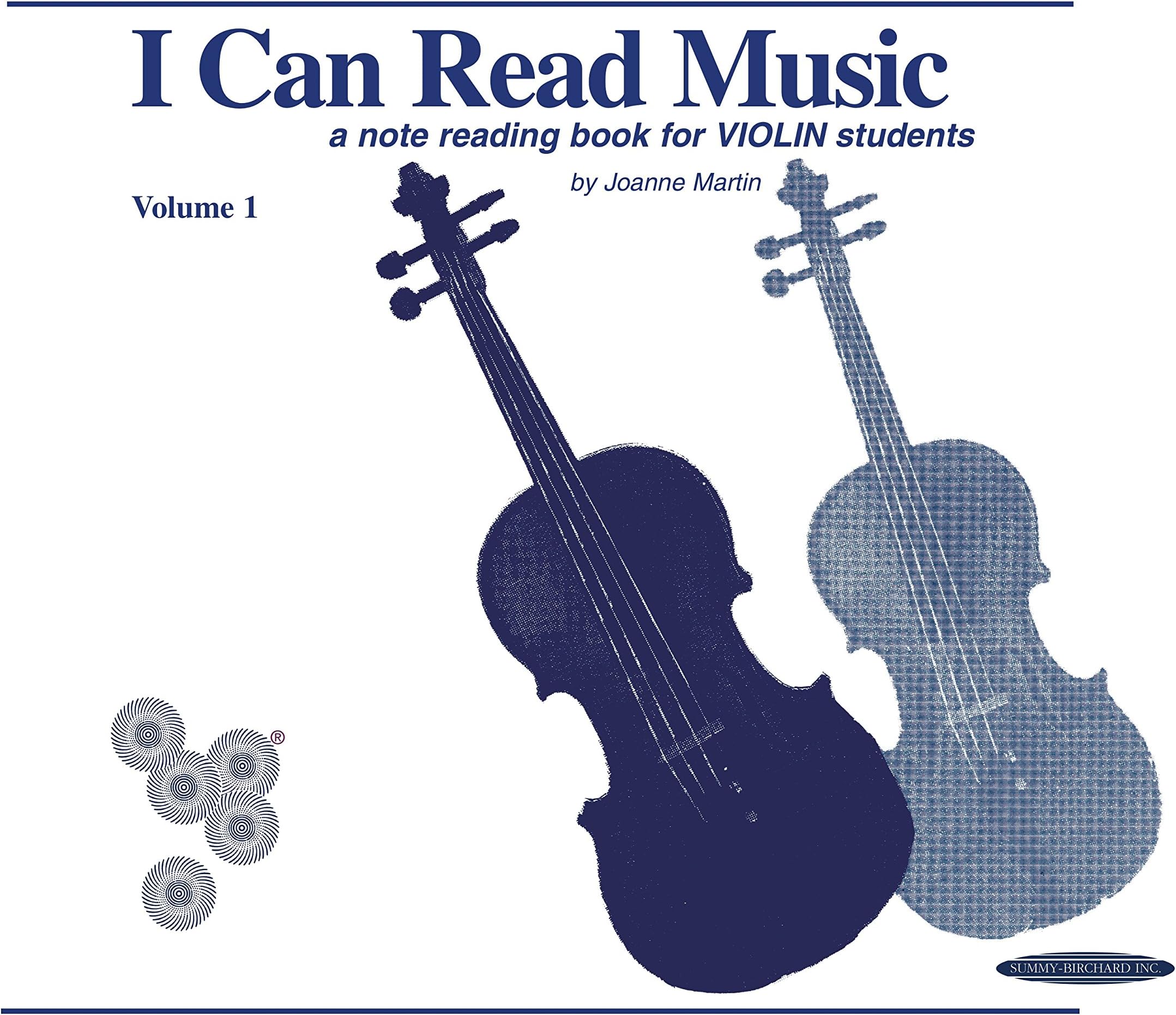
I Can Read Music, Volume 1: A note reading book for VIOLIN students
Product ID: 105249422
These easy-to-read, progressive exercises by Joanne Martin develop a student's reading skills one stage at a time, with many repetitions at each stage. I Can Read Music is designed as a first note-reading book for students of string instruments who have learned to play using an aural approach such as the Suzuki Method®, or for traditionally taught students who need extra note reading practice. Its presentation of new ideas is clear enough that it can be used daily at home by quite young children and their parents, with the teacher checking progress every week or two. Review: Good quality! - This is a great book for steadily building note reading skills. Half of the book is devoted to pitch recognition and half to rhythm on open strings. The print quality is great and the spiral binding helps little ones keep the book open easily. This could be a bit repetitive for some but that’s kind of the point of it. No pictures or images, just exercises in a nice larger font so it’s easy for beginners to read. Review: Why it Works - This is to be used by a teacher during lessons and then practiced at home. It is not a teach yourself system. It is designed for young children, and contrary to some thoughts out there, it does not squelch any musical desires. Young children love the fact that they can conquer a lesson a week, and love the way they can be successful - thereby celebrating every small step. I use this in my studio of 30 students, and as long as it is taught well, it is a challenge enjoyed by all. Read the intro - for the "pitch" section, you are to go through it saying all of the note names, then again with the finger numbers - both with steady pulse. Then you play it. The rhythm section is clapped, then played. I would highly recommend it.
| Best Sellers Rank | #1,210,278 in Kindle Store ( See Top 100 in Kindle Store ) #4 in Violin Songbooks #5 in Music Exercises #7 in Violins (Books) |
S**O
Good quality!
This is a great book for steadily building note reading skills. Half of the book is devoted to pitch recognition and half to rhythm on open strings. The print quality is great and the spiral binding helps little ones keep the book open easily. This could be a bit repetitive for some but that’s kind of the point of it. No pictures or images, just exercises in a nice larger font so it’s easy for beginners to read.
L**E
Why it Works
This is to be used by a teacher during lessons and then practiced at home. It is not a teach yourself system. It is designed for young children, and contrary to some thoughts out there, it does not squelch any musical desires. Young children love the fact that they can conquer a lesson a week, and love the way they can be successful - thereby celebrating every small step. I use this in my studio of 30 students, and as long as it is taught well, it is a challenge enjoyed by all. Read the intro - for the "pitch" section, you are to go through it saying all of the note names, then again with the finger numbers - both with steady pulse. Then you play it. The rhythm section is clapped, then played. I would highly recommend it.
P**N
Easy
Great book. Easy to use. Your music teacher will be happy you are using it.
M**K
The best! Can’t say enough great things about it!
I’m a Suzuki teacher, and I have been using this book for teaching my students for 20 years. It is the best out there. I use it for kids of all ages and adults. Use a metronome with it from the beginning to help establish what a beat is. I start using volume 2 of this when I get half way through volume 1, and then give them an assignment from both volume 1 and 2 each week after that, so that the basic concepts in the beginning of volume 1 aren’t forgotten. (Basics are reviewed in beginning of volume 2.). Don’t skip or rush through them, and with metronome, your students will become solid music readers. Despite the assumption Suzuki kids can’t read, (and I was one of those poor kids as a child), many of my students have scored the highest in all-state auditions in sight reading after being trained through these books.
C**E
Great way to teach note reading especially for Suzuki teachers
This is a great note reading book for Suzuki trained children. It is very comprehensive in that the child really knows how to read the note and rhythm backwards and forward by the time they finish the book. The book keeps the pitch practice separate from the theory, but is set up into easy lessons. I use this with my violin students. I use one lesson a week. It takes about a year to complete it. I have the kids sing the names of the note in pitch before they ever play it. I do the same with counting the rythms. I will not start a student note reading until they can proficently play without their posture becoming compromise as I try to distract them while they play. I expect consistant good tone before a child ever begins to note read.
K**R
works well with suzuki method
I teach suzuki method, and once students get about half way through book 1 of the suzuki violin. I bring out this book. Because I no longer have to worry about posture, and the students are comfortable with their bowing and they know the note names of most of their finger postions on the violin, they can easily just focus on reading the music. the direction of this book is very thoughtful. If you go in sequence order it will be very rewarding. Each lesson has just notation on page and then just rhythm on the other. the rhythm is also done in different time signatures as well. I really like the layout of this book. It makes since, and makes sure the student really is READING the music.
P**D
Great for young children
My 8 and 9 year olds love going though this book. It's easy to follow and it jump starts them learning how to read music.
D**3
Working great for a seven year old
My daughter is seven years old, and has been doing Suzuki violin since she was five. We have now started using this note reading book in our practices, and it is working well. We are about halfway through the book, and she is getting very comfortable reading notes. I think it's important that the student is old enough to be comfortable reading (as in reading books) before starting to learn note reading. Another key is to use this book the right way. We started at lesson one, and for each row of notes, my daughter first says the name of each note in the line. Then she plays it. We only play the line once (if she gets it right) or twice (if she makes mistakes), because the point it to read the notes. After the second time playing a line of music, she has it memorized and she is no longer reading it. We only do about three lines of music per day and then switch to our typical violin practice.
J**A
Livro conforme imagem
Livro espiral, capa com gramatura um pouco maior que uma folha (mais grossa). Foi solicitação da professora de violino como complemento ao método Suzuki (estuda há alguns anos). Vamos encapar para maior durabilidade.
B**E
Perfetto, un ottimo supporto allo studio della musica.
Come da descrizioni. Acquistato perché mia figlia frequenta la scuola Suzuki, è al 2° anno di violino, la maestra utilizza questo libro.
M**A
Parfait pour les violonistes débutantss
Acheté pour mes élèves ayant du mal à lire et associer les notes sur leur instrument. Très progressif et parfaitement adapté : la lecture commence par les notes utilisées au début de l'apprentissage (corde à vide, puis 1er doigt, etc.), contrairement aux méthodes habituelles. Ce qui permet de renforcer le lien entre lecture et connaissance du manche et des doigtés (lecture, puis chant puis jeu sur l'instrument). La page de droite est consacrée au rythme, pas utilisée pour le moment mais très bien faire aussi.
E**E
good book
not as clear as expected when one cannot read music at all and starts with this book Good examples - acceptable
P**R
Ideal para empezar
Lo bueno de este libro es que está orientado específicamente a violinistas. Es muy sencillo, para empezar de cero. Para alguien que ya sepa algo de lenguaje quizá se quede demasiado básico y tendría que empezar directamente con el volumen 2.
Trustpilot
3 weeks ago
2 months ago