
DOWNLOAD THE APP


Customer Services
Copyright © 2025 Desertcart Holdings Limited
DOWNLOAD THE APP
Full description not available
F**1
A must have guide in the camera bag
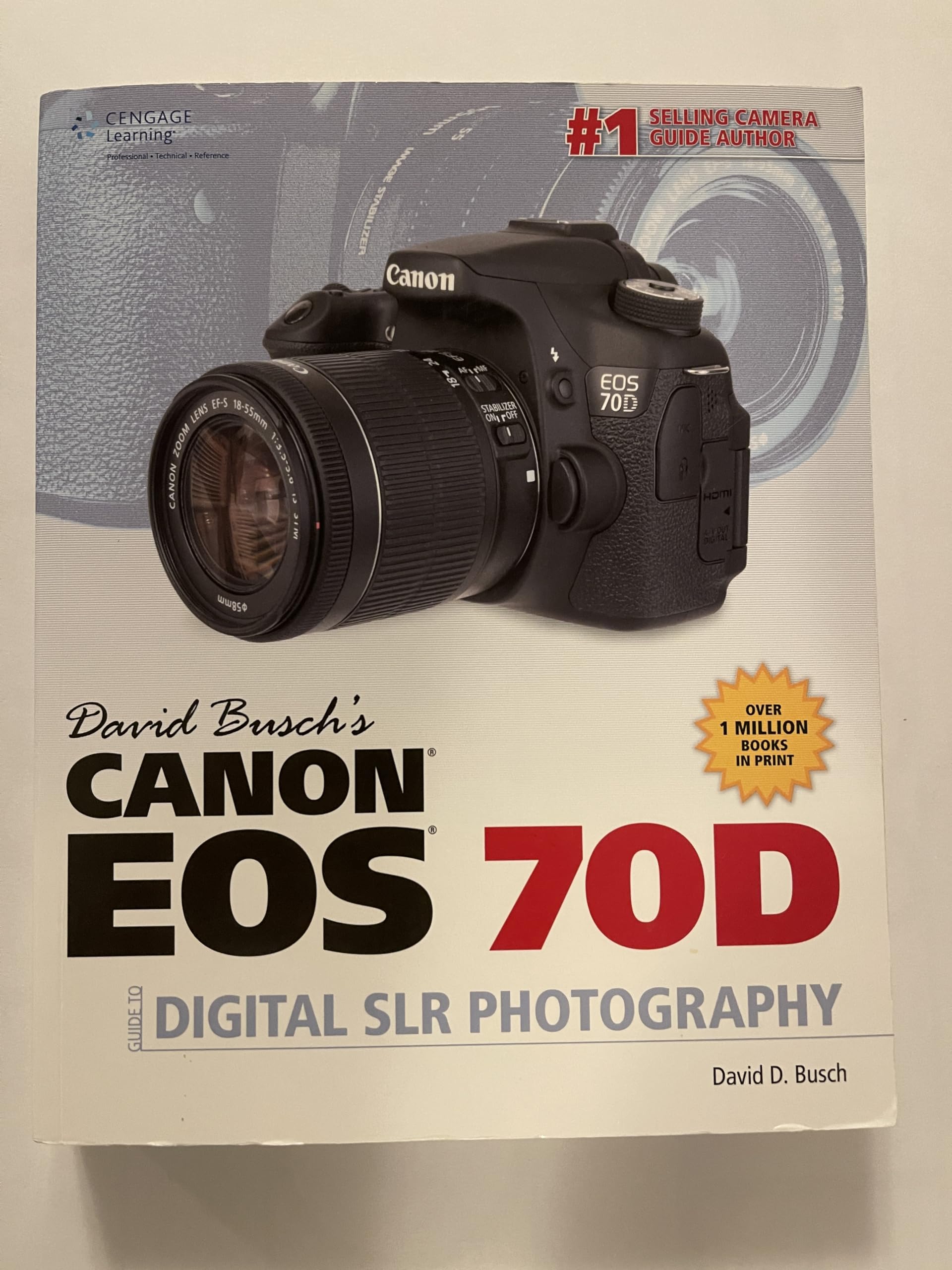
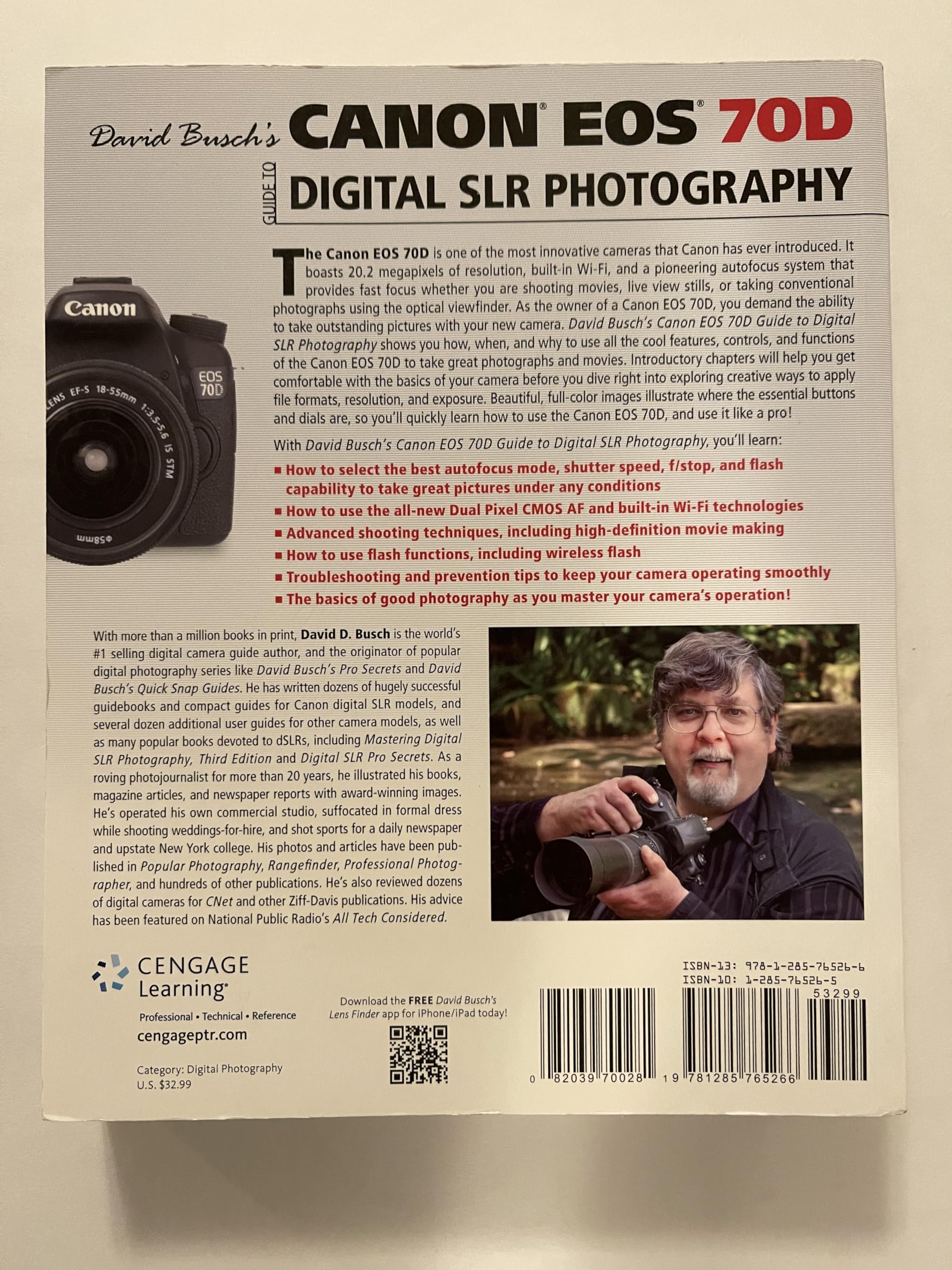
Another MUST have companion book for any 70D owner - As always, the Canon Factory manuals are about as helpful and user friendly as deciphering hieroglyphics on a cave wall via candlelight - Sorry Canon, but the included factory manual is a bit much and too difficult to quickly navigate to specific reference material - I've always joked that Canon needs to include a 'user guide & manual' on the actual camera manual because it's always so dryly written and complicated for the amateur and a yawn for the semi pro/pro - That's where David Busch steps in and saves the day -Whether you're an experienced pro with a vast working knowledge of photography that understands the Zone system, focal lengths, shutter speed and aperture and the relation between the two, ISO, and the Kelvin scale OR just a regular person looking for a user friendly guide to explain their new camera in a language that everyone can comprehend, this is the go to book and guide -Don't even bother with the official Canon manual - Set it in the bookcase and forget about it (I stopped telling people to set fire and/or shred the official Canon factory manual because when you upgrade cameras and decide to sell the old one on Ebay, it's best to have the manual) - At any rate, David Busch's guide on the 70D is another winner - It's loaded with detailed info on everything the camera does, complete with charts, reference material and examples - He not only shows the 'how' but also includes the 'why' part - Followed up by examples in a detailed, well written and clear (but not long) language that won't confuse the beginner/casual photographer or bore the experienced guys out there - Each chapter covers a specific topic, camera function or setting - No vague nondescript ramblings that jump all over the book -There are billion how to guides on each camera out there - I've prob tried every other well known author but after my first Rebel XTI I've stuck with this guy - From the XTI to the T1i, T21, 60D, 7D and now 70D - My collection is the go to for reference and the first thing I read when I purchase or use a camera and need quick rundown - My collection of David's books are falling apart from the wear and tear I have put on them over the years - You could just shoot in Auto Mode and let the camera do all of the thinking for you (which is fine if that's all you need) - However, after you learn what the camera is capable of and how easy it is to achieve impressive results with just a few adjustments and practice, you'll never want to shoot in Auto Mode again - You will learn not only how to set up your camera, better yet, you will learn photography and all of the crazy photo jargon you hear the experienced guys use will start making sense to you - You will soon not only understand the language but speak it as well -Buy the guide, take the official Canon guide (don't set fire to it) and file it away - Read this book/how to guide instead - Had I not bought his guide back when I first got interested in photography I probably would of returned the camera and crossed photography off my list of potential hobbies - Now it's at the top of my list and I credit the author for his help via these well written user guides.
C**L
Very detailed book with many clear illustrations!
Very detailed book for Canon EOS 70D. Great explanations for all camera functions including some select lenses and flashes. It includes a lot of clear color pictures and detailed illustrations. This was a used book that was nearly new and had no markings or torn pages. This book saved me over $20 off the price of a new one.
N**T
Very pleased with this book
The Canon 70D is my first DSLR after 20 years of using P&S's; before that I had a film SLR. I am not one to put a camera on auto-everything and let that suffice. This book is a terrific resource for helping me get up to speed not only with the many features of the 70D camera but goes well beyond what the manual that came with the camera covers. This book definitely lives up to my expectations, and once I make it through the entire book, I can see myself referring back to it time after time. It has a very well-prepared index, something that the manual seriously lacks. I think that the preview of the book speaks for itself, as well as the many positive reviews it has gotten. UPDATE, one month later: Because I'm experimenting with as many of the features of my camera as possible, I have referred to this book practically every day since I received it. I still use the camera manual though, mainly for the diagrams that include reference page numbers--if that doesn't answer my question, it gives me some terminology that I can go back to the Busch book with and search for. P.S. And yes, there are some places where you can tell this manual is an update from the Canon 6D (not 60D), but that doesn't bother me...some instructions just haven't changed.
N**D
Got me on the right track for using my new camera effectively
As a hobbyist looking to take my skills to the next level, I upgraded to the 70D from an xTi. Canon's manual is not awful, but with so many new features to learn (WiFi connections, video, live view and touchscreen, advanced custom autofocus functions) I thought I could benefit from a third-party book as well, and so I purchased this book.There's much to like in this book. Although some details in the early chapters are repeated from the camera's manual (such as the map of camera buttons, ports, and controls), this information is easier to read and better illustrated; most topics in the rest of the book go well beyond the camera's manual. The author supplements explanations with high-quality color photos and tips and anecdotes from his personal experience; he also does a nice job in most places of explaining not only how to use a feature, but why.STRENGTHS:It is not easy to write a book intended to satisfy a wide audience with varying skill levels and experience, but I think there is something in this book for everyone. Here's a sampling of topics I thought were particularly detailed and helpful:- Good treatment of metering methods (evaluative, partial, spot, center-weighted), with photos that illustrate which method to use for a given lighting situation, as well as helpful examples of when to use exposure modes (aperture priority, program mode, etc.)- Thorough explanation of exposure compensation and bracketing- Two chapters devoted to working with flash (I haven't yet dabbled in flash photography, but I have good info to refer to when I start)- Tips for connecting to and using WiFi- Troubleshooting and prevention section, which includes topics such as how to upgrade the camera's firmware,considerations for making the best use of memory cards, and practical tips for cleaning the camera's sensor manuallyOPPORTUNITIES FOR IMPROVEMENT:I have found the autofocus system to be the most challenging part of using this camera. Chapter 5 of the book includes a good explanation of the new dual pixel CMOS AF system, as well as steps for microadjusting your lenses. However, I would have liked to have seen more explanation of tying together all of the factors that contribute to nailing focus for a given situation, in one place. Here are some examples of how Chapter 5 missed some opportunities to go beyond the camera's manual:- Manual focus. It would be helpful to address the situations where better results would be obtained using manual focus instead of AF. This is also where using the magnification function in live view to check focus could be mentioned, with a reference to the live view chapter for details.- Manual zone AF selection. At first, I thought this method was like a "single point assist" feature, where the camera uses a single point you choose within the zone, plus one or more nearby "helper" points within the zone. By playing with the feature, I realized that is is just a way to narrow the 19-pt auto method to a smaller area, maybe as a compromise for when you don't have time to select a single focus point. Mentioning this in the book would have helped turn on that light in my brain sooner.- Custom functions related to AF. Chapter 5 is where the majority of focus-related topics are covered, but custom functions are not covered until Chapter 9. More cross-references are needed to Chapter 9. For example, there was no mention in Chapter 5 that you could further tweak the way your camera focuses, including telling the camera how to respond when a subject accelerates, decelerates, or stops quickly or when another subject enters the frame, or that you can specify whether the camera's priority should be on accuracy of focus or speed of the shutter release when you take a series of photos of a moving subject.- Back button focusing. The description of C.Fn III-04 would have been a good opportunity to briefly explain back button AF and what settings are needed to completely divorce focus from the shutter button.- Other AF considerations. The book neglects to mention other considerations for achieving good focus using the AF system, such as when to turn image stabilization on or off and when to set the lens to a limited focus length.With that said, the author was approachable and open to suggestions for improving the book, so maybe this information will appear someday on his errata page as bonus info.
Trustpilot
2 weeks ago
2 weeks ago