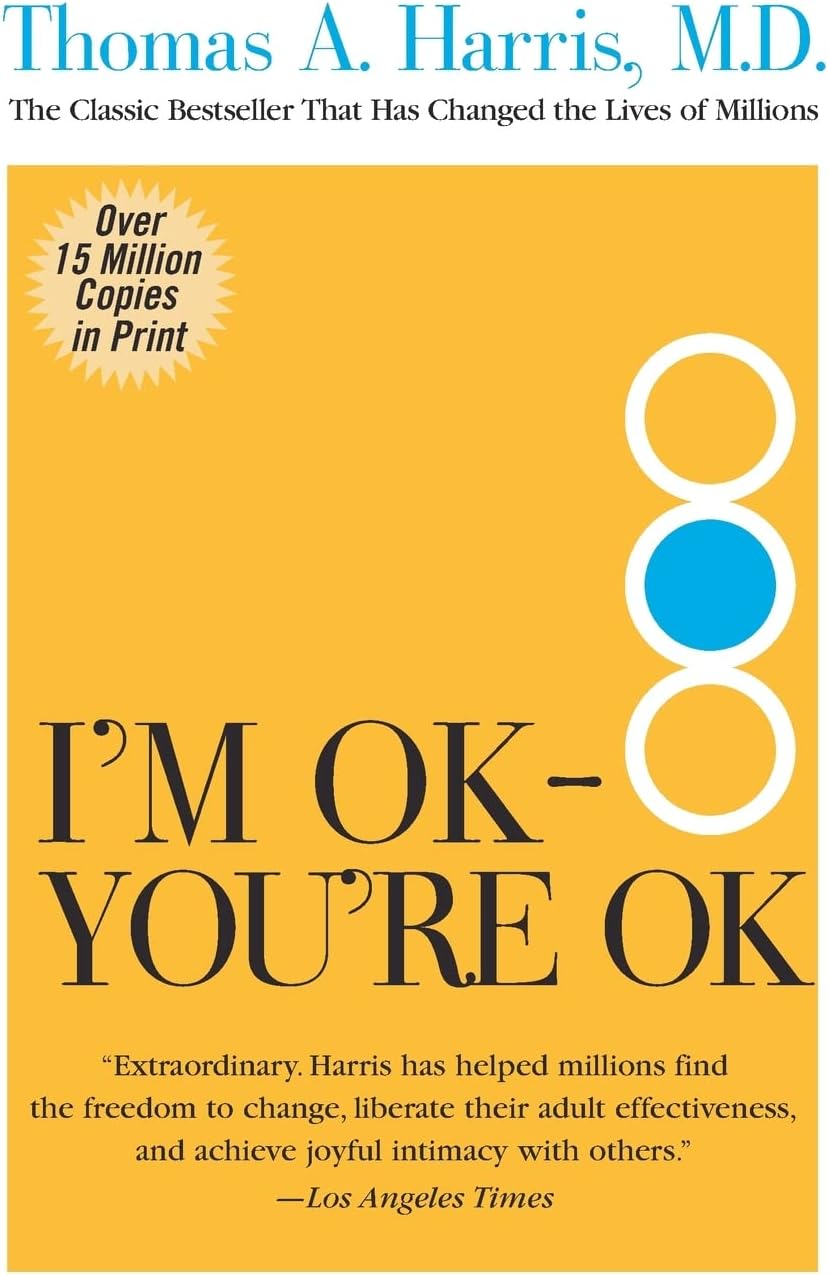
I'm OK--You're OK: The Pioneering and Bestselling Self-Help Guide
Product ID: 12506501
Buy anything from 5,000+ international stores. One checkout price. No surprise fees. Join 2M+ shoppers on Desertcart.
Desertcart purchases this item on your behalf and handles shipping, customs, and support to Thailand.
I'm OK-You're OK: The Pioneering and Bestselling Self-Help Guide [Harris, Thomas] on desertcart.com. *FREE* shipping on qualifying offers. I'm OK-You're OK: The Pioneering and Bestselling Self-Help Guide Review: Much better than OK - In this book Dr. Harris sets out to relay how we can understand our behavior using simple terminology. He also attempts to explain why people don't live as good as they know how to live, and why they often act against their own self-interest. Dr. Harris asserts that within every human being there are 3 psychological roles. These roles are constructed based on "recordings" of what a person sees, hears, and experiences from birth through childhood. The 3 roles are: Parent- The admonitions and rules that a child heard from his parents and witnessed in what they did; the recording of external events. The no's, the don't's, the praise, the criticism. The author includes some common phrases I'm sure many people have heard from their parents such as "You're judged by the company you keep," "Clean your plate," "You can never trust a man/woman," and so on. This is the authority figure within each person, this is the part that tells others what they're doing wrong and doles out criticism or guidance, and when we beat ourselves up for doing something wrong or not doing enough this is the role we take on; that of the Parent. Child- The feelings a person feels when he is experiences various interactions with other human beings, mostly his parents; the recording of internal events. Because very young children are unable to converse, most of their early recordings are feelings. Dr. Harris writes "The predominant by-product of the frustrating, civilizing process is negative feelings. On the basis of these feelings the little person early concludes, "I'm not OK" (p. 28). He goes on to say "Frequently we find ourselves in situations where we...find ourselves in a corner. These hook the "hook the Child," and cause a replay of the original feelings of frustration, rejection, or abandonment. When anger dominates his reason, we say his Child is in command" (p. 30). The Child also contains positive qualities including creativity. Adult- The ability to view reality objectively and make decisions based on those objective facts. "Adult data accumulates as a result of the child's ability to find out for himself what is different about life from the "taught concept" of life in his Parent and the "felt concept" of life in his Child. The Adult develops a "thought concept" of life based on data gathering and data processing" (pg. 31). What happens when people in different psychological roles interact? What happens when a person's Child interacts with another person's Parent? Read this book to find out. Dr. Harris uses other terminology such as "strokes" (recognition or validation) and the various ways people go about attaining those strokes. A passage which caught my attention noted how Child-Child transactions rarely last very long. The author notes how the hippie movement faded because by cutting off the source of disapproval (Parent) the hippies also cut off their source of valid praise. "Boy to girl: "Of course I love you. I love everybody!" (p. 78). If everybody is special, strokes no longer mean anything. He also elaborates on what he views as the 4 ego states a person can hold about himself and the other people: -I'm Not OK, You're OK -I'm OK, You're Not OK, -I'm Not OK, You're Not OK, -I'm OK, You're OK. This was not necessarily a challenging read, though it caused me to think about how I interact with others, how the behavior of other people causes me to sometimes think irrationally ("hooking my Child"), and it's given me another way to view other human beings. Highly recommended. Review: Got in Ebook of Old Favorite - I read this book at least 50 years ago and I still use it as a reference, so bought the Ebook... I have found it is, in my opinion, the easiest way to apply a bit of psychology to your own life... It uses a simply variety of decisions you can make for yourself... I'm OK - and You're OK... as opposed to I'm Ok and You're NOT OK... or sadly I'm Not OK and You're Not OK...and something must be done... I've been sharing with a new friend of mine to help her use the simple tools... For me, it automatically goes into use as I consider somebody with whom I might have strong feelings... If I know I'm OK...then what is the problem with the other guy? Get the idea? BTW, I did take several classes on practicing it as well... So if you have some trouble thinking about it at first...just take your time, Know Thyself is the Goal... Gabbie
| Best Sellers Rank | #37,779 in Books ( See Top 100 in Books ) #200 in Interpersonal Relations (Books) #264 in Self-Esteem (Books) #917 in Personal Transformation Self-Help |
| Customer Reviews | 4.6 4.6 out of 5 stars (2,205) |
| Dimensions | 5.31 x 0.72 x 8 inches |
| Edition | Reprint |
| ISBN-10 | 0060724277 |
| ISBN-13 | 978-0060724276 |
| Item Weight | 8.8 ounces |
| Language | English |
| Print length | 320 pages |
| Publication date | July 6, 2004 |
| Publisher | Harper Perennial |
R**N
Much better than OK
In this book Dr. Harris sets out to relay how we can understand our behavior using simple terminology. He also attempts to explain why people don't live as good as they know how to live, and why they often act against their own self-interest. Dr. Harris asserts that within every human being there are 3 psychological roles. These roles are constructed based on "recordings" of what a person sees, hears, and experiences from birth through childhood. The 3 roles are: Parent- The admonitions and rules that a child heard from his parents and witnessed in what they did; the recording of external events. The no's, the don't's, the praise, the criticism. The author includes some common phrases I'm sure many people have heard from their parents such as "You're judged by the company you keep," "Clean your plate," "You can never trust a man/woman," and so on. This is the authority figure within each person, this is the part that tells others what they're doing wrong and doles out criticism or guidance, and when we beat ourselves up for doing something wrong or not doing enough this is the role we take on; that of the Parent. Child- The feelings a person feels when he is experiences various interactions with other human beings, mostly his parents; the recording of internal events. Because very young children are unable to converse, most of their early recordings are feelings. Dr. Harris writes "The predominant by-product of the frustrating, civilizing process is negative feelings. On the basis of these feelings the little person early concludes, "I'm not OK" (p. 28). He goes on to say "Frequently we find ourselves in situations where we...find ourselves in a corner. These hook the "hook the Child," and cause a replay of the original feelings of frustration, rejection, or abandonment. When anger dominates his reason, we say his Child is in command" (p. 30). The Child also contains positive qualities including creativity. Adult- The ability to view reality objectively and make decisions based on those objective facts. "Adult data accumulates as a result of the child's ability to find out for himself what is different about life from the "taught concept" of life in his Parent and the "felt concept" of life in his Child. The Adult develops a "thought concept" of life based on data gathering and data processing" (pg. 31). What happens when people in different psychological roles interact? What happens when a person's Child interacts with another person's Parent? Read this book to find out. Dr. Harris uses other terminology such as "strokes" (recognition or validation) and the various ways people go about attaining those strokes. A passage which caught my attention noted how Child-Child transactions rarely last very long. The author notes how the hippie movement faded because by cutting off the source of disapproval (Parent) the hippies also cut off their source of valid praise. "Boy to girl: "Of course I love you. I love everybody!" (p. 78). If everybody is special, strokes no longer mean anything. He also elaborates on what he views as the 4 ego states a person can hold about himself and the other people: -I'm Not OK, You're OK -I'm OK, You're Not OK, -I'm Not OK, You're Not OK, -I'm OK, You're OK. This was not necessarily a challenging read, though it caused me to think about how I interact with others, how the behavior of other people causes me to sometimes think irrationally ("hooking my Child"), and it's given me another way to view other human beings. Highly recommended.
G**S
Got in Ebook of Old Favorite
I read this book at least 50 years ago and I still use it as a reference, so bought the Ebook... I have found it is, in my opinion, the easiest way to apply a bit of psychology to your own life... It uses a simply variety of decisions you can make for yourself... I'm OK - and You're OK... as opposed to I'm Ok and You're NOT OK... or sadly I'm Not OK and You're Not OK...and something must be done... I've been sharing with a new friend of mine to help her use the simple tools... For me, it automatically goes into use as I consider somebody with whom I might have strong feelings... If I know I'm OK...then what is the problem with the other guy? Get the idea? BTW, I did take several classes on practicing it as well... So if you have some trouble thinking about it at first...just take your time, Know Thyself is the Goal... Gabbie
N**N
After having read several books by the author of Transactional ...
After having read several books by the author of Transactional Analysis, Eric Berne, I decided to read I'm Ok - You're Ok. It presented Transactional Analysis in an easier to understand language and helped solidify my understanding of the concepts. The authors explanations on the distinctions between the different ego states are well thought out and provided additional insights. It was not until near the end of the book that I fully realized that the premise of his argument that children are initially in a NOT OK state was based on the Christian concept of original sin. In order to justify that particular argument the author states that among other things the trauma experienced during vaginal birth gives the child this initial NOT OK position. It is hard to apply this argument to all births or even say that child birth is traumatic for every child; some children don't cry when they are born. Eric Berne disagreed with the initial state of an individual being NOT OK which he stated in his final work before his death: What to Say After You Say Hello. The meat and the potatoes of the book were the areas where it discussed human behavior; the behavior between individuals and the behavior between nations. When the author began to promote his philosophical and religious views, and use them as justification, it started to veer off course.
E**L
Profound
Deeply thought provoking and instructive psychological philosophy (if I may be permitted to call it that) despite the dated references from the 60’s. Unsure why this school - transactional analysis - never grew into a larger field the way NLP or CBT has, it certainly seems as though it could have. There isn’t much I could find beside this and another follow up book by Harris and the original Berne “Games..” book. Really, it takes you right to root causes for human psychic suffering and presents a unique and sophisticated method for correcting oneself. This is what I found so powerful. The book builds to a somewhat grandiose crescendo about global morality, Christianity, good and evil...I felt this went a bit too far into proselytizing rather than teaching, but I’ll still say to anyone: read this, 5 stars deserved. You will be OK. Really.
C**S
A classic--if a bit tedious to read
Great explanation of transactional analysis and a meaningful follow-up to Berne's Games People Play. The "theory" may be a bit tedious, but allows you to understand OK and not OK behaviors. Excellent.
L**I
Very interesting little book to make you think about how you react and deal with certain situations
M**O
Fantastic discovery of the transactional analysis , it helped me a lot in my personal life ( I did skip few paragraphs on the social aspects)
K**K
Book size is small. But content is Great. This book is nothing but explanation to Sankhya Philosophy (Transactional Analysis) in today's language, where how three states of EGO Sat-Parent, Tam-Child and Raj-Adult develops in human beings. EGO develops due to OTHERS and NEED. EGO develops due to SEPARATION Feelings. OTHERS = I am OK, You are not OK, I am not OK, You are Not OK, I am not OK, you are OK. The 4th Program = Turiya= All are OK. I am OK, You are OK. Study Sankhya Philosophy, Tridoshas of Ayurveda and this book one after the other to understand exact meaning. Also read TRUTH ETERNAL book of Shri Ramchandra of Fetegarh Heartness-Sahaj Marg to know - HOW PARENT (SAT) was born. And - How CHILD (TAM) was born and - How the ADULT (RAJ - REALITY) was born by the combination of SAT and TAM. Author's another book STAYING OK deals with TURIYA state elaborately. Read and implement practically the FOURTH State ALL ARE OK, to experience Oneness and destroy Negativity in your life. Thanks to the Author. Book printing can be improved a lot, by publishers.
L**O
Es un estudio muy inteligente sobre los sentimientos de los niños,que muchos adultos desconocemos o no son evidentes, Al estar presentado enteramente en forma de ejemplos y de casos o anécdotas supuestos en lugar de dar una lección de comportamiento de los padres,las conclusiones para corregir los comportamientos adultos son mucho más fáciles para su puesta en práctica. Es una verdadera biblia de como ayudar a los pequeños a su desarrollo,sin esfuerzo por parte de los adultos que lo leen con placer .Puede cambiar la vida de los hijos.
A**A
Good book
Trustpilot
2 weeks ago
3 weeks ago