
DOWNLOAD THE APP


Customer Services
Copyright © 2025 Desertcart Holdings Limited
DOWNLOAD THE APP
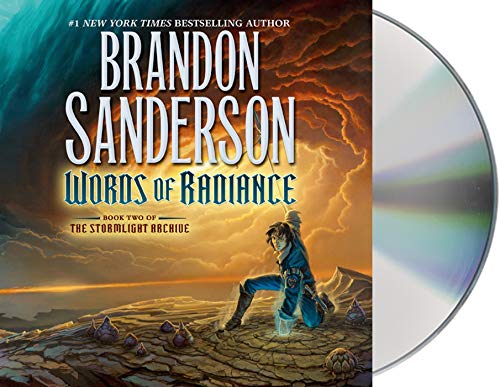
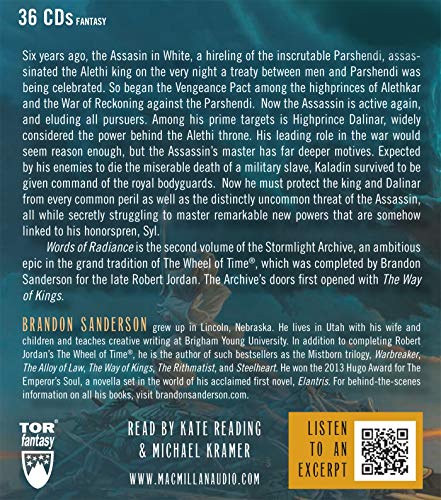
Full description not available
R**Y
Gumption and Spit (Or: Well, I'm back. Again.)
Sometime later on in Words of Radiance, during one of the many Interludes that appear between each of the behemoth novel's five sprawling parts, a character named Lift ambles up the side of a castle wall using powers we'll leave here unspecified on her way to steal. Soon thereafter, a boy joins her side and asks her how she managed to scale the wall, as there was no ladder for her to do so, and he himself needed a rope that she lowered down to him. "Gumption and spit," Lift replies, before traipsing onwards towards her destiny. Gumption and spit, indeed. Here is a marvelous combination of things that can result in magical things - even if the final product is a bit messy.Over one year ago, I wrote up my thoughts concerning Brandon Sanderson's entry volume to the Stormlight Archive, "The Way of Kings" and had a blast lauding the book, not to mention infuriating fans of Dune everywhere. The Way of Kings was (and is, upon re-reading) one of the best fantasy novels I have ever read - heck, one of the most best books I've ever read, period - and I gave it a 9.5/10 (a 5/5 by Amazon's star system) after desperately pruning it down from the 10/10 I initially wanted to give it by taking off half a point for Kaladin Stormblessed's face palm worthy emo moments and Shallan Davar being...well, herself. In short, The Way of Kings was one of my favorite books of all time, in large part because of the series it promised.So, the question I needed Words of Radiance to answer was, "Is the series still promising?" And the answer is "Yes." And that's a good, good thing - a relief, even. Following my tradition, the first paragraph of this review is about as closer to a spoiler as I'm going to get - fear not, wary reader. No spoilers follow for Words of Radiance...but if you haven't read the Way of Kings, I'd recommend not going any further than this. I will address subject matter you probably don't want to know. Come on back after you've read the first book and the series, and we'll talk.For the rest of you, we'll go ahead and get the brass tax out of the way up front here - Words of Radiance is a good book. I'd give it an 8.8/10 on my scale, or about a 4.5/5 on Amazon's star scale. Amazon doesn't seem to see the need for half stars in their options, so in an effort to not under-represent this book, I'm marking it as a 5/5. Technically, it's closer to a 4/5, but that 4 star rating just looks bad, doesn't it? Frankly, I don't have the heart to mark Words of Radiance down that far. It is, by all accounts, a better book than its predecessor, and Sanderson has clearly grown as an author, his prose and descriptive power reaching very good levels. So why the negative hullabaloo from the Way of Kings' self-professed biggest fan?Well, I guess it's just because I didn't like this book as much as the first one. Not by a long shot, actually. In fact, so long as we're being honest, I thought parts one and two of Words of Radiance were two of the bleakest, most "oh my God not Song of Ice and Fire syndrome please Sanderson no" pages I've ever trudged through. It was, for lack of a better word, a frightening time in my life, having been excited for this book since I first left Roshar so long ago. I had recently returned from a deployment to Afghanistan, and I had more wrapped up in the Stormlight Archive than a simple thirst for entertainment. It was the first book I read upon returning to the States, and there's something...special, maybe, about that. That, and this book series is going to be ten books long. I will grow up with it, in many ways, as will we all. I was pretty frightened that the Way of Kings might have been a fluke, and the nine books that followed it were destined to be more like the middle of the Wheel of Time or the last two iterations of Ice and Fire.Be at peace, readers. Parts 3, 4 and 5 of Words of Radiance are all truly wonderful, and Sanderson seemed to get his mojo back by the time I hit them. The book earns the five star rating I've awarded it, and its because of its moments of sheer brilliance that I find myself disappointed and genuinely baffled by the unnecessary moments of tedium that drag the book as whole down away from its predecessor. Ultimately, the Stormlight Archive is, at the end of Words of Radiance, in very good shape. There are places for it to go, questions for it to answer, battles to be fought and mysteries to be unraveled. That's all that matters, really. This was Shallan's book, and thus the book most of us were most wary of to begin with. She was a frustrating character in the Way of Kings, and in some ways she's even more frustrating here, but for very different reasons. I didn't particularly like her in the first book, and I liked her even less by the end of this one. I can't help but wonder if my relationship with the book was in large part due to my relationship with her.My biggest complaint about Words of Radiance is actually directly connected with its biggest strength. It is a massive tome - a sprawling behemoth of a book, and as a result we get to see more of Roshar than ever before. More of its politics, its mysteries, its religions, its cultures, its landscapes, its magic. Thank God for that, since I love this world and I never want to leave. But Sanderon's pacing here is...well, off. (The witty banter is also painful to read, at times, but it adds to the charm of the characters, in its own weird way.)What I mean about the pacing is this - parts one and two trudge along at a snail's pace, getting bogged down by high prince politicking (that ends up being unimportant come book's end), Shallan lying to herself and to the world, and Kaladin returning to his fantastically emo roots, and Adolin channeling a G-rated Jaime Lannister minus Cersei. Dalinar recedes into the background a bit here, but I don't mind this as much as I thought I would, Jasnah continues to be a great character, Lopen gets funnier, and Shen proves to be more elaborate than he originally seemed. Rock remains a good cook.We see much more of Parshendi culture, learn more about the lost city of Urithuru, and of Taravengian's evil plan to save the world. We learn about the nature of spren early on, and about the nature of shard blades late in the book. Part five of Words of Radiance is arguably the best part of the bunch, and is also the shortest - by a LONG shot - and could have easily been a hundred pages longer. Should have been, I'd venture to say, as the first 90% of the book leads up to the climactic final 10% - but when the revelations finally emerge, they're given maybe a page or two of attention. It startled me. The twists you came to find out - predictable or not - should have been given much, much more space to breathe. I would have loved that. In an effort to counterbalance this paragraph of nay saying, I will say that there are a couple of duels / battles in Words of Radiance that had me smiling like a blithering idiot. Sanderson still knows how to write a fight. Man oh man oh man.So does Words of Radiance reveal too much or too little? Both, I think - Sanderson shows us so much in this book, yet it feels like he's trying to fit in as MUCH as humanly possible into a tiny space, which baffles me, since he just spent a thousand pages building up to those reveals. It was like he lost a little faith in the fact that his world is interesting enough as it is without having to try and elaborate what makes it interesting, and as a result he worked and worked and worked on parts of little consequence, exposing the clues too neatly, and when it came to the parts that really, actually mattered, he was out of both time and space.There was no need to try and recreate the mind breaking ending of the Way of Kings, but I do appreciate the effort to do so. Maybe it'll be something we can expect in every book, a final hundred pages of twists and twists and twists. At best, this could set the Stormlight Archive aside from its contemporaries in wonderful fashion. At worst, Sanderson could...*lowers voice to a conspiratorial whisper* go the way of the Shyamalan. I know, blasphemy. Honestly, though, the Shyamalan effect is the deadliest enemy facing the Stormlight Archive on the whole right now. Hopefully the twists we find in book three of the Stormlight Archive are more satisfying.I wonder, honestly, if Sanderson himself is very aware of the book he has wrought. He's a very perceptive man, and being a professor at Brigham Young University has allowed him to organize his thoughts on writing with the clear efficiency only someone who teaches writing could muster. I cannot help but assume that, post publication, he looks at Words of Radiance the way a professor might. The world of Roshar is still here, still full of surprises, still full of characters who will do things that surprise you. The characters are still (thankfully) themselves, and the magic is still really, really cool.Yet something is lost when we come into this book expecting twists around every corner. It makes the moment when they finally come so much less remarkable - indeed, I actually predicted almost every twist before I ever cracked the book open, and I'm not always very good at that. I wonder, therefore, if part of the reason I didn't enjoy Words of Radiance as much as I had hoped I would is simply because I spent the whole book reading between the lines, searching for assassins in every shadow, for twists in every ambiguous statement. If it's possible for the quality of the book to lie in the reader, then that has been exemplified here. This brings me, at last, to the part of the book that astonished me most.The character of Wit - who I am of the opinion acts almost as an avatar for Sanderson himself in the world of Roshar and Shadesmar - comments on the flaws and nature of the book surrounding him at the end of both the Way of Kings and Words of Radiance. He usually reveals the best twists in the midst of leaning on the fourth wall, and comments on what he perceives to be injustices in the world of art. In the Way of Kings, Wit argues that originality is what humanity values most, and in Words of Radiance, he argues that all art is subject to perspective."Give me an audience who have come to be entertained," Wit says in the epilogue, "but who expect nothing special. To them, I will be a god. That is the best truth I know."Fellow readers, my advice is simple. Go into Words of Radiance looking to be entertained. Don't look for the twists. Looking for the twists is like sneaking a peek at presents the month before Christmas. Just wait, let the day come, and then tear the paper to pieces and scatter it all around, feeling the rush of not knowing what lies within. Sanderson is crafting for us a master series, and has eight more books to present. I for one am breathless for the continuation of the series, and have full faith in the author to turn this series into something very, very special. I'll see you all at the end of book three, which I am already hungry for. And, finally, to Mr. Sanderson himself. Thank you, sir, for welcoming me home.8.8/10
V**E
The plodding continues...
So if the Way of Kings plodded on a bit, at least it had Kaladin's struggle through being a bridgeman to keep it interesting. In Words of Radiance, the plodding never really ends. It's interrupted with interesting bits now and again, and some of those interesting bits are really very good and very engaging. But before long, we're back to plodding, terrible dialogue, cardboard characters, and tensionless scenes of bugger all happening. I'll dive in and explore why this one left much to be desired for me.<b>Technical Aspects</b>Sanderson's strength has never been the technical aspect of his writing. Now, that's certainly not an unforgivable sin. It is possible to have a compelling narrative with less-than-stellar writing, and technicality is not the soul of good fictino. But here, with such a long, drawn-out epic, the story just drags oftentimes and Sanderson's lackluster prose doesn't do much to liven things up between the bits of the story that actually matter, which seem few and far between as one wades through seemingly endless bland conversations and activities that might end up giving one or two small pieces of information that contribute toward the eventual meanderings of the plot or character development, but mostly just seem like filler...which this book certainly doesn't need.His dialogue is hit or miss. I'll address this more later, but he CANNOT write witty banter, which is unfortunate...because I swear that half of the dialogue in this book, especially for some characters is <i>nothing</i> but "witty" banter. It just ends up coming across as dialogue that would perhaps be fitting between two eight-year-olds, but not between full-grown adults. I'll talk about that more in the Characters section.His descriptions continue to be adequate but not spellbinding for the most part. We get the picture of the world well enough, though it does come across pretty generically in my mind. This series seems to have this thin layer of originality on the surface, but it ends up just coming out as a generic fantasy mishmash in my mind, at least from a visual point of view. I do like his Stormlight magic system and the order of the Knights Radiant (even if they're basicaly just Jedi knights), as well as some aspects of the spren and other god-like beings. The politics and human civilizations though are pretty bland, with pompous lords and dissatisfied peasants and armor and swords and battles and a distinctly almost-human OTHER to fight. Not that everything has to be original. I'm just saying that I don't find that many aspects of this series new and interesting in terms of setting/cultures/worldbuilding, with a few notable exceptions as I mentioned.Some of the language used both for narrative and dialogue seems anachronistic or just out of place for the world we're in. Words like "awesome" (as used by a very annoying 13-year-old...I'll get to her later) just don't fit in with the epic fantasy setting we're in.Most of what actually IS interesting in this book (and there are some things) comes from what happens in the plot, not from technical prowess or good dialogue, with a few notable exceptions, such as some of Dalinar's conversations with Kaladin.All that said, the technical part of the writing isn't horrific. It's functional but not something you'll remember.<b>Story</b>Now, I don't want to judge story or plot too harshly because it's a very subjective thing but I'll put in my two cents about a few things at least.One thing I really want to gripe about is the lack of any overarching conflict aside from that between nature and man. There are sort of accessory villains, each wanting to influence events in the world for their own ends, but none of them are really explored that much and there are so many different groups that it's hard to remember who wants to do what. In the end, it's really the storms that are the great threat to mankind.In the first book, Sadeus was the big villain and I thought that was much more compelling. He seemed like a friend at first, if an uneasy one, and eventually everything led up to his big betrayal. That genuinely came as a shock! In this though...well...there's nothing really like that. The Parshendi are the bad guys and they stay the bad guys. They're not even <i>in</i> most of the book though, so the tension can't come from them and there's not really anyone else for it to come from except here and there scattered throughout the jumbled mess of plotlines. Fiction, especially epic fantasy, <i>is</i> conflict after all.The Parshendi are there too, as I said, but it's unclear why they want what they want. We found in the last book that they assassinated Gavilar, the king of the Alethi and so they kind of become resigned to their fate as the prey of the Alethi as they are hunted on the Shattered plains until they suddenly decide that the Alethi are actually the bad guys...because they wanted to bring back the Parshendi gods or keep them from being brought back or...something...it's not really clear. In fact, <spoiler>Eshonai's entire plotline is literally pointless. Nothing we need to know comes out of it that couldn't have been supplied by Rlain in the end anyway and her decision to kill off half the population makes absolutely no sense whatsoever. And then she dies, along with all her other Stormform brethren! Pointless! We didn't even really get to see that much of what they can do!</spoiler>.There are a lot of pointless little plot things here and there, as I've said. There's a scene (this isn't a spoiler at all) where Dalinar and company are going to meet the Parshendi out on the plateaus to discuss something. Adolin insists on going in his father's place and posing as Dalinar during the meeting while Dalinar tells him what to say via spanreed. Why? No reason...just no reason at all. They suspect assassins might take the opportunity to strike, but that's never really stopped Dalinar before and this meeting is pretty darn important. Also, NOTHING ends up happening anyway so it's not even justified from a narrative perspective. It seems like an attempt to add drama when it really isn't called for at all and I'd rather just see the story progress. That'a just one example of many.Now, as I said, I could forgive a lot when it comes to story/plot if the characters are interesting and compelling. After all, characters and how they deal with their conflicts are what really drive compelling stories. Characters are what saved The Way of Kings for me after all (Well, Kaladin at least). Did they (he) save this one for me? Well...erm....<b>Characters</b>No. No they did not. I mean, they weren't terrible. I still gave the book three out of five stars because I do still relate somewhat with a few of them and I genuinely wanted to see what happened to them. It wasn't always a hate-read for me, mostly because I do like some of the characters, mostly Kaladin, Shallan, and Dalinar. That said, they were still pretty weak for the most part. I'll go through each of the major ones.<i>Kaladin</i>Kaladin was my favorite character of the last book. His struggle to unite his bridgeman companions and free them all from their oppression while discovering arcane powers was genuinely captivating at times. Aided by pretty great flashbacks to his younger days with his family at home and the events that led to his enslavement, his story sold the book to me even though the other characters had the personality of cement. He had a great arc, a compelling (if a bit cliché) personality, and genuine conflict to fight against.As this book starts though, he already has all that he wants. He's in a really great place as Dalinar's bodyguard and his men are all taken care of and free. He quickly devolves into a moaning child and stays that way through most of the book. The colorful characters that accompanied him last time (like Rock, Teft, Sigzel, etc.) play a much more minor role and Kaladin has to cary this one by himself, which he kind of fails to do. He discovers more powers and masters them pretty effortlessly (boring).The only real arc he has relates to one of his bridgemen and the king. This is a great subplot and I won't spoil it, but Kaladin learns some humility and also learns that the duty to protect extends farther than he thought. It's not perfect, but it was a good aside from the bunch of nothing he was doing before.All in all, Kaladin comes across as a big pout in this book. Uninteresting, petty, and tortured by his inner demons, which also aren't that interesting.<i>Adolin</i>Mr. Boring McBlandypants himself. Comes across as a too-perfect idiot who is obviously just there for Shallan to fall in love with before she realizes that Kaladin is the one for her. That's not even a spoiler because it doesn't happen in this book but I just know it will...Next<i>Shallan</i>Shallan was boring in the last book...and she still is, but at least she's DOING something in this one. The beginning is just awesome for her but then quickly devolves into boringland again once she reaches the plains. Sanderson tries way too hard to make her witty and quirky but it just backfires and makes her really annoying. If that was the intention then it was effective...but not in a good way. Maybe it's supposed to be in her character that she's really bad at making witty jibes at people, but if that's the case then why do they actually seem hurt by her comments or jokes at times? There are only so many times a "your mom" or "your face" type of joke is funny...and that's not that many times. But that's basically the extent of her wit; "your mom" and "your face" jokes, as in Kaladin: "Ah, that chasmfiend is retreating!" Shallan: "It was probably your unfortunate face that did the job" Kaladin: "Well your mother probably looks even worse..." No, that's not an actual excerpt but I wouldn't have been surprised if it had. It's that bad at times.There's also an odd moment or two when Shallan reacts very strongly and negatively to the suggestion that she needs to be protected. That was never really set up and comes out of nowhere, supposedly based on her history of being sequestered away by her father. Still, it feels random and out of nowhere and way too strong.I do really like Pattern for the most part, even though he too has some dumb lines. Shallan discovers her powers pretty easily as well and has a lot of subplots relating to the ghostbloods that just kind of go on and on without paying off.We do find out the big reveal about Shallan's past, but it's a huge letdown as we've already put the pieces together for ourselves at that point. Her flashback scenes are actually quite excellent though and old Shallan is way more interesting than present times Shallan. She had more of a conflict in the years leading up to the main story and the events that take place with her brothers and father are far more interesting than what she's doing with the ghostbloods or in her attempts to find the Oathgate. It's a good example of how small, character-based moments are far more interesting than overblown, epically fantastical things in the world without emotional engagement.<i>Dalinar</i>Dalinar is kind of the same bland soldier he was in the first book. I like some of his conversations with Kaladin and how he acts as a bit of a foster father to him, but I wish there was more of that. Most of his time is spent being gruffly speculative.<b>Summary</b>This isn't a bad book. It's just not for me. I like every scene and every chapter in a book to serve the overall plot while giving their exposition and character development. That is certainly not the case in this book. This book has plot threads and character stories weaving all over the place, not always moving the story forward. I like dialogue to feel real and in the vein of the world we're in. Lift talking about all her "awesomeness" and stuff like that really takes me out of a story. Lift, by the way, was really annoying. Anyone who has read the book knows who I'm talking about.Anyway, if you were a big fan of the first one, you'll probably like this one too. I read this one begrudgingly because I like the first one more than I hated it. I think Sanderson may just not be up my alley. He seems like a perfectly nice guy from interviews and I enjoy his lectures. He's not even a bad writer. Just not for me. I'll probably end up reading more of his work, but I'll be taking a break for a while.
H**H
Like watching Catchphrase.
Finishing book 2 (of an eventual 10) is like being on Catchphrase. A square is being removed each time leading to the answer....but we're only at the end of book 2 so need to be patient.It's so massive, complex and absorbing and the depth is staggering. I just wish it was slightly more accessible; there are times when it makes Gardens of the moon look like paint by numbers.I'm still unsure about the nature of Spren, shardblades, the heralds and so on but I think I understand what's going on slightly better. People have already mentioned that Sanderson would rather have you confused than bored and no doubt about it, you will not be bored.As with the way of kings we follow Kaladin, Dalinar, Adolin and Shallan. It's such a pleasure seeing them all interact and we find out more about the latter's past. This is actually her book and she's great.But complexity and ambiguity aside this is just amazing, the closing stages of the book are a revelation and I was stunned at some of the reveals.What an amazing world. enjoy it.
V**R
Genial
The second book is equal to the first. I dare say that this work is at the highest level of fantasy expected from writers like Moorcock. The detail of Sanderson’s world give an extra level of depth and tricks like chapter jumping work perfectly like in some world class classics of the genre.After this pompous review let me continue with a more honest one. These books made me re-discover reading. I’d given up because I couldn’t find something at the level of Lord Of The Rings or Corum. Well, this writer created something at THAT level. Detailed, energetic and above all “realistic”(believable is maybe a better word?). What a journey, I don’t want it to end.
S**N
Intriguing, Captivating
The writer is a genius. I did not realise how big the plot was until the writer started including numerous kingdoms and their side story as well. I searched a bit on google and found that the author has created his own universe and all his different books are set in different realms in that universe. That is really a massive plot and I am going to finish all of his books in those different realms, really excited to see how he combines them to give an even bigger story. I have thoroughly enjoyed this and can safely say that once you start, you won’t be able to stop yourself until you finish it and then off course buy the next one immediately. Great author, great story
D**N
Enthralling
I will remember Words of Radiance as the book that sucked me into this series proper. The first book was very good, but I didn't feel the need to rush out and grab the next one straight away. With Words of Radiance however, I found myself reading it in half the time, immediately buying the third book after finishing it, and eagerly finding more information online about the series. After reading it, I now know there is no escaping the rest of the series for me. I've read the Mistborn series, The Reckoners and The Rithmatist and this is probably my favourite of all of Sanderson's books so far.
P**B
A masterpiece, simply put.
I hate this book also....Much like the first it has ruined so many other series for me. Thankfully I started the series with the first and this title out, sadly I finished both within 4 days of back to back reading :/Much like the first, its a continuation of the world and further development of the characters. The first titles very much focused on Kal and his back story, while this title focus's on the back ground of Shallan. That's not to say we see no development elsewhere, in fact a lot of the minor character from the first book have been expanded upon and characters such as Adolin and and his brother get a lot more detail fleshed out.In this book we see the main cast coming to grips with who / what they are. The method and how it happens is intriguing as ever and very well written. We also see comprehensive detail on other totally independent characters who I suspect will play a bigger role going forward.As ever, the world is well written and captured in such vivid detail, its easy to conjure how the places will look in your mind. The magic system is expanded upon and details are written and well fleshed out.Much like the first, the traditional enemy's have logical and underlying motives for what there doing rather then being all out evil people which allows you to almost sympothaise with them.Either way much like the first, this is a stunning entry into the series and I cannot wait for more. My only regret is learning about and picking up the series before we are even a quarter of the way through. Its going to keep me wanting more for the next half a decade I expect!
Trustpilot
1 week ago
1 month ago