We remain fully operational. Our teams are working around the clock to ensure your deliveries continue safely.

DOWNLOAD THE APP


Customer Services
Copyright © 2025 Desertcart Holdings Limited
DOWNLOAD THE APP
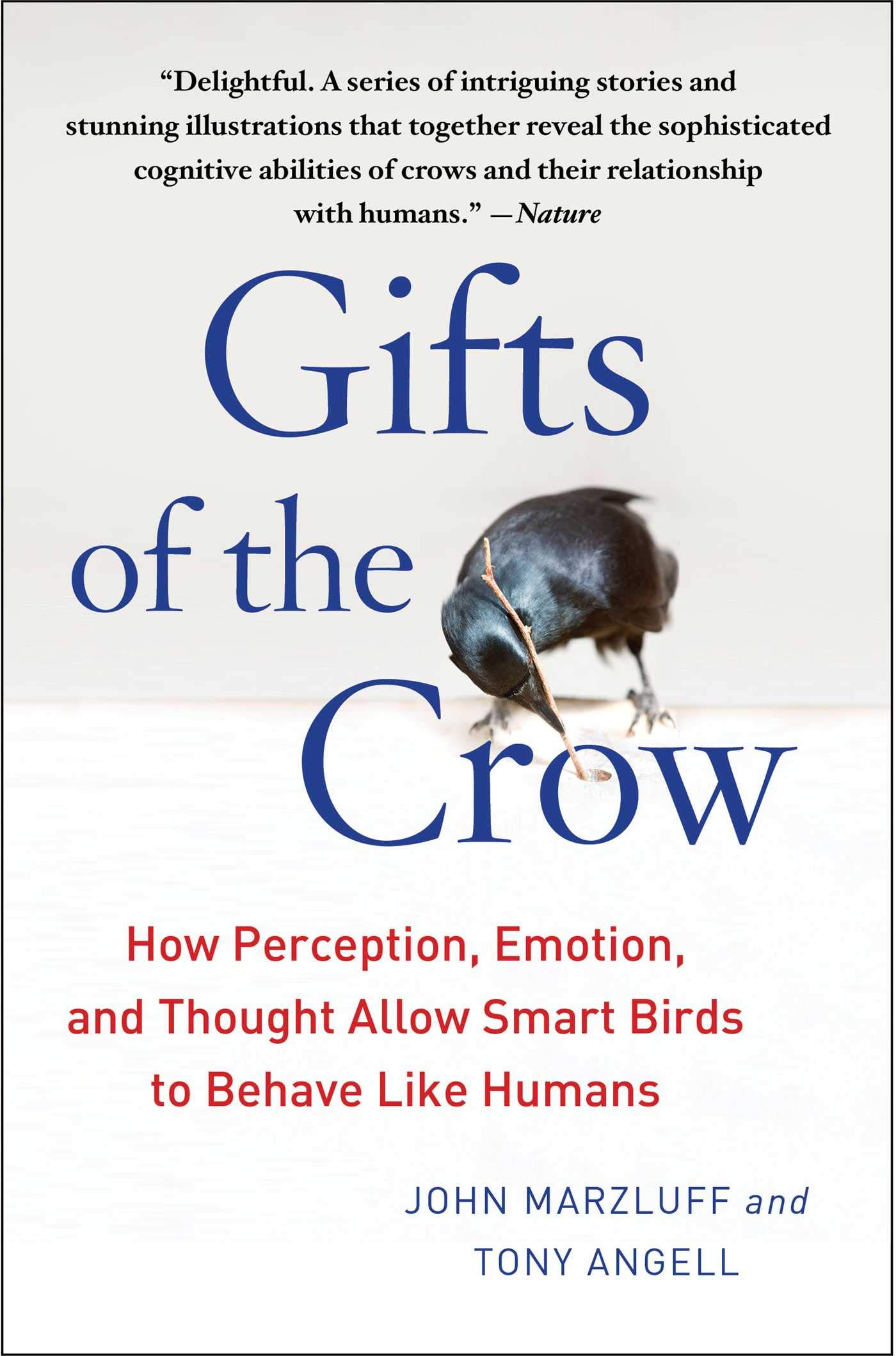
Buy Gifts of the Crow: How Perception, Emotion, and Thought Allow Smart Birds to Behave Like Humans on desertcart.com ✓ FREE SHIPPING on qualified orders Review: Birds Are Much Smarter Than We Think - Gifts of the Crow by John Marzluff and Tony Angell is a book proving that birds are a lot smarter than one may think. You may think that birds are just animals that live on this earth and strive for survival. Marzluff and Angell take the bird and prove to the readers that these magnificent animals are more than meets the eye and that with proper research and observation, a bird is actually an intelligent creature, just like us humans. Although this may seem bizarre and quite a bit farfetched, it is not since Marzluff is an expert on birds and their behavior through the years of study and research that he has conducted with birds. Along with his research, Marzluff has written and published many papers and books just like this one depicting the behavior of birds. Angell on the other hand, has less experience with research, but more experience in observing wildlife and transforming what he sees into works of art. Therefore, whether you think this book is accurate or completely false, I stand on the position that these authors are correct in the sense that birds do behave like humans mostly because the evidence is presented all throughout the book and how can you not believe something when evidence is presented in front of you? The main idea behind this book is basically Marzluff and Angell primarily focusing on the behavior of birds belonging to the avian family Corvidae including crows, ravens, jays, and nutcrackers. Throughout this book, the two authors do not try to persuade readers to agree with their writings and research, but instead attempt to portray to humans that these birds are more than meets the eye. The authors try to show how these birds are smarter and more intelligent than they appear to be. Throughout this book, we see concepts of neuroscience being presented. Betty is a crow and one of the birds that the two authors have been observing for some time. Betty shows cognitive abilities when the authors test her by putting bird food in a tiny bucket and they put this bucket in a glass cylinder. Next to the cylinder the authors put a twig. Betty is now placed by the experiment. She attempts to reach the food with only her break. She fails. Next she grabs the twig and tries to scoop the food out. She fails. Finally, she bends the tip of the twig to make hook and then she hooks the twig to the bucket and pulls the bucket out. What the authors observe here is that these birds have cognitive abilities as well as the ability of remembering actions. They call this the "knowledge of cause and effect". Betty knew that her beak would not reach the food so she looked for other means. She found the twig and used this. She knew she would not get it out with the straight twig so she bent the edge and made a hook. This is remarkable to observe since you can actually see the bird using its brain to think things through. Marzluff and Angell believe the bird was able to remember its actions and attain the goal which it strived to obtain because of their brains. Marzluff states that "the forebrain of a crow assesses sensory information, integrates this view of the environment with context and emotion to form memories, and sends electrical and chemical instructions to motor control regions to command action" (Marzluff and Angell 5). Another quite amazing example is the risk taking that crows take. Marzluff has been observing the risks that crows take as well. He gives one example of how crows have learned to simply duck if a car is approaching them rather than flying away. This gives crows an advantage to road kill since other animals will not go near road kill because they run the risk of getting killed themselves. That is not the case for crows. These birds will see a car coming, and due to what they know, they will simply duck and wait for the car to pass. This is hard to believe but Marzluff's studies and observations have proved the risk taking that crows encounter. Just one more example that stuck me while reading was a raven named Bela. Bela has been marked by Marzluff with a yellow ring on her claw to distinguish her from others. Marzluff has been going to the park and feeding her for quite some time now. Whenever he approaches, Bela swoops down from the tree and flies around him until he gives her the food. However one day Marzluff is walking with a group and Bela notices him, but instead of flying around him, this time Bela flies around, caws violently which this makes other crows start to fly around him and caw. What Marzluff believes happened here is that Bela used her recognition skills and remembered Marzluff, but did not recognize the others. She felt threatened and therefore retaliated in the way that she did. This just comes to show you how different these birds are and how smart and intelligent they can really be. There are a lot more stories just like these in the book that prove to the readers how smart these birds are. These stories have scientific evidence proving the true nature of these birds. When evidence is shown it is really hard to try and negate something and say it is untrue. Therefore, this book is a clear illustration of the intelligence of these birds. Review: Fascinating look into the lives and personalities of crows - We have crows. Uninvited crows who have now become a welcomed neighbor. They make a lot of noise but after reading this book, we feel privileged to have intelligent, animated and entertaining squatters. This book covers the scientific aspects as well as the everyday habits that make crows so interesting. They mate for life. They recognize human faces. They are known to leave gifts. This is the perfect gift for anyone who has an interest in birds, especially crows.
| Best Sellers Rank | #44,821 in Books ( See Top 100 in Books ) #10 in Ornithology (Books) #51 in Bird Field Guides #159 in Biology (Books) |
| Customer Reviews | 4.5 4.5 out of 5 stars (1,112) |
| Dimensions | 5.5 x 0.8 x 8.38 inches |
| Edition | Illustrated |
| ISBN-10 | 1439198748 |
| ISBN-13 | 978-1439198742 |
| Item Weight | 8 ounces |
| Language | English |
| Print length | 320 pages |
| Publication date | February 5, 2013 |
| Publisher | Atria |
M**K
Birds Are Much Smarter Than We Think
Gifts of the Crow by John Marzluff and Tony Angell is a book proving that birds are a lot smarter than one may think. You may think that birds are just animals that live on this earth and strive for survival. Marzluff and Angell take the bird and prove to the readers that these magnificent animals are more than meets the eye and that with proper research and observation, a bird is actually an intelligent creature, just like us humans. Although this may seem bizarre and quite a bit farfetched, it is not since Marzluff is an expert on birds and their behavior through the years of study and research that he has conducted with birds. Along with his research, Marzluff has written and published many papers and books just like this one depicting the behavior of birds. Angell on the other hand, has less experience with research, but more experience in observing wildlife and transforming what he sees into works of art. Therefore, whether you think this book is accurate or completely false, I stand on the position that these authors are correct in the sense that birds do behave like humans mostly because the evidence is presented all throughout the book and how can you not believe something when evidence is presented in front of you? The main idea behind this book is basically Marzluff and Angell primarily focusing on the behavior of birds belonging to the avian family Corvidae including crows, ravens, jays, and nutcrackers. Throughout this book, the two authors do not try to persuade readers to agree with their writings and research, but instead attempt to portray to humans that these birds are more than meets the eye. The authors try to show how these birds are smarter and more intelligent than they appear to be. Throughout this book, we see concepts of neuroscience being presented. Betty is a crow and one of the birds that the two authors have been observing for some time. Betty shows cognitive abilities when the authors test her by putting bird food in a tiny bucket and they put this bucket in a glass cylinder. Next to the cylinder the authors put a twig. Betty is now placed by the experiment. She attempts to reach the food with only her break. She fails. Next she grabs the twig and tries to scoop the food out. She fails. Finally, she bends the tip of the twig to make hook and then she hooks the twig to the bucket and pulls the bucket out. What the authors observe here is that these birds have cognitive abilities as well as the ability of remembering actions. They call this the "knowledge of cause and effect". Betty knew that her beak would not reach the food so she looked for other means. She found the twig and used this. She knew she would not get it out with the straight twig so she bent the edge and made a hook. This is remarkable to observe since you can actually see the bird using its brain to think things through. Marzluff and Angell believe the bird was able to remember its actions and attain the goal which it strived to obtain because of their brains. Marzluff states that "the forebrain of a crow assesses sensory information, integrates this view of the environment with context and emotion to form memories, and sends electrical and chemical instructions to motor control regions to command action" (Marzluff and Angell 5). Another quite amazing example is the risk taking that crows take. Marzluff has been observing the risks that crows take as well. He gives one example of how crows have learned to simply duck if a car is approaching them rather than flying away. This gives crows an advantage to road kill since other animals will not go near road kill because they run the risk of getting killed themselves. That is not the case for crows. These birds will see a car coming, and due to what they know, they will simply duck and wait for the car to pass. This is hard to believe but Marzluff's studies and observations have proved the risk taking that crows encounter. Just one more example that stuck me while reading was a raven named Bela. Bela has been marked by Marzluff with a yellow ring on her claw to distinguish her from others. Marzluff has been going to the park and feeding her for quite some time now. Whenever he approaches, Bela swoops down from the tree and flies around him until he gives her the food. However one day Marzluff is walking with a group and Bela notices him, but instead of flying around him, this time Bela flies around, caws violently which this makes other crows start to fly around him and caw. What Marzluff believes happened here is that Bela used her recognition skills and remembered Marzluff, but did not recognize the others. She felt threatened and therefore retaliated in the way that she did. This just comes to show you how different these birds are and how smart and intelligent they can really be. There are a lot more stories just like these in the book that prove to the readers how smart these birds are. These stories have scientific evidence proving the true nature of these birds. When evidence is shown it is really hard to try and negate something and say it is untrue. Therefore, this book is a clear illustration of the intelligence of these birds.
H**N
Fascinating look into the lives and personalities of crows
We have crows. Uninvited crows who have now become a welcomed neighbor. They make a lot of noise but after reading this book, we feel privileged to have intelligent, animated and entertaining squatters. This book covers the scientific aspects as well as the everyday habits that make crows so interesting. They mate for life. They recognize human faces. They are known to leave gifts. This is the perfect gift for anyone who has an interest in birds, especially crows.
S**A
Very interesting read
I love crows, they are incredibly smart. This book has a lot of information about these creatures. It’s very interesting to learn from people who study them to get insights and scientific knowledge. It’s kind of like being introduced to them and what their life is like.
D**T
Absolutely brilliant and educational
Absolutely brilliant and educational! A great extent of research went into this book! I find the contents to be true based upon my own personal experiences and observations including documentation! I am about to publish two books: (1) THE CAWING (2) CROWS DON’T LIE
K**R
Interesting
This guy is an interesting book. I learned a lot about bird brains. It is amazing that their brains work somewhat like ours. I enjoyed this book!
D**N
My crow Kevin
I have a crow and family that's a bunch of mooches. But they're a lot of fun. He calls, I come . He's trained me
E**W
It was 'ok.'
I've read another of his books before and it was also 'ok.' While insightful this was a little too scientific-y for my mind, and I've got a couple of science degrees and am a HARD-CORE armature naturalist,who's very picky about correct classifications of species and all that jazz! There's a lot of scientific jargon with little 'down-to-Earth' explanations; it's almost like you have to know anatomical psychology to really get a grasp on much of the subject matter and with bird's brains no less! While there are diagrams, it's at the end of the book, which I found frustrating having to flip back and forth to know what was being explained with the bazillions of neural pathway explanations for the various behaviors outlined. There are good parts, though, with anecdotes and scientific explanations used to back up the possible reasons for the displayed behavior. To be fair, I've read several corvid books and have yet to find one that REALLY hits the spot for me. I think I'd like one that explains the life-cycle of various corvids along with explanations of the behavior or traits worth pointing out, like, what are physical/behavioral differences between male and female corvids? Do only females participate in auxillary/nest helper behavior in American crows? Do other species of corvids display auxillary/helper behavior? Why do Northern ravens have such distinct, noticeable nasal 'bristles' compared to other corvids? Why aren't ravens found in super-urbanized places like American crows? Why are American black-billed magpies only found in the western and central U.S. and not the eastern or southern half? Why does the Yellow-billed magpie only lives in a certain local of California and no where else? Why aren't Blue Jays found in the western U.S. and why aren't Stellar's jays not found in the eastern half? Why do only Northern ravens perform aerial acrobatic feats?, etc., THIS would be a meaty, juicy book for me!
M**K
Absolutely love this book
This book was a total surprise in the scope of the information and the detail in which the author wrote. I had heard rumors/tales of crows and how the can either become a friend to humans...or an enemy. This book tells the whole story, through scientific examples around the world. A great read.
A**A
Un libro di elevato interesse frutto di uno studio di anni fatto dall'autore. Particolarmente dettagliate e approfondite le analisi di come ogni singola azione dei corvidi, apparentemente più tipica degli esseri umani che degli uccelli, sia riconducibile ad uno specifico processo mentale. Il libro comunque non è ostico ma accessibilissimo e affascinante, corredato da disegni molto ben fatti e raccontato con ammirazione e affetto per questi incredibili uccelli. Le esperienze vissute dall'autore e da tante altre persone, insieme alla solida base scientifica, lasciano alla fine soddisfatti perché il libro consente di imparare cose sorprendenti e inimmaginabili fino a qualche tempo fa, che non lasciano dubbi sulla grandezza della Natura per la quale incutono uno sconfinato rispetto.
H**N
This is a carefully researched, very readable and superbly illustrated work. There are ten chapters: 1 - Amazing Feats and Deep Connections. 2 - Birdbrains Nevermore. 3 - Language. 4 - Delinquency. 5 - Insight. 6 - Frolic. 7 - Passion, Wrath and Grief. 8 - Risk Taking. 9 - Awareness. 10 - Reconsidering the Crow. There's an illustrated appendix, divided into ten parts, that explains the anatomy and physiology of the crow-brain, and there are extensive source notes and references followed by a helpful index. Examples of intelligence are given relating to several species in the crow family including Caledonian crows, carrion crows, jackdaws, jays, magpies, ravens and rooks, and birds from a variety of countries, including Canada, England, Indonesia and the US, are involved. Care is taken to analyse the scientific findings to establish the precise kind of learning that has taken place in the minds of these various crow family members. The conclusion is that they are capable of following reasoning patterns similar to the basics underlying similar functions found in the human mind. Making everything even more interesting is the fact that the evolutionary route taken in the development of bird brains is different from that pursued in the evolution of mammalian brains, a fact which results in bird brains functioning differently from mammalian, including human, brains. Whereas mammals, including humans, have evolved from reptilian ancestors via the mammal-like reptiles, birds have evolved from reptiles via the therapsid dinosaurs. This work explains in an easy to follow fashion how all this came about and how the highly intelligent crow family is continuing to evolve and adapt to enable it to cope with the man made problems of the modern world. Although there's much we still have to learn about crow family intelligence our knowledge is increasing all the time as more observations, experiments and intelligence tests are carried out in an increasing number of places. In addition to this kind of information, this work is packed with fascinating accounts of various people's relationships with members of the crow family. The work is helpfully illustrated by Tony Angell's superb illustrations, which enhance the text in a revealing fashion that even the most inventive photography could not have achieved. In addition, the artist has created eight helpful illustrations explaining the working of the crow brain plus one drawing explaining the bird's nervous system. Text and drawings compliment each other in a fashion that fosters the easy assimilation of a whole hoard of inspiring facts about the intelligence of the crow family. This book is a great read and thoroughly recommended
P**I
Ich interessiere mich sehr für Rabenvögel und habe bereits viel zum Thema gelesen. Das vorliegende Werk sticht dadurch hervor, dass es zum einen umfassende Untersuchungen zu allen Aspekten aus dem Leben von Rabenvögeln beschreibt - und zwar sowohl wissenschaftliche Experimente als auch Beobachtungen aus aller Welt. Letztere sind in ihrer Vielfältigkeit und den oftmals faszinierenden Details besonders spannend (und oftmals auch lustig)! Zum anderen werden sehr umfangreich die neuesten Erkenntnisse zu den kognitiven Fähigkeiten von Rabenvögeln bzw. die zugrundeliegenden anatomischen Grundlagen (v. a. Aufbau der Gehirne) erläutert.
蟹**解
Good reading. Just as human is exceptionally intelligent among mammals, crows are equivalently intelligent among birds. Amazing is this great descendants of dino’s!
S**P
Love this book. As a huge lover of Crows & Ravens it is a good read and understanding of their true nature
Trustpilot
5 days ago
4 days ago