Some deliveries may take a little longer than usual due to regional shipping conditions.

DOWNLOAD THE APP


Customer Services
Copyright © 2025 Desertcart Holdings Limited
DOWNLOAD THE APP
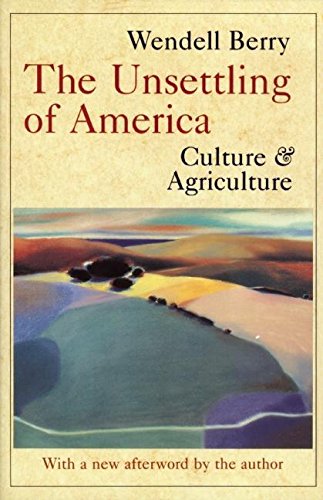
The Unsettling of America: Culture and Agriculture
M**M
A Great Read
America is in the midst of an agricultural crisis; the crops that farms produce are reduced in quality, soil is eroding, and more and more small farms are being taken over by large mega-farms with the new “go big or go home” mentality that dominates the rural landscape. This issue is what Wendell Berry is responding to in his book, written in 1977. However, the book has aged well, as the problems with the American agricultural system persist to this day. In this book, Berry searches for the root of these agricultural problems, arriving at the broad conclusion that the problem is American culture as a whole, particularly its move towards specialization and loss of holistic living. This change has severed the average American’s relationship with the land that sustains them, and people need to rekindle that relationship to reverse the current destructive agricultural trends. One consistent theme of Berry’s search is America’s predilection towards specialization. People no longer develop multiple skills or talents; rather, they become experts in a certain field or trade, forgoing a holistic approach to their work. Instead, people train themselves to be more like small, easy to replace cogs in a larger machine, losing a rounded approach to life. Berry’s largest concern is that this trend has infiltrated agricultural practice, leading to the formation of what he calls “agribusiness,” which is agriculture that is concerned with making as much money as possible. These large agribusinesses are replacing the farmer of old, who had to be a nurturer, husbandman, and much more besides just someone who grew crops. This combination of traits is what allowed (and continues to allow some farmers) to grow the highest quality food possible, because they understood the relationships between the different aspects of farm life. This model is hard to come by nowadays, as the trend has shifted from the production of high quality food to producing a high quantity of food. Berry considers this ingrained culture a sort of “orthodoxy,” something almost dogmatic in nature; his advice to break this orthodoxy is to live “on the margins.” This particular advice to defy cultural norms recalls his famous poem Manifesto: The Mad Farmer Liberation Front, published only a few years before this book. The proposals Berry makes most certainly defy cultural norms, as he suggests a luddite-esque return to preindustrial agricultural practices similar to the one employed by the Amish. However, this shift is not the only thing Berry recommends; he also offers some seemingly more practical methods of shifting the paradigm. These include developing a healthy skepticism of specialists; a shift in governmental focus to protecting the small and weak from the great and powerful; a universal composting system that connects urban populations and the farmers that feed them; avoid monocultures, and facing the problem of carrying capacity on this earth. As a young environmentalist, I find Berry’s book and all of its criticisms quite compelling. The sheer number of topics he manages to discuss, covering fidelity in marriage and Peruvian mountain farmers in one book, also impresses me. Even though he examines a wide array of topics, Berry never loses the focus of his book and ties the subjects back to culture and its relationship with agriculture. The result is a book that discusses the overall cultural and agricultural problems in America that is relevant thirty-five years after its publication. That said, I find myself questioning how practical his overall suggestion of returning to preindustrial agricultural models is. With an exploding global population and unequal food distribution, it seems that such a drastic switch would not be feasible, and frankly irresponsible. I do think that Berry is right to point out the many flaws in our current method of agricultural production, particularly the issue of monocultures and agribusiness, but I think to reject over one-hundred years of technological innovation does not seem like a viable solution.The Unsettling of America is an important piece of writing that all environmentally minded people should read. Berry provides an excellent starting point for thinking about where culture and the environment intersect, as it occurs much more often than people might believe. Exploring the agricultural and environmental crises through a cultural lens is the only way we can ever hope to tackle such massive problems. Berry understands that, and articulates it well in this book.
F**N
Top notch book
Wow! I read this for a book club and it was wayyy more enlightening and interesting than I predicted. Highly recommend this read will open some doors you didn’t know where there.
A**H
An Argument For Long Term Thinking To Thrive On What We Have
Thoughtfully critical of the social-economic systems in place in the U.S. in the 70's, but could not be more relevant today, as evey point he highlights seems to be even more prevalent today (2015) and every point he predicts as inevitable outcomes of the follies of our misguided short term gain approach, appears to have come true. What I particularly found intereseting is that he not only provided specific criticism, he also provides solutions. Now, I'm not sure I agree with everything he says in terms of solutions, but there's a lot to take away from this book. If you're looking for a different take on environmentalism that is very much about proper use of land, not just looking at nature as something to look at, where indeed sometimes that might be the case, but really it's about figuring out how use the land without ruining it (sustainable farming), then you are in store for a thought provoking read.
D**S
Prophet, poet and farmer, Wendell Berry should be who we listen to
If you read nothing else in the next year or two, you must read this book. Few books can truly be said to be groundbreaking in their prophetic nature. Poet, farmer, quiet radical, Wendell Berry, in The Unsettling of America: Cultural and Agriculture unleashes a prophetic opus that, with amazing accuracy, told us what our lives and the biosphere would be like as a result of the practices of industrial agriculture. The truth of his prophesy will astound you considering the book was written nearly 40 years ago and is still as fresh today as it was when Berry wrote it. With rare eloquence and the sensibilities of a poet, Berry lays out both the how and the why the world is on a reckless path of destruction by both the post-modern mindset and the application of the practices of the industrial revolution to agriculture ... all due to avarice.
R**C
As Usual, Wonderful Writing of Real Truth
Wendell Berry's writings have to be the most to-the-point, profound and real about life in rural America, how it used to be, how it might still be, but how often it is not. 'The Unsettling of America' encapsulates this all with a strong and real writing style and which tells the truth about our current way of living.I would recommend this book to all readers, country and city dwellers alike, as it is so telling and exposing of the mess we have made of our landscape, the reasons why, and how we might actually return it to being more vibrant and real.I would also recommend reading "Against the Machine" by Nicols Fox, recently published, which goes into more detail about the destruction of people's lives by the 'machinery' of the system in which we live, and how we might stop this also.
V**M
THIS BOOK WILL CHANGE YOUR LIFE
SIMPLY THE BEST BOOK YOU WILL EVER READ ON HOW TO RESTORE THE EARTH AND HAVE A GREAT QUALITY OF LIFE.... With the next few years being questionable because of climate change, economic uncertainty, and political unrest this book provides an outlook that, if embraced, will help the planet resolve many of its ills, while at the same time provide you with an amazing quality of life.Along with the book is the amazing video that is Back to Eden... here's the link [...] If you are looking for how to prepare or create a more sustainable life, if you value true freedom, if you value connecting with the divine, READ THIS BOOK...it will change your life.
J**Y
prophetic
So many things talked about in this book have happened. There's things he talks of that seem unbelievable...but years ago he said there would be dairy farms here and beef farms there and the diverse farms would give way to specialization. That has happened. There's a good many points in this book that presents his views - and that of many Americans - straight up. Not everyone will agree. There are companies who say it's safe to use their chemical or it's only the other guy who's careless. Country and farms are disappearing today at a rate that most don't even realize. When it's all paved over or subdivided...reread this book.
L**E
How the industrialization of food production has ruined agriculture!
This work is a seminal piece of literature that gives the historic basis of how the process of providing food for the people of the world has become so 'industrialized' - to the point where food is no longer nourishing, or tasty, it has also become harmful to consumers and has led to the destruction of millions of small farmers' livelihoods due to the greedy behaviour of the food 'giants'.
Trustpilot
5 days ago
2 weeks ago