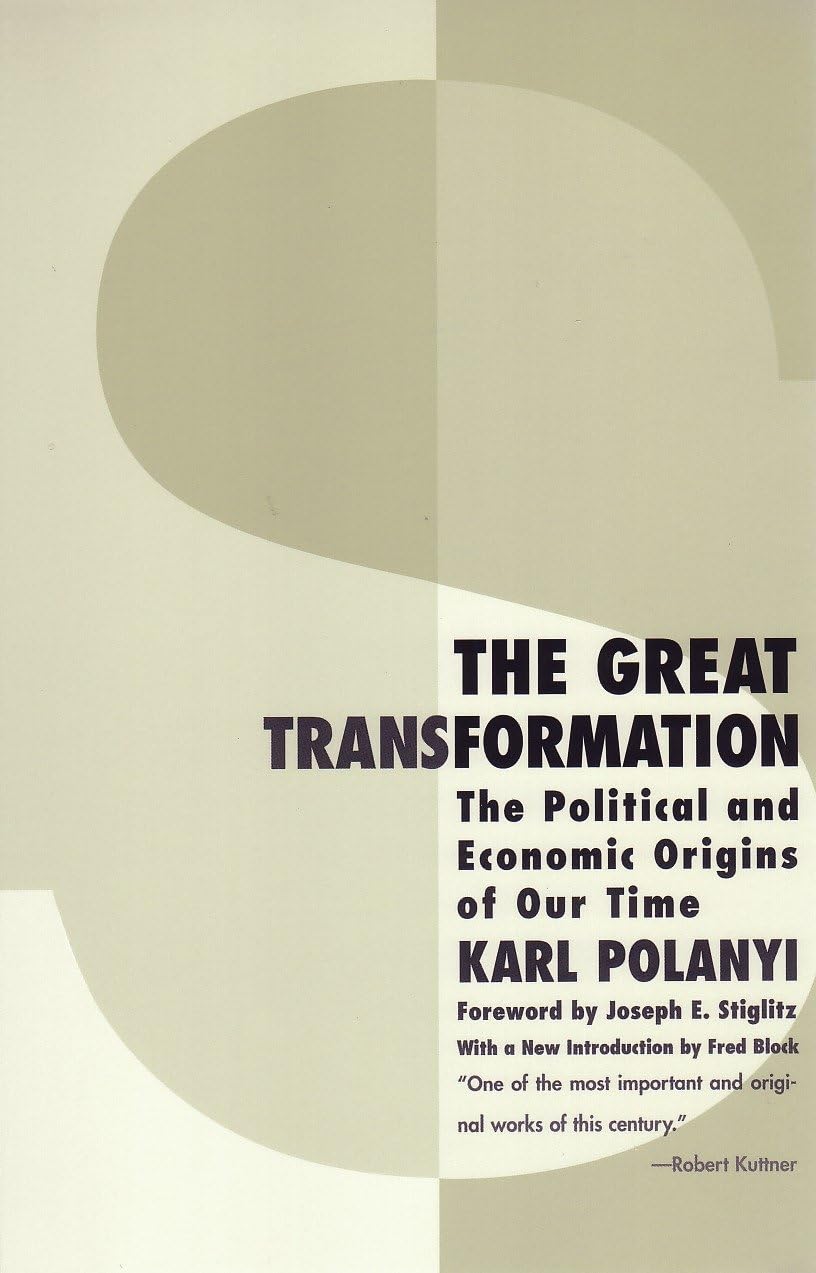
The Great Transformation: The Political and Economic Origins of Our Time : Polanyi, Karl: desertcart.in: Books Review: I'm a student from marketing but I recommend it a compulsory read anyone who has even a ... - I'm a student from marketing but I recommend it a compulsory read anyone who has even a niche interest in the economy and society. Reading this book will help you to see the relationship between the market and the society like never before. Review: Great stuff. Deserves 5 stars. - This is a fascinating book.
| Best Sellers Rank | #569,366 in Books ( See Top 100 in Books ) #893 in Economic Conditions (Books) #1,032 in Economic Policy & Development #1,359 in Economic History (Books) |
| Customer Reviews | 4.6 4.6 out of 5 stars (413) |
| Dimensions | 13.92 x 2.54 x 21.51 cm |
| ISBN-10 | 080705643X |
| ISBN-13 | 978-0807056431 |
| Item Weight | 465 g |
| Language | English |
| Paperback | 360 pages |
| Publisher | Beacon Press; 2nd ed. edition (28 March 2001) |
A**R
I'm a student from marketing but I recommend it a compulsory read anyone who has even a ...
I'm a student from marketing but I recommend it a compulsory read anyone who has even a niche interest in the economy and society. Reading this book will help you to see the relationship between the market and the society like never before.
A**R
Great stuff. Deserves 5 stars.
This is a fascinating book.
S**A
Five Stars
a must read for anyone who wants to understand economics and how we are the world we are.
K**S
Historical exceptionality of market-driven society. A great book. A classical investigation concerning the relationship between economy, culture, and politics. Anthropologically sound.
E**N
This is one of those books that can provide an epiphany to the reader -- but not very many American readers have even heard of it, unfortunately. That could be due to it's being a book primarily about English economic history, with assumptions that the reader is familiar to some extent with things like the Poor Laws and Tory socialism. But I wasn't, and was still able to glean some great insights from the work. That could be because Polanyi is not afraid of repetition. :-) A key insight, and the one that could be summed up as the theme of the book, is Polanyi's realization that prior to about 1830, the market and the economy were considered part of society. That is, economic activity was something that people did along with everything else they did, like engage in social/familial relationships, religious rituals, etc. But with the 1830s came a paradigm shift: the advent of rational capitalism. Now, the market was considered an entity by itself, outside of society. This market entity was viewed as governed by universal laws. Like laws of physics, these market laws were independent of culture, independent of social group, independent of time period, and, in fact, independent of human behavior. While any observer of human nature would say that people often make decisions for emotional reasons -- and modern neurological research shows that virtually every decision we make is a combination of the rational and the emotional -- these market laws assumed only rational behavior on the part of economic actors. Though Polanyi doesn't mention it, it's now easy to see how Alfred Marshall could get carried away with creating a mathematical foundation for microeconomics and how Leon Walras could, reportedly, say that if something couldn't be studied mathematically, it wasn't worth studying. There's no current way to model emotions with math, and so the Ricardian prototype of an emotion-less economics continues into the modern economics of today. These universal market laws frees the market from any social constraints. A number of modern neo-classical economists assert that this makes economics purely amoral, i.e., without regard for any ethics. Therefore any attempts by the public, by politicians, or by workers to add ethics to the market is an interference with pure market workings, which, according to their interpretation of Adam Smith's "invisible hand", will produce optimal results if just left alone. But Smith never said that, and in fact rational capitalism, in elevating greed and selfishness to the status of goals -- see the Ayn Rand work "The Virtue Of Selfishness" -- is, IMO, not amoral at all, but rather is a morality of its own. Anyway, back to Polanyi's insights. Another key one is the concept of a "double movement" in 19th century England. Each move to create a purer market created an ad-hoc counter move. E.g., Ricardian free trade was faced with opposition from workers losing their jobs and local firms losing business Americans can easily think of another example: where the employment of children (eventually) led to laws restricting that employment, simply because human beings have too much of a sympathetic nature to sit still for children losing limbs in the dangerous factories and mines of the time. Polanyi notes that capitalists often blame these anti-capitalist laws on planned activity by socialist anti-market groups, but he says they're actually the result of the recognition by the general public that they don't want to live under a pure market system. Yet another good insight is Polanyi's recognition that market laws treat labor, land, and money as commodities. We can see that today, where neo-classical economists assert that the law of supply and demand should apply to workers as it applies to anything else in the economy. That is, if there's a surplus of workers in one area and a shortage in another, supply and demand dictates the flow of workers from the one area to the other. But a laid-off textile worker in South Carolina is not going to move to China for a job. That's my own example, but Polanyi offers his own from modern English history. The book isn't perfect. Polanyi does have a tendency to generalize, a common failing among authors, IMO. E.g., in discussing the rise of fascism in the 1930s, he's on very shaky ground when he starts talking about the US or about Russian policy intentions during that period. I gave The Great Transformation 5 stars because, even with its faults, the reader will be thinking about Polanyi's insights for some time to come. I am.
塩**衛
ハイエク、ミルトン フリーマンといったネオリベラルの市場万能主義の経済学者を信奉して、規制撤廃や官から民の流れを主導した学者やジャーナリズムが、口にすることさえなかった学者が著わした本書が再び世界では関心を集めている。浅薄皮相な学者やジャーナリズムが、日本という国の現在の停滞と混迷に大きな力を貸してきたことを思うと、遅きに失している感もあるが、ハイエク等と同時代者であるこの経済学者の深い思索に富む言説に触れることは、今こそ求められていることだと思う。
M**O
In my opinion, this book is the most important book of the 20th century. With historical, empirical and anthropological diligence, Polanyi shows that the "market" is not something which arises naturally or spontaneously but has been created by heavy and brutal as well as planned interventions of the state. On the other hand, social countermovements happened spontaneously to safe nature, men and the economy from the brutal force of free markets. Polanyis conclusions are based on profund historical and empirical analysis. With Polanyis insight it is unbelievable what happened since the 1980s in a (Neo)liberal backlash, completely ignoring the implications of the book with respect to nature, men and our society. We now have the empirical evidence, that Polanyi was true and that (1) markets have to embedded into the economy and (2) the economy has to be embedded into society and not the other way around. I would highly recommend this book to everyone, it is more important than ever.
M**S
This in an outstanding work on economics and is a must read for anyone interested in how we got to where we are economically speaking. It is written with verve and although a tour de force, is a fairly challenging read. The book delivers incisive commentary on the impact of economic practice on human life, an aspect frequently overlooked in most economic writing and, as it was written many decades ago, may be considered prophetic.
Trustpilot
1 month ago
5 days ago