Some deliveries may take a little longer than usual due to regional shipping conditions.

DOWNLOAD THE APP


Customer Services
Copyright © 2025 Desertcart Holdings Limited
DOWNLOAD THE APP
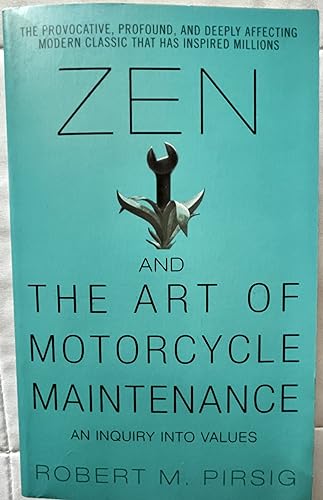
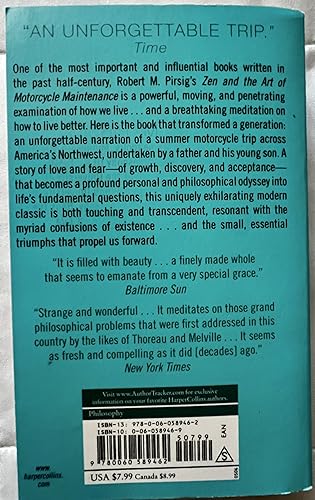

🛣️ Ride the Road of Reflection!
Zen and the Art of Motorcycle Maintenance is a thought-provoking exploration of values, blending a narrative of a motorcycle journey with philosophical insights, making it a must-read for those seeking deeper understanding in a fast-paced world.
| Best Sellers Rank | #107,178 in Books ( See Top 100 in Books ) #24 in Contemporary Literature & Fiction #147 in Traveler & Explorer Biographies #2,156 in Memoirs (Books) |
| Customer Reviews | 4.4 4.4 out of 5 stars (13,603) |
| Dimensions | 4.19 x 1.12 x 6.75 inches |
| Edition | First Edition |
| ISBN-10 | 0060589469 |
| ISBN-13 | 978-0060589462 |
| Item Weight | 9.6 ounces |
| Language | English |
| Print length | 540 pages |
| Publication date | April 25, 2006 |
| Publisher | Mariner Books |
L**D
Plenty of Buddhism in this book, it's just not overt
Looking at the reviews here, this book is loved by hundreds and reviled by a small percentage. I wonder what causes so much passion? It's wonderful that we have, among those who gave the book just one star, so many people who are so far above it intellectually -- too familiar with philosophy, too personally enlightened, perhaps -- to find any value in it. But I would like to point out to the subset of our best and brightest, those who tell everyone else not to waste their time reading it, that just because you got nothing out of the book doesn't mean no one else will. One of the complaints I see here is that there isn't much of the title's Zen nor much motorcycle maintenance, either -- and I note that the author says something about this in his introduction, so it must be true, right? -- yet I believe there is plenty of both. If the reader is expecting an introduction to Zen or a How To manual on motorcycle maintenance, those will not be found. It's not even the author sharing his enjoyment of either of the two fields with his audience. But the themes that run throughout the book explore many of the same ideas the Buddha did, and several concepts important to motorcycle maintenance that will not be found in manuals are discussed throughout the work. But the title really represents the duality that Pirsig puts under his microscope: Zen represents the hippie "go with the flow" attitude that is contrasted to the "slice and dice" schemes of technology, via motorcycle maintenance. And in the end, the title doesn't say just motorcycle maintenance; it's the "Art " that's critical, because one thing the book is aiming for is to show us that the science of technology is an art -- or at least should be an art -- and that the two ways of looking at life don't need to be in opposition, but can be quite naturally blended, to the benefit of all concerned. It might seem like the novel is caught in its time, with language about those who see things as "groovy" vs. "the squares" but the dichotomy between the two has been under discussion in various forms for centuries: romanticism vs. empiricism, passion vs. logic, science vs. religion. The same split is found today underlying two sides of the debate over climate change. If the book is not approached as being literally about Zen and motorcycle maintenance, but as using these as stand-ins for concepts that can be much larger -- or even much smaller -- there is a lot to be gained here. Another complaint is that the protagonist is not sympathetic, but that's because this isn't a novel written from the romantic side, nor, really, the empirical side -- it's not even a novel, though it reads a lot like one -- it is a true-enough tale of relationships between two related men, and a father and a son, and a road trip that carries with it time for plenty of slow discussion of philosophy. The book takes its time putting the pieces together, and the author isn't trying to win our love -- if you can approach the book on its own terms rather than with a whole load of expectations about what it should do and how it should do it, you may get something out of it -- but to truly enjoy it, you've got to go with the flow, you know? I know I get a lot out of it every time I read it. I love road stories, and this one is paced just like a real long-distance trip, with long stretches of time to think things through interspersed with short breaks for taking care of the business of life. That what's going on in the environment, relationships, and other encounters reflects what's being thought through in the long stretches is a small bonus. The writing is clean and evocative, enjoyable. For the most part, the carefully constructed introduction to all the elements needed to understand the philosophy is gentle enough to be clear and not overly taxing, at least until the deepest parts, which can be hard to follow (and for good reason). The elements of psychological mystery captivate me each time. I first read ZAMM the year it was released, in the mid-70s, and have read it at least every five years since then, and each time I thoroughly enjoy it. The first time through, I could not follow the philosophy all the way down into the descent into madness it brought on. Five years later -- with time for the ideas to be examined through my own life -- I got it, even agreed with it. This time, this reading, is the first time I ended up doubting the validity of the greatest philosophical insights the story offers. Ironically, it's my deepening understanding of Buddhism that changed my mind. There really is a lot of Buddhism in this book, and not specifically Zen, either, but the deepest themes common to all forms of Buddhism. The questions about the wisdom of dividing the world up into a duality of the physical vs. the mental, of seeing ourselves as somehow separate from everything else, these were explored by the Buddha, too, though the framework he used to discuss these ideas was -- obviously -- nothing to do with motorcycles. In Dependent Arising he, too, considers how it comes to be that we split the world in two. "Name and form" he calls this split, and later thinkers have described what he was talking about as the same subject-object division that Pirsig is mulling over in ZAMM. The Buddha, though, says that it is "desire for existence" -- not quality -- that, to borrow Pirsig's phrase, "is the generator of everything we know". I tend to agree with the Buddha because I can see in our lives, and through our sciences, what that desire for existence is and why it drives us to divide the world up the way we do, and exactly how it leads us into trouble. I can't say the same for Pirsig's metaphysics, but that doesn't stop me from deep enjoyment of the book. I hope to have another half-dozen five-yearly reads, if I'm lucky, and -- who knows -- maybe I will come around again to see it the way he does.
P**A
Well worth reading and re-reading
I first read Zen and the Art of Motorcycle Maintenance in high school, and reading it then was an amazing discovery. I remember not being able to stop reading it, going on until well past midnight, barely able to stop when it was time to sleep, and finishing it the next day. When I saw that the Kindle edition was down to $2.99, I didn't hesitate and bought it and read it again. Books are different beasts when you read them a second time. The first time I loved the description of the scientific method and it's application to debugging computer programs (in addition to the problems you find when you need to repair a motorcycle): When you’ve hit a really tough one, tried everything, racked your brain and nothing works, and you know that this time Nature has really decided to be difficult, you say, “Okay, Nature, that’s the end of the nice guy,” and you crank up the formal scientific method. For this you keep a lab notebook. Everything gets written down, formally, so that you know at all times where you are, where you’ve been, where you’re going and where you want to get. In scientific work and electronics technology this is necessary because otherwise the problems get so complex you get lost in them and confused and forget what you know and what you don’t know and have to give up. (Loc 1603) This time around, I found another part of the story, the story about a father and son, re-united after a horrifying personal disaster, and the realization that it as his son that brought him out of the psychiatric ward: We’re related to each other in ways we never fully understand, maybe hardly understand at all. He was always the real reason for coming out of the hospital. To have let him grow up alone would have been really wrong. In the dream too he was the one who was always trying to open the door. I haven’t been carrying him at all. He’s been carrying me! (Loc 6249) What's great about the book is that all this is interspersed with a motorcycle trip from Minnesota to California. It's full of little tips about cycle touring that indicate that Pirsig did do quite a bit of motorcycle touring, though he does spend way too much time on a freeway in California instead of riding down the coast. (And much like most tourists, he makes the mistake of visiting the California coast during the summer, when it's mostly fogged in) There are also little interesting observations about people on the road: While we wait for chocolate malteds I notice a high-schooler sitting at the counter exchanging looks with the girl next to him. She’s gorgeous, and I’m not the only other one who notices it. The girl behind the counter waiting on them is also watching with an anger she thinks no one else sees. Some kind of triangle. We keep passing unseen through little moments of other people’s lives. (Loc 4385) Ultimately, the book's a philosophical novel, with lots of explanation of the authors' ideas about the nature of Quality, the split between the arts and the sciences, and his attempts to unify the two by keeping Quality undefined as, "You know it when you see it." For a rhetoric class at the places Pirsig has taught, I think this approach might work. For those of us working in technology, however, I'm not sure that non-definition is useful. There's a certain sense that those who care passionately enough about their work enough to have strong opinions and defend them are better engineers than those for whom engineering is "just work." On the other hand, you could argue that in many ways, the constant arguments over the quality of say, the choice of programming language is well over-blown, and people would mostly be better of getting work done than engaging in the low-Quality flame wars that you find on the internet. Regardless of how you feel, however, the novel is thought-provoking, interesting, and never dull, despite being mostly about ideas, rather than being about characters or plot. It's a great book and well worth reading and re-reading. Highly recommended.
N**N
a fabulous read
even with the tough, sticky, slow spots!! I'm glad that, after all these years of pensive hesitation, this title FINALLY crossed my path and grabbed the opportunity to jump on the back and enjoy the Ride [ even if I couldn't see around his helmet ! ] it ^^WAS^^ my generation . . .
A**R
A quick scan of the online reviews available for this book will quickly show you that it provokes strong reactions in those that read it - there aren't many 3* ratings here! While at first glance these ratings might appear to be indications of the inate quality of the book itself, they would better be thought of as indications of the quality of the experience that each reader had when interacting with the book. Each reader will bring something of themself to the book, and so the quality of this experience will be influenced both by the book and also by the reader. When you look at it like this, it is obvious that how much you like this book will depend on yourself as much as on the book itself. However, since people's reactions to it seem generally to tend towards the extremes, it seems probable that you too will either have a great, or a terrible experience. In order to help you make an informed judgement on this, a few observations, in which I will attempt to approach as near to objectivity as possible: - It is not a 'hippy bible', as one earlier contributer suggested. It is a book about philosophy which blends discussions about the nature of peoples interactions with the world around them with a story of a road trip taken by a father and son. - It is entirely rational. There's no new-age mysticism, no real discussion of sprituality - rather a critique on how you look at things and interact with them. - It is fairly intellectual, but necessarily so. The author has a very clear, conversational style of writing, and the ideas he attempts to express are not difficult, but nonetheless the reader is required to think during the reading process. I suggest that you read this book. It has certainly influenced my thinking on the world, probably more than any other single book I've read. However, if you really hate it as much as the contributor 'blowski', I certainly would suggest that you stop reading before you get two thirds of the way through. No point in getting as mad as he did about it.
湯**き
不思議な自伝小説。まずタイトルがミスリーディング。ZENなんてほとんど一瞬しか出てこない(2箇所か)。次にモーターバイク・ツーリングはやってるが、MOTORCYCLE MAINTENANCE程のものでもない。しかも、1章から22章位までは、何を目的で書いてるのか、全然解らない。途中から始まるプラトン、アリストテレス、ソクラテスの話もどこの方向に向かってるのか解らない。そう、バイク・ツーリングでどこに向かってるのか解らないのと同様、本の行き先もわかない。「なんで、この本がこんなに評価されたんだろう?」と読みながら疑問になったりする。でも、読み進める事が出来たのは、私に若い頃に英語を教えてくれた若いアメリカ人女性が学校で与えられた英語教材のテキストを「こんなの読んでも面白くないでしょ?私、ホントは別の本を考えてたのよ。その本の題名はZEN AND THE ART OF MOTORCYCLE MAINTENANCE。高校生の時に読んでショックを受け感動した。それをクラスで使って皆で読んで欲しかった」と言ったことが頭から離れなかったから。実際には、学校の教材に適していたかは疑問ではある。この本を読み切るには普通の学生レベルの英語力以上の語彙力が必要かもしれない。それに場面の展開でなく、思考の展開でストーリーが進んでいくから、著者の独特な英語の言い回しの文章を味わう余裕(丁度、バイク・ツーリングで風切る感触を味わうような余裕)がないと続けられないかも そのように半信半疑ではあったが、なんとなく先の展開を期待していた。そしたら、23章あたりから、私には俄然、面白くなっていった。読後感は「読み切った」という達成感が半分、「結局、面白かった」という満足感が半分 個人的な事情だが、この本を読んだ数か月前にBERTRAND RUSSELLのHISTORY OF WESTERN PHILOSOPHYを読んでいて、これも、西洋哲学史というよりはBERTRAND RUSSELLの思想家としての個人的な評価をバンバン書いてる本で、そこにあったギリシャ哲学と比べながら読めたので、良かったかもしれない いずれにせよ、最後まで読み切って損はない、と思う本
G**L
Some sections of this book required energy for me personally to get through, discussions of technical Greek philosophy and such, but I assure you, the whole book is so so worth it.
C**A
I read this book for the first time in 1979, when I was 17 and had just taken a road trip similar to the one Pirsig narrates with a group of friends. My very best friend gave me her copy. As I recall I found it difficult to read but somehow it always stuck... I am now about to take a road trip through the States again with my husband, my daughter and my son. It will be very interesting to see how time and life has changed my perception both of the trip and of the book.
L**A
Encontrei a recomendação deste livro em um artigo sobre negócios e empreendedorismo que dizia que todo empreendedor deveria ler esse livro. Ele não fala de business plans, MVPs, etc etc. Ele aborda a natureza humana ainda antes, no homo faber, ou o homem "criador", que me lembra muito o movimento maker. Ele fala da essência de se fazer bem pelo propósito de fazer bem: craftsmanship. Esse livro foi lançado em 1974 e continua atual, com suas reflexões sobre a percepção humanam o não viver do agora, a tecnologia e como as pessoas se relacionam. Escrito em uma narrativa em primeira pessoa, lhe permite viver e pensar como um filósofo em uma jornada sobre sua moto. Até onde pude me informar, não é um livro de ficção, mas uma história real, o que faz com que a narrativa ser ainda mais interessante. Fazia um tempo que eu procurava uma boa leitura não técnica e nem relacionado a negócios. Esse livro encaixou como uma luva.
Trustpilot
1 month ago
4 days ago